
What is answer engine optimization and why standard search strategies fall short
The silent evolution of the query

The query is no longer a search; it’s a conversation.
For twenty years, we trained ourselves to type broken keywords into a blank white box. We wrote “best CRM for startups” and waited for ten blue links. We clicked. We skimmed. That was the routine. But that classic click-through habit is dying. Now, people ask actual questions: “Which CRM under fifty dollars has the best pipeline automation for a small agency?” They expect a single, clear answer. No clicking required.
This flips traditional search on its head. Google used to act like a digital traffic cop pointing users to your site. Now, search engines behave like librarians who read your pages, summarize the main points, and hand over the answer. This is where aeo seo becomes a necessity. If your content isn’t structured for these answer engines, your organic visibility will simply vanish. I’ve watched marketing teams lose half their informational blog traffic in a single quarter because they ignored this shift. It happens fast.
It’s a tough pill to swallow for marketers who spent years obsessing over keyword density. We used to measure success by ranking position. But ranking first doesn’t mean much when an AI-generated summary takes up the entire screen. The classic multi-click search funnel has collapsed into a zero-click destination.
Think about your own habits. When you ask an AI tool to compare software, you don’t want a list of blogs. You want a direct recommendation. The engine scans the web, pulls the facts, and writes a custom response on the spot. If your site is just a collection of vague, keyword-stuffed paragraphs, the crawler will bypass you entirely. It needs clear, structured data it can parse in milliseconds.
This transition won’t happen overnight for every single search. People buying products still need to visit transactional sites. But informational queries, which form the foundation of top-of-funnel content marketing, are being swallowed up by conversational engines. To stay visible, brands have to stop writing solely for human clicks and start optimizing for machine intelligence. That means making a real shift toward generative engine optimization, structuring your insights so large language models can easily extract, credit, and display them.
What is answer engine optimization?
How does Google search differ from asking an AI?
What actually happens when you optimize for an AI instead of a search bar? That is answer engine optimization (AEO). It is the deliberate practice of formatting your digital content so conversational models like ChatGPT, Claude, and Perplexity can easily extract, trust, and cite it. Instead of trying to rank a list of blue links, you are feeding clean, factual answers directly to LLMs.
Why do people keep confusing AEO with traditional SEO? Think of classic SEO as a library catalog. It indexes pages using keywords, backlinks, and authority signals to point users toward the right book. But what does an AI search engine do? It does not just point to the book. It reads the pages for you, extracts the facts, and synthesizes a single answer on the spot.
Who is your actual audience now? It is no longer just a human scanning a page. You are writing for an AI crawler that needs to parse data in milliseconds. If your answers are buried under fluff, the LLM will simply ignore you.
Does this mean traditional SEO is dead? Absolutely not. In fact, AEO relies entirely on your site’s technical health. If your crawling infrastructure is broken, AI bots cannot read your data anyway. But is a fast site enough? Not anymore. If your content structure is unreadable to an LLM, speed won’t save you.
How do we capture these conversational queries? We have to change how we format our information. If you want to see how this works in practice, read our guide on answer engine optimization and why it changes how we write to see how AI citations actually function.
How do you bridge the gap? While old-school indexing relies on keyword density, AEO looks at entity relationships and direct Q&A structures. When users ask complex questions, the engine wants direct answers, not fluff. Will this drive millions of clicks tomorrow? Probably not. But it puts your brand exactly where decisions are being made.
Why your organic click share is quietly disappearing
The shrinking slice of organic search traffic
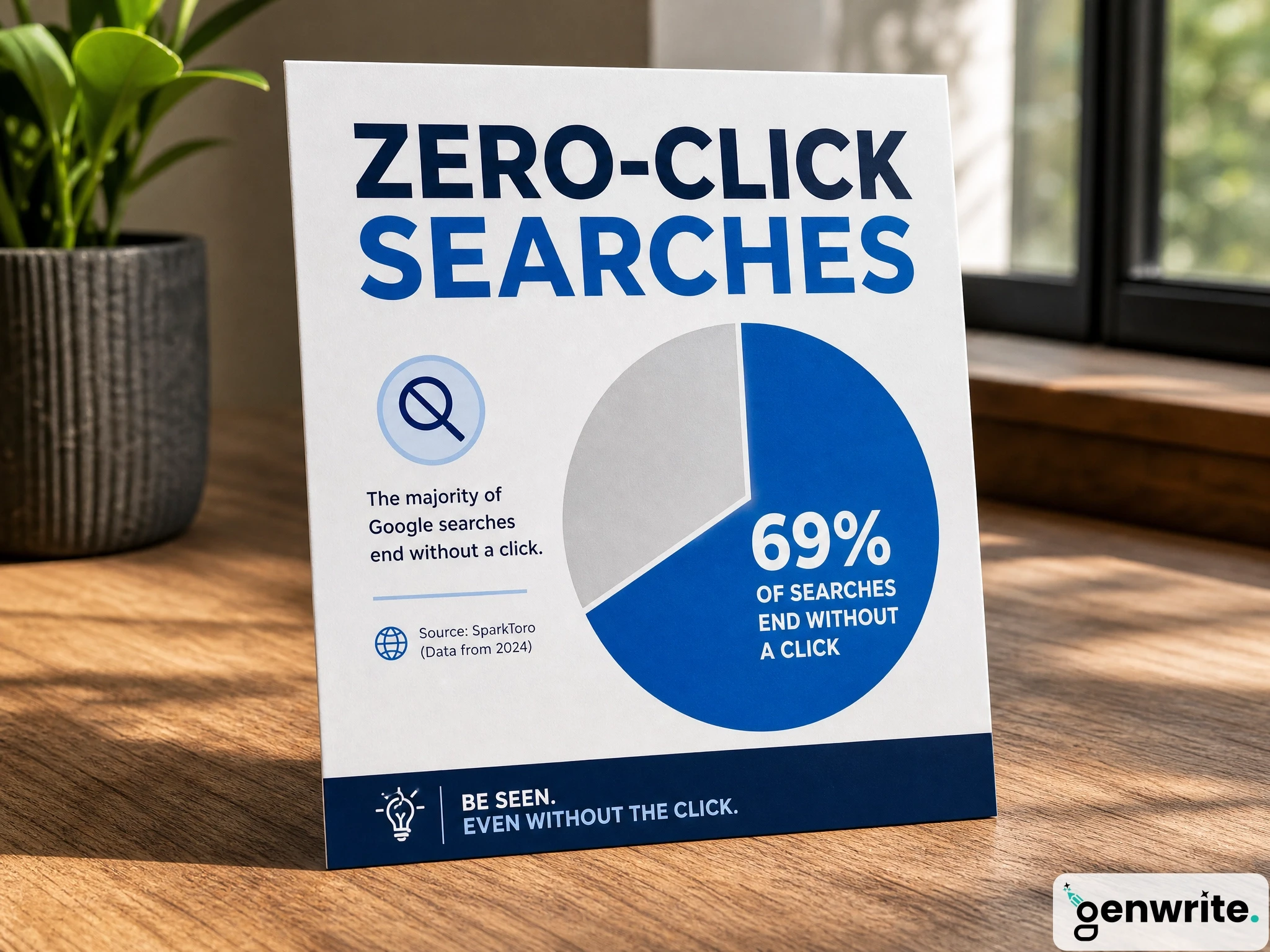
Let’s look at the hard numbers. When Google serves an AI Overview at the top of the search results page, the traditional organic click-through rate plummets from an average of 15% down to a mere 8%. That’s a near-halving of your organic search traffic overnight, simply because a machine summarized your page before a searcher could click it. Even worse, those tiny citation links embedded inside the conversational summary capture only about 1% of total visits.
This shift means standard keyword targeting is no longer enough to sustain your pipeline. When users get their answers directly on the search engine results page, they have zero incentive to click through to your website. To survive this shift, you have to pivot from basic keyword matching to a dedicated strategy for answer engine optimization, which focuses on getting your brand’s insights directly into the LLM’s knowledge base. This is the new reality of ai search optimization.
But here’s where most teams get it wrong. They keep pumping out generic, keyword-stuffed articles hoping to rank for high-volume terms. The reality is that search bots now prioritize structured facts, clear entity relationships, and direct answers over keyword density. If your content is buried in fluff, the crawler simply ignores it. We see this daily when auditing sites: pages that once brought in thousands of visits are suddenly ghost towns because an AI snippet solved the user’s query instantly.
For example, a B2B software comparison query that used to drive hundreds of high-intent leads now ends with the AI recommending three platforms directly in the chat interface. The user never leaves the search page. This means your traditional funnel is leaking at the very top. While some search experts argue that high-intent users will still click through to verify details, the preliminary data suggests most are content with the quick summary.
So, how do we counter this? We must adapt our creation process. Using smart tools to analyze competitor coverage and structure data helps ensure your content is clean enough for LLM extraction. It’s not about writing more words; it’s about writing high-density, easily parsed facts that search engines cannot help but reference.
Structuring content for natural LLM extraction
Building blocks for machine-readable layouts
LLMs parse tokens and map semantic relationships instead of reading like humans. A messy nest of div tags ruins this process. When search bots crawl chaotic HTML, they fail to attribute facts correctly. If you want to rank in answer engine optimization, your markup must be clean and semantic.
Put a direct, 40-to-60-word answer paragraph immediately after your H3 or H4 headers. This acts as a clean extraction target for AI summarizers. Stick to standard <p>, <ul>, and <table> tags. Avoid custom CSS frameworks that obscure underlying data structures.
A basic seo writer ai often ignores these structural nuances. The result? Pages that crawlers cannot read. To fix this, group related concepts with nested schema markup. This defines clear entity relationships.
Keep code simple. Nesting should be shallow. LLMs struggle to extract a single statistic when they have to jump through multiple layout wrappers. Keep data flat. Label tables with clear headers. Make definitions starkly simple. This discipline connects classic seo aeo strategies with modern search bot requirements.
Optimizing list structures and tables for quick extraction
LLMs process lists efficiently only when they are predictable. Use parallel grammatical structures. If the first item starts with an active verb, the subsequent items must follow suit.
Never merge cells in tables. Merged rows or columns break the parsing logic of extraction bots. Keep data simple, explicit, and direct. Modern AI SEO tools automate these structural audits. This keeps your content clean and readable for machine crawlers.
Why human editors must refine what AI-generated tools produce

The trap of the unedited draft
If you’re just pushing “generate” and publishing raw outputs straight to your CMS, you’re playing a losing game. Large language models (LLMs) excel at synthesizing existing web data, but they naturally default to the average.
They predict the most likely next word, which means they produce the most predictable content. In the era of conversational search, predictability is a death sentence. You can’t outsmart an algorithm by feeding it its own echoed voice.
AI engines don’t just look for keyword matches anymore; they look for unique information gain. When an LLM crawler indexes your site, it evaluates whether you’re bringing anything new to the table.
Raw drafts often miss the subtle, secondary search intents that real humans naturally address. If your content reads like a rehashed Wikipedia entry, an answer engine has no reason to cite you. It will simply summarize the topic itself and keep the user on its own platform.
But how do you fix this without slowing your production to a crawl? The answer lies in establishing a tight editorial loop. We’ve seen that teams relying on raw outputs fail to rank because they ignore the mechanical limits of language models. This is why smart publishers focus on rewriting generic content from SEO writing tools to inject actual subject matter expertise and original data into every draft.
Designing for both seo and aeo
To win at both seo and aeo, your strategy must evolve beyond basic keyword matching toward deep ai search optimization. Your content needs a human touch to polish the structure and insert real-world friction. An editor can add that critical first-person perspective or a contrarian take that LLMs are too polite to generate.
Sometimes, this is as simple as adding a specific case study or correcting a slightly hallucinated statistic. Other times, it requires restructuring the entire narrative so it answers a user’s question within the first two sentences.
Results will vary depending on your niche, of course, but clean, edited content consistently wins more citations. So, don’t treat AI as a hands-off publishing machine. Use it to build the foundation, and then let a human editor build the trust.
The mathematics of source selection: why fact density beats keyword stuffing
What happens when an LLM decides which source to cite? Traditional Google search relied heavily on keyword frequency, backlink authority, and user engagement signals. But large language models parse information differently. They look for information density, structural clarity, and verifiable entities.
Let’s compare the mechanics of old-school keyword targeting against modern answer engine optimization (aeo seo).
| Traditional SEO Focus | Modern AEO SEO Focus |
|---|---|
| Keyword density and placement | Entity relationships and semantic triples |
| High backlink volume | Authoritative citations and raw data density |
| Long-form fluff to satisfy word count | Direct, high-density factual answers |
A landmark study by researchers at Princeton, Georgia Tech, and IIT Delhi on Generative Engine Optimization (GEO) revealed something fascinating. By introducing clear facts, direct citations, and statistical data to a page, creators could boost their visibility in AI-generated answers by up to 40%. The algorithms powering search assistants don’t care about your keyword variations; they want to resolve user queries with high-confidence data points.
When an AI crawler scans your site, it attempts to map your content into a knowledge graph. It looks for “triples”,subject, predicate, and object. If your text is bloated with filler, the bot struggles to extract clean facts. This is where legacy writing habits fail us. We used to write 2,000-word guides filled with fluff just to rank. Now, those extra words actually dilute your factual density, making your site less likely to be cited by LLMs.
To win in this search environment, we must change how we build our text. Using an advanced SEO content optimization tool can help structure your data so machines can easily parse it. It’s about shifting your mindset from how many times can I say this keyword to how many verified facts can I pack into this paragraph.
Of course, this doesn’t mean your writing should read like a dry database. The best content still maintains a human flow while keeping a high ratio of hard data to adjectives. It’s a delicate balance, and honestly, even top brands struggle to get it right every time. But the data shows that those who prioritize precision over padding will survive the shift to conversational search.
Setting up your technical signals for AI crawlers

Technical signals for conversational bots
You can write the most factual piece of content in your niche, but if an AI scraper struggles to parse your technical architecture, your brand won’t show up in the chat response. Conversational engines don’t browse websites like humans do. They ingest raw data, map relationships, and match entities.
To make your site machine-readable, you need to configure specific technical signals that tell LLMs exactly who you are and what you offer.
1. Establish an llms.txt file
Just as robots.txt guides traditional search crawlers, the new /llms.txt standard serves as a direct roadmap for language models. This is a simple markdown file placed at your root directory. It provides clean, unbloated summaries of your website’s key pages. It helps bots quickly digest your core offerings without wasting their context windows on heavy HTML layouts.
2. Clear up entity ambiguity with schema
AI search engines rely heavily on knowledge graphs. If your brand name is a common word, or if you share a name with another business, LLMs easily get confused.
- Organization Schema: Define your exact brand name, headquarters, and founders.
- SameAs Properties: Link your schema directly to your official Wikipedia, Wikidata, and social profiles to verify your identity.
- Product and FAQ Schema: Use explicit nested markup to present product specs or direct answers clearly.
Implementing these structured data formats is a core pillar of modern ai search optimization because it translates raw text into a machine-readable graph. While schema isn’t a magic bullet,Gemini might still ignore your markup if your page-level data is messy,it stacks the deck in your favor.
3. Manage bot permissions carefully
Blocking all AI scrapers in your robots.txt might protect your intellectual property, but it also guarantees complete invisibility in conversational search engine marketing. Instead of a blanket block, selectively allow user-agents like GPTBot, ClaudeBot, and PerplexityBot.
At GenWrite, we configure technical frameworks automatically so your automated blogs naturally match what these crawlers look for. By structuring your technical foundation this way, you ensure your brand is ready for extraction when a high-intent query occurs.
Real scenarios where AI search alters consumer decisions
Real-world scenarios: how conversational search alters choices
Imagine a marketing director named Sarah. She needs a new project management tool that integrates with Slack, has Gantt charts, and stays under fifteen dollars per user.
Five years ago, Sarah would search “best project management software” on Google. She’d click four different affiliate blogs, skim through repetitive lists, and build her own comparison spreadsheet. It took hours of manual filtering.
Today, she types that exact list of requirements directly into Perplexity or ChatGPT.
The AI doesn’t give her ten blue links. Instead, it builds a custom comparative table on the spot. It recommends two specific platforms, explains exactly how their Slack integrations behave, and flags a hidden pricing tier she might have missed. Sarah makes her decision in four minutes without ever visiting a vendor’s homepage.
This is how conversational search engine marketing actually works in the wild. If your brand isn’t inside that generated table, you didn’t just lose a click,you lost the entire customer journey before it even started.
We observed a similar shift with a B2B SaaS client last month. They had excellent traditional rankings for their primary keywords. Yet, their demo sign-ups from search began drifting downward. After auditing their visibility, we found they were completely omitted from conversational answers.
When we ran queries through LLMs, we realized the models were recommending their competitors instead. Why? Because those competitors had clear, structured data explaining their API limitations, while our client hid that information behind a gated PDF. The LLM simply assumed our client didn’t support the integration.
It’s a brutal reality of modern aeo seo. These engines aren’t looking for clever marketing copy; they’re looking for clean, extractable facts to answer highly specific user constraints.
Sometimes, even the best optimization won’t get you cited if your product details are locked behind forms. So, we must adapt how we present our data to ensure these agents can read, digest, and recommend us.
Auditing your brand’s voice inside conversational tools

Running manual audits on conversational engines
Most traditional rank trackers are completely blind to conversational search. They look for pixel coordinates on a Google SERP, completely missing the synthesized answers generated by Large Language Models (LLMs). If you want to know how your brand is represented, you have to query these engines directly and systematically.
Start by building a manual tracking sheet. We track three core buckets: direct brand queries, category-level comparisons, and high-intent informational questions. Every Monday, run a set of standardized prompts across ChatGPT, Claude, and Perplexity.
Here are three diagnostic prompts that work:
- What are the top three tools for [your niche] and how do they compare?
- How does [Your Brand] differ from [Competitor X]?
- Which software offers the best integration for [specific workflow]?
Record the output and score your presence. Is your brand mentioned? Are they pulling from your actual site or an outdated review? If they cite you, note the exact URL. This process helps you understand your baseline for answer engine optimization without spending thousands on unproven enterprise platforms.
Next, look at your referral traffic. While search consoles do not show conversational queries yet, your analytics platform does. Track visits from chatgpt.com, perplexity.ai, or android-app://com.openai.chat. This traffic has incredibly high intent. Users who click through from an LLM citation have already been pre-qualified by the AI. You can simplify this manual work by using specialized SEO AI tools that track referral patterns and content performance automatically.
The evidence is mixed on how often these engines update their internal indexes. Sometimes a newly published blog post is cited within days; other times, the engine relies on cached data that is months old. This is why consistent, weekly tracking is necessary. If your brand is completely absent, it indicates a structural indexing issue, or your content lacks the entity-clear structure that ai search optimization requires. Treat these tools as live focus groups, not just search engines, and adjust your content formatting based on their gaps.
Adapting before you become invisible
The path forward: balancing the two worlds
You don’t have to choose between traditional organic search and the new wave of conversational engines. In fact, trying to separate them is a recipe for losing visibility altogether.
The smartest teams are realizing that a unified strategy combining both aeo seo practices is the only way to stay relevant. Traditional search engines still drive massive transactional volume, while AI engines shape the initial research and consideration phases. If you ignore one, you’re essentially leaving half your funnel on the table.
But how do you actually execute this dual approach without doubling your team’s workload? The reality is that the core fundamentals of great content don’t change, but how we structure and distribute that content must adapt. You can start by checking out these conversational search optimization guides to learn how to scale your content production while maintaining the strict formatting rules LLMs demand.
We often see companies overcomplicating this transition when they first start out. They worry they need entirely separate workflows for traditional search and AI search. But the truth is much simpler: clean, structured data and direct, factual answers satisfy both Google’s helpful content system and OpenAI’s retrieval crawlers. It’s about writing for humans first, but formatting for the machines that index your work.
Of course, this dual seo aeo approach isn’t a magic bullet that will fix a fundamentally weak product or poor positioning. If your brand lacks real-world authority, no amount of technical schema or clever paragraph structuring will force an LLM to recommend you. But if you already have a solid foundation, aligning your content with how machines extract information is the easiest win available today. Start small, audit how your brand currently appears in major conversational search engines, and build your data structure from there to protect your traffic.
Tired of guessing what AI search engines want? GenWrite handles the heavy lifting of content creation and SEO optimization so you stay visible.
Frequently Asked Questions
How does answer engine optimization differ from traditional SEO?
Traditional SEO focuses on climbing a list of blue links to win clicks, while AEO is about getting your brand directly cited inside an AI-generated answer. You aren’t just targeting keywords anymore; you’re structuring data so LLMs pull your facts into their summaries.
Why are standard ranking metrics failing marketers right now?
Most traffic is disappearing because AI overviews answer user queries right on the results page. Since users don’t need to click through to your site anymore, tracking old-school keyword positions doesn’t tell you if people are actually seeing your brand.
What role does fact density play in getting cited by AI?
LLMs love specific data, statistics, and clear statements rather than fluff. If your paragraphs are packed with verifiable facts, conversational search engines are way more likely to quote you as a primary source.
Can I automate my AEO strategy without losing quality?
You can definitely use tools to speed up research and structuring, but you’ll still need human editors to polish the output. Raw AI drafts usually lack the unique insights that make a brand worth citing.