
What is Answer Engine Optimization and why your SEO strategy is broken
The new reality of the zero-click landscape

The death of the ten blue links
Remember when ranking first on Google meant a guaranteed flood of organic traffic? That math doesn’t work anymore. Now, when someone asks a question, an AI crawler pulls data, synthesizes it, and presents a neat paragraph right at the top of the screen. The searcher gets exactly what they need in seconds. They don’t click through to your website, and they don’t scroll past the fold.
This isn’t a future threat; it is happening right now. We are witnessing a massive transition where traditional search behavior is being replaced by conversational engines like Perplexity, Gemini, and ChatGPT. If your marketing playbook still relies entirely on traditional tactics, you’re essentially optimizing for a ghost town because ai search seo requires a completely different approach.
According to recent industry data, roughly 60% of search queries now end without a single click. This massive shift is forcing a pivot toward AEO vs. SEO strategies designed for this zero-click reality.
But how do you optimize for an engine that doesn’t want to send you traffic? It requires changing how we think about content structure entirely. Instead of writing long, winding narratives to keep people scrolling, we have to feed machines clear, unambiguous facts they can extract instantly.
Honestly, some niche industries might still survive on old-school keyword traffic for a bit longer, but the writing is on the wall for most of us. To survive this transition, your brand must shift from being a destination to becoming the source of truth that AI models cite. If your content isn’t structured for these machines, you simply won’t exist in the answers they generate.
What does Answer Engine Optimization actually mean?
What is the new search reality asking of your content?
Why are your organic click-through rates plummeting even when your rankings stay the same? The answer lies in how modern engines process information.
What is answer engine optimization (AEO)? It is the practice of structuring digital content so large language models (LLMs) and conversational search tools can easily parse, cite, and attribute your brand as a primary source. While traditional search focus was on link retrieval, the new era of seo aeo is about earning direct inclusion inside the synthesized answer itself.
How does this shift your daily content strategy? The core difference lies in moving away from link retrieval toward an answer-first structure. Instead of hiding your insights deep within a 3,000-word post, you must format data so machines can extract it instantly. If an AI bot cannot find a direct, verifiable answer in your first two sentences, it will simply cite a competitor who made their data easier to parse.
Are you still writing for algorithms that only look at keyword density? The reality is that modern engines value directness and structural clarity over keyword repetition. If your site does not adapt to this conversational shift, you risk becoming invisible in a zero-click world.
The brutal reality of why your standard SEO strategy is failing
Stop looking at your rank trackers. They’re lying to you.
For years, agency playbooks treated position-one rankings as the holy grail of digital marketing. But the ground has shifted. Over 60% of search journeys now end in zero-clicks directly on the search engine results page (SERP). Users don’t need to visit your site when Google’s AI Overviews, ChatGPT, or Perplexity answer their questions instantly.
This shift means your link-heavy, high-volume keyword strategy is burning cash. If your agency is still relying on legacy SEO tools vs ai to track deterministic rankings, you are measuring metrics that no longer correlate with actual business revenue. Traffic is dropping, yet we pretend everything is fine because a dashboard shows green arrows.
The illusion of position-one traffic
What good is ranking first if nobody clicks?
Traditional search optimization was built on a simple contract: create content, get indexed, and receive traffic. Today, search engines have become answer engines. They ingest your hard work, synthesize it into a neat paragraph, and keep the user on their platform. You do the heavy lifting; they keep the audience.
So, how do you adapt? You stop optimizing for clicks and start optimizing for conversational authority. This is where aeo seo comes into play. It’s no longer about winning the click; it’s about becoming the trusted source that the AI cites. If an LLM uses your data to formulate its response, your brand wins the trust, even if the traditional traffic metric looks flat.
But let’s be honest here. This transition is incredibly painful. It requires letting go of comfortable monthly traffic reports and explaining to stakeholders why impressions matter less than citation share. Some industries might see a temporary drop in raw visits as they pivot. But clinging to outdated deterministic rank-tracking models is a guaranteed way to watch your margins evaporate.
Conversational authority over raw volume
The goal is no longer to capture every high-volume, generic keyword. Instead, focus on answering specific, high-intent queries with absolute precision. If your content is structured as a direct answer to a complex user problem, search crawlers will pull it. If it’s buried under 2,000 words of generic intro fluff, it gets ignored.
The key structural shift: search engine optimization vs answer engine optimization
The structural split: SEO vs AEO
The metrics we used to live and die by are losing their meaning. If you still judge digital success solely by organic clicks and keyword rankings, you are missing the massive shift happening under the hood of modern search.
Traditional SEO was built for discovery. A user typed a query, Google returned ten blue links, and the user clicked through to find the answer. Answer Engine Optimization (AEO) is different. It is built for synthesis. Instead of pointing users to a destination, engines like ChatGPT or Perplexity read your content, extract the facts, and present them directly as a single response.
This shift changes how you produce content. You can’t rely on vague, high-volume landing pages designed to capture broad search intent anymore. Modern engines demand structured, high-density facts. Transitioning your workflow with an AI blog generator helps automate this formatting. This makes sure your articles contain the clear, direct answers that LLMs look for when generating conversational citations.
| Metric / Dimension | Traditional SEO | Answer Engine Optimization (AEO) |
|---|---|---|
| Primary Goal | Drive organic traffic to a website | Secure citation in synthesized answers |
| Core Metric | Clicks, impressions, CTR, keyword rank | Share of Voice (SoV), citation frequency |
| Search Interface | Ten blue links, featured snippets | Conversational chat UI, direct voice outputs |
| Primary Engines | Google, Bing, DuckDuckGo | ChatGPT, Perplexity, Gemini, Copilot |
| Content Structure | Long-form narratives, landing pages | Direct Q&A, structured tables, schema |
The real difference is how these systems value your data. Classical SEO rewards dwell time, internal links, and backlink authority. Those factors still matter for baseline authority, but answer engines care far more about semantic accuracy and entity relationships. They don’t want to send a user to your site. They want to use your site as a verified source of truth to answer a prompt directly.
This leaves marketers with a tough balancing act. You have to maintain traditional optimization for transactional searchers who still use classic search bars. At the same time, you have to format your data so machine crawlers can easily extract facts for conversational queries.
It’s a transition from optimizing for human clicks to optimizing for machine comprehension. If your content can’t be parsed by an LLM in milliseconds, your brand won’t exist in the conversational search ecosystem.
The mathematics of source selection: why fact density beats keyword density
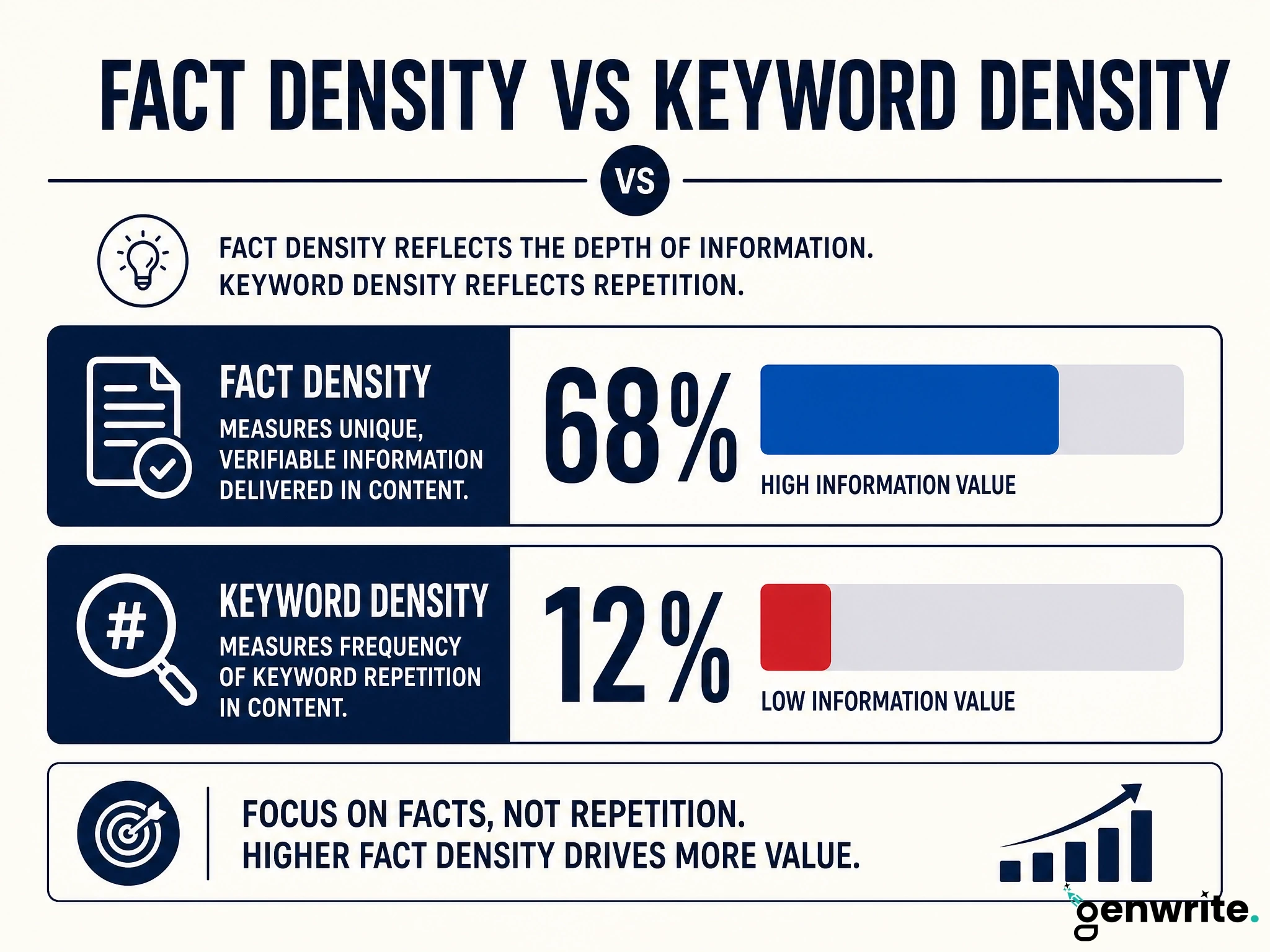
The shift from keyword frequency to semantic weight
LLMs don’t care how many times you repeat a target phrase. Instead, modern retrieval systems use dense vector embeddings to measure the actual information value of a passage. If your page is mostly fluff built around a keyword, an AI engine’s retriever will bypass it entirely.
A landmark study from Princeton, Georgia Tech, and IIT Delhi proved this shift. Researchers found that adding clear citations, direct quotes, and verifiable statistics can boost a page’s visibility in generative search results by up to 40%. You can read more about how these dynamics function in this guide on mastering search and answer engine optimization. The math is simple: AI search models prioritize high fact density because it makes their retrieval-augmented generation pipelines more reliable. They want to avoid hallucination, so they anchor their answers to highly structured, verifiable data.
How AI engines calculate information value
When an AI engine processes a query, it pulls candidate passages and scores them. It looks for structured data points, hard numbers, and consensus-backed assertions. If your content lacks these elements, it fails the extraction threshold.
This is where your content creation environment matters. Standard word processors do not help you measure semantic weight. If you compare basic draft editors to specialized software, the difference in output quality is stark. Using premium SEO writing tools helps writers map out semantic density before publishing. These platforms guide you to include the exact entities and factual relationships that search bots expect. It’s the difference between guessing what terms matter and knowing exactly what entities an LLM is looking for.
Admittedly, we don’t know the exact mathematical weight every search engine assigns to specific facts. The algorithms are constantly changing. But we’re seeing a clear trend. To succeed at [optimizing content for ai engines], you must strip out the filler words. Replace generic advice with hard data, expert quotes, and structured tables. That is how you turn a basic blog post into an authoritative source that LLMs trust.
How to write and format content for instant machine extraction
Designing content for LLM parsers
Large language models do not read your content to enjoy the prose. They scan it to extract immediate, factual answers to user prompts. If your content hides the main answer under three paragraphs of throat-clearing introduction, the crawler moves on.
To capture these zero-click placements, you must structure your pages for rapid machine digestion. This is the core of learning how to rank in ai search engines. It requires a shift from writing for human scanners to writing for programmatic parsers.
1. Build tight answer blocks
Start your target sections with a direct question as a heading, followed immediately by a two-sentence answer. Keep this answer under 45 words. Use the active voice and state the definition or solution immediately.
The first sentence should define the core concept directly without using vague pronouns. The second sentence must provide the immediate context or primary benefit. This structure allows scraping bots to pull your definition directly into a chat interface without needing to parse complex sentence structures.
2. Address secondary search intent
A single direct answer is rarely enough to satisfy a conversational crawler. AI search engines look for depth beyond the initial question. If your page only answers the obvious query, it fails to provide the next logical step in the user’s journey.
When your content neglects these deeper layers, you lose authority. We often see this fail when a standard seo writer ai ignores secondary search intent, leaving the content too shallow for conversational search engines to cite. You must anticipate the user’s follow-up questions and address them in consecutive subheadings. This creates a logical path that LLMs can follow to build a complete response.
3. Strip the conversational filler
AI engines are trained on massive datasets and can easily spot fluff. Phrases like “in the modern era” or “it’s important to remember” add zero semantic value. They waste crawl budget and dilute your semantic density.
Instead of relying on generic AI-generated copy, you need to refine your drafts manually or use a specialized tool like GenWrite that formats content properly from the start. Taking the time to edit AI blog drafts so they rank means stripping out robotic filler and replacing it with proprietary data points, specific tools, and real-world numbers.
Admittedly, this formatting approach won’t guarantee a citation for every highly competitive query. Results will vary based on your domain authority and the complexity of the niche. But it positions your site as a clean, highly readable source that LLMs can easily parse.
Structuring your schema markup to become an authoritative entity

The technical foundation of entity-based search
AI engines don’t read websites like humans. They run on graph databases, mapping connections between discrete entities like people, places, organizations, and concepts. If your site is just a wall of unstructured paragraphs, crawlers have to guess how your content fits together. Don’t let them guess. You need a machine-readable identity built on structured schema markup.
Structured data formats like JSON-LD provide explicit context for AI agents. When you implement Organization, Product, and Review schemas, you tell the crawler exactly what you sell and who you are. For instance, using the sameAs property in your Organization schema to link your brand to your official Wikidata, LinkedIn, or Crunchbase profiles creates an undeniable entity relationship. The model no longer has to infer your industry. It has verified database proof.
This structured layer has to match your visible on-page elements. When you focus on optimizing H1 tags and transactional metadata, you provide a clean, unified signal that matches the underlying schema. If your schema claims you sell enterprise software but your H1 tags target generic informational queries, search models will flag the discrepancy. Aligning your technical schema with optimized H1s helps AI engines verify search intent, allowing them to confidently recommend your product as a direct solution.
Implementing the entity layer
When optimizing content for AI engines, your technical implementation should prioritize specific schema properties.
First, use knowsAbout within your Author or Organization schema to list topics, technologies, or industries where you have verified expertise. Second, apply about and mentions in your Article schema to explicitly define the core subject, pointing directly to Wikipedia entries for those terms. Finally, use itemReviewed for product reviews to establish the exact entity being evaluated. This prevents the AI from confusing your review with a competitor’s product page.
While adding schema markup does not guarantee your site will be cited by conversational engines every time, it removes translation errors. You stop relying on the AI’s ability to parse natural language and instead feed its database the exact structured nodes it craves.
What it looks like in practice: brands successfully quoted by ChatGPT and Perplexity
Real-world scenarios: how LLMs pick their sources
A few months ago, I was researching commercial heat pump failures in cold climates. Instead of scrolling through Google, I asked Perplexity: “What is the failure rate of CO2 heat pumps below -10 degrees, and who fixes them in Ohio?”
Rather than pulling up a massive manufacturer’s landing page, the engine cited a mid-sized regional mechanical contractor. This contractor didn’t have millions in backlink budgets. But they had a highly specific, table-structured blog post detailing field failure rates from their own technicians. The AI engine extracted the exact table, summarized the findings, and cited them as the sole authority.
This is the core of how to rank in ai search. It isn’t about domain authority anymore; it’s about information density and directness.
Consider another scenario. A user asks ChatGPT: “What’s the difference between Hubspot and a lightweight alternative for a 5-person agency?” Instead of pulling HubSpot’s own marketing copy, ChatGPT synthesized a comparison table citing a small boot-strapped CRM. Why? Because that smaller competitor had a clean, objective comparison page that didn’t hide behind gated PDFs or vague sales speak. It laid out the raw numbers, pricing, and limitations in a clean, machine-readable format.
The third scenario happens daily in the e-commerce space. When someone asks Gemini for the “safest dog harness for a three-legged terrier,” it doesn’t just list Amazon bestsellers. It pulls from a niche pet rehabilitation blog that published a detailed, structured guide on amputee pet ergonomics.
If you’re trying to replicate this success, you can’t rely on old-school, fluffy copywriting. Many teams are now leveraging an AI blog generator to produce highly structured, answer-first content that directly addresses these complex, long-tail queries.
The common thread across all three examples is simple. These brands stopped writing for search volume. Instead, they started writing to resolve highly specific user queries with absolute clarity. Sometimes, their traffic numbers actually dropped, but their brand impressions inside conversational engines skyrocketed.
Five mistakes that make your website completely invisible to AI bots
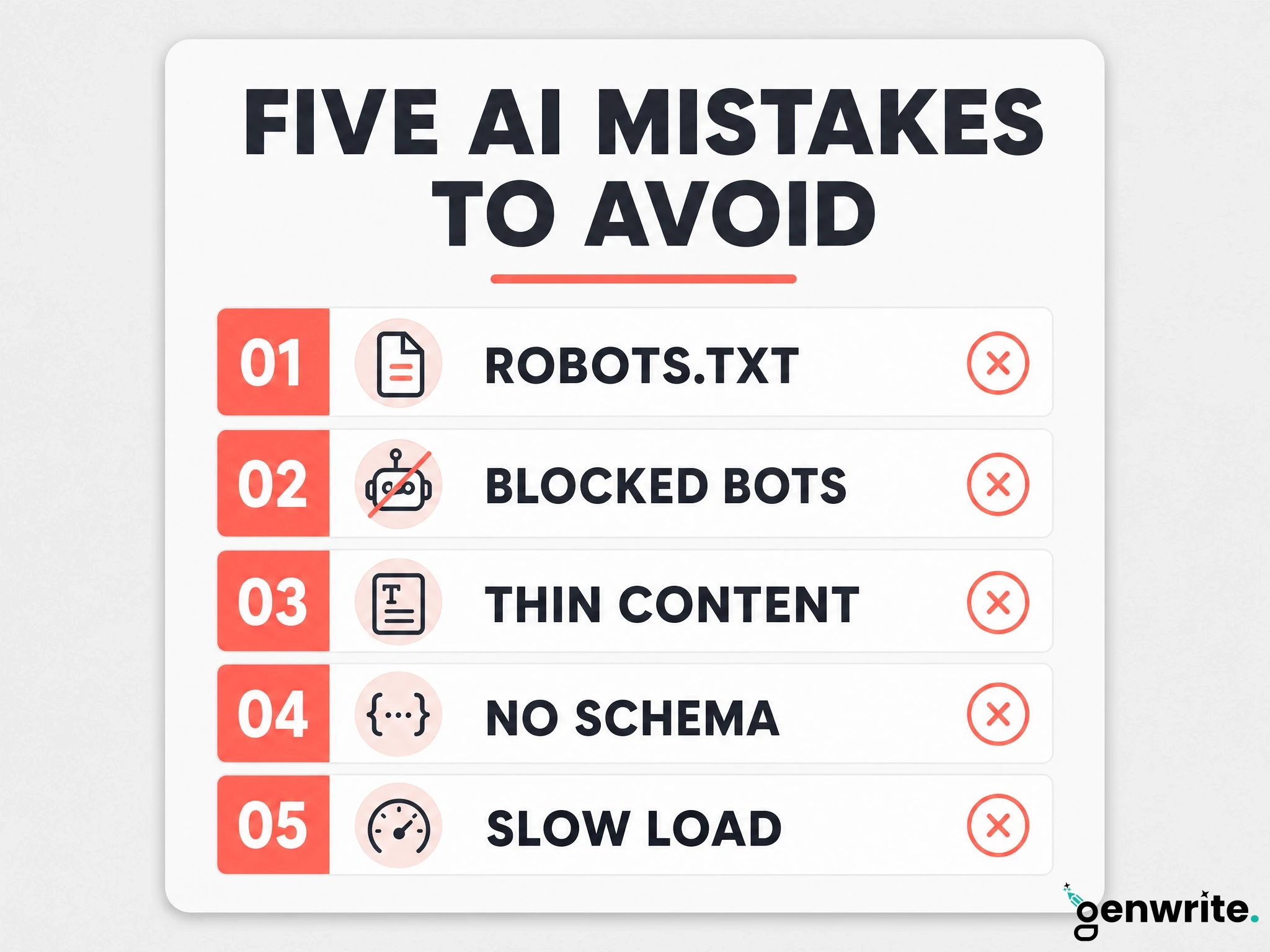
Five fatal traps blocking AI scrapers
Your legacy SEO playbook is actively hiding your website from large language models (LLMs). If you only optimize for Google’s old algorithm, AI search engines like Perplexity and ChatGPT will bypass your content entirely. It’s not a lack of authority. Your technical layout and content structure are simply unreadable for modern scrapers. Fixing this doesn’t mean rewriting your entire site by hand. It means changing how you structure information.
Here are the five mistakes killing your visibility in AI search.
1. Low fact-to-word ratio
AI search bots don’t care about your word count goals. If you write 150 words of fluff before delivering a single metric, the scraper leaves. LLMs want high-density data. If your content lacks hard facts, specific names, or clear definitions, it gets filtered out as noise.
2. Raw, unoptimized automation
Automation works. Lazy automation kills. Sure, using an AI blog generator saves hundreds of hours, but dumping raw, unformatted outputs onto your site is a fast track to obscurity. AI bots need clean, structured data blocks. If your automated posts lack defined answer targets or clear semantic headings, scrapers can’t extract the facts. They’ll just skip you.
3. Neglecting schema markup and entity associations
LLMs don’t just read words. They map entities. Without structured schema markup, you force the bot to guess who you are, what you sell, and who you serve. If your schema is missing or outdated, search models can’t link your content to real-world entities. You end up invisible when users ask high-intent questions.
4. Inconsistent brand messaging across platforms
Say you’re a “B2B SaaS platform” on your website, a “consulting firm” on LinkedIn, and an “enterprise agency” in your press releases. LLMs will get confused. They cross-reference data from everywhere. When they hit conflicting definitions, they flag your brand as unreliable and move on.
5. Blocking the wrong user agents
Some brands panic-blocked all AI crawlers in their robots.txt files to protect their IP. That’s a massive mistake. While it might prevent some generic scraping, it completely removes your brand from conversational search results. If GPTBot or PerplexityBot can’t crawl your pages, you don’t exist to their users. You need selective blocking, not a total blackout.
Moving beyond the traditional search bar
The future of search isn’t binary
We aren’t choosing between traditional search engines and conversational AI. The reality is they’re merging. If you treat answer engine optimization as a separate silo from your standard search strategy, you’re doubling your workload for no good reason. They are two sides of the exact same coin.
Think about how LLMs pull their data. They don’t invent facts out of thin air,at least, not when they’re working well. They rely on clean, structured, authoritative web pages that they can parse in milliseconds. By structuring your content with clear semantic headers and direct answer blocks, you satisfy both Google’s search crawlers and Perplexity’s spiders at the same time.
It’s easy to feel overwhelmed by this shift. But the transition doesn’t have to be a manual nightmare. Using an advanced AI blog generator can help you automate this structural heavy lifting, ensuring your articles are formatted for both human readers and machine extraction right out of the gate. We built GenWrite to handle this exact inflection point, blending semantic depth with modern technical schema automatically.
So, what is the immediate next step? Don’t delete your existing blog posts. Instead, audit your top ten traffic-driving pages. Add a direct, two-sentence answer block right at the top of each major section. Strip out the fluff, define your terms clearly, and make it incredibly easy for an AI bot to quote you. This integration doesn’t happen overnight, but those who format their sites for machine readability today will own the zero-click answers of tomorrow.
Tired of watching AI bots ignore your traditional blog posts? GenWrite handles entity structuring and AEO formatting automatically so you get cited.
FAQ
What is Answer Engine Optimization?
Answer Engine Optimization (AEO) is the practice of structuring your website content so AI tools like ChatGPT and Perplexity can easily parse, understand, and cite it as a primary source.
Why is traditional keyword SEO failing right now?
Traditional SEO relies on matching exact keywords and ranking for blue links. AI search engines don’t care about keyword density; they synthesize answers using entity networks and high fact-density data.
How do I get my brand cited by ChatGPT?
You’ll need clean schema markup, structured definitions, and clear entity relationships. If you make it easy for an LLM to extract a direct answer, it’s much more likely to drop your brand name in the citations.
Does AEO replace traditional SEO completely?
Not really, it’s more like an upgrade. You still need technical SEO basics, but you have to shift your writing style from fluff-heavy paragraphs to dense, authoritative answers.