
Are your agency’s legacy search platforms holding you back from AI scale?
Are 15-year-old SEO suites silently killing your agency’s margins?
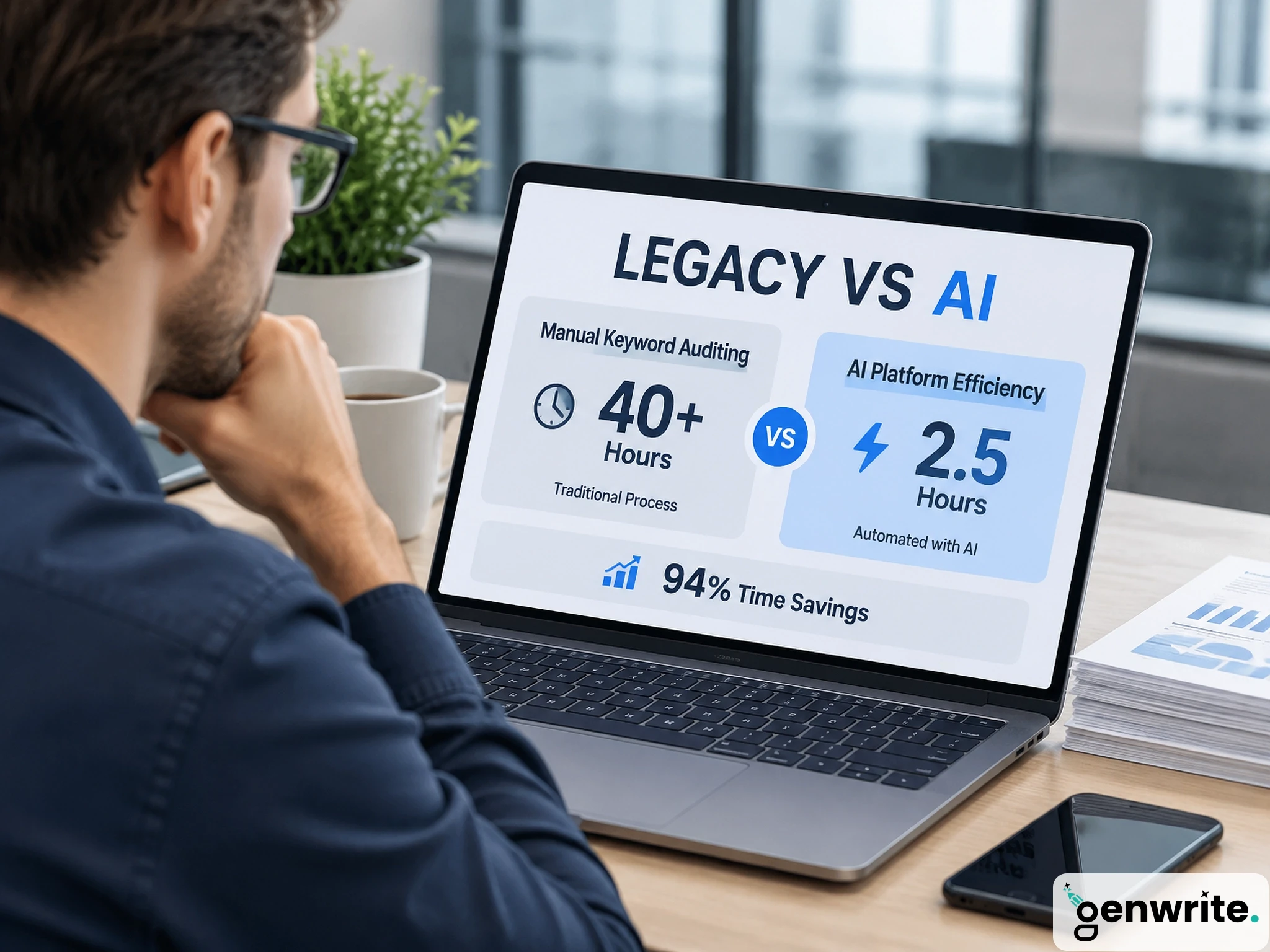
Are your tools eating your profits?
How much time did your team spend manually pulling keyword reports this week? If you are still relying on legacy SEO suites rather than AI-native platforms, your margins are likely eroding under the weight of manual labor. It is a quiet drain. The search environment has changed. We are no longer dealing with a simple index of blue links; today’s search is predictive and probabilistic. This means we cannot just rank pages anymore. Instead, we have to optimize for how large language models recommend brands.
But how do you adapt when your current toolkit does not even understand generative search? You simply cannot solve modern search problems with 15-year-old database architectures. To survive, agencies must transition toward modern agency SEO automation software. That means mastering answer engine optimization to get your clients cited. If you do not make this shift, you are optimizing for a dying web.
The core split: deterministic indexers versus predictive models
The shift from static databases to dynamic intelligence
For fifteen years, search strategy was simple. We built everything around static databases, matching exact keywords, tracking historical search volume, and counting backlinks. It worked. But that era is over.
People don’t just type three-word phrases into a search box anymore. Instead, they ask complex, multi-layered questions directly to conversational engines like ChatGPT and Claude. Legacy tools simply can’t parse those semantic relationships.
They’re stuck indexing old data. Meanwhile, modern seo platform for marketing agencies options focus on real-time intent mapping. That’s the real divide. One approach looks backward at last month’s search volume, while the other tries to predict how an LLM will package information tomorrow.
Predictive models aren’t perfect, of course. They still miss minor search trends now and then. But relying entirely on outdated keyword indexes is a fast track to getting left behind. If your team still spends hours manually grouping keywords, switching to ai seo software for agencies isn’t just a time-saver. It’s a survival strategy for an industry where the rules change daily.
A side-by-side look at the feature gap
Feature breakdown: legacy platforms vs AI-native systems
Let’s look at how these systems actually handle data. The real gap isn’t just about speed; it’s about the sheer amount of manual labor. Traditional platforms require your team to manually group thousands of keywords into clusters. It’s tedious work that takes hours, and the data is often stale before the spreadsheet is even saved. Modern systems do this instantly. They map search intent using real-time semantic analysis, turning what used to be a weekly chore into a live, automated feed.
Reporting is where the divide becomes a chasm. Old-school suites still focus on tracking static desktop rankings on Google. But search has changed. Today’s AI search software monitors cross-LLM citations, showing you exactly how often your brand gets cited in generative answers on Gemini, Copilot, and Perplexity. If you’re still relying on traditional rank tracking, you’re missing the entire conversational search market.
The content creation workflow itself has also shifted. Legacy platforms give you a basic text editor with a rigid, paint-by-numbers keyword checklist. It’s a slow way to write. Modern workflows use premium SEO writing tools that analyze semantic density and user intent as you type. This isn’t just about writing faster. It’s about letting agencies scale up their content production without losing editorial quality.
The raw truth about tool limitations and content quality
Let’s look at the actual balance sheet. Legacy SEO suites charge eye-watering monthly subscription fees for database features your team barely touches. They lock your agency into manual, fragmented workflows where expensive strategists spend half their day copying data between browser tabs. This is the hidden margin killer of traditional seo versus ai tools: you are paying premium software rates to move at a crawl.
But AI platforms have their own sharp edges. If you simply pump out raw machine text without any human editorial oversight, search engines and readers will notice. In fact, many agencies fail because they don’t stop to consider whether audiences actually trust drafts generated by a specialized seo writer ai when there’s no human-in-the-loop system to verify facts.
When figuring out how to choose ai seo tools, you must avoid platforms that promise magic, single-click solutions. Look for systems like GenWrite that automate the research and structuring phases while keeping your editorial standards intact. The goal isn’t to replace your creative team, but to remove their administrative bottleneck.
When to stick with classic platforms versus when to migrate
Balancing legacy stability with AI speed
How do you decide between your trusted, decade-old SEO suite and a modern engine built for agency scale seo automation? It depends on your current client mix and technical debt.
If your revenue relies on enterprise clients demanding hyper-specific, manual backlink auditing or local citation cleanup, keep your legacy platforms. They still excel at deep, historical database lookups. But they will fail you if you try to use them for modern content intelligence.
When evaluating how to choose ai seo tools, look at your production bottlenecks. If you need to produce high-velocity, search-optimized content across fifty client accounts without hiring a small army of writers, you must migrate. Modern search requires scale.
The transition doesn’t have to be painful. You can build an editorial bridge by pairing legacy keyword research with automated draft generation. Just remember that AI automation is not a set-it-and-forget-it solution. To protect your brand’s reputation, you must establish a human-in-the-loop workflow to optimize AI blog posts by stripping out robotic patterns and injecting first-party data. This ensures your scaled output actually ranks.
What compounding search infrastructure looks like in practice
I recently watched a mid-sized agency in Chicago nearly collapse under the weight of its own monthly deliverables. They spent eighty hours a month just copy-pasting competitor data into spreadsheets.
By adopting modern agency seo automation software, they shifted from linear human handoffs to concurrent, automated production. Instead of waiting weeks for keyword research, brief writing, and drafting, their systems ran in parallel.
The result? They scaled output fourfold without hiring a single extra writer. When you stop paying for manual labor disguised as strategy, your margins recover almost overnight. That is how modern ai seo software for agencies transforms depreciating tasks into compounding assets.
Future-proofing your agency’s search department

Building the modern search desk
The debate between traditional seo versus ai tools often misses the forest for the trees. It isn’t just about output volume anymore; it’s about capture. Your team can generate thousands of pages, but if those pages don’t target high-intent buyers, your agency’s margins will keep shrinking.
So, how do we fix this? The answer lies in choosing a modern seo platform for marketing agencies that bridges the gap between raw scale and strategic execution. Agencies must learn to optimize your H1 headings and metadata specifically for transactional search intent so that the traffic you generate actually converts. It’s time to stop chasing vanity metrics and build a hybrid workflow that protects your bottom line.
Tired of wasting billable hours on manual audits? GenWrite automates end-to-end blog creation so your agency scales faster.
FAQ
Why are traditional SEO tools failing modern marketing agencies?
Legacy suites were built for a static web of keyword rankings, not dynamic AI overviews. They force your team to spend hours on manual audits that don’t match how users actually find brands today.
How do AI-native search tools differ from classic keyword indexers?
Classic tools rely on backward-looking data and rigid keyword lists. AI platforms use predictive models to map intent and scale search campaigns automatically, saving hours of manual labor.
When should an agency finally ditch its legacy SEO software?
If your team spends more time formatting exports than driving strategy, it’s time to migrate. Most agencies see an immediate margin boost once they shift repetitive research to automated systems.
Does AI-generated search content actually rank well?
It does, provided you use a human-in-the-loop workflow. Raw unedited drafts rarely work, but platforms that handle research, linking, and publishing properly will easily outpace manual workflows.