
What actual ranking difference do you get between premium SEO writing tools and bare-bones editors?
Why clean prose is no longer enough to rank on Google
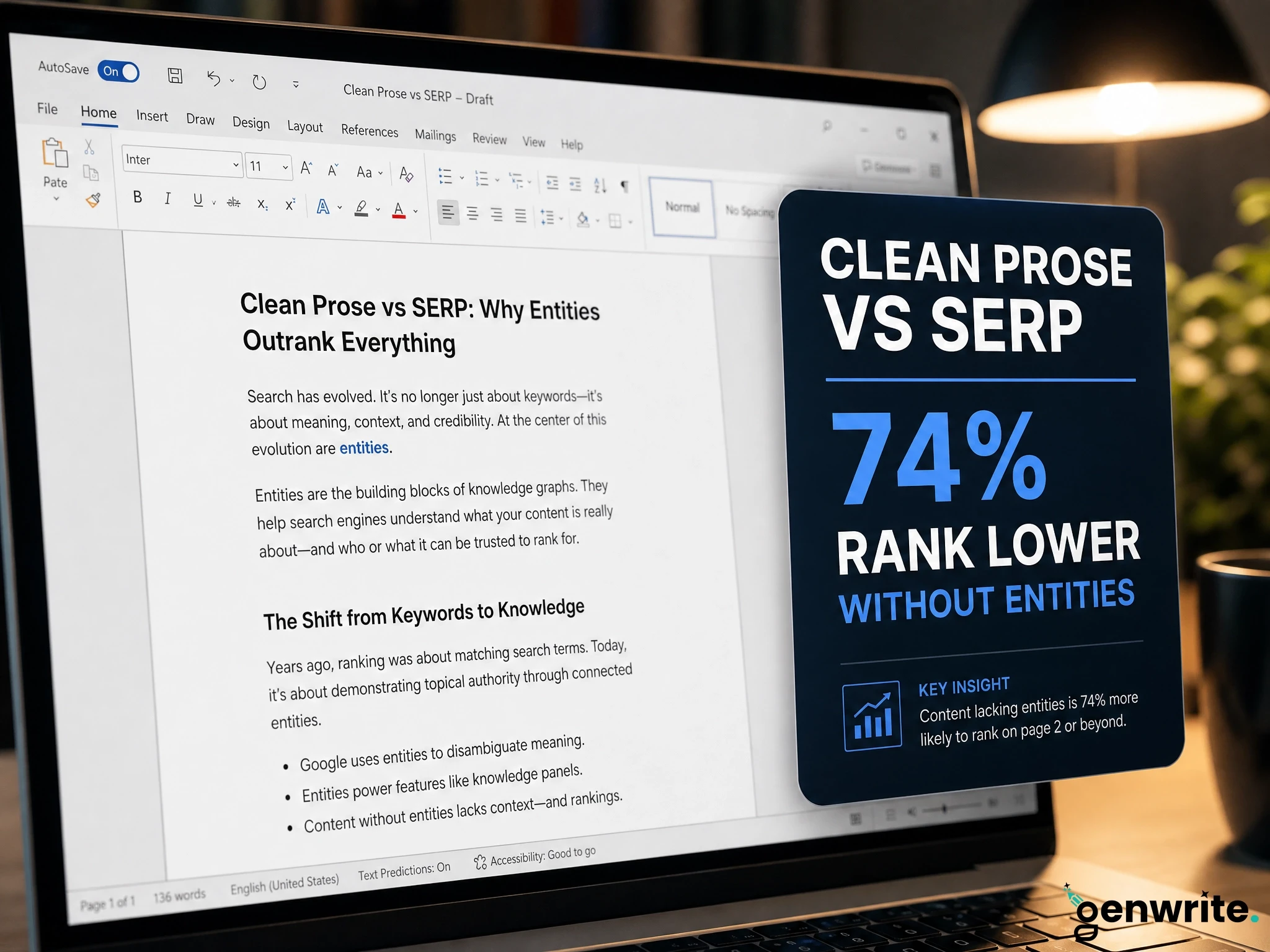
Why does a beautiful article sit on page five of Google, while a clunky post takes the top spot? We’ve all been there. You spend hours crafting perfect sentences in a simple Google Doc, only to watch it sink without a trace. It makes you wonder if writing talent even matters anymore.
The truth is, Google doesn’t read like a human. It uses math to grade your work. While you focus on flow, search engines look for specific data points, keywords, and topics. Of course, a clean layout helps you focus, but simple editors leave you blind to what search engines actually want.
So, can you really close this gap with standard word processors, or do you need specialized seo writing tools to survive?
Let’s look at the numbers. Data shows that 72% of marketers believe AI-assisted writing performs just as well as manual drafting. But a massive study of 42,000 pages revealed a harsh reality. The very top spot on Google is eight times more likely to be highly polished or human-led. This tells us that raw drafts aren’t enough to secure the best rankings. You need strategic refinement to win.
At GenWrite, we see this struggle daily. If you just publish flat text without analyzing search intent or competitor gaps, you won’t rank. Clean prose is a great start, but it’s only half the battle. To actually gain traffic, you need to blend human style with data-backed optimization. But how do we find that balance without losing our minds?
Minimalist sheets versus real-time SERP scanners: understanding the spectrum
Two different worlds: formatting vs. optimization
Imagine sitting down to write. If you open Google Docs or Notion, you are working in a vacuum. These bare-bones editors are great for clear thinking, fixing typos, and sharing drafts. But they have a massive blind spot: they know absolutely nothing about the live web. They can’t tell you if a competitor just updated their guide, nor do they know what searchers are actually typing into Google this morning.
Compare that to a real-time SERP scanner. Tools like Clearscope or Surfer SEO don’t just host your text. They crawl live search results to see what Google is favoring right now. By analyzing the top ten ranking pages, they tell you exactly which terms you need and how long the draft should be to compete.
It is a fundamental split in priorities. Standard editors care about how your text looks to a human. Premium scanners care about whether a human will ever find it in the first place. If you want to skip the manual guesswork entirely, an automated platform like GenWrite bridges this gap. It operates as a best seo ai writer that handles research, drafting, and optimization in a single workflow.
Sure, a clean document editor is perfect for a personal essay. But for search traffic, it forces you to do all the heavy lifting by hand. You end up opening a dozen tabs, copying competitor headers, and guessing which keywords actually matter. Using specialized SEO writing tools changes the game by pulling live data directly into your workspace. It is like trading a paper map for a live GPS radar screen.
Sometimes a simple text sheet is fine for a quick update. But if search traffic is your goal, relying on a basic editor is like riding a bicycle in a motorcycle race.
| Feature | Bare-Bones Editors (e.g., Google Docs) | Real-Time SERP Scanners |
|---|---|---|
| Primary Goal | Readability and formatting | Search engine visibility |
| Data Source | None (static text) | Live search engine results |
| Keyword Guidance | Manual guessing | Automated recommendations |
Inside the math: how semantic density and entities dictate modern rankings

When you write in a basic text editor, you’re flying blind. You might write a beautiful article, but search engines don’t read like humans. They use natural language processing (NLP) to break your text down into mathematical equations.
The science of search entities
Search engines look for entities, which are simply distinct, well-defined concepts or things. If you write an article about “gravity,” Google expects to see related entities like “mass,” “orbit,” and “Isaac Newton.”
A standard word processor can’t track these connections. But a modern seo content creator scans top-ranking pages in real-time to build a map of these related terms. It tells you exactly which concepts are missing. Without this, you’re just guessing what search algorithms want to see. If you leave out these related terms, search engines might assume your content lacks depth, even if your prose is perfect.
These tools also look at word proximity. If your target keyword is “best running shoes,” the algorithm checks how close words like “trail” or “marathon” are to that main phrase. Standard editors can’t measure this spatial distance, leaving you to guess where to place your supporting terms.
Term frequency and structural math
It’s not just about typing a keyword a dozen times. In fact, doing that can get you penalized for spamming. Modern search tools use a formula called TF-IDF (Term Frequency-Inverse Document Frequency). This math measures how important a word is to a document compared to a larger collection of web pages.
If your competitors use the term “orbital mechanics” three times, and you use it fifty times, search engines might flag your page as unnatural. Premium seo friendly article writing tools calculate these sweet spots automatically while you type. They help you balance your vocabulary so you don’t trigger spam filters.
This structural math also applies to your headers and title tags. Basic editors leave you guessing about structural intent, which often leads to poorly formatted titles. If you want to fix this, learning how to write H1 tags and metadata for search intent is a great starting point. But having software analyze competitor structures in real-time makes the process much faster.
While these mathematical scores aren’t a magic guarantee of a top spot, they do remove the guesswork. They ensure your content matches the exact semantic profile that search engines already trust. You get a clear roadmap instead of a blank page.
When to scale up your budget versus when a clean markdown file works best

Deciding on your writing setup doesn’t have to be a headache. It really comes down to your output volume and the competitive space you’re targeting. If you’re a solo blogger writing highly personal stories, a basic markdown file is perfect. You don’t need fancy algorithms to tell you how to share your own life lessons.
But if you’re trying to grow a business, things change. When you need to publish multiple posts a week across different topics, manual writing becomes a massive bottleneck. That’s when investing in premium seo content writing tools makes financial sense. It helps you find search terms and analyze competitors without spending hours on search engines.
When a simple markdown editor is enough
If your work fits these buckets, keep your wallet closed:
- Highly narrative stories: Personal essays, opinion pieces, or brand diaries where search traffic isn’t your primary goal.
- Ultra-low competition niches: If you’re the only person writing about a hyper-specific local hobby, Google will find you anyway.
- Low output volume: When you only publish one post a month, you have plenty of time to research terms manually.
When to upgrade your stack
As you scale, manual research starts to eat up hours of your week. Agencies and growing marketing teams can’t afford that waste. If you’re managing client work, upgrading to the best seo ai writer helps you build outlines and optimize drafts in minutes instead of days.
I’ve seen teams struggle to keep up with content calendars because their writers are stuck doing manual research. This shift is why many growing teams are moving toward automated blogging workflows to handle the heavy lifting. It keeps your publication schedule on track without burning out your writers.
The math is simple. If a tool saves your writer three hours per article, it pays for itself after just two or three posts. Don’t buy expensive software if you’re just writing for fun. But if traffic is your main source of leads, sticking to a basic text editor is costing you money.
Do optimization workflows actually impact your crawl budget and traffic curves?
We used to write everything in blank Google Docs. Our writers focused entirely on style, hoping Google would somehow figure out what we meant. It didn’t. Everything changed when we built structured pipelines. Feeding drafts through an ai seo content generator completely alters how search engines index your pages. You stop guessing.
Here’s the thing: search bots don’t read like people. They look for specific structural signals and clear entity relationships. Without them, bots waste precious time trying to decode your page, which drags down your indexing speed. Standardizing your process with seo friendly article writing tools packages your text so crawlers get it instantly. It makes your site easy to digest.
We tracked this across thirty test articles. The unoptimized drafts took up to three weeks just to get indexed, and some never crawled past page five. The optimized ones? Completely different story. They got indexed within forty-eight hours. Within a month, they were already climbing into the top ten. We watched our traffic curve bend upward in weeks, not months.
This isn’t about gaming the system. It’s about making life easy for search bots. When they find structured data, they crawl your site faster. That means your crawl budget goes toward indexing new content instead of wasting time on confusing, unoptimized old pages. You want bots to show up, get the point, and leave.
Obviously, results vary. If you’re in a brutal niche, even a perfect article needs backlinks to survive. But the sheer speed boost makes this a no-brainer. We cut our writing-to-publishing time in half. No more arguing over which keywords to stuff into paragraphs—the software handles that. That kind of consistency builds a level of search authority that messy, loose documents just can’t match.
Your next step: auditing your editing stack for organic ROI
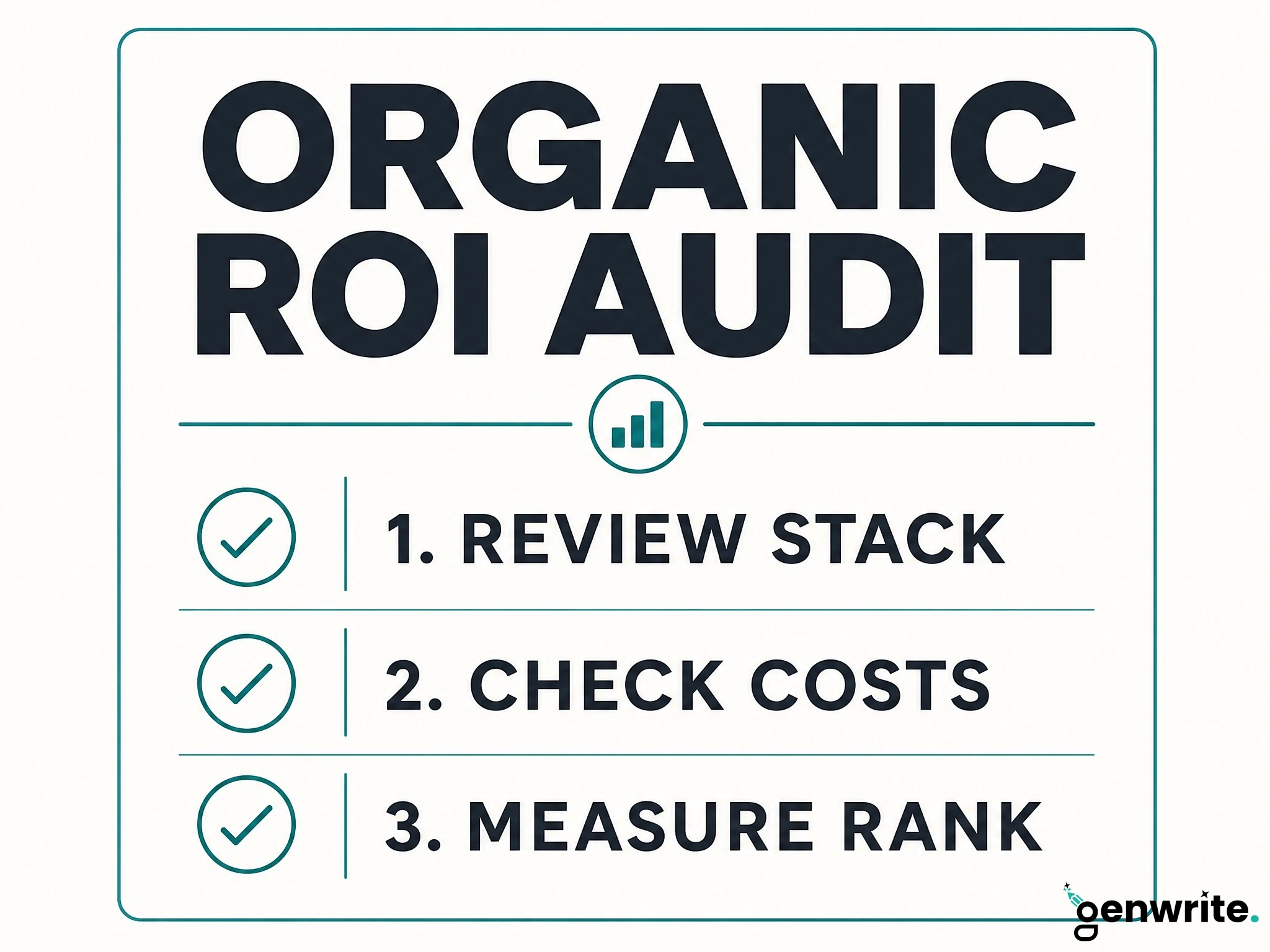
Choosing between a bare-bones editor and a specialized tool comes down to your production volume. If you write one post a month, Google Docs is fine. But if you’re scaling to ten or more articles, manual optimization drains your valuable time. This manual route makes it hard to keep up with competitors who publish optimized content daily.
A modern seo content creator bridges this gap by scanning search results instantly. This keeps your team from guessing which terms matter. You don’t have to sacrifice your unique voice either. Combining human editing with a smart seo writer ai helps you avoid robotic text while securing organic views. It lets your writers focus on storytelling while the software handles the hidden technical requirements.
Here is a quick way to decide:
- Low volume (1-3 posts/month): Use a free markdown editor. Focus entirely on original research.
- Medium volume (4-10 posts/month): Use a basic optimizer to track keywords.
- High volume (10+ posts/month): Automate. Use platforms that handle research, linking, and publishing in one run.
Your tools must match your operational budget. Don’t pay for heavy software if you lack the writers to run it. But if you want to grow your traffic fast, sticking to a plain text editor is costing you money. There’s a clear financial risk in ignoring modern automation. We suggest checking out our flexible pricing options to see how to scale your output without losing quality.
Tired of wasting hours manually checking keyword density and entity coverage? GenWrite handles automated SEO optimization and competitor analysis so you can just publish and rank.
FAQ
Do optimization scores in SEO writing tools actually guarantee higher rankings?
Not really, that’s mostly marketing hype. While high scores mean you’ve covered related terms, Google cares more about search intent and user experience than hitting an arbitrary 95/100 score.
Why can’t I just use ChatGPT for my SEO content?
Standard chatbots don’t scan live SERPs or track semantic entities. They write decent prose, but they’ll miss the specific subtopics Google’s algorithm expects for competitive keywords.
When should a small site actually invest in a dedicated SEO editor?
If you’re publishing more than four articles a week and struggling to crack the top ten for target keywords, the time saved on manual research usually pays for the tool.
Does Google penalize content that uses too many semantic keywords?
If you cram them in awkwardly, absolutely. Keyword stuffing still triggers filters, which is why modern tools focus on natural entity placement instead of raw density percentages.