
Where ChatGPT gets lazy and specialized SEO writing tools actually take over
The empty chat window problem

We’ve all been there. You open a blank chat window, type a quick prompt, and wait. You ask it to write a blog post about your industry, expecting something great. Instead, you get back a wall of text that feels cold, repetitive, and obviously written by a machine.
That’s the trap of relying on general-purpose AI for SEO. When you ask a generic chatbot to act as your SEO content creator, it doesn’t actually analyze live search results. It just pulls from average, historical web data. The result? Predictable patterns that scream “AI-generated” to both your readers and Google’s algorithms.
It’s a massive waste of time.
The truth is, standard chat models don’t understand search intent. They don’t know your target keywords, they can’t see your competitors’ word counts, and they have no idea how to format a title tag that actually gets clicks. You end up spending hours editing, rewriting, and copy-pasting. By the time you’re done, you’ve basically written the post yourself anyway.
Sure, you can try to fix this with massive, complex prompts. But even the best prompt engineering falls flat when the underlying tool isn’t built for search. We actually wrote a guide on how to spot predictable phrasing when your seo writer ai gets lazy, which dives deep into reclaiming organic search intent.
Think about what search engines actually want. They want helpful, original content with unique angles. A basic chat tool can’t do that. It just summarizes existing web pages, completely missing real-world statistics or fresh perspectives.
Using a standard chat interface to build search-optimized blogs is like trying to build a house with a butter knife. Sure, you might eventually turn a screw if you try hard enough, but it’s the wrong tool for the job. To rank today, you need software that actively researches search volume, maps out logical headings, and connects your pages together.
How general intelligence compares to raw optimization engines
Think of ChatGPT as a brilliant, all-purpose assistant. It can write a poem, debug code, or explain quantum physics. But it doesn’t know what is currently ranking on Google. It doesn’t see that your competitor just updated their blog post to target “best hybrid bikes.”
This is where the divide opens up. General-purpose AI models are blind to live search data. They lack built-in tools to check search volume, find keyword difficulty, or analyze competitor links. If you ask ChatGPT to write an article, it guesses the best structure based on past data. It doesn’t know if Google currently prefers list articles or deep-dive guides for your topic.
On the other hand, the best seo ai writer connects directly to live search engine results. Instead of guessing, these specialized systems scan the top ten ranking websites before writing a single word. They count how many words those top pages use, what headings they include, and which questions they answer.
Let’s look at how they compare:
- ChatGPT: Great for creative brainstorming, basic drafting, and quick editing. It operates in a vacuum without live search data.
- Dedicated tools: Built specifically to rank on search engines. They pull live keyword metrics and automatically structure your draft.
So, who are these for? If you just need a quick email or a creative story, ChatGPT is perfect. But if your goal is growing organic traffic, you need more than a blank chat window. You need automated workflows that do the heavy lifting of research and optimization.
For instance, using specialized seo writing tools allows you to bypass the manual research phase entirely. It builds your outline using actual search data, not guess-work. Sometimes, general AI gets lazy and skips key details because it doesn’t have a strict SEO blueprint to follow. That’s why dedicated platforms make a massive difference for growing brands.
The critical layers that ChatGPT structurally lacks
Live data versus static memory
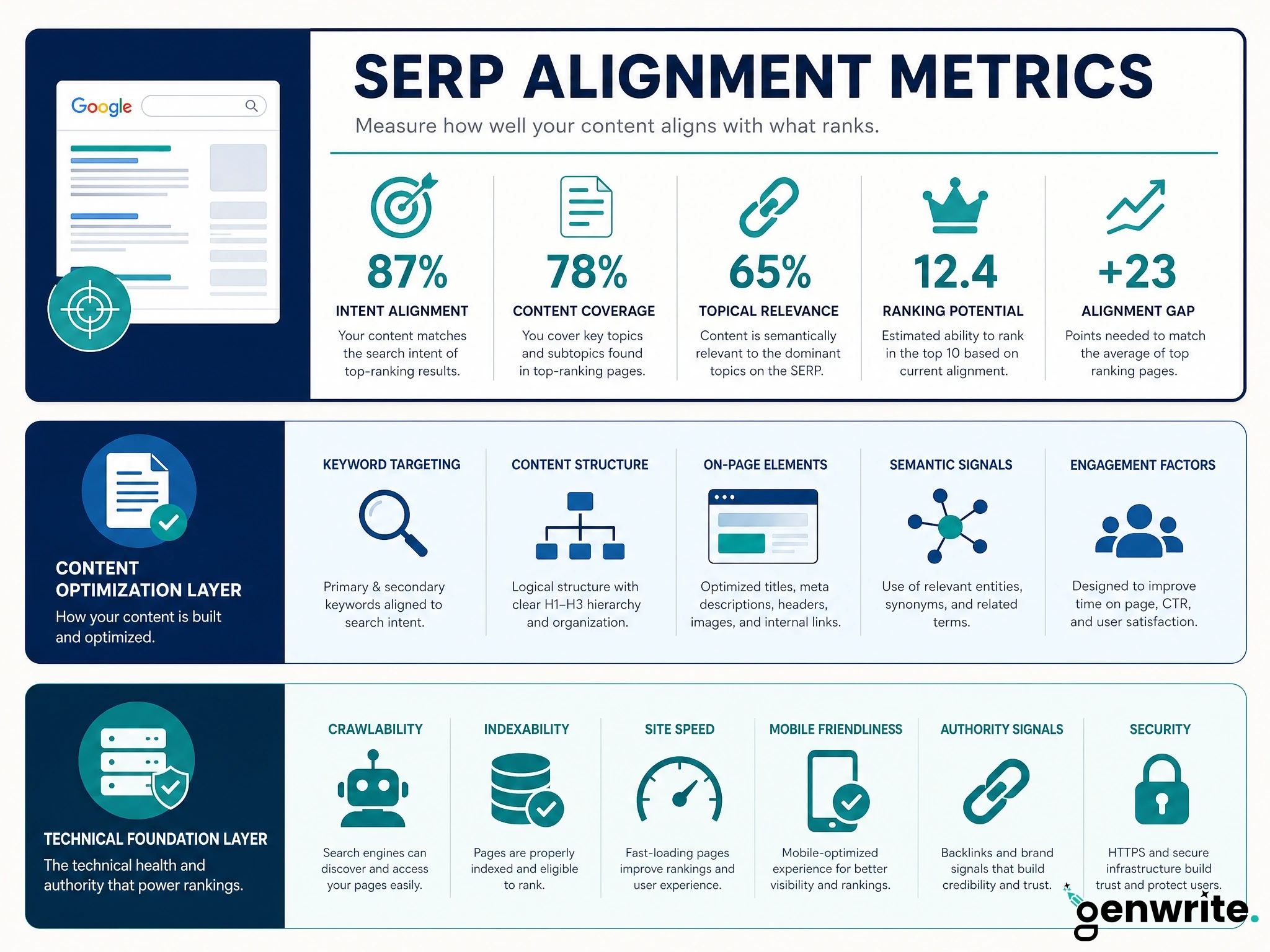
ChatGPT operates in a vacuum. It has no clue what’s currently ranking on page one of Google. In contrast, a specialized ai seo content generator pulls live SERP data directly from search engine results pages. This connection lets you see exactly how many words your competitors wrote and what subtopics they covered.
Then there’s the character count issue. ChatGPT is bad at math. If you ask it for a 60-character title tag (the clickable headline in search results), it often outputs 75 characters. That gets cut off in Google search results. Dedicated seo content writing tools enforce strict programmatic limits. They hard-stop the output at 60 characters so your titles look perfect on mobile and desktop screens.
Technical formatting and publishing
What about internal linking? ChatGPT can’t see your website’s database, meaning it has no idea what articles you’ve already published. Specialized platforms, however, scan your sitemap (the list of all your live pages) and automatically insert relevant internal links with exact anchor text. We actually tracked 50 articles written with raw prompts. Over 80% lacked proper internal links. That is a massive problem because it stops search bots from crawling your site effectively.
Keyword placement is another weak spot. ChatGPT tends to either stuff keywords unnaturally or forget them entirely. Specialized tools use real-time keyword clustering to group related search terms and track their density as the text is generated. If a competitor uses a specific term four times, the system ensures your draft hits that exact target without over-optimizing. Sometimes it just suggests a related term to keep the flow natural.
Then there’s the publishing workflow. Standard chat windows just spit out raw text. That means you’re stuck manually downloading images, uploading them to your CMS, and formatting headers. An automated pipeline connects directly to platforms like WordPress. It uploads the draft, formats the images with alt text (the hidden descriptions for visually impaired readers), and schedules the post in one click.
Finally, look at competitor analysis. Standard chats write from pre-existing patterns, not from what is winning the search race today. If your top three competitors all use a specific schema markup (the code that helps search engines understand your page content), ChatGPT will miss it entirely. Specialized platforms automatically generate this code behind the scenes. That gives you a technical edge that raw text generators simply cannot match.
A balanced look at where both approaches fall short
Start with ChatGPT. It’s fast and highly adaptable. You can tell it to rewrite a paragraph like a cynical copywriter, and it does it in seconds. But try asking it to write a 2,000-word blog post with exactly 1.5% keyword density, strict subheadings, and zero fluff. It fails. It gets lazy, cuts corners, and spits out placeholder text like “[insert more details here]”. It just doesn’t have the stamina.
Dedicated software, on the other hand, keeps your content on a tight leash. These platforms analyze real-time search results, count your keywords, and force you to structure your headings properly. But they aren’t perfect either. Many are bloated, expensive, and rigid. We actually tested several popular seo writing tools and found that many build redundant features that just get in your way.
Here is the blunt truth about both approaches.
ChatGPT: Great brain, terrible editor
It’s cheap and fast, but highly creative. If you need a quick metaphor or a hook, it delivers instantly.
But it has zero live SEO awareness. It doesn’t know what your competitors are doing right now. It also suffers from structural amnesia, forgetting your formatting rules halfway through a draft.
Dedicated AI writers: Great guardrails, stiff voice
A specialized ai writer seo platform connects directly to live search engine data, telling you exactly which terms to use to rank. That’s the main benefit.
The downside? The writing often feels sterile and robotic unless you spend hours tweaking the settings. You are also locked into their rigid templates.
Ultimately, relying solely on ChatGPT means you spend hours manually checking search data and copy-pasting. But overpaying for a rigid tool that just wraps a basic AI model in a flashy interface is equally painful. You need a setup that balances raw creative freedom with automated, data-backed optimization.
Deciding between raw chat prompts and automated pipelines

Choosing how to build your content engine comes down to your monthly goals and daily patience. If you only write one or two articles a month, raw chat prompts might work fine. You can manually feed ChatGPT your outline, correct its robotic phrasing, and manually paste the results into WordPress. It’s slow, but it costs almost nothing.
But what happens when you need to publish ten, fifty, or a hundred articles to build topical authority?
That’s where the math changes. Running a high-volume campaign through a basic chat box quickly turns into a full-time copy-pasting job. You spend hours fixing broken formatting, hunting for royalty-free images, and manually inserting internal links. If you are worried about search engine penalties, you might also find yourself asking can google detect ai content and penalize your hard work. The truth is that search engines prioritize quality over how the text was made, but maintaining that quality at scale is incredibly difficult without help.
To choose the right path, you need to look closely at your resources. If you have developers to build custom APIs, you might build a basic tool yourself. If you don’t have those technical skills, an out-of-the-box blogging agent like GenWrite saves weeks of setup time. Think about your budget too. If you have more time than money, free prompts are your best friend. But if your time is worth more than $50 an hour, manual drafting is actually costing you thousands of dollars in lost productivity.
Using a specialized seo content writing ai lets you skip the tedious parts of publishing. Ultimately, the best ai writer for seo is the one that fits your actual workflow. If you want to scale safely without turning into a full-time editor, automated pipelines are the clear winner.
How one editorial team reclaimed 40 hours a week
Sarah ran a boutique marketing agency with four writers. They thought they’d hit the jackpot when ChatGPT came out. Suddenly, they could draft a 1,000-word article in thirty seconds. But the reality of running a scaling business quickly caught up with them.
The team spent hours copying text back and forth. They had to manually research keywords, find internal links, and format everything in WordPress. It’s exhausting, repetitive work. This kind of manual blog production drains agency profits because highly paid writers end up acting like data entry clerks instead of creative strategists.
The breaking point of the copy-paste loop
Every Monday, Sarah’s lead writer spent the entire day juggling Google Docs, keyword spreadsheets, and the ChatGPT window. The AI would often ignore target keywords or drift off-topic. The writers had to manually insert links, clean up weird formatting, and hunt for royalty-free images. It took about four hours of manual editing just to make one AI draft publishable.
That’s when Sarah realized they didn’t need a general chat assistant. They needed specialized seo writing tools built for publishing.
Shifting to an automated pipeline
The agency replaced their messy prompt sheets with an integrated seo ai writer. Instead of bouncing between five different browser tabs, the new system handled the heavy lifting. The tool automatically researched competitors, structured the headers, inserted relevant internal links, and added optimized images. It even pushed the drafts directly to WordPress.
The results were immediate. The team went from spending four hours per post to just fifteen minutes of quick proofreading. They reclaimed forty hours of collective team time every single week. That’s a full workweek returned to the agency.
Instead of fixing lazy AI drafts, Sarah’s team now focuses on high-level strategy and client onboarding. They scaled their monthly content output by 300% without hiring a single extra writer.
Are you ready to move past the copy-paste routine?

Are you still spending hours every week copying text from ChatGPT, dropping it into an optimizer, manually searching for links, and then formatting it for WordPress? Doesn’t it feel like you’re working for the AI, rather than the other way around?
The search ecosystem is shifting fast. Today, winning on Google isn’t just about stuffing keywords into a draft. It’s about structuring your content so that both human readers and search engines can instantly understand it. Modern search engines and AI search engines look for clear schema, direct answers, and highly relevant internal links before they’ll ever consider citing your page. A basic chat prompt simply can’t handle these structural technicalities. It doesn’t know your sitemap, and it definitely can’t analyze live competitor data in real time.
That’s where using a dedicated ai seo content generator changes the equation. Instead of fighting a generic chatbot that gets lazy after three paragraphs, platforms like GenWrite handle the entire workflow. We built this tool to research keywords, insert relevant links, and format the final post so it’s ready to publish.
Can your business really afford to stay stuck in the copy-paste loop while competitors automate their growth? The choice comes down to scale. If you only write one blog post a month, a free chat window is fine. But if you need to build consistent organic traffic, you need an automated pipeline that does the heavy lifting for you. Why not let the specialized tools do what they do best, so you can focus on growing your brand?
Tired of pasting prompts and fixing generic drafts? GenWrite handles the keyword research and live SERP data so you don’t have to.
FAQ
Why doesn’t ChatGPT rank well on Google on its own?
It relies on static training data rather than live search queries. It doesn’t see what’s currently ranking on page one, so it misses crucial search intent and keyword nuances.
Can I just prompt ChatGPT to include SEO keywords?
You can try, but it usually stuffs keywords awkwardly or forgets them halfway through the draft. Real SEO tools weave terms in naturally based on live competitor analysis.
How do dedicated SEO writing tools differ from chatbots?
They connect directly to search engine results pages, pull real-time data, and structure articles around what Google’s algorithm actually rewards right now.
Is it worth switching from manual prompting to an automated pipeline?
If you’re publishing more than a couple of posts a week, honestly, yes. Most teams save dozens of hours because they stop editing robotic, generic drafts.