
When your seo writer ai gets lazy — how to fix robotic drafts and reclaim organic search intent
Why your AI-assisted drafting feels like it is on autopilot

You hit “generate.” You wait five seconds. Out pops a clean, grammatically flawless draft. But as you scroll down, that initial excitement evaporates. It’s lifeless. It reads like a compliance manual written by a committee that’s terrified of making a point.
That’s the classic sign of a lazy seo writer ai running on pure autopilot. Instead of taking a stand or offering a sharp angle, the software defaults to safe, predictable fluff. It flattens your ideas. A tiny formatting tip gets the exact same real estate and emphasis as your core business strategy. There’s no rhythm, no grit, and absolutely zero human perspective.
Dumping these flat drafts onto your blog ruins your brand. Readers spot the lack of effort in seconds and bounce. And yes, search engines notice when people flee your site—if users leave immediately, your rankings tank.
The real connection between seo and content creation has always been about solving actual human problems. If your page sounds like a machine talking to a machine, you’ve lost the game before it even starts. I see this mistake constantly. People assume AI tools let them copy, paste, and hit publish. They don’t. Raw outputs are just raw materials.
You have to step in to turn a generic list of tips into a guide people actually want to bookmark. In this post, we’ll look at why automated tools fall into these boring patterns, run through a quick 15-minute diagnostic to fix them, and get your copy back to winning over actual humans (and search crawlers).
What makes automated tools revert to predictable averages?
Most writers don’t realize that standard language models are basically just glorified autocomplete engines. When you prompt an LLM, it doesn’t think; it calculates the most mathematically probable next word. This is next-token prediction. Because the underlying math relies on statistical averages, the output naturally drifts toward the safest, most common phrasing. In AI research, we call this typicality bias.
It’s why drafts feel so hollow. If a model writes “in the modern,” its weights almost always force it to output “world” or “corporate environment.” It won’t choose a sharp, concrete phrase like “Slack channel” or “SaaS workspace” unless you force its hand. It picks the average because the average is mathematically safe.
How search engines spot the math
Search engine crawlers are incredibly good at spotting these predictable mathematical footprints. Google doesn’t just read your text; it evaluates structural entropy and information gain. If an indexer sees that your page matches the exact syntactic patterns of ten thousand other blogs, it flags the content as low-effort. Sometimes, the crawler will just stop rendering your site to save its own compute budget.
Relying on a basic ai seo content generator without custom temperature settings or system prompts leads straight to this graveyard. The search engine sees zero information gain, so it drops your rankings.
Breaking the predictable loop
To rank, you have to break these default mathematical paths. At GenWrite, we build systems that inject proprietary data and strict structural constraints to disrupt this typicality loop. This is the core difference between a high-performing seo ai generator and basic APIs that dump generic spam onto the web.
If your drafts read like a textbook written by a committee, your organic traffic is going to tank. You have to force the model out of its comfort zone. We do this by feeding the generator raw internal data, highly specific brand voice parameters, and negative constraints that explicitly ban lazy transition words. That’s how you beat the math.
The truth about Google’s spam filters and AI detection

Let’s stop obsessing over AI detectors. They don’t work the way you think they do, and chasing a 100% “human” score is a massive waste of your time.
Google doesn’t hate AI content. It hates spam. If you use a basic tool to pump out hundreds of dry, useless pages to game search rankings, you’ll get crushed. But if you use a smart best seo ai writer to build genuinely helpful resources, you’re perfectly safe.
Many marketers panic trying to pass third-party detection tools. The reality? These detectors are notoriously unreliable. They flag human writing as machine-made all the time. I’ve seen original, handwritten copy get marked as 90% artificial just because the sentences were clean and structured.
Instead of chasing a fake score, focus on search intent. To understand the technical side of this, look at the actual facts on how google detect ai content. Google’s systems look for helpfulness, depth, and real-world utility, not whether a machine helped you type.
Why helpfulness beats detection
Google’s helpful content system is looking for actual answers. If a user searches for “how to fix a leaky faucet,” they want a clear list of tools and steps. They don’t care if an AI helped organize those steps. They care if the water stops leaking.
That’s why we built GenWrite. A modern seo content creator shouldn’t just spit out generic paragraphs. It needs to pull in real competitor data, insert actual links, and format everything for human readers first.
Stop trying to trick a detector. Start writing things your audience actually wants to read. The best defense against any algorithm update is simply being useful.
How to run a 15-minute diagnostic on a flat draft
Spotting a lifeless AI draft takes about three seconds. The text feels flat, the rhythm is monotonous, and it reads like a textbook written by a committee. Don’t waste hours trying to rewrite the whole thing from scratch. A quick 15-minute diagnostic can turn a sterile draft into something people actually want to read.
Kill the monotonous rhythm
Robotic drafts suffer from uniform sentence lengths. The AI writes a ten-word sentence, follows it with another ten-word sentence, and repeats this pattern until your eyes glaze over. It puts readers to sleep.
Fix this by mixing your sentence lengths. Follow a long, explanatory sentence with a short, punchy one. Like this. It breaks up the visual monotony. It keeps the reader moving down the page without getting bored.
Strip out the stuffy transitions
Watch out for formal transitional phrases. If your draft is littered with words like “furthermore,” “moreover,” or “consequently,” cut them immediately. Real people don’t talk like that.
Replace them with simpler words like “and,” “but,” or “so.” Better yet, just start a new sentence. If you are currently testing different seo writing tools to find platforms that write naturally, checking how they handle transitions is a great place to start. Most tools fail this test because they rely on academic jargon to sound smart.
Replace abstract fluff with concrete examples
Robotic text loves vague, high-level concepts. If your draft says “our software optimizes operational efficiency,” change it to something concrete. Say “our tool saves you three hours of manual data entry every Tuesday.”
Here is a quick checklist to run through during your audit:
- Use contractions naturally by changing “it is” to “it’s” and “do not” to “don’t” to soften the tone.
- Apply the “So What?” test to every paragraph, deleting anything that doesn’t solve a specific reader problem.
- Run a tool audit to find seo content writing tools that let you set custom brand rules, which avoids this editing headache altogether.
Sometimes, a draft is so stiff that rewriting it takes longer than starting over. That’s why choosing a reliable SEO content writing AI from the beginning saves so much time. This simple cleanup process ensures your content sounds human while keeping search engines happy.
Adapting your copy for answer engine optimization
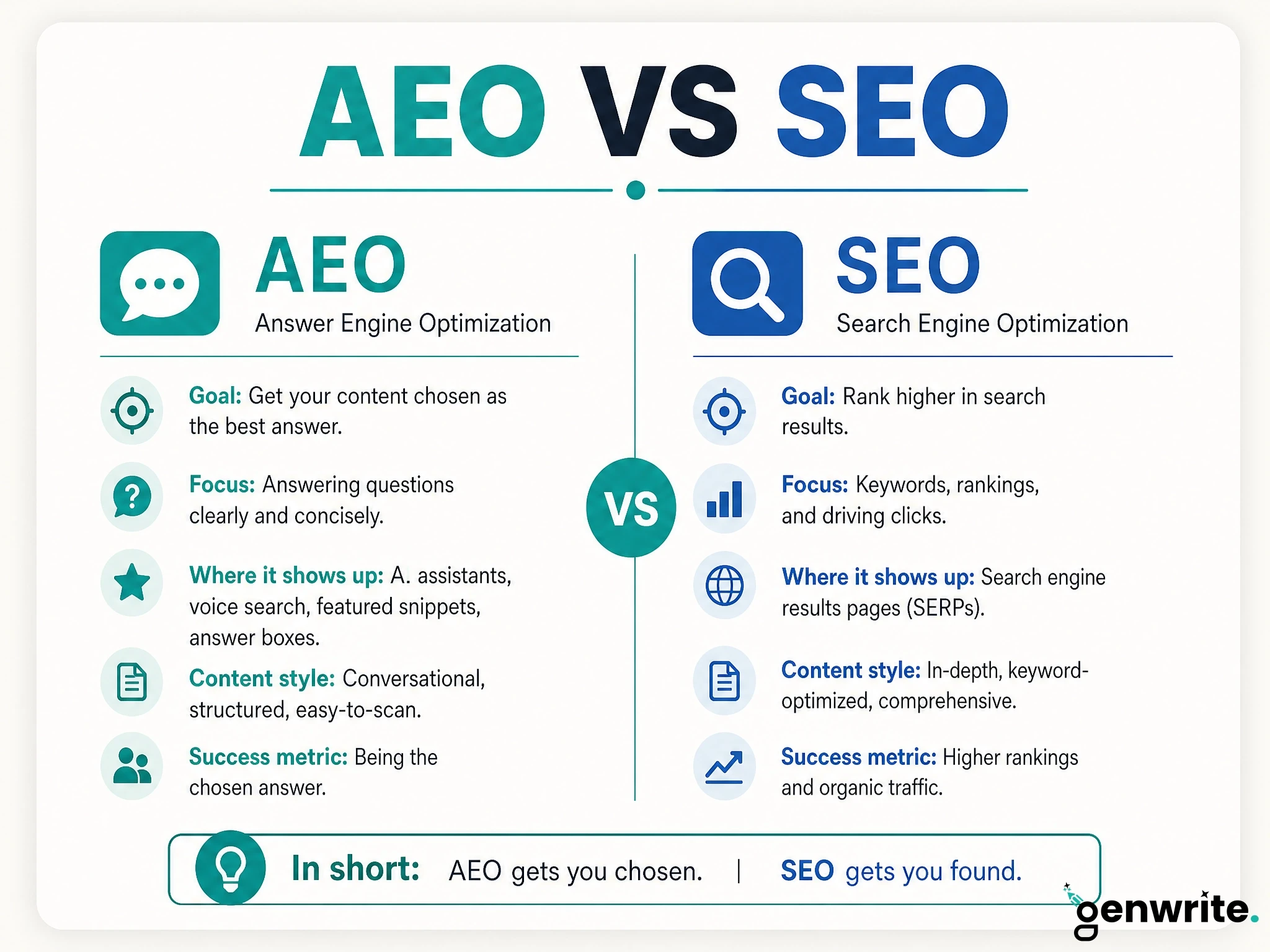
People don’t search the internet the way they used to. Instead of typing “best CRM software” into Google and clicking three different blogs, they ask an AI assistant to compare them. This shift means your old playbook is failing. You’re no longer just writing for human eyes. You’re writing for machines that feed those humans their answers. If they can’t digest your page in two seconds, you don’t exist.
To stay visible, you must pivot from standard search engine optimization to Answer Engine Optimization (AEO). Let’s compare how these two approaches look in practice:
| Feature | Traditional SEO | Answer Engine Optimization (AEO) |
|---|---|---|
| Goal | Rank high on search pages | Get cited as the direct source by AI |
| Structure | Long intros, deep background | Direct Q&A, tables, bullet points |
| Target | Human searchers clicking links | Machine models extracting facts |
When you use a standard seo writer ai, it often defaults to the traditional column. It writes long, winding paragraphs to hit word counts because that is what old algorithms rewarded. But search engines and LLMs now prefer quick, structured facts. If you want your brand to show up as a citation, you need to write for machine extraction.
For example, don’t let your writer start a section with, “Throughout history, businesses have always needed to track their customer relationships.” That’s fluff. Instead, use a clear heading like “### What is CRM software?” and follow it immediately with a one-sentence definition. It is about being useful immediately.
But how do you train your tools to do this? When using an ai seo content generator, you must force it to use tables, bullet points, and numbered lists. Machines love structured data because it’s easy to parse. If your data is trapped in a massive wall of text, the AI will simply skip your site and cite your competitor instead. We see this happen to dozens of sites that refuse to adapt.
This shift might feel uncomfortable if you’re used to chasing raw page views. And honestly, traffic numbers will likely look different as direct answers take over. But adapting to answer engine optimization vs standard SEO ensures your brand remains the trusted source that these engines point to. It’s about winning the citation game.
How we stopped prompting and started building brand guardrails
We used to spend hours typing long, complicated prompts into our AI tools. We’d write things like “be professional but friendly” or “write an engaging blog post.” The results? Boring, generic drafts that felt like every other article on the web. It was clear that vague instructions don’t work when you are trying to scale your publishing.
So, we changed our approach. Instead of trying to coax the AI with endless prompts every single time, we built strict guardrails directly into our workflow. That’s how we design modern seo content writing tools to actually respect a brand’s unique identity.
The first step was creating a negative keyword list. This is a list of words the AI is absolutely forbidden to use. We banned words like “revolutionary” or “transformational” because they immediately scream “machine-written.” If a draft uses these words, it gets flagged instantly. But we found that setting boundaries is actually much easier than writing endless prompts.
Next, we defined our target reader avatar with extreme precision. We didn’t just say “marketers.” We described “Sarah, a busy marketing manager with ten minutes to find a solution before her next meeting.” This simple shift changed how the AI structured its arguments. It started putting the most valuable information right at the top of the page, rather than hiding it under three paragraphs of fluff.
We also set strict structural rules. For example, we told the system that no sentence could be longer than 25 words, and every paragraph had to be under four sentences. These guardrails forced the tool to write in a punchy, readable style that actually keeps people on the page.
Of course, this doesn’t always solve every issue instantly, but it dramatically cuts down editing time. It bridges the gap between basic seo and content creation and high-performing organic traffic. By setting clear boundaries, you stop prompting and start producing content that actually sounds like your brand.
Reclaiming the human edge in organic search
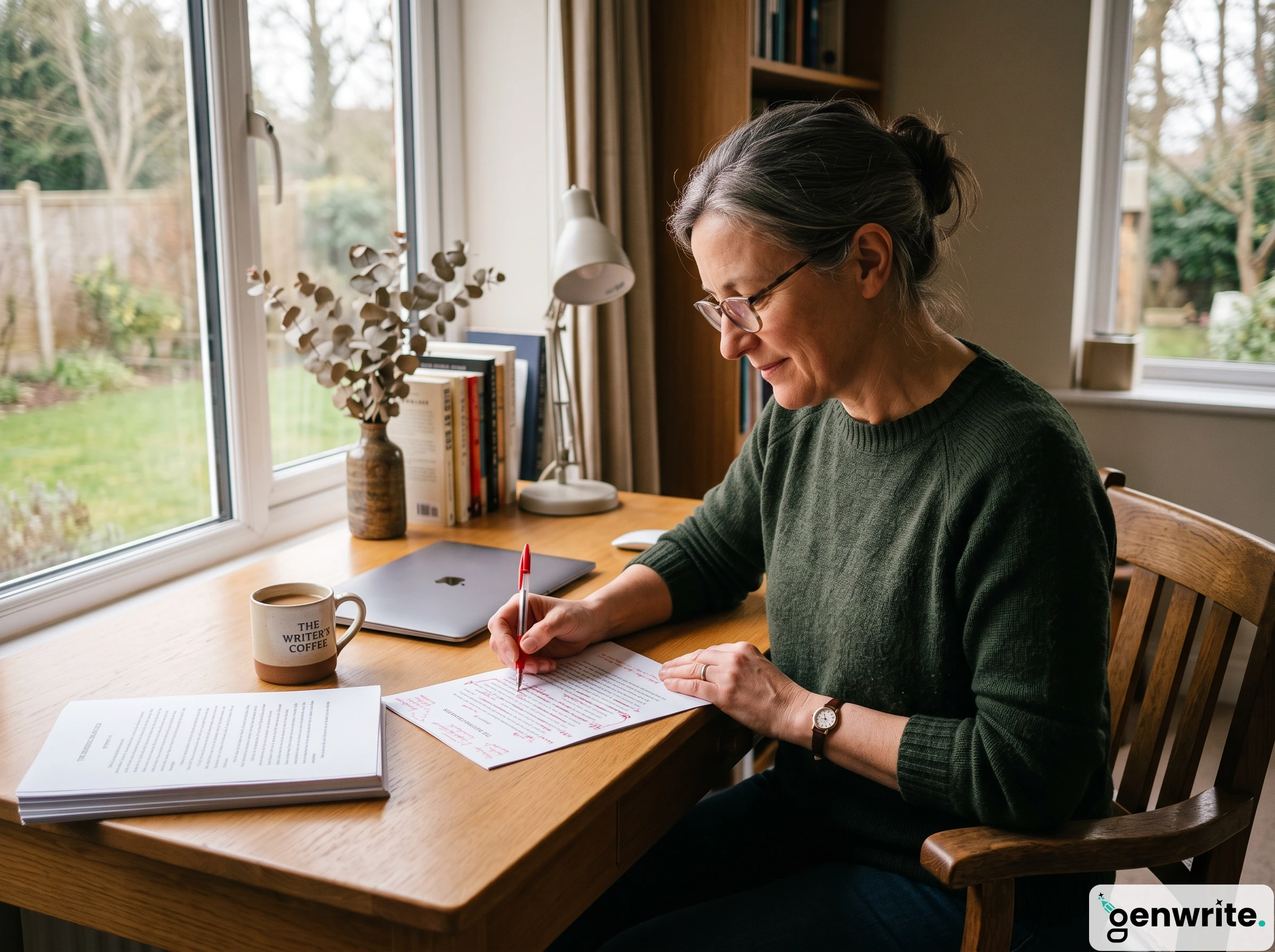
Last month, I reviewed a draft our team generated for a client. It was grammatically perfect, but it felt completely lifeless. It read like an instruction manual written by a robot.
We almost hit publish anyway because we were in a huge rush. But we stopped ourselves. Instead, we spent ten minutes injecting real-world friction by mentioning a specific software bug we hit that week and how we resolved it. That tiny human touch doubled our average time-on-page metrics.
The lesson was clear to us. Raw machine drafts save hours of typing, but they can cost you organic rankings if you leave them on autopilot. Smart publishers don’t throw away technology; they change how they use it.
By combining a powerful seo content creator with a quick, disciplined human edit, you get the best of both worlds. You get the speed of machine automation alongside the genuine authority that search engines crave.
Finding the best seo ai writer isn’t about finding a tool that replaces your thinking. It is about using a platform like GenWrite to handle the tedious keyword research, competitor analysis, and outline building, so you can focus entirely on adding real-world perspective.
Honestly, the reality is that search algorithms are getting better at spotting generic fluff every single day. If your article looks exactly like ten other search results, it will eventually sink. Of course, a quick edit won’t save a fundamentally bad topic, but when you treat your AI draft as a solid foundation rather than a finished product, you protect your organic reach. Spend those extra ten minutes adding your own voice.
Tired of editing flat drafts from your current tools? GenWrite handles keyword research, competitor analysis, and publishing while keeping your brand voice sharp.
FAQ
Why does content from an seo writer ai sound so repetitive?
Language models predict the most likely next word based on massive datasets, which usually means they default to the safest, most average phrasing possible. That’s why you get endless lists and predictable clichés instead of sharp opinions.
Does Google penalize content created with an AI writer?
Google doesn’t care if a machine writes your draft as long as it’s helpful and accurate. They penalize low-quality, spammy garbage, whether a human wrote it or a bot spat it out.
How can I fix a robotic draft quickly?
Start by killing generic transition words, swapping predictable adjectives for specific nouns, and injecting a real-world example in the first three paragraphs. Most drafts just need a dose of personal experience to sound human.
What’s the best way to handle keyword optimization without sounding weird?
Write the section naturally first, then weave your keywords in where they actually make conversational sense. If you force an exact match phrase into a sentence, readers and search engines will both spot it immediately.