
What is answer engine optimization and why is standard SEO no longer enough?
The shift from clicking links to consuming direct answers
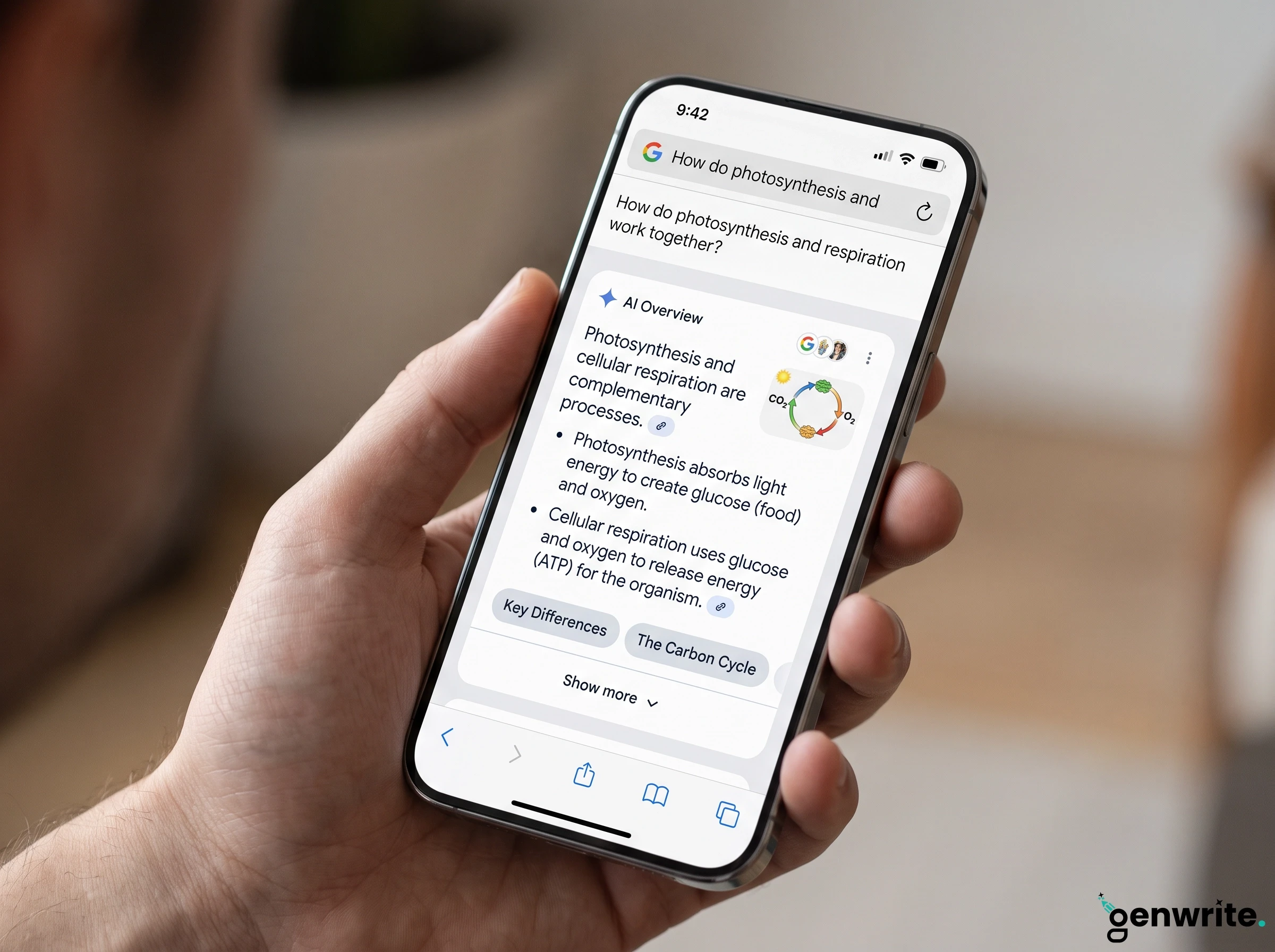
Remember the old search ritual? You typed a query, scanned blue links, and clicked three different sites to piece together an answer. That workflow is dying. Today, we expect search tools to do the heavy lifting. Instead of acting as directories, they operate as synthesis engines. They read the web, extract facts, and present a single response directly on the screen.
This transition means traditional informational queries aren’t driving traffic the way they used to. When a user asks a complex question, platforms like ChatGPT, Gemini, and Perplexity deliver the answer instantly. If your marketing relies entirely on users clicking through to read a basic explanation, you’re likely seeing your organic traffic slip away. We’re rapidly moving toward an ecosystem dominated by conversational and AI-powered platforms.
This shift forces us to change how we think about content creation. It’s no longer enough to rank first; you have to be the source that the AI actually trusts and cites. To survive, brands must pivot toward winning the zero-click economy by optimizing for generative search and focusing on structured, highly factual, and authoritative data.
At GenWrite, we see this shift play out daily with our partners. Successful publishers are transitioning from old-school keyword stuffing to building deep, structured context that machines can easily parse. In the following sections, we’ll break down exactly how this new search ecosystem operates, why traditional playbooks are failing, and how you can adapt your strategy to earn citations in AI-generated answers.
What is answer engine optimization anyway?
Getting cited by AI is the new ranking first
Answer engine optimization (AEO) is about formatting your content so AI models, search bots, and voice assistants can instantly read, synthesize, and cite it. Traditional SEO wants clicks on landing pages. AEO is different. It targets “answerability.” Your goal is to make your brand’s data the exact source an AI pulls to answer a prompt.
If your site isn’t built for machine reading, you don’t exist. Traditional SEO optimizes for human eyes clicking a blue link. But answer engine optimization forces you to write for LLM crawlers. These bots don’t want to send users to your blog. They want to grab your facts, repackage them, and leave you with a tiny footnote citation.
You have to design content to be mined. Forget keyword density. What matters now is semantic completeness and clean schema markup. When an algorithm scans your page, it looks for clear entity relationships and direct answers. If your content is buried in marketing fluff, the bot skips it.
To win, ditch the vanity metrics. AI engines like Perplexity, Gemini, and ChatGPT want structured, scannable data that answers a specific question. They look for consensus, clean markup, and authoritative claims. Nothing else.
The metric of success has changed. Organic traffic still matters, but smart teams now track AI mentions and citations. If an LLM recommends your competitor because their site was easier to parse, you lose. The customer is gone before they ever see Google.
Standard SEO gets you indexed. AEO gets you recommended. Fix your content architecture now, or fade into background noise.
Why traditional search strategies are breaking under pressure

The hard math of the zero-click reality
The numbers are brutal. They aren’t theoretical anymore. Recent data reveals that AI platform traffic grew 527% year-over-year, while traditional organic search traffic fell by 27%. At the same time, over 60% of standard Google queries now end without a single click.
Google is no longer just a directory pointing users to external websites. It has become an answering engine that serves up direct summaries right on the results page. If your entire digital strategy relies on someone clicking a blue link, you are fighting for a rapidly shrinking pool of traffic. Yet many marketing teams still spend thousands of dollars on manual keyword stuffing. They are trying to rank third or fourth on a page that users don’t even scroll down to see.
That is why modern marketing requires a fundamental shift toward using ai in seo to build content that conversational models actually pull from. At GenWrite, we see this daily: brands that optimize for direct answers survive, while those stuck in outdated publishing tactics simply fade away.
This is not a minor algorithmic tweak. It is a structural shift. Traditional SEO was built around short-tail queries like ‘best project management software.’ Conversational users, however, ask highly specific, multi-layered questions like ‘Which project management software integrates with Slack, supports Agile, and fits a budget under fifty dollars per user?’ Standard landing pages are not designed to answer these complex prompts cleanly, so Large Language Models (LLMs) ignore them.
The problem compounds quickly. When a user asks an AI assistant for a recommendation, the assistant synthesizes information from across the web into a single, cohesive paragraph. It does not present ten blue links. It presents one definitive answer. If your brand is not the one cited in that answer, you do not exist to that user.
This does not mean classic organic search is dead. High-intent transactional queries still require deep site visits. But if you want to capture informational traffic, standard keyword optimization will not save you. Search behavior has changed permanently. To stay visible, you must stop optimizing for algorithms that index links and start optimizing for algorithms that synthesize facts.
SEO, AEO, and GEO: mapping the new search alphabet soup
Deciphering the modern search acronyms
If you’ve spent years mastering traditional search rankings, the sudden rise of AEO and GEO might feel like moving goalposts. But these aren’t competing philosophies. They’re nested layers of a single, modern search strategy. Understanding how they interlock is the first step to surviving the shift in user behavior.
To win in this environment, you must understand how these three disciplines interact.
| Discipline | Primary Goal | Target Interface | Success Metric |
|---|---|---|---|
| SEO | Rank #1-10 on search engine results pages | Traditional web browsers | Organic traffic and click-through rates |
| AEO | Win direct answer boxes and featured snippets | Voice assistants and search snippets | Impression share and zero-click visibility |
| GEO | Get cited in LLM response syntheses | Generative engines (Perplexity, Gemini, ChatGPT) | Citation rate and brand share of voice |
Traditional SEO remains your technical foundation. Without clean code, fast load times, and clear topical relevance, crawlers won’t even find your pages. It focuses on the technical architecture, keyword targeting, and backlink authority that prove your site is a trusted resource. If your site lacks basic optimization, newer AI engines won’t trust your data either. Traditional search engines still drive a massive volume of transactional traffic, so this foundation cannot be ignored.
AEO takes that foundation and shapes it for immediate consumption. It relies heavily on schema markup, Q&A formatting, and concise, factual statements. When a user asks a smart speaker or a search bar for a quick fact, AEO determines whether your content is the one read aloud. It’s about being the single, definitive answer to a specific question. This requires a shift from long-form narrative to highly structured, bite-sized data blocks.
GEO is the newest layer. It focuses on how large language models synthesize information across multiple web sources. Instead of just ranking a single page, GEO optimization aims to position your brand as the consensus answer when an AI engine drafts a conversational response. You want the model to pull your data, quote your experts, and link back to your site as a primary source.
Admittedly, the exact weight that LLMs place on specific GEO signals remains a moving target. The search engines constantly update their generation algorithms, making absolute certainty impossible. But the core principles of authority and factual accuracy never change.
So, how do you manage all three without tripling your workload? Smart teams use an ai seo optimization platform to automate the structured formatting required for both traditional search and newer generative engines. This ensures your content is clean enough for bots to parse, direct enough for answer engines, and authoritative enough for LLMs to cite.
How to format your content so machines can parse it easily
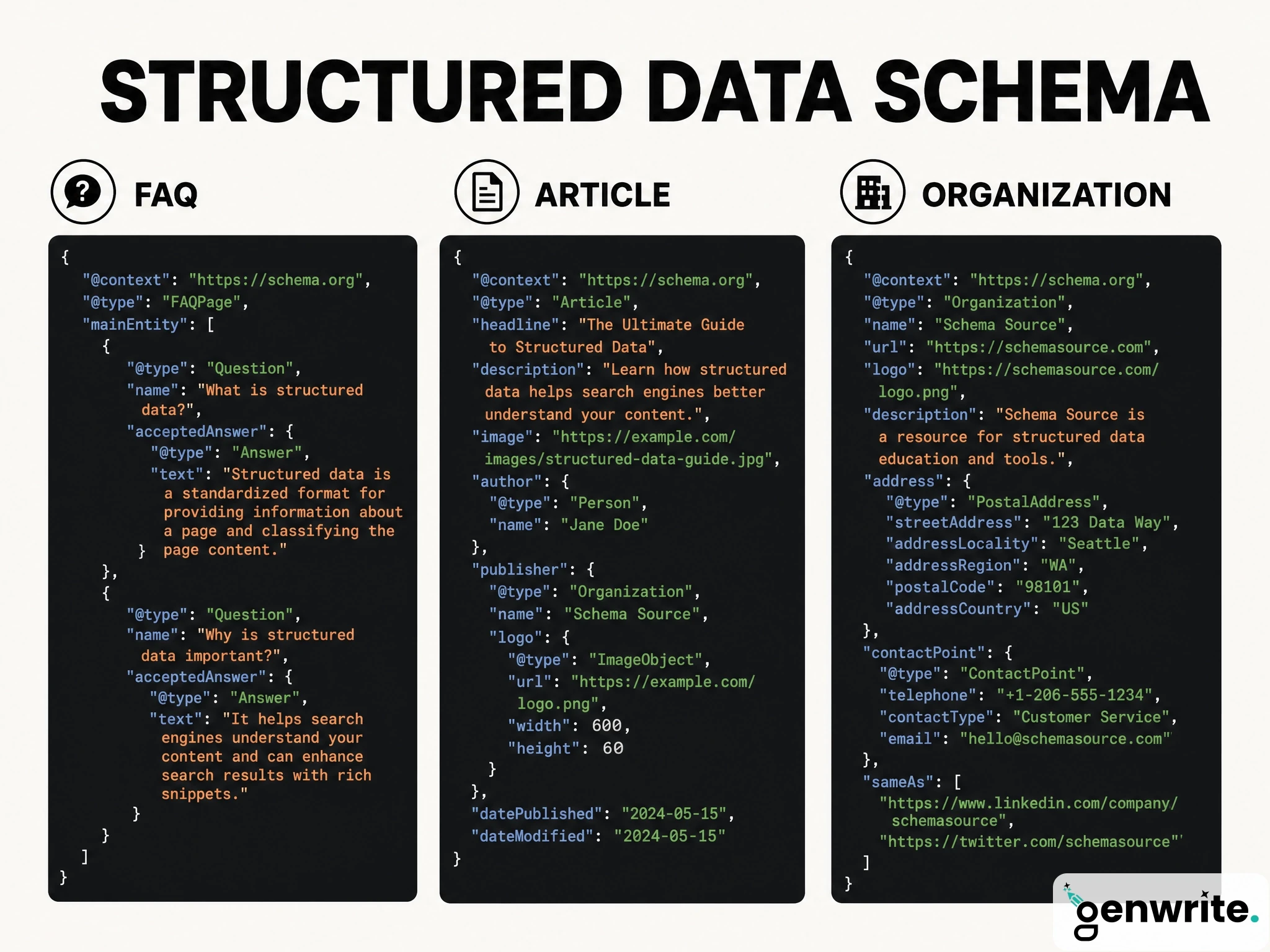
structuring content for machine consumption
Large language models (LLMs) and search bots don’t read your articles to enjoy the prose. They crawl pages to extract structured facts, map entity networks, and find immediate answers to specific user queries. If your content is buried under paragraphs of creative throat-clearing, machines will simply skip it.
To make your pages easily parseable, you should adopt the inverted pyramid format. Put your most valuable conclusion at the very top of the page or section, then follow with supporting data, and finish with background context.
Start by using direct answer blocks immediately beneath clear, question-formatted subheadings. If your subheading asks “What is the primary benefit of automated internal linking?”, the very next sentence should be a direct, definition-style answer. Keep this response under 55 words. Avoid starting with fluff or introductory clauses. This layout makes it incredibly easy for search bots to extract your text for featured snippets. It is also one of the most effective strategies when learning how to rank on google sge and similar generative search interfaces.
But prose structure is only half the battle. You also need to feed search engines clean context cues through schema markup. Implement FAQ schema, Article schema, and Product schema where appropriate. This structured data acts as a translator, telling search engines exactly what your content represents without requiring them to guess.
You must also pay attention to how you refer to entities. Instead of using vague pronouns like “it” or “this tool” across multiple paragraphs, use the actual name of the entity. For example, explicitly name the software, process, or concept you are discussing. If you write ‘Our platform helps with this,’ the machine has to calculate what ‘this’ refers to. If you write ‘GenWrite automates blog creation,’ the entity relationship is crystal clear. This helps search engines map entity networks accurately, linking your brand to specific concepts in their knowledge graphs.
Admittedly, restructuring your entire site manually is a massive chore. Many teams find that building these structured formats at scale is nearly impossible without template-driven pipelines. But if you don’t make your content easy for bots to parse, your organic visibility will likely suffer as conversational search takes over.
The quiet drain on your website’s crawl budget
When you scale content production to hundreds of pages overnight, you aren’t just testing your CMS. You’re testing Googlebot’s patience. Every domain has a finite crawl budget, determined by host load capacity and crawl demand. If you flood your site with thousands of raw programmatic pages, Googlebot spends its limited resources parsing low-value URLs instead of your high-impact money pages.
This mismatch triggers crawler fatigue, a state where search engines deprioritize your domain because the cost of rendering your pages outweighs the perceived search value. But when the bot encounters endless directories of repetitive structures, it slows down its crawl rate or stops requests entirely to avoid overloading your server. Meanwhile, your high-priority product pages or core blogs sit in the indexation queue, completely unvisited. We have seen sites lose organic visibility on pages that drive 80% of their revenue simply because they dumped thousands of unedited drafts into their sitemaps without a clear technical plan.
Understanding what actually happens to your crawl budget when you use an AI seo content generator is vital before launching any bulk campaign. When Googlebot encounters high-frequency publishing patterns without clear quality signals, it recalibrates its crawl frequency downward. It’s an automated defense mechanism against programmatic noise. If your server response time spikes due to rendering-heavy AI content, the bot will slash your crawl allocation even further.
To mitigate this, smart ai content optimization requires strict technical guardrails. You must monitor your log files for 304 (Not Modified) and 404 status codes to ensure Googlebot isn’t wasting time on dead ends. Use robots.txt to block search bots from staging directories, and prioritize XML sitemap updates so only high-quality, fully-edited pieces are queued for discovery. Sometimes, slowing down your publishing cadence and focusing on indexing priority actually gets your content crawled faster. The goal is to guide the bot directly to your highest-value content assets, leaving nothing to chance.
The risk of fact-free scaling and Google’s stance on automation

Publishing hundreds of pages of unverified AI content is the fastest way to tank your site’s search reputation. Many brands think they can outsmart search engines by flooding the index with raw, unedited LLM outputs. But they can’t. Google doesn’t care if you use automation, but it cares deeply about whether your content actually helps anyone. And when you scale without a safety net, you end up publishing confidently written lies.
Google’s algorithms are trained to spot programmatic spam that lacks real-world experience or original insight. If your pages are filled with generic text that looks exactly like a thousand other web pages, your rankings will drop. Worse, search bots evaluate your site’s E-E-A-T (Experience, Expertise, Authoritativeness, and Trustworthiness). If you are hit by a Google AI content penalty, it’s almost always because the automated content failed to provide genuine value or original research.
Why hallucinations kill organic trust
Large language models are built to predict the next word, not to verify historical or scientific facts. They make up statistics, misattribute quotes, and invent product features. If you use a standard seo content writing ai tool without editorial oversight, you risk publishing these hallucinations. And once you lose that algorithmic trust, recovering your organic visibility is incredibly difficult. The reality is that search engines and answer engines alike will quickly blacklist domains that consistently feed them false data.
You don’t have to abandon automation to protect your rankings. But you do need to redefine your production pipeline. Smart teams treat AI as a drafting partner rather than an autonomous publisher. This means establishing a strict human-in-the-loop workflow. By taking time for vetting the factual accuracy of your seo ai writer, you preserve your brand’s integrity while maintaining the speed advantages of AI. This extra step might slow down your publishing schedule slightly, but it prevents catastrophic ranking drops.
How AI engines verify truth and choose who to cite
A few months ago, I watched a well-funded SaaS brand launch a massive self-promotional campaign. They updated their homepage, wrote dozens of blogs claiming they were the “fastest-growing project management tool,” and waited for the AI-driven search traffic to roll in. But when users asked ChatGPT or Perplexity for recommendations, the brand was completely absent.
Why? Because AI engines don’t take your word for it.
These systems verify truth through digital triangulation. When an LLM crawls the web to construct an answer, it cross-references your claims against a web of third-party networks, user reviews, and independent databases. If your site claims you are an industry leader, but your G2 profile, Reddit threads, and industry directories are silent, the algorithm flags the mismatch. It’s a consensus game. The engine looks for entity consistency,meaning your brand’s facts, features, and leadership details must remain identical across the entire digital footprint.
To win in this environment, your strategy must pivot toward widespread credibility. This is where modern AI SEO tools become invaluable. Instead of just churning out keyword-stuffed text, you’ll need to monitor how your brand is represented across the web and build a footprint that AI engines can easily verify.
These algorithms rely heavily on off-site authority signals. They weigh digital reviews on platforms like Trustpilot, high-quality citations in reputable publications, and structured schema data that explicitly defines your brand’s relationships to other known entities. And if the consensus among these external sources is positive and consistent, the engine will confidently cite you as a trusted source.
Sometimes, even a single inconsistent directory listing or an outdated press release can disrupt this verification process. The reality is that we’re no longer just dealing with keywords; search engines are evaluating your reputation. If you want to succeed at answer engine optimization, you must treat the entire web as your homepage, ensuring that every digital mention of your brand reinforces a single, verifiable truth.
Writers as editors: rethinking the agency production model

The traditional agency business model is facing a quiet crisis. For years, we’ve billed clients based on human hours spent staring at blank Google Docs, slowly typing out baseline industry explanations. It’s an incredibly slow way to work, and frankly, it’s eating your profitability alive.
When your team spends eighty percent of their time drafting generic paragraphs, they have almost no bandwidth left for actual strategy. This is where the real shift happens. By automating the initial draft, you can protect your bottom line and scale your output without constantly hiring more junior writers.
Think about what happens to your agency margins when you stop writing every blog manually. The math changes instantly. Instead of paying a writer to spend six hours researching and drafting a single post, they spend forty-five minutes editing an AI-generated draft. They shift from creators to curators.
This editorial shift is where the real value is unlocked. Your writers are no longer just putting words on a page. Instead, they focus on factual verification, adding unique brand perspectives, and structuring data for search bots. They make sure the content matches search intent and includes the necessary schemas. They transition from simple copywriters to high-value content strategists.
Of course, this model doesn’t work if you just copy-paste raw outputs. The reality is that raw AI generation often lacks depth. The secret to successfully using ai in seo campaigns is keeping human editors in the loop. You need real editors to inject original research, fix awkward phrasing, and verify claims. But starting with a highly structured, automated draft saves hours of tedious labor.
By treating AI as the foundation and humans as the editorial filter, you get the speed of automation and the nuance of human expertise. It’s the only sustainable way to scale content in a world where search engines demand both volume and absolute accuracy.
Building your roadmap for the zero-click era
We need to stop obsessing over blue links and standard search positions. The real metric of the next decade isn’t where you sit on a search page; it’s your “Share of Model.” When a user asks an LLM for a recommendation, does the machine cite your brand? Or does it completely ignore your existence? Merging your classic search practices with modern aeo seo techniques is the only way to stay visible.
Building this roadmap doesn’t require throwing out your existing playbook. Instead, it’s about layering structured formatting and verified facts over your current content. You need clean, machine-readable formatting, tight entity alignment, and absolute factual accuracy. But let’s be honest: doing this manually at scale is an absolute nightmare. That is why smart teams are turning to automated systems like the GenWrite AI blog generator to handle the heavy lifting of structure and keyword optimization.
Your AEO checklist
Start with these three areas:
- Entity alignment: Connect your brand to established industry concepts.
- Factual density: Pack your pages with verifiable data, not fluff.
- Model tracking: Monitor your brand mentions inside LLM responses directly.
Does this mean you can just hit “publish” and walk away? Probably not. The human editor remains the ultimate safeguard against factual errors. But by automating the tedious formatting and initial research, your team can focus entirely on strategic oversight. It is time to stop waiting for clicks that are never coming back and start optimizing for the engines that actually answer the questions.
This shifts your focus from vanity metrics to actual citation footprint. While results will certainly vary depending on your industry niche, ignoring this transition is a recipe for digital invisibility. You have to adapt before the search engines completely close the gate on traditional traffic.
Tired of manual content restructuring for AI search? GenWrite handles the heavy lifting by automating SEO-optimized content creation so your brand gets cited.
FAQ
How does answer engine optimization differ from traditional SEO?
Traditional SEO focuses on winning clicks and ranking high on a search results page. AEO optimizes your content so AI models like ChatGPT and Perplexity cite your brand directly inside their zero-click generated summaries.
Why are organic click-through rates dropping across most websites?
It’s because users now get their answers immediately from AI overviews and conversational chat interfaces. They don’t need to visit a traditional website unless they want deeper context.
Can small businesses compete for citations in AI search engines?
They definitely can if they use clear, structured formatting and strong entity signals. AI models don’t just look at domain authority; they parse clear answers and logical page layouts.
What is the best way to format content for LLM extraction?
You’ll want to use the inverted pyramid style, clear heading hierarchies, and robust schema markup. Give machines the direct answer right away instead of burying it deep in the paragraphs.