
Will Google penalize your site for using AI? What the search engine actually cares about
The big myth: will Google penalize your site for using AI?

The truth about the Google AI content penalty
Let’s clear up the biggest panic first. You’ve probably heard whispers that using AI to draft your articles is a one-way ticket to search engine oblivion, but the reality is far simpler. Google doesn’t care if you use an AI blog generator. Their official guidelines state that automation, including generative systems, isn’t against their policies as long as you aren’t using it to manipulate search rankings.
The search engine targets low-quality spam, not the tech you used to write the words. Publish a robotic, generic wall of text that fails to answer a searcher’s question, and your rankings will tank. But that’s true whether a human spent ten hours on it or a machine generated it in ten seconds. Google wants original, helpful content with real-world experience baked in. So, stop asking how to trick the algorithm. Ask how to make the draft genuinely useful.
Remember the old days of keyword stuffing? Marketers used to pay cheap content farms to churn out thousands of unreadable words just to rank for specific terms, which is why Google built updates like Panda to stop them. Today, the mission is identical. They want answers that actually solve the user’s problem. If your automated drafts do that, you’re safe.
Many publishers think they need to hide their automation tools behind complex rewriting scripts. Honestly, it’s a waste of energy. Teams spend so much time trying to bypass unreliable “AI detectors” that they forget to check if the content is actually any good. Even fully human-written articles get flagged as machine-made by these tools all the time. Obsessing over questions like does Google penalize AI content is simply looking at the problem through the wrong lens.
Instead of worrying about whether search engines can spot automation, focus on how you can use content automation to build a faster, smarter publishing workflow. Let the systems handle the heavy lifting of research and structure. That frees you up to add the personal anecdotes and expert insights that search algorithms actually look for. Sure, this doesn’t work if you just copy-paste raw outputs without editing. But when done right, it turns the machine from a replacement into a highly efficient assistant.
Can Google detect AI writing (and does it actually matter)?
Can Google detect AI writing? The short answer is yes, but the real question is whether they actually care.
For years, publishers have obsessed over AI detection scores, running drafts through third-party tools to hit a fictional “100% human” rating. The reality is that search engines don’t need a dedicated AI detector to rank your content. Instead, they look for the footprint of low-effort publishing.
AI detection vs. quality evaluation
To understand how search engines view your content, it helps to compare what people fear versus how search algorithms actually behave.
| The AI Detection Myth | The Algorithmic Reality |
|---|---|
| Google uses rigid classifiers to flag and penalize any automated text. | Google uses machine learning to identify spam patterns and unhelpful pages. |
| High AI-detector scores guarantee your site will lose organic search traffic. | Low-quality, repetitive content gets demoted, whether written by humans or bots. |
| The goal of SEO is to trick search engines into thinking a human wrote every word. | The goal of SEO is to satisfy search intent with original, accurate information. |
When we look at detecting AI text on Google, the search engine’s systems are trained to spot patterns of low utility. If your article reads like a generic compilation of the top five search results with zero added perspective, it will struggle to rank. This isn’t because an AI wrote it, but because it offers nothing new to the reader.
Why the production method is secondary
Google’s quality rater guidelines focus heavily on experience, expertise, authoritativeness, and trustworthiness. They want to know if the content creator has actual experience with the topic. A human writing a sloppy, unresearched summary from their couch can trigger the same quality flags as a poorly prompted bot.
We’ve run tests where raw machine-generated text ranked well initially, only to tank after a core update. The drop wasn’t due to a sudden AI detection flag, but because users landed on the page, found it shallow, and immediately bounced back to search results. That user behavior is what ultimately matters.
That’s why successful teams don’t abandon automation; they change how they use it. By shifting from basic text prompt tools to a specialized AI blog generator that handles deep research and semantic structure, you bridge the gap between efficiency and quality. The algorithm doesn’t care if you used a digital assistant to format your thoughts or write a draft. It cares if the final page actually solves the user’s problem.
Why human-led AI content is a growth necessity

The economics of the blank page
Staring at a blank screen is the most expensive habit in modern marketing. When you pay a writer to draft a 1,000-word post from scratch, you’re paying for hours of basic research, structural outlining, and manual typing. It’s a slow, tedious process that keeps agency margins incredibly thin. The cost of manual drafting acts as a silent tax on your growth.
But when you switch to a hybrid workflow, the economic math changes completely. AI tools generate the foundational draft in seconds, shifting your writer’s energy from creation to curation. They become high-leverage editors, injecting real-world examples, polishing the brand voice, and verifying technical accuracy.
This shift is how growing agencies scale blog output without doubling their payroll. The reality is that draft production costs drop by roughly 60% when you move away from manual writing. That saved time and capital goes directly into distribution, competitor analysis, and deeper keyword research.
And this directly impacts your organic search visibility. Many creators still worry about search penalties, asking: will Google rank AI articles? The short answer is yes, provided the final product offers genuine value. Google’s algorithms look for original expertise and helpfulness, not the specific software used to generate the draft.
So, the intersection of AI writing and SEO isn’t about cutting corners; it’s about scaling your structural capacity. You can’t build topical authority if you’re only publishing two posts a month. You need volume, but it has to be high-quality volume.
Of course, this hybrid model doesn’t work if you simply copy-paste raw outputs. Unedited AI text often lacks unique insights and can sound repetitive. But when a skilled editor refines the draft, you get the best of both worlds: the speed of automation and the nuance of human experience.
By using AI to build the skeleton, your team can focus on what actually moves the needle: proprietary data, expert quotes, and custom graphics. It turns your content pipeline into a repeatable assembly line where humans provide the quality control. That’s how you win in a competitive search environment without burning out your team.
The hard truth about scaled content abuse
Let’s stop pretending Google has a secret detector that flags every piece of AI text just because a machine touched it. That isn’t how search systems operate. The real target isn’t the technology you use; it’s scaled content abuse. When publishers pump out hundreds of generic pages a day solely to capture search traffic without offering a single shred of new information, they cross a line.
Google’s spam policies define scaled content abuse as producing pages in bulk to manipulate search rankings, regardless of whether those pages are written by cheap human writers or basic scraper bots. If your content lacks original research, unique perspectives, or genuine utility, it violates the Google helpful content guidelines. The algorithm doesn’t care about your drafting process. It cares about whether your page actually helps a human reader solve a problem.
The difference between scale and spam
There’s a massive difference between scaling your content operations responsibly and abusing the system. Cheap keyword tools often spit out hollow, repetitive paragraphs that read like a broken record. This is where many DIY automation setups fail. They generate pages that look like content but function as search engine bait.
But automation itself isn’t the enemy. Smart teams use an advanced AI blog generator to handle the heavy lifting,like structured keyword mapping and initial drafting,while keeping a tight editorial grip on the final output. This hybrid approach ensures every piece of published content actually answers user intent. It’s about efficiency, not shortcuts.
Why lazy automation gets crushed
If you hit “generate” on 500 articles and publish them to your WordPress site without looking at them, you’re playing SEO Russian roulette. The search engine’s helpful content system is designed to identify and demote these exact patterns.
- Zero original insight: Just repeating what top-ranking sites already say.
- Poor user signals: High bounce rates when visitors realize your page is a fluff-filled desert.
- Cluttered site architecture: Flooding your index with low-value URLs that dilute your overall topical authority.
Sometimes, a low-effort site might see a temporary traffic spike after a massive publishing push. But the reality is that those gains rarely survive the next core update. If you want sustainable organic growth, you have to inject human oversight, real-world data, and actual editorial standards into your automated pipeline. If you aren’t willing to read your own content, don’t expect Google’s users to read it either.
How to set up a safe automated SEO pipeline
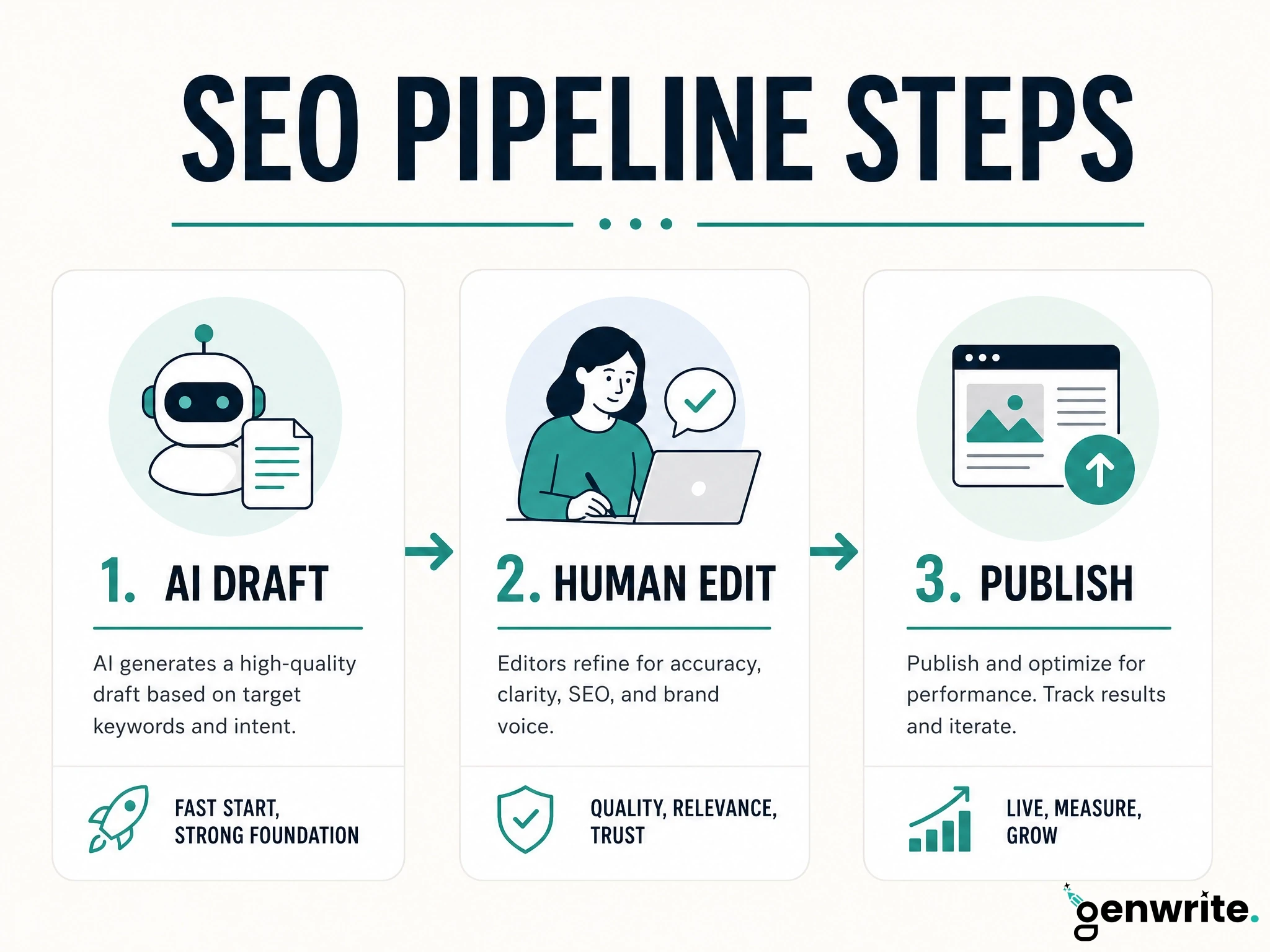
Most publishers fail with AI because they try to automate everything or nothing. They either publish raw, unedited AI drafts that search engines eventually ignore, or they write everything manually and get left behind by faster competitors. The sweet spot lies in a hybrid pipeline. By letting software handle the repetitive technical chores, your team can focus entirely on voice, accuracy, and original insights.
Here is how to structure this workflow to protect your site’s search rankings while scaling up production.
Step 1: Automate the mechanical on-page tasks
Start by automating the predictable, rule-based elements of SEO. This includes generating initial title tags, meta descriptions, and schema markup based on your target keyword. When managing AI generated content SEO, instead of manually auditing every post, implementing automated seo optimization workflows allows you to handle these repetitive fixes instantly. Your tools can draft these elements in seconds, leaving your team to simply approve or tweak them rather than writing them from scratch.
Step 2: Inject unique data and brand voice
Raw AI outputs are often generic. To prevent your posts from blending into the background, you must establish a strict editorial review. This is the stage where humanizing AI content for SEO happens. Have an editor inject real-world examples, proprietary data, or unique quotes. If the draft makes a broad claim, replace it with a specific case study. This step transforms a generic draft into an authoritative resource that search engines love.
Step 3: Implement programmatic internal linking
Internal links distribute page authority across your site, but mapping them manually is incredibly slow. Use an automated script or a dedicated tool to scan new drafts against your existing sitemap. The system should automatically suggest anchor text and link placements. But never let the system publish these links without a quick human review to ensure the context makes sense to actual readers. It is easy for automated tools to get anchor text wrong if they lack real-world context.
Step 4: The final quality gate
Never set your pipeline to direct auto-publish without a final human gatekeeper. The editor’s job is not to rewrite the entire piece from scratch, but to check for factual accuracy, formatting errors, and overall readability. Think of your AI writer as an incredibly fast junior draft writer. You still need an editor-in-chief to sign off on the final product before it goes live. This keeps your pipeline safe, scalable, and highly effective.
The factual accuracy gap in basic AI content
Large language models (LLMs) are probability engines, not database query tools. They predict the next most likely token in a sequence based on statistical weightings from training data. Because of this mathematical architecture, raw AI text frequently contains plausible-sounding lies, often called hallucinations. An LLM confidently invents statistics or attributes quotes to non-existent studies simply because the generated sequence matches its neural weights. It looks correct to the machine.
This mathematical guessing game threatens search rankings. When publishers ask if Google penalizes AI content, the answer is nuanced. Google does not target automation itself. However, its algorithms are highly sensitive to inaccurate or misleading information. Under the Search Quality Rater Guidelines, accuracy directly impacts your site’s E-E-A-T score. If your page publishes false medical advice, inaccurate financial data, or incorrect technical specifications, search quality algorithms will suppress your visibility.
To scale production without tanking credibility, you must establish a rigid, multi-stage human verification workflow. Relying on a basic, unmonitored seo ai writer without editorial oversight is a fast track to algorithmic devaluation.
A technical blueprint for an active human-in-the-loop (HITL) verification system requires three distinct steps:
1. Statistical and claim extraction
Before editing for style, run the raw output through a quick extraction pass. Isolate every number, percentage, and date. Treat them as guilty until proven innocent.
2. Source attribution matching
For every claim extracted, the editor must trace the information back to a primary source. If the draft states that a market grew by 14% last year, find the specific industry report that proves it. If you cannot find a primary source within two minutes, delete the claim entirely or replace it with verified data.
3. Anchor bias correction
LLMs write with absolute authority, even when guessing. Watch out for overconfident assertions. If the text makes a sweeping claim about how a software feature works, test the feature yourself or consult your engineering documentation.
This verification process might feel like it defeats the purpose of automation. But editing a structured draft is still 60% faster than starting from scratch. Combining machine efficiency with human verification is the only sustainable path forward for AI writing and SEO. Even with rigorous checks, minor errors slip through. Building this systematic safety net reduces your risk profile while keeping your content pipeline moving.
Why shallow keyword generators fail to build topical authority

Why do so many sites publish hundreds of blog posts only to see their organic traffic flatline?
Is it possible that search engines have evolved past simple keyword matching? The reality is that most legacy seo content writing tools operate on a flawed premise. They scrape top-ranking pages, count keyword frequencies, and tell you to repeat those exact terms. But does that actually prove you understand the topic?
When an AI generator simply repeats shallow, keyword-stuffed text across twenty different pages, it creates a flat, thin site structure. True topical authority isn’t about repeating a target phrase fifty times. It’s about mapping the semantic distance between related concepts. For instance, does your content connect “resource allocation” to “capacity planning” and “burn rate” in a logical hierarchy? If it doesn’t, search engines will quickly figure out that your site lacks real depth.
How does Google actually evaluate whether you’re an expert or just a copycat? Under the latest Google helpful content guidelines, search crawlers look for original information gain. If your article contains the exact same points as the top ten search results, why would a search engine rank you? If you’re just rehashing existing content, you’re not adding value.
And what does this mean for your AI generated content SEO strategy? It means you must shift from keyword matching to entity mapping. How do you do that? You start by grouping your articles into hubs and spokes that address user intent at every stage of the buying journey.
Let’s look at how this works in practice. If you’re writing about cloud migration, a basic generator might suggest repeating “cloud migration steps” over and over. But a sophisticated semantic approach maps out the structural distance between database schema conversion, latency issues, and roll-back strategies. It builds a web of highly specific, interconnected articles instead of thin, repetitive pages. Why settle for a single generic page when you can build a comprehensive resource hub?
But does this mean you have to write every single word manually? Not necessarily. The trick lies in using intelligent automation that understands semantic relationships rather than just keyword density. You want a system that acts like a subject matter expert, identifying the missing subtopics your competitors failed to cover. How else can you scale your publishing schedule without sacrificing the quality that search engines demand?
Honestly, even the best semantic models sometimes miss the mark if they don’t have human oversight to inject real-world context. But they still perform miles better than tools that treat search optimization like a simple math equation. If you want to rank today, you have to ask yourself: is your content answering the next three questions your reader will have, or is it just repeating the question they already typed?
Preparing your automated content for the AEO search era
The way people search is undergoing a quiet but massive shift. Instead of scrolling through pages of blue links, users increasingly rely on instant summaries pulled by large language models. This means your content needs to do more than rank on a page; it has to be easily digestible for the algorithms feeding these conversational engines. If you want your automated pipeline to survive this shift, you must pivot toward answer engine optimization (AEO). This practice ensures your drafts are structured specifically for zero-click queries and AI-generated overviews.
Structural changes that satisfy AI crawlers
Many publishers ask a fundamental question: will Google rank AI articles when search engines transition to AEO? The answer is yes, but only if those articles are formatted to make extraction incredibly easy. Raw, unstructured blocks of text are difficult for LLMs to parse and summarize accurately, which often leads to your site being skipped entirely.
To make your automated drafts highly attractive to conversational search engines, you should adopt a few specific structural habits. Place clear, concise answers directly below your subheadings. If your heading asks a question, the very next sentence should answer it directly within 40 words.
Using clean markdown tables for comparisons rather than descriptive paragraphs also helps. LLMs find structured data far easier to scrape and display in conversational widgets. Sometimes, this highly structured approach feels a bit repetitive to a traditional editor. But the reality is that search engines prioritize clarity and extractability over flowery prose.
Adapting your automated workflow
You can easily configure an advanced content generation system to apply these structural rules automatically. Instead of manually rewriting every draft, set your templates to include definition blocks and clean bulleted lists at natural intervals. This ensures your content remains highly competitive, whether a user is typing a traditional query into a search bar or asking a voice assistant for a quick recommendation.
We’ve found that articles structured this way get pulled into AI overviews far more frequently than standard long-form essays. It’s not about writing less; it’s about writing with a clear hierarchy that machines can instantly decode.
Your blueprint for risk-free automated publishing

I remember looking at a client’s analytics dashboard after they published a batch of eighty unedited, raw AI articles. The traffic line looked like a cliff. They thought they were shortcutting the system, but Google’s spam algorithms caught on within days. That painful moment taught us that scaling search traffic isn’t about removing humans from the loop; it’s about shifting the human’s role from writer to editor-in-chief. You cannot simply press go and expect long-term organic growth without looking at what you are shipping.
When we transition to using an AI blog generator to handle the heavy lifting of drafting, we must implement a strict verification pipeline. Google’s quality guidelines explicitly evaluate who created the page, how it was made, and why it exists. If your pipeline doesn’t answer those three questions clearly, your organic rankings will eventually slip. You need to ensure every piece of content actually serves a real person’s curiosity or pain point.
Here is the exact verification checklist we run through before any automated draft goes live on our sites:
- Verify the “Why”: Does this draft actually solve the searcher’s query, or is it just repeating what is already on page one? If it doesn’t offer a clearer, faster answer, rewrite the introduction immediately.
- The Fact-Check Pass: Generative models still hallucinate. Check every year, statistic, and brand name.
- Inject Proprietary Context: Add one or two sentences of your own experience, a unique observation, or internal company data. This is the core of humanizing AI content for SEO.
- Format for Real People: Break up long text blocks. Use tables for product comparisons and clean bullet points for lists.
Admittedly, this extra editorial layer takes ten to fifteen minutes per post, and it means you won’t be publishing hundreds of posts a day with a single click. But the results speak for themselves. By blending smart content automation with human oversight, you build a sustainable library of search-friendly assets that actually convert readers into customers.
Tired of manual SEO busywork? GenWrite builds safe, research-backed automated pipelines so you can scale without risking penalties.
FAQ
Can Google actually detect AI-generated text?
Google’s search systems don’t look for AI watermarks or use third-party detector scores to rank pages. They focus entirely on content quality, helpfulness, and user intent, meaning well-written AI drafts rank just fine if they provide genuine value.
Does Google’s spam policy ban all automated writing?
Not at all. The policy targets scaled content abuse, which means mass-producing low-quality junk just to manipulate search results. If you’re using automation to help build useful resources, you’re not breaking any rules.
How do I make my automated blog posts rank better?
You’ll want to inject firsthand experience, fix factual inaccuracies, and add unique insights that raw AI models miss. Most top-performing sites treat AI as a draft assistant rather than a final publisher.
Is it worth trying to bypass third-party AI detectors?
Honestly, most detector scores are unreliable and Google doesn’t use them anyway. You’re better off spending that time improving readability and answering reader questions directly.