
What is Answer Engine Optimization, and is your content ready for it?
The quiet transition from blue links to direct answers

The end of the ten blue links
Remember when ranking on page one of Google meant a guaranteed flood of organic traffic? You’d tweak your meta tags, build a few backlinks, and watch the clicks roll in. It was simple. But if you’ve looked at your Search Console metrics lately, you’ve probably noticed something unsettling. Your rankings are holding steady, but your organic traffic is slipping away.
It’s not a penalty. It’s just that the way people find information has changed.
Instead of scanning a list of blue links, users now expect immediate, conversational answers right on the search results page. Platforms like Perplexity and Google’s AI Overviews are training searchers to stop clicking. Why would they? When they get a clean, synthesized answer in seconds, there’s no reason to visit your site. It leaves traditional web publishers out in the cold.
This is where answer engine optimization comes in. We’re no longer just optimizing for human eyes scanning search results. We’re optimizing for the bots that summarize those pages, feeding these AI models the precise data they need to cite your brand.
It’s easy to view this as the death of organic reach. But it’s actually a massive opening for teams that adapt quickly. By moving from traditional SEO to generative search optimization, you can position your brand as the definitive source these AI engines rely on. The rules are changing fast, and survival means learning how to speak the language of LLMs.
A definition for the zero-click era
Answer engine optimization (AEO) is the process of structuring and refining web content so that AI-powered assistants, voice search systems, and featured snippets can easily discover, extract, and present it as the definitive response to a user’s query. It shifts the focus from traditional page ranking to direct information retrieval.
How does this actually function under the hood? Traditional search algorithms index pages based on keywords and backlink authority. But modern answer engines (like Perplexity, ChatGPT, and Google’s Gemini) rely on large language models (LLMs) to synthesize information on the fly. They don’t just point users to a website; they read, summarize, and deliver the answer directly.
This shifts the battlefield from keyword matching to entity relationships and conversational clarity. If your content is buried in vague prose or unstructured layouts, these bots will simply bypass your site. You can’t rely on old-school tactics anymore. Modern optimization requires a dual strategy. We call this SEO AEO integration, where you optimize for both human searchers and machine synthesizers.
To win here, your data must be instantly digestible. This means using clear schema markup, direct Q&A formats, and clean semantic structures. If an AI agent can’t parse your main point in milliseconds, your brand doesn’t exist in zero-click search results.
Why ranking first on Google is no longer the ultimate goal

The death of the traditional click-through
For twenty years, winning the top spot on Google was the ultimate goal. If you ranked first, you got about 30% of the clicks. That math is dead. Today, over 60% of Google searches end without a single click to an external site. Zero-click searches are no longer an anomaly; they are the new default.
Generative AI changed everything. ChatGPT alone has over 250 million active users, and tools like Google’s AI Overviews are expanding fast. People don’t want to open five different tabs to piece together an answer anymore. They want a single, clear response right away. If your marketing strategy still relies on getting users to click through to your site, you are fighting over a rapidly shrinking pool of traffic.
Think about how you search now. A few years ago, if you wanted to compare software, you opened three tabs, skimmed the articles, and made a decision. Today, you just ask an LLM to build a comparison table for you. You never visit the source sites, but the brand cited in that table still wins your trust. The goal has shifted. It is no longer about getting the click—it is about earning the citation.
This reality forces a shift toward a hybrid approach that balances traditional SEO with AEO (Answer Engine Optimization). When an AI model synthesizes an answer, it pulls from a select group of trusted sources. If your content isn’t structured for these models, you simply don’t exist in their output. Ranking in AI search engines requires a complete rethink of organic visibility. It is not about driving raw traffic anymore. It is about being the factual source the AI trusts.
Doing this manually is incredibly difficult. Keeping up with how search models interpret data requires constant monitoring and fast updates. Using modern SEO optimization platforms helps teams adapt their existing content to semantic search demands before traffic drops off a cliff. The reality is simple: ranking first on Google doesn’t mean what it used to. If your content isn’t optimized to feed these answer engines, your brand will slowly become invisible.
SEO vs AEO vs GEO: mapping the modern search stack
Navigating the three layers of modern search
The search environment isn’t a single highway anymore. It’s a three-tier stack. If you’re still optimizing solely for blue links, you’re missing how modern users actually find information.
Traditional Search Engine Optimization (SEO) focuses on driving traffic directly to your website. You build domain authority, target specific keywords, and earn backlinks so searchers click through to your pages. But when Google displays a direct answer or ChatGPT summarizes a topic, the user never visits your site. That’s where the other layers of the stack become critical.
Answer Engine Optimization (AEO) targets the immediate, zero-click response. Think of voice assistants, smart speakers, and featured snippets. Your goal here isn’t necessarily to earn a long-form read. Instead, you want to be the definitive, structured source that answer engines read aloud or display as a quick card. It requires a highly structured, conversational format that answers specific questions without fluff.
Generative Engine Optimization (GEO) is the newest layer, designed specifically for generative search optimization. GEO ensures that Large Language Models (LLMs) like Gemini, Perplexity, and Claude include your brand in their synthesized answers. Instead of just pulling a single snippet, these systems synthesize multiple sources to build a custom response. If your content isn’t structured for retrieval-augmented generation (RAG) systems, you simply won’t exist to these models.
Let’s look at how these three strategies compare in practice:
| Feature | Traditional SEO | Answer Engine Optimization (AEO) | Generative Engine Optimization (GEO) |
|---|---|---|---|
| Primary Goal | Drive organic clicks to website | Provide immediate, single-source answers | Secure citations in synthesized AI responses |
| User Behavior | Browsing and comparing links | Quick factual lookups (voice/snippets) | Conversational research and synthesis |
| Key Tactics | Backlinks, page speed, keyword density | Schema markup, Q&A formatting, clear definitions | Authoritative citations, entity alignment, trust signals |
These strategies don’t work in isolation. In fact, they build directly on top of each other. You can’t succeed at ai search engine optimization without a solid technical SEO foundation. While some niche industries might still rely purely on traditional clicks for now, most brands will see their organic visibility decline without adjusting to these new layers.
The real friction lies in execution. Writing content that ranks well on Google, fits cleanly into a featured snippet, and gets cited by an LLM is incredibly time-consuming. You have to balance natural human readability with rigid machine-readable structures.
The reality is that generative engines still rely heavily on the authority signals that traditional SEO established. But they process information differently. While traditional search engines index keywords, generative engines look for conceptual relationships and verified facts. If your content lacks clear entity relationships, LLMs will likely ignore it during their retrieval process.
To survive this shift, you have to write for both humans and machines simultaneously. This is why many digital teams are moving away from manual formatting. Using an automated AI blog generator allows you to handle the structured formatting, schema integration, and technical optimization required to satisfy all three layers of the modern search stack without burning out your content team.

Moving from keyword stuffing to semantic entity networks
Beyond raw strings: how LLMs construct meaning
Search engines no longer read your content as a sequence of isolated characters. Instead, they transform text into high-dimensional vector spaces where words become mathematical coordinates. This is the core shift in modern ai search engine optimization. When a user asks a complex question, retrieval systems don’t match exact words; they calculate the semantic similarity between the query’s vector and your content’s vector space.
If your article repeats “best cloud databases” ten times without defining the relationships between relational databases, ACID compliance, and latency metrics, search bots categorize the page as thin content. They are looking for entities,distinct, well-defined concepts, places, or things,and the edges that connect them. For example, “PostgreSQL” is an entity, “SQL” is an entity, and “is a dialect of” is the connecting edge.
This shift explains why traditional seo content writing tools fail so frequently. They encourage writers to stuff synonyms into a post to hit an arbitrary keyword score. But search engines and LLMs assess semantic authority, not density. If you are building a site’s architecture, you need to map out these entity relationships explicitly. Without this structural depth, your content remains hollow, making it easy for search crawlers to bypass your site entirely during retrieval-augmented generation (RAG) processes.
To evaluate how well your site structures these connections, you need specialized answer engine optimization tools that inspect your schema markup and crawl path efficiency. Knowledge graphs organize information into triples: subject, predicate, and object. If you write about “machine learning,” a search engine expects to see related entities like “neural networks,” “training data,” and “backpropagation” structured in a logical hierarchy. If these secondary entities are missing, the search engine assumes your page lacks depth. Granted, building these dense semantic networks manually is incredibly time-consuming, and results can vary depending on how cleanly your site’s CMS renders JSON-LD data.
The anatomy of a semantic entity network
To transition your content strategy, stop thinking about keyword lists. Think in terms of node expansion:
- Core Entity (Node): Your primary topic (e.g., “API gateway”).
- Related Entities (Nodes): “Rate limiting”, “OAuth2”, “reverse proxy”, “load balancing”.
- Predicates (Edges): “secures”, “manages”, “routes”.
When you structure your articles around these triplets, you make it effortless for web crawlers to map your pages to their internal knowledge bases. This isn’t just about pleasing Google’s algorithm; it’s about formatting your data so LLMs can extract facts cleanly without hallucinating.
Structuring your site so bots can extract answers instantly

AI crawlers don’t read your pages the way humans do. They parse the underlying Document Object Model (DOM) tree, looking for direct paths between questions and answers. If your content is buried under creative but vague metaphors, the bots will simply ignore it. To win at optimization for ai search, you must design your layouts to be parsed in milliseconds.
This starts at the very top of your page. Many marketing teams lose their organic visibility by using clever, poetic headers that fail to communicate clear utility. Instead of hiding your main topic, focus on optimizing your heading tags for search intent. Your H1 must state exactly what the page is about, using clear noun-verb structures that search crawlers can map immediately to user queries. If a bot can’t associate your header with a specific user intent within its first pass, it will pass over your site entirely.
Why heading hierarchies shape bot understanding
Your heading hierarchy should follow a strict logical sequence. Never skip levels,don’t jump from an H1 directly to an H3 or H4. AI crawlers use this nesting to map parent-child relationships between concepts. An H3 should represent a broad subtopic, while the nested H4s represent the specific questions or aspects under that subtopic. This strict nesting signals to the bot exactly how your information is grouped and prioritized.
The “inverted pyramid” paragraph structure
When structuring your paragraphs, use a strict inverted pyramid format. Put the direct answer in the very first sentence, then use the subsequent sentences to provide supporting context or nuance. It’s often called “front-loading” your information.
- The target question (H4): Keep it short and direct (e.g., “What is the best temperature for brewing espresso?”).
- The direct answer (First sentence): Write a concise, 30-word response that starts with a direct definition or value.
- The context (Following sentences): Add secondary details, exceptions, or data points that build on the core answer.
This format allows extraction algorithms to pull your text directly into zero-click search features or LLM response windows without needing to parse and clean up your prose first. It reduces the computational effort required for a bot to understand your page.
Structured tables and schema integration
Bots prefer structured data because it eliminates semantic ambiguity. When comparing options or presenting datasets, skip the long paragraphs and use a clean HTML table.
| Feature | Human-first design | Bot-readable layout |
|---|---|---|
| Header style | Creative, abstract | Direct, question-focused |
| Paragraphs | Narrative, slow build | Direct answer first |
| Data format | Embedded in prose | Structured tables and lists |
Additionally, always implement Schema.org markup. For aeo seo success, FAQ schema and Article schema are not optional. They act as a direct translation layer, telling search engines exactly who wrote the piece, what questions are answered, and where the primary facts reside. This strategy doesn’t always guarantee an instant zero-click snippet, but it dramatically improves your odds by making your content instantly digestible for LLM crawlers.
Running on-page optimization on autopilot
Last year, I watched a brilliant content strategist spend an entire Tuesday afternoon manually editing schema markup and fixing broken internal links across forty blog posts. She was exhausted, and honestly, it was a tragic waste of her talent. Instead of writing deep, authoritative answers that search bots actually want to crawl, she was stuck doing digital plumbing.
This is where traditional workflows break down when you try to scale for answer engines. If your team spends hours writing title tags or auditing link health, you have zero time left to build the semantic depth that modern search requires. Transitioning to an automated seo optimization workflow isn’t just about saving time; it’s about survival in the zero-click era. When you put these tedious technical tasks on autopilot, your creators can focus entirely on subject matter expertise.
What does this look like in practice? An intelligent system can instantly inject structured schema, verify that your internal links are active, and format your headers for machine readability. Of course, this automated approach doesn’t always catch every single edge case, but it handles 95% of the heavy lifting. We’ve seen teams reduce their publishing prep time by 80% just by letting software handle the basic HTML tagging. But let’s be clear: automation won’t fix a fundamentally broken content strategy. It simply clears the administrative runway. If your underlying text lacks real-world insights, even the cleanest technical setup won’t get you cited by an AI search engine.
And that is the core shift. Traditional SEO focused heavily on these mechanical tweaks to satisfy a simple crawler. But modern search bots are looking for structured clarity and semantic depth. This shift from classic seo to aeo requires a flawless technical foundation. By offloading the mechanical grunt work, you give your team the breathing room to build the detailed, expert resources that algorithms love to quote.
Reclaiming your creative hours
Let’s face it: no writer went to school to spend their career copying and pasting meta descriptions. When we automate the boring parts, we actually make the job more human again. You get to focus on interviews, proprietary data, and real storytelling. And those are precisely the elements that LLMs cannot synthesize on their own.
Which answer engine optimization tools actually work?
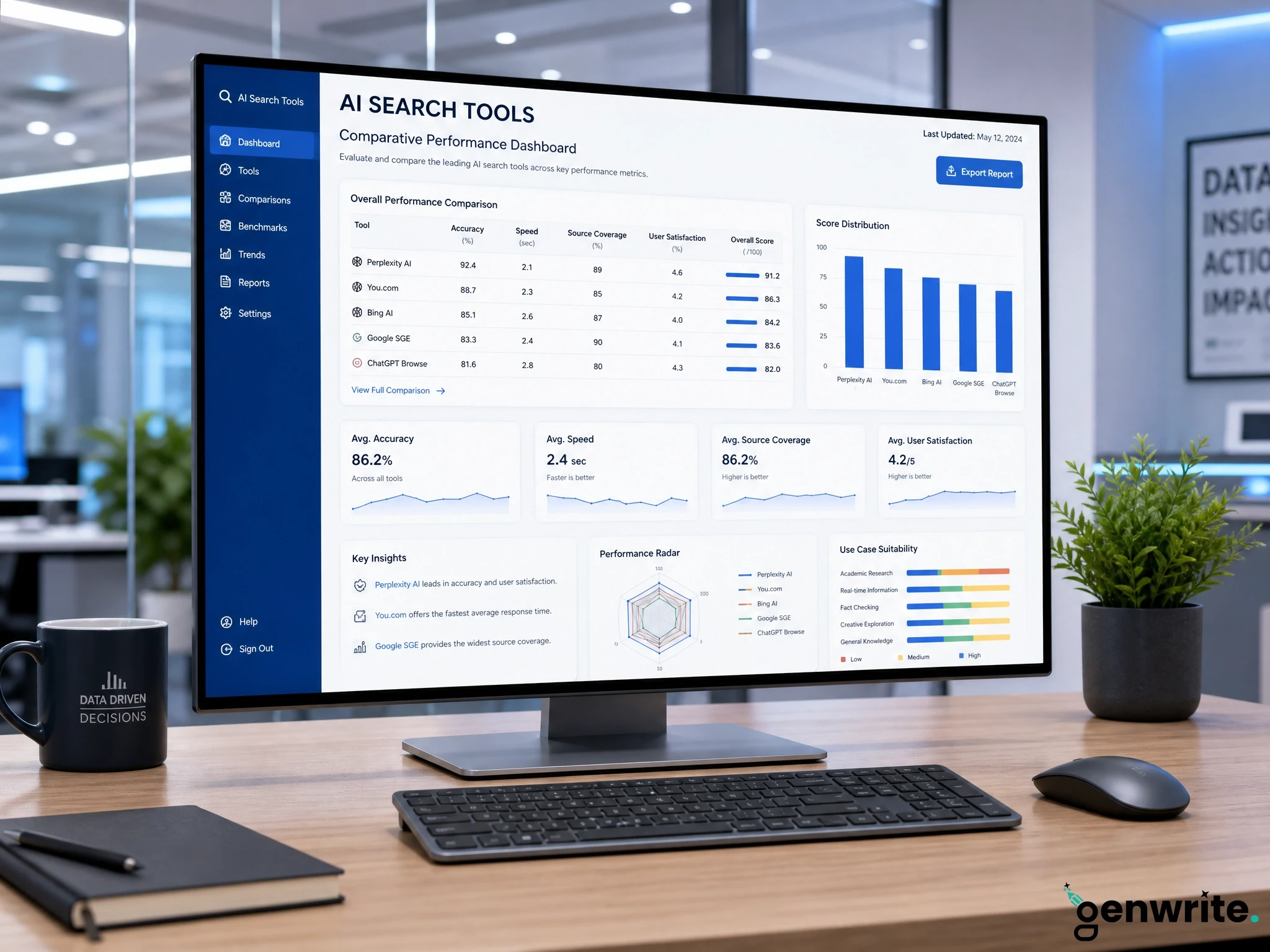
How do you measure organic visibility when the traditional search engine results page is replaced by a single, synthesized paragraph? If Google Search Console doesn’t show you which sentences Claude or ChatGPT extracted to answer a user’s query, how can you optimize for them?
The tools we relied on for a decade are suddenly facing an identity crisis. Tracking keyword rankings feels increasingly irrelevant when the real battle is for citations inside Large Language Models. So, which answer engine optimization tools actually move the needle, and which ones are just selling repackaged keyword trackers?
Let’s look at the current state of the market. Traditional giants are rushing to adapt. Semrush, for example, has introduced features aimed at tracking AI-generated search footprints, helping brands see how often they appear in Google’s AI Overviews. But is that enough to understand your ranking in ai engines?
To truly understand your footprint, you need to monitor brand mentions and citation share across multiple models. Specialized brand trackers are emerging to fill this gap. These platforms query systems like GPT-4o, Claude, and Gemini at scale to see which sources they cite for specific commercial queries. Are you being recommended as a top-three solution, or are you completely left out of the synthesized answer?
This is where the integration of creation and optimization becomes vital. If you’re manually trying to adjust your content based on these shifting citation patterns, you’ll always be three steps behind. Using an AI SEO tool that automatically aligns your content structure with how bots parse data can save dozens of hours of manual rewriting.
But how reliable is this data? The honest reality is that tracking is highly volatile. A model might cite your blog post in the morning and completely ignore it in the afternoon due to minor weights adjustments or temperature settings. This means you cannot treat tracking with the same rigid certainty as old-school rank tracking.
Instead of obsessing over daily fluctuations, what should you focus on? Look for tools that measure aggregate citation share over time. If your brand mentions are consistently rising in synthesized answers, your semantic optimization is working. If they are dropping, it is time to reassess your content’s factual density and entity structure.
Are you ready to swap traditional rank tracking for model citation audits? The transition is painful, but the alternative is complete invisibility in the zero-click era.
Future-proofing your visibility
The shift toward AI-driven search isn’t a signal to abandon traditional organic search strategies. Instead, it’s an invitation to adapt. Traditional search engines still drive massive traffic, but ignoring how LLMs digest your pages is a recipe for sudden invisibility. Winning in this new environment means merging classic technical foundations with structured, direct-answer optimization.
You don’t need to rewrite your entire library overnight. Start by auditing your high-performing pages to see if they directly answer the complex questions your audience actually asks. For teams trying to scale this transition without drowning in manual edits, leveraging an AI blog generator can streamline the heavy lifting of restructuring content.
But remember, technology alone won’t save a weak strategy. The quality of your underlying insights still dictates whether an engine trusts your brand enough to source it. Results will vary depending on your niche, but those who structure their data early will capture the lion’s share of zero-click citations.
So, how do you begin? You can automate your approach to SEO optimization and scale your visibility using GenWrite’s platform. The future of search belongs to those who make their expertise instantly accessible to both humans and machines. It’s time to build for both.
Tired of chasing shifting search algorithms? GenWrite handles keyword research, structuring, and publishing so your site shows up in AI answers automatically.
FAQ
How does AEO actually differ from traditional SEO?
SEO focuses on getting a blue link on a search results page, while AEO targets direct answers inside AI chat tools. You’re optimizing for extraction, meaning AI bots pull your exact sentences to answer user questions directly.
Why are traditional keyword strategies failing with AI search?
AI engines don’t care about keyword density the way old Google crawlers did. They look at semantic relationships and clear entity networks. If your facts aren’t connected logically, bots just skip over them.
Can small websites actually compete in AI search results?
Honestly, smaller sites often win if their content is structured better. If you use precise definitions, tables, and direct answers, AI citation algorithms will pick you over bloated corporate pages.
What happens to website traffic when users get instant answers?
You’ll likely see fewer casual browsers, but the visitors who do click through are usually much more qualified. They’ve already seen your brand cited as the authority and came to your site to take action.