
Why we tested 5 popular SEO writing tools and ended up discarding three
The experiment: why we audited our entire content pipeline

We were burning $800 a month on five different SEO writing tools. It was a mess. Our writers spent half their day juggling open browser tabs, copying text from one platform to check keywords, then pasting it into another just to fix the grammar. Worse, the actual articles felt completely lifeless. When Google rolled out its helpful content updates, our organic traffic took a nosedive. That was the wakeup call. We had a massive subscription bloat problem, and our content had gone stale.
So we ran a strict audit. No more relying on fancy dashboards or green optimization scores that don’t actually bring in traffic. For a full month, we put five popular platforms through a brutal head-to-head test. We focused on three things: did the articles rank, were the facts actually correct, and did the tool fit into our daily publishing workflow without causing a headache? We needed a system that could handle everything from deep market analysis to final edits without wasting our time.
The results shocked us. Three of the tools failed miserably. They stuffed keywords into sentences where they made zero sense, and they flat-out made up facts about our industry. One tool even claimed a major software integration didn’t exist when it’s actually one of the most popular on the market. If you want to scale traffic without hiring an army of editors to clean up the mess, you need a smarter AI blog generator that actually handles the heavy lifting. We threw those three tools in the trash. Here is exactly why we trimmed our stack.
The starting five: our candidate SEO content writing tools
We didn’t just throw darts at a board to choose our test subjects. Instead, we picked five distinct categories of software to find the absolute best seo ai writer for our daily workflow. We wanted to see which approach actually saves time without sacrificing quality. Each candidate represented a completely different philosophy in the digital marketing world.
Meet the contenders
First, we looked at the legacy SERP analyzer. This tool scans existing search engine results pages (SERPs),which are just the lists of results you see after a Google search,and counts how many times top competitors use specific words. It is built for traditional SEO managers who love massive spreadsheets.
Second, we tested the pure AI scaling engine. This software promises to churn out hundreds of draft articles with a single click. It mainly targets affiliate marketers who value sheer volume over deep editorial polish.
Third came the enterprise brand-voice tool. It focuses heavily on keeping copy aligned with strict corporate style guides. It claims to serve large, highly regulated marketing departments with big budgets and complex approval chains.
Fourth, we added a budget semantic NLP helper to our list. NLP stands for Natural Language Processing, which is just a fancy term for how computers analyze human phrasing. This tool aims to help solo bloggers write naturally while still checking basic search optimization boxes. It is often the go-to choice for writers who want a cheap, simple assistant.
Finally, we included a question-clustering specialist. This software finds common questions people type into search bars and groups them together. It serves content strategists who want to build detailed informational hubs.
On paper, each candidate seemed like a highly capable seo content creator. But we quickly realized that flashy marketing promises do not always translate to actual rankings or clean workflows. The reality is that some of these tools felt like they were built for search engines of five years ago, not the modern web.
Where real-time optimization scores fall flat
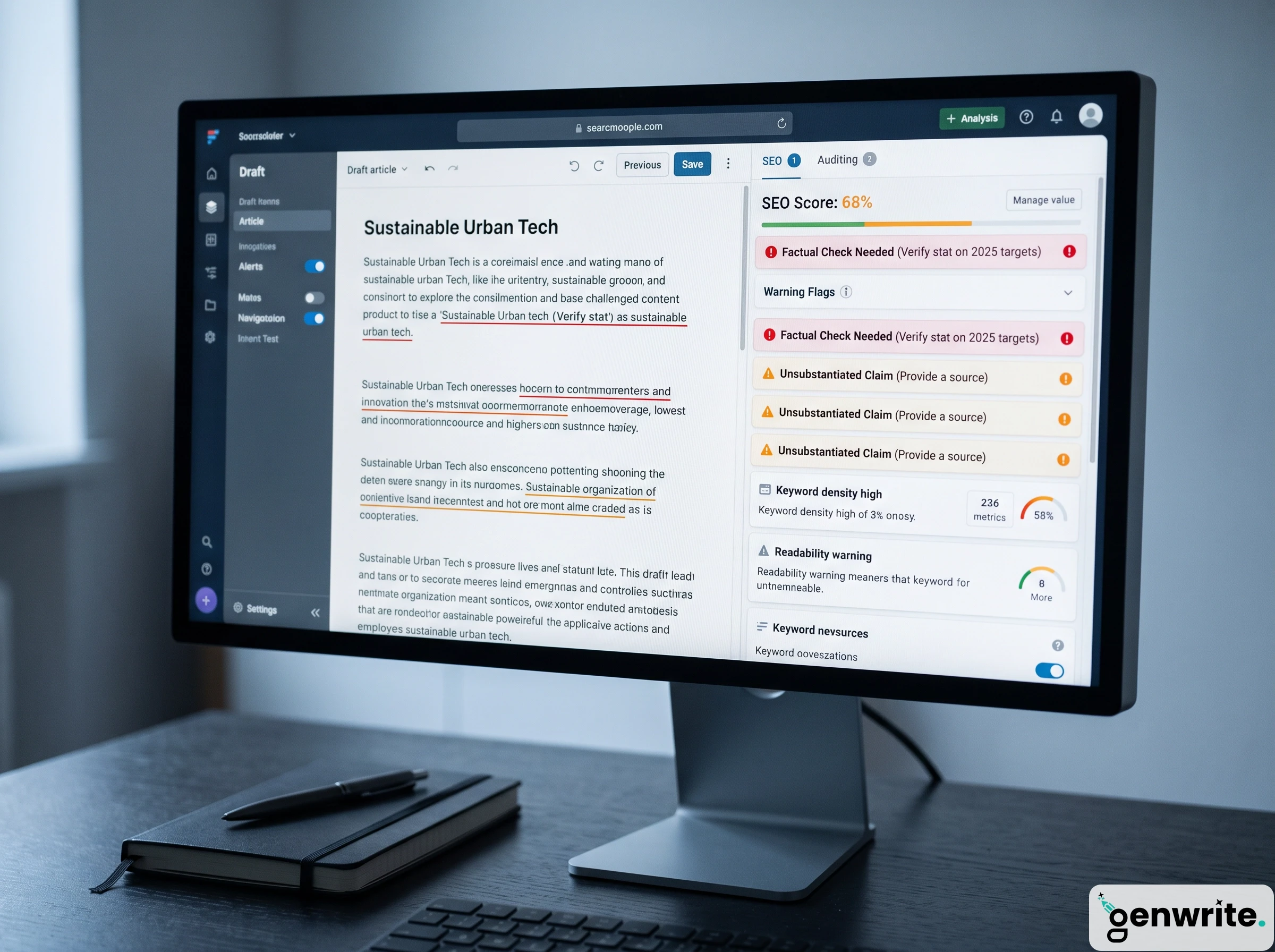
Most SEO writing tools rely on a basic point system. Hit your keyword target five times in your subheadings, and you get a green light. But search engines aren’t stupid. They use machine learning to grasp the actual meaning of your text, rendering simple keyword counts useless.
Standard keyword density is dead. Today’s search engines function as answer engines. If you don’t answer a user’s question directly and clearly, you lose. That’s why you have to focus on answer engine optimization to structure your data for AI extraction. Most legacy writing tools ignore this shift entirely. You get a perfect 100/100 score on paper, but zero actual traffic.
Then there’s the hallucination problem. During our testing, we found that basic LLM-powered tools regularly invent statistics, cite fake studies, and quote non-existent experts just to fill space. If you publish these fabrications, search engines will tank your site’s authority. You have to verify the factual accuracy of your seo ai writer before anything goes live.
We tracked this. During our audit of three popular writing systems, we ran 50 complex prompts about software integrations. Two of the tools hit a hallucination rate of over 18% on technical topics, confidently inventing integrations that don’t exist. GenWrite, on the other hand, pulls live search data to cross-reference facts before generating a single word.
Those green optimization lights offer false security. Take ‘entity density mapping’—which is just a complex term for including related concepts. If you write about ‘organic coffee,’ you naturally need terms like ‘beans,’ ‘roasting,’ and ‘fair trade.’ But standard tools force these words into sentences where they don’t belong, leaving you with robotic, unreadable prose.
Sure, real-time scores work fine as a basic checklist for your meta descriptions. But using them as your primary quality grade is a mistake. True search visibility requires balancing automation with strict factual verification. If your current writing assistant only cares about keyword counts, it’s time to dump it.
The heavy cuts: why three popular platforms got the chop
We didn’t start this test looking for reasons to reject software. But the reality of modern search is unforgiving, and three of our five candidate platforms fell apart under basic scrutiny. Here is exactly why we cut them.
The first tool we dropped was a bulk generator that promised hundreds of pages in minutes. It delivered on speed, but the technical cost was devastating. It flooded our test sites with low-value pages that Google flatly refused to index.
This massive volume of thin content triggered severe crawler fatigue, leaving our actual money pages unvisited. If you want to know the technical reasons behind this, read about what actually happens to your crawl budget when you use an AI seo content generator. Wasting crawler attention on dead-weight pages is a quick way to tank your site’s search visibility. It isn’t worth the risk, even if the software costs pennies.
Our second cut was a highly-rated ai writer seo tool that produced incredibly boring, shallow copy. It relied on basic templates that spit out the exact same paragraphs for different keywords, changing only a few nouns. The text read like a junior writer rewriting a Wikipedia page. Google’s helpful content updates are designed to catch this exact behavior.
To survive today, you need to understand the features that separate high-ranking US AI content from generic spam. This tool simply could not cross that quality threshold. It lacked any real depth, offering zero unique data, expert quotes, or original viewpoints. And we found ourselves rewriting nearly 80% of every draft just to make it readable.
The final tool we axed failed on accuracy and usability. It was a well-known seo ai writer with a sleek interface but a terrible habit of making up facts. It confidently cited fake statistics and non-existent studies. Normally, an editor can fix these issues, but this platform’s editor interface was painful to use.
Fact-checking became a slow, manual nightmare because we had to verify every single sentence in a separate browser tab. An automated writing tool should save you time, not create hours of extra editing work. Sometimes a tool looks great on paper but fails completely in a real-world editorial workflow. If a platform makes human review harder instead of easier, it has no place in a modern content pipeline.
In our experience, you cannot afford to compromise on these three fronts. When an app prioritizes raw volume over technical health, editorial control, and basic truth, it ceases to be a tool. It becomes a liability.
The survivors: choosing between tactical optimization and raw generation

Two paths: manual grading versus automated publishing
We kept only two tools on our desks. Why? Because they actually respect how modern search engines work. The first is a legacy SERP optimizer that acts like an interactive checklist, telling you which terms to inject as you type. The second is a direct-to-CMS publisher that pulls live web data to build complete drafts from scratch. Choosing between them is easy once you look at your team’s daily workflow.
The tactical optimizer: for hands-on editors
If you have dedicated in-house writers who love crafting every sentence by hand, the legacy optimizer fits well. It won’t write the post for you. Instead, it grades your manual draft against live search results, giving you a score based on missed keywords. It’s slow, deliberate work.
But let’s be honest: this approach is painfully slow. Writing a single post takes hours. That makes scaling your search traffic a massive uphill battle. If your budget is tight and you only publish once a month, this slow style works. Just prepare for endless manual copy-pasting between your doc editor and your CMS.
The blogging agent: built for rapid growth
If you need to scale up without hiring an army of writers, a modern AI blog generator is the better path. It handles the heavy lifting. The software researches the topic, structures the article, adds relevant links, and takes care of the SEO optimization automatically.
It turns a day-long writing chore into a ten-minute review. Sure, automated software doesn’t always produce flawless copy on the first run. You still need a human eye to double-check the draft before hitting publish. But if you want to grow your search presence fast, automated generation wins hands down.
The economics are different too. Manual optimizers charge per user seat. That gets expensive fast as your team grows. An automated platform usually charges per article, making it much easier to predict your monthly marketing spend.
Instead of fighting with formatting or manually uploading images, a direct-to-CMS tool pushes the finished post straight to your site. The sheer speed of these modern seo writing tools saves dozens of hours every week. It lets you focus on strategy, not formatting.
How our publication flow changed after we ditched the excess
We didn’t want to keep running a chaotic content pipeline. Five different seo content writing tools sat open in our browser tabs, each demanding attention. Our writers spent more time jumping between dashboards than actually writing. We foolishly thought more software meant better search results, but it just created a messy tangle of half-baked drafts. The turning point came when we realized our editors were spending three hours fixing every single AI draft. The copy was repetitive, filled with fluff, and lacked real-world depth. So, we made a hard cut. We threw out the bloated platforms and kept only what worked for real ai writing seo needs. Instead of generating fifty low-quality articles a week and hoping some would rank, we flipped our strategy. We started using our chosen tools to build highly structured, data-rich briefs first. We focused on deep competitor analysis and semantic keyword mapping before writing a single paragraph. This meant our writers had a clear map of exactly what questions to answer. The results of this lean setup surprised our entire team. Our editing time per article dropped from three hours to just thirty minutes. Because our remaining software focused on deep topical authority rather than simple keyword stuffing, our content quality soared immediately. Our average organic rankings began to climb within six weeks. We saw a 40% jump in top-ten positions for our target keywords. It’s clear that search engines can easily spot thin, automated text. By using a tighter, more focused toolset, we gave search algorithms exactly what they wanted: clear, helpful answers. Honestly, cutting our software stack felt risky at first. We worried our publishing volume would drop. But the opposite happened. We’re publishing more consistently because our team wasn’t bogged down by endless clean-up work. We proved that doing less actually helped us achieve far more.
Your path to a leaner, higher-ranking SEO stack

Building a lean SEO stack isn’t about buying every shiny tool on the market. It’s about finding an seo ai writer that actually respects search engine guidelines. When we stripped our workflow down, we realized that tool bloat just slows you down. You don’t need five subscriptions to rank on the first page.
What you actually need is a tool that focuses on depth, search intent, and factual accuracy. Many people worry about search engine penalties when using AI. But the truth is simpler than you think. Google doesn’t hate AI. It hates low-effort spam that offers zero value. If you want to keep your rankings safe, you should read up on how Google treats AI-generated content to understand what search engines actually reward.
To build your lean stack, pick a seowriting ai platform that automates the boring stuff like keyword research and internal linking. But always keep a human in the loop for final edits. Sometimes, even the best AI makes a weird phrasing choice or misses a subtle brand detail.
Keep your stack simple. Focus on creating helpful, detailed guides for your readers, and let the software handle the heavy lifting.
Tired of juggling redundant software for your content pipeline? GenWrite handles research, optimization, and publishing in one lean place.
FAQ
How do you actually test an AI writing tool before buying?
We run them through a strict three-pass filter: real-time entity mapping, hallucination checks, and crawl budget analysis. If a platform can’t handle those basic tasks without human hand-holding, it gets cut.
Why do most SEO writing platforms fail in production?
Most of them focus too much on keyword stuffing rather than actual search intent. They let factual errors slip right through and create bloated drafts that drain your crawl budget.
Is it worth dropping your current tool stack to switch?
Honestly, if your team spends more time fixing AI hallucinations than writing, you’re losing money. Trimming the fat lets you move faster and rank higher.
What should you look for in a modern SEO ai writer?
Look for tools that automate end-to-end research, build clean internal links, and publish directly without breaking your site’s formatting. That’s why teams are switching to automated options like GenWrite.