
Why top US agencies are shifting client content to automated blogging
The shifting economics of agency content production

The agency scale trap
Every agency owner knows the dread of the monthly content calendar. You promise fifteen SEO-optimized posts to a new client. Suddenly, your head writer is drowning in research briefs. Your margins evaporate.
Hiring more freelancers to scale up just doesn’t work anymore. It’s slow, expensive, and breaks down completely when you’re managing twenty different client portfolios. That’s why smart teams are shifting to an ai content agency model, swapping manual drafts for automated systems.
By adopting ai driven content creation, these agencies reclaim hundreds of hours spent on manual keyword mapping and outline approvals. It saves serious money, too. Sure, these systems need initial setup and oversight. They aren’t magic. But the economic shift is real. If you’re still relying on the traditional writer-to-editor assembly line, you’re probably losing money on every single word you publish.
Why lazy chatbot prompts are failing modern SEO standards
The gap between generic chatbots and specialized SEO engines
Copying a basic prompt into a standard chatbot gets you readable text. But it rarely ranks. Why? Because generic models don’t actually see the live search engine results pages (SERPs). They write from historical training data, completely blind to what is working right now. This is where ChatGPT gets lazy and specialized SEO writing tools take over to build content that actually ranks.
Google doesn’t care about generic readability; it wants precise, data-backed answers that match search intent. Standard chatbots can’t analyze your competitors’ keyword density or reverse-engineer the top-ranking pages. They just guess. On the other hand, specialized ai software for seo pulls live SERP data directly, maps out the correct heading hierarchy, and optimizes the structure on the fly.
If you’re using basic ai content marketing tools without live search integration, you end up with thin, repetitive copy. Sure, raw AI text might occasionally rank for a zero-volume keyword by accident. But hope isn’t a strategy when you’re trying to scale an agency.
| Feature | Generic Chatbots | Dedicated AI SEO Pipelines |
|---|---|---|
| Data Source | Static training data | Real-time SERP & competitor analysis |
| SEO Structuring | Manual prompting required | Automated schema and keyword mapping |
| Scaling | One-by-one manual inputs | Bulk generation with CMS sync |
Connecting the pipeline with automated scheduling and CMS sync
How do agencies manage thirty client blogs without losing their minds? They don’t do it manually. Modern setups isolate each client into distinct workspaces. This keeps brand voices, targeted keywords, and visual styles completely separate. Once you configure these basic guardrails, the platform handles the heavy lifting. You simply map out a content calendar, and the software takes over.
When you automate blog writing through a dedicated engine, the draft doesn’t just sit in an isolated dashboard. The pipeline connects directly to content management systems like WordPress, Shopify, or Webflow via secure APIs. It formats the headers, inserts optimized images, and injects relevant internal links dynamically.
An autopilot queue then schedules the post for the exact hour your target audience is online. Of course, automated blog content isn’t entirely set-and-forget; you’ll still want an editor to review the final formatting before it goes live to catch occasional layout quirks. But this connected workflow reduces the publishing process from a three-hour manual chore to a simple, two-minute approval click. It keeps client sites active without draining your team’s energy.
Is Google penalizing AI? The truth about automated content quality
Demystifying search algorithms and machine-generated text
The fear of a sweeping algorithm penalty keeps many agency founders up at night. But the reality is far more practical. Google’s webmaster guidelines explicitly state that content is evaluated on its utility, accuracy, and depth, regardless of how it was produced. The search engine doesn’t block AI-generated articles; instead, its automated systems, like SpamBrain, target thin, low-effort pages that offer zero original value.
To survive competitive US search markets, your automated blogging setup must move beyond simple text generation. It requires real-time search intelligence, live data verification, and strict factual checks. Standard large language models (LLMs) rely on static training data, leading to hallucinations that instantly trigger quality demotions.
Using a specialized ai software for seo ensures that every generated draft is grounded in current SERP analysis. This approach satisfies search engines’ Experience, Expertise, Authoritativeness, and Trustworthiness (E-E-A-T) criteria. But don’t just set it and forget it. Safe publishing still relies on a lightweight human review layer to verify tone and formatting before hitting publish.
The path forward: Transforming writers into strategic editors
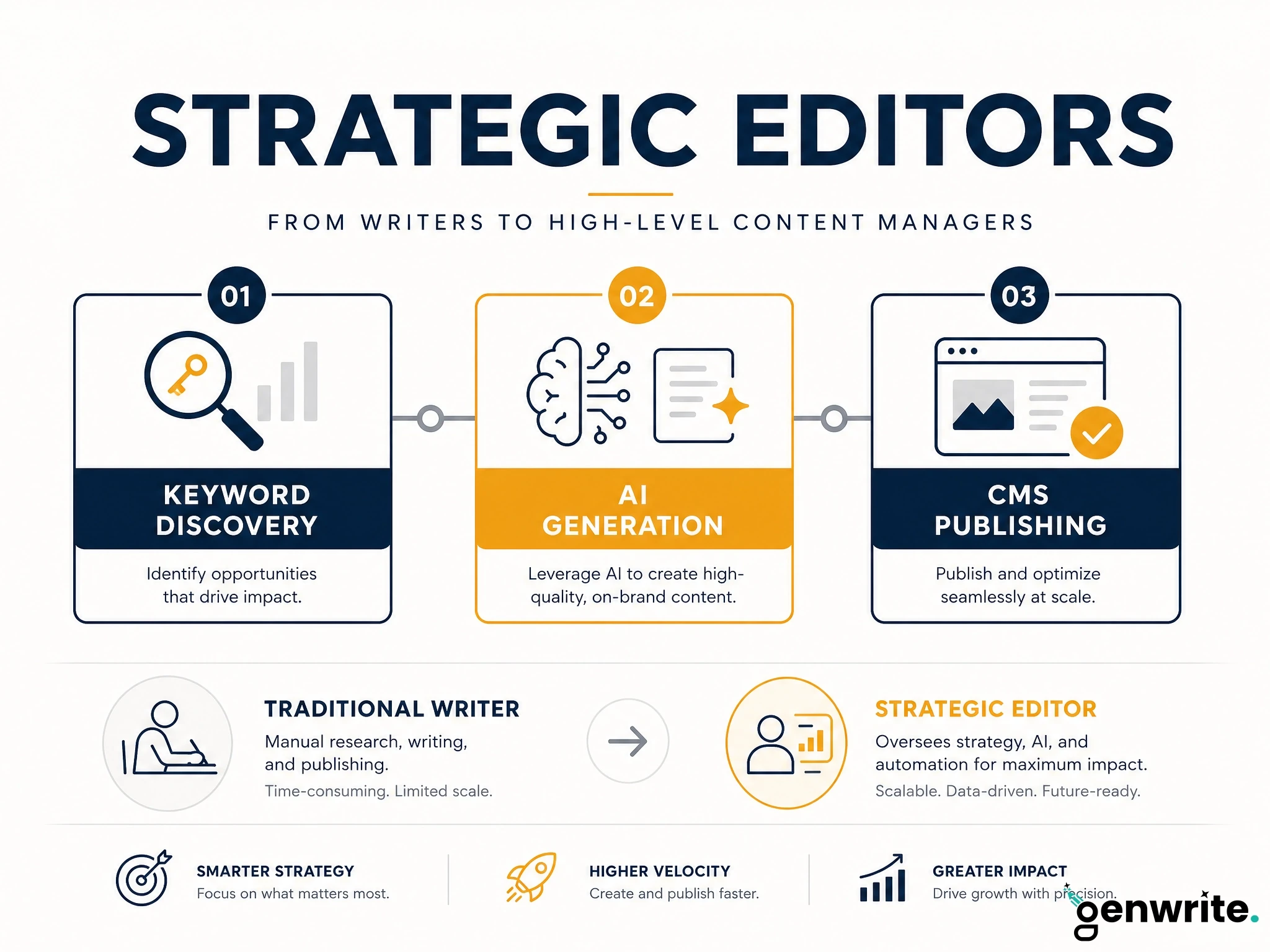
Turning drafts into strategy
Let’s face it: paying talented writers to stare at a blank Google Doc for hours is bad business. Top agencies aren’t firing their teams; they’re reframing their roles. Writers are now editors and strategists. By deploying an automated content creation pipeline, you free up your team to focus on conversion optimization, distribution, and real client strategy.
The math is simple. If your agency still spends weeks producing ten basic SEO posts, you’re losing margin to competitors who scale with automated systems. The future belongs to the lean ai content agency that treats AI as the heavy-lifting engine and humans as the quality control. This setup doesn’t just save hours; it protects your margins.
Stop letting manual production bottleneck your agency’s growth. Shift your staff to high-value editing, hook up your CMS to automated workflows, and scale your client portfolios without adding headcount. It’s time to automate the baseline and edit for the win.
Tired of burning agency hours on manual drafts and expensive freelancers? GenWrite handles keyword research, SEO optimization, and auto-publishing so you can scale client traffic effortlessly.
FAQ
Why are marketing agencies shifting to automated blogging?
Manual writing and freelance management eat up too many billable hours. Agencies use automated workflows to cut production costs and scale client traffic without hiring a massive writing team.
Does Google penalize automated blog content?
Google doesn’t care if content is AI-generated as long as it’s helpful and meets quality standards. It’s low-effort spam they flag, not automation itself.
How do automated blogging tools connect to client CMS platforms?
Most tools use direct API integrations with platforms like WordPress or Webflow. They push researched, optimized drafts straight to the staging or live site without manual copying.
What’s wrong with using standard ChatGPT prompts for client SEO?
Basic prompts usually spit out generic fluff that misses search intent and lacks unique data. Honestly, most readers bounce immediately because it doesn’t solve their specific problems.