
Why ranking number one on Google won’t save your search traffic as AI search grows
The fading crown of the top search result
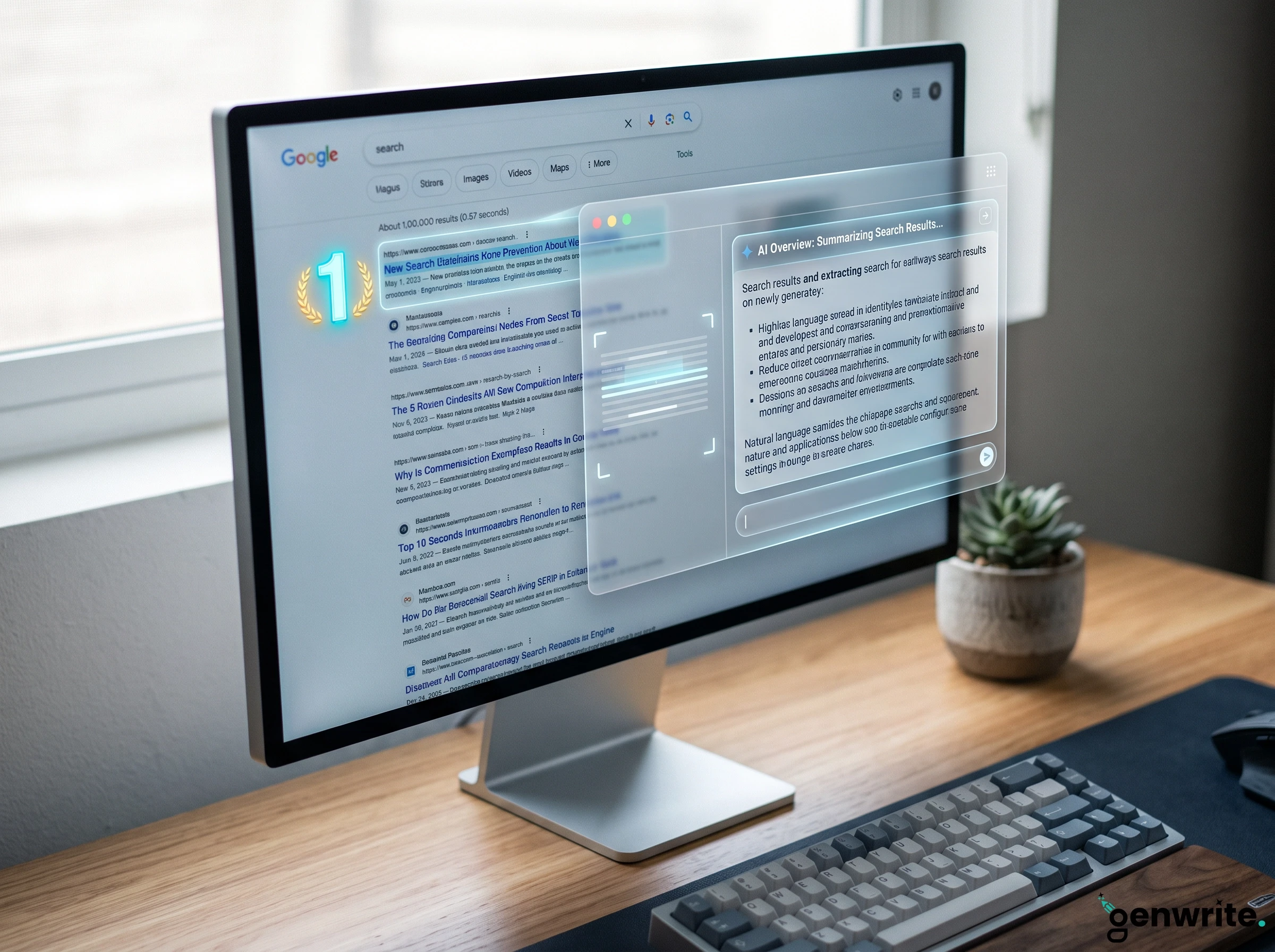
You spent months targeting keywords and tweaking on-page elements to finally reach the top of Google. Then you check your analytics. The traffic surge isn’t there.
What went wrong?
The ground is shifting. When Google’s AI Overviews or ChatGPT serve up a complete answer right on the results page, users get what they need without clicking a single link. Your ranking hasn’t budged, but its value has plummeted.
Surviving this zero-click reality means moving beyond classic SEO to answer engine optimization (AEO). The goal is simple: get cited inside those AI-generated summaries. While traditional search still works for complex research, quick-answer traffic is drying up.
Instead of just chasing keywords, you have to optimize for conversational engines. That means structuring your data so LLMs can easily parse, pull, and credit your work.
Why the click-based web is quietly shrinking
The math behind the disappearing click
The numbers tell a story that many search marketers still try to ignore. By early 2026, ChatGPT reached over 800 million weekly active users. This changed everything. Instead of clicking through blue links, searchers now get answers directly on the results page.
This has triggered a quiet crisis for traditional websites. Tracking data shows that organic search traffic for many publishers has dropped by 15% to 35% because of direct AI summaries. When Google AI Overviews synthesize a complete answer, the incentive to click vanishes.
Ranking first no longer guarantees human visitors.
To survive, smart teams are pivoting from traditional SEO to answer engine optimization. This keeps their brand visible in AI-generated summaries. But it requires a deep understanding of how generative engines extract facts. Without adjusting, your content risks becoming invisible training data. It feeds AI models. You get zero clicks. The era of relying solely on SERP real estate is over.
The transition from standard search to machine retrieval
From index matching to vector retrieval
Traditional search engines rely on inverted indexes. They match query tokens, calculate TF-IDF (term frequency-inverse document frequency), and run PageRank to measure domain authority. It’s pure mechanics. Large Language Models (LLMs) discard this playbook. Instead, they use Retrieval-Augmented Generation (RAG) to query vector databases where your content exists as dense vector embeddings representing semantic meaning rather than raw strings of text.
When a user asks a complex question, the retrieval system calculates the cosine similarity between the query embedding and your content’s passage embeddings. It’s mathematical alignment, not keyword matching. This transition to semantic intent makes geo optimization a baseline technical requirement, not an optional upgrade.
The machine doesn’t care about your keyword density. It wants factual density. If your content lacks clear subject-predicate-object relationships or structured schema, the model’s vectorizer cannot map it accurately. You lose the retrieval step entirely.
Winning at aeo seo requires a shift in focus. Stop trying to rank entire pages. Instead, structure your data so machines can parse, chunk, and embed it without losing context. Your goal is feeding the vector space high-quality, extractable data blocks.
What actually drives visibility inside Perplexity and ChatGPT?
How do conversational engines actually decide which sources to trust when a user asks a complex query? If traditional keyword stuffing is dead, what are the new rules of the game?
For systems like Perplexity, the selection process isn’t a mystery; it relies on a sophisticated three-layer (L3) reranking system. To win this crawl, your content must satisfy three core perplexity ranking factors: extreme recency, high domain authority, and early user engagement. If you are writing about technology or business, the stakes are even higher, as these categories receive the bulk of conversational search volume.
But what about chatgpt search optimization? OpenAI’s search model behaves similarly, prioritizing direct answers backed by structured, easily extractable facts. If your site lacks clear entity relationships, these models simply skip you. This is why forward-thinking teams are turning to automated SEO optimization tools to keep their libraries freshly updated.
Can your current publishing workflow match this speed? Probably not without help. If you aren’t updating your high-performing pages weekly, you are already losing visibility to fresher, albeit lower-quality, sources.
Structuring your content for seamless machine extraction
How to optimize for AI search through structural design
If you want to know how to optimize for AI search, you have to make your content irresistible to an LLM’s retrieval-augmented generation (RAG) pipeline. It starts by abandoning the fluffy introductions. AI search agents don’t read like humans; they scan for immediate, high-density value.
First, design clean answer blocks right at the top of your sections. Use a single, direct sentence to answer the core query, followed by bulleted supporting facts. This structure makes it incredibly easy for scrapers to grab your text and credit you as the source. You should also implement structured data schema, such as FAQ and Article schema, to give search bots explicit context.
But structure alone isn’t enough if your writing sounds like a generic machine wrote it. If you want to maintain visibility, you need to understand how to fix robotic AI content so it keeps ranking on Google by layering in first-party data and unique observations.
Finally, check your robots.txt file. Many publishers block crawlers out of fear, but walling off OAI-SearchBot or PerplexityBot simply guarantees you’ll never be cited. Open the door to these bots, structure your data clearly, and let the machines do the distribution for you.
The checklist for surviving the zero-click era

Stop obsessing over blue links. If you want to survive the zero-click era, your playbook needs an immediate overhaul. First, open your robots.txt file. Ensure you aren’t blocking user-agents like GPTBot or OAI-SearchBot unless you want to be completely invisible to conversational search.
Second, kill the generic AI fluff. Raw, unedited outputs get weeded out by modern search rerankers. You must aggressively refine your drafts,understanding why real editors rewrite automated content is the first step to injecting the original data and unique perspectives these models actually cite.
Finally, scrap traditional rank tracking. Shift your KPIs to citation share and brand mentions within LLM responses. This is the core of generative engine optimization. If ChatGPT isn’t referencing your brand, your old-school SEO rank means nothing. Adapt your aeo seo strategy now or watch your traffic vanish.
Tired of watching AI search steal your organic clicks? GenWrite handles keyword research, competitor analysis, and optimization so your content gets cited.
FAQ
Why is ranking number one on Google losing its value?
AI search engines summarize answers directly on the page, meaning users don’t need to click traditional links anymore. It’s a zero-click reality that leaves top-ranking sites fighting for scraps.
How do tools like ChatGPT and Perplexity choose which sources to cite?
They rely on vector retrieval and semantic relevance rather than exact keyword matches. They pick sources that provide dense, clear, and authoritative answers to complex queries.
Can small websites still get noticed in AI search results?
Absolutely. If you structure your content with clear facts, original data, and clean markdown tables, AI engines will often cite smaller niche sites over bloated corporate pages.
What is the biggest mistake marketers make with AI search engines?
Most people keep writing for outdated keyword volumes instead of focusing on direct machine extraction and citation share.