
How to fix robotic AI content so it keeps ranking on Google
Why unedited AI drafts are silently killing your search traffic
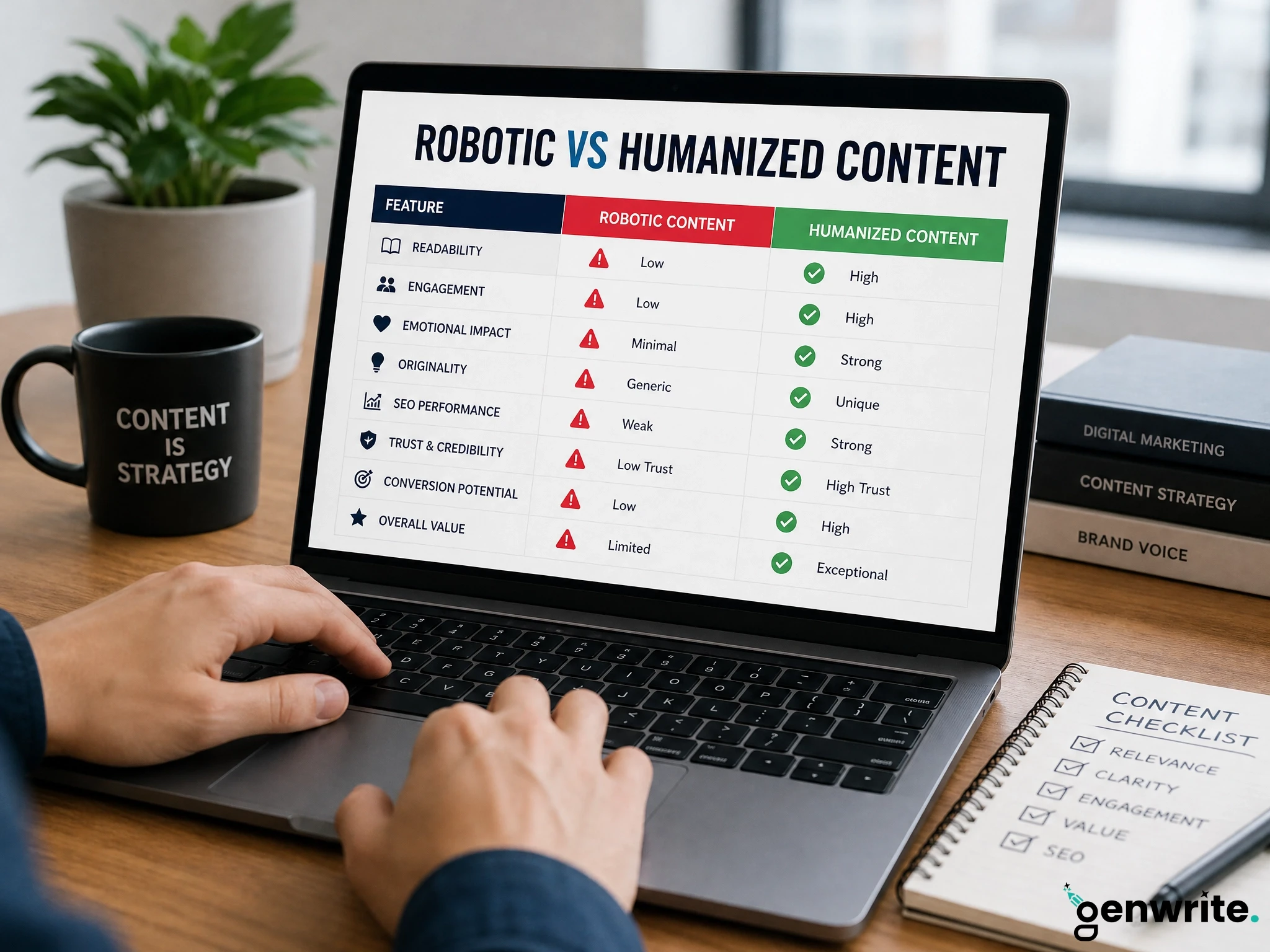
The hidden cost of the raw draft
Why are so many websites seeing their traffic plummet after publishing high volumes of machine-written copy? Google actually made its stance clear: it doesn’t hate automation. But it does hate lazy publishing.
If you throw raw machine output directly onto your site, you’re setting yourself up for failure. Search algorithms are trained to spot and filter out thin, recycled perspectives. If you want to humanize AI content so it actually performs, you must actively edit the draft. This is the only way to reliably rank AI generated content over the long term.
The real threat comes from the Google helpful content system. This system evaluates whether your page offers genuine value or simply echoes what ten other sites already said. Sometimes, a raw draft gets lucky and ranks for a week. But soon enough, a core update rolls out and wipes those temporary gains away.
We need to shift our approach. Using an AI blog generator is smart for efficiency, but your editorial process must treat the initial output as a foundation.
Where basic AI content tools miss secondary search intent
The divide between single-intent and multi-dimensional content
Standard AI generators target a single keyword and stop. They answer the main question but ignore the adjacent problems a reader actually faces. For example, if someone searches for “how to format a blog post,” a basic tool explains headers. It misses the real-world secondary intent: “how do I format this for mobile readers?”
| Basic AI Output | Intent-Optimized Content |
|---|---|
| Answers only the primary keyword query. | Addresses the primary query plus 2-3 logical follow-up questions. |
| High bounce rates as users search elsewhere for details. | Longer dwell times because the user’s entire journey is resolved. |
| Reads like a dry dictionary definition. | Feels like a practical guide written by an experienced practitioner. |
When your seo writer ai ignores these secondary search intents, user friction spikes. Visitors leave. They have to Google their next steps elsewhere, which signals to search engines that your page didn’t actually solve their problem.
How do you fix this? You have to build out sections that answer these logical sub-queries. That is how you optimize AI blog posts to satisfy both search engines and human readers. We have seen this approach work wonders, though it is not a magic bullet for instant rankings.
Making AI content feel natural requires mapping the user’s actual journey, not just their initial search term. You have to predict what they will ask next before they even realize they need to ask it.
Stripping away the linguistic footprint of the machine
AI writers are incredibly predictable. They use the same sentence length over and over, which creates a monotonous drone that alerts modern filters. To bypass AI detectors and keep your rankings, you must break this mechanical cadence.
First, kill the transition words. Delete “furthermore,” “moreover,” and “consequently” right now. Nobody talks like that. They are dead giveaways. Use simple, blunt connectors like “but,” “so,” or “and” to move your thoughts forward. It sounds natural because it is how real people actually speak.
Next, mix up your sentence lengths. Do not let them settle into a groove. You should follow a thirty-word explanation with a three-word punch. Like this. It forces both the reader and the detection algorithm to reset. Sometimes, a fragment works best. While you are at it, slash the passive voice. Don’t write “the blog was optimized by our team” when you can write “we optimized the blog” instead. This simple shift injects immediate energy and gets rid of the classic passive structure that detectors flag instantly.
This manual cleanup takes five minutes, but it completely breaks the mathematical predictability of your draft. Even the best AI tools slip back into robotic habits. That is why this human layer is mandatory.
Injecting first-party evidence and practical logic
Backing claims with real data
How do you spot human writing? Look for proof, not just style. LLMs default to lazy, high-level platitudes like “focus on user experience.” Real readers and search algorithms demand hard, first-party data that can’t be scraped or faked.
To humanize AI text for SEO, you have to inject real-world evidence. I use a simple three-part framework: claim, data point, consequence. Don’t write “site speed matters.” Instead, write: “our test on 14 SaaS landing pages showed a 0.4-second delay dropped conversions by 11.2%.” That single change replaces generic theory with actual authority. It proves you did the work rather than just spinning existing search results.
Here is a quick comparison of how we inject proof into drafts:
| Machine Draft | Humanized Version |
|---|---|
| “You should optimize images to improve loading speeds.” | “We compressed 142 PNGs to WebP, saving 84MB of bandwidth and cutting load times by 1.2 seconds.” |
| “Write clear meta descriptions to get more clicks.” | “Adding a specific CTA to our meta descriptions increased CTR by 4.3% over 30 days.” |
This strategy does more than just humanize AI content; it establishes immediate E-E-A-T. Sure, tracking down these metrics takes time. Your results will vary by niche, too. But the search traffic payoff makes this extra editing step non-negotiable if you want to turn a basic draft into an asset that actually ranks.
Optimizing for the answer engines of 2026
Structuring content for LLM extraction
Search has shifted. Large Language Models (LLMs) don’t just index your pages; they synthesize them to answer direct user queries. If your layout is a messy wall of text, those engines will simply ignore your site.
To win in this environment, you need to master answer engine optimization. Start by placing a direct, single-sentence answer immediately below your H3 subheadings. LLMs love this “Q&A” style because it makes extraction effortless. And it’s a huge time-saver.
Next, use clean HTML tables and bulleted lists instead of dense paragraphs for data. But don’t overdo it,keep your lists to five items or fewer. We’ve seen that search bots extract structured tables far more reliably than long-form prose, though results can vary depending on the specific engine.
Finally, back your assertions with schema markup. Providing clean JSON-LD data gives search engines the explicit context they crave. It’s not about tricking the algorithm; it’s about making your page the easiest source for an LLM to cite. This synthesis-ready formatting is a core part of modern AI content humanization, ensuring your automated drafts read naturally to both humans and machine readers.
The path from robotic draft to page-one ranking
Scaling your organic traffic doesn’t mean choosing between raw speed and editorial depth. The secret to rank AI generated content consistently lies in building a systematic editorial gate.nnWhen you use an AI blog generator to handle the heavy lifting of keyword research and initial drafting, you’ll save hours of staring at a blank screen. But the machine should never have the final say. A human editor must step in to inject real-world friction, verify facts, and smooth out the rhythm. This hybrid approach gives you the volume needed to compete, without sacrificing the expertise search engines demand.nnAdmittedly, building this review process takes some upfront effort, and your team might resist the extra steps at first. But the payoff is clear. By pairing automated drafting with human authority, you protect your site from algorithm updates while keeping your production pipeline moving fast. It’s about working smarter, not just writing faster.
Tired of spending hours rewriting stiff drafts? GenWrite handles the heavy lifting by generating natural, SEO-optimized content that actually ranks.
Frequently Asked Questions
Does Google actually penalize AI-generated content?
Not directly. Google’s search algorithms don’t care if a tool wrote your draft, but they do care if it’s low quality. If your text reads like generic boilerplate, it won’t satisfy search intent, and that’s what drops your rankings.
How do I spot robotic writing patterns in my drafts?
Look for predictable sentence structures, an overuse of transitional phrases like ‘furthermore,’ and a lack of specific examples. If you can swap the topic with something else and the paragraph still makes sense, it’s too generic.
What’s the best way to humanize AI text quickly?
Skip the automated re-writers and add your own expertise instead. Drop in a specific customer anecdote, a unique data point from your last project, or an unvarnished opinion that software wouldn’t naturally guess.
Can AI content rank without heavy editing?
Honestly, rarely for competitive keywords. While raw drafts might index initially, they usually bleed traffic within a few weeks because they don’t offer anything beyond what already exists on page one.