
Why real editors are rewriting everything their seo writing tools produce
Why raw machine drafts are a liability, not a shortcut

We’ve all been there. You click a button, wait thirty seconds, and suddenly you have a 2,000-word article. It feels like magic. But publishing that raw text right away is a massive gamble that usually ends up hurting your business metrics. While AI is great for speed, raw drafts are a liability because they lack the actual human perspective that turns casual readers into paying customers. Honestly, most unedited drafts read like they were written by a committee of robots who’ve never actually bought a product in their lives.
At GenWrite, we help teams spin up drafts quickly. But we always tell our users that automation is just the starting line. If you don’t polish what the machine spits out, readers will spot the generic patterns and bounce. To protect your rankings, you have to learn how to fix robotic AI content before you hit publish.
The gap between traffic and conversions
Many marketing teams measure success purely by publishing volume. They assume more pages automatically mean more sales, but that’s a trap. If your articles read like a dry encyclopedia, visitors will leave in seconds.
Imagine a software company using an AI writer to churn out fifty articles on project management. Sure, those posts might have all the right keywords. But if they lack real-world scenarios, nobody is going to sign up for a software trial. Readers want to know how actual project managers handle messy team conflicts. They don’t want a dictionary definition of a Gantt chart.
Without those human details, your traffic won’t convert. Search engines might index your pages at first, but when readers immediately click away because the writing feels robotic, your rankings will tank. While results vary depending on your niche, real human editing is what actually turns a bouncing visitor into a new customer.
Why algorithms strip the soul out of your brand voice

Ever notice how most AI blogs sound exactly the same? It is always that polite, dry tone that feels like a corporate training manual nobody wants to read. That happens because standard seowriting ai models are trained on the average of the internet, calculating the most probable next word to create something safe. That math washes away anything unique, quirky, or bold.
Relying on raw machine output kills your brand’s personality. The software strips out local slang and cultural references. It trades your authority for a sterile voice that fails to connect with real people. If you sound like everyone else, you’re just background noise.
I see this happen constantly when teams try to scale up content. They publish dozens of articles, but their conversion rates tank. Sure, the traffic might show up. But readers bounce the second they realize no real human is behind the words. They want your genuine insights, not a rehashed Wikipedia page.
This is where platforms like GenWrite actually help. Instead of treating AI as a replacement for human thought, smart teams use it to build high-quality drafts that handle the heavy lifting of keyword research and basic structuring. But you still need real editors to breathe life back into those drafts. An editor brings the personal anecdotes and sharp opinions that an algorithm simply cannot invent.
Sometimes, a draft only needs a few quick tweaks. Other times, the machine’s default settings are so stubborn that you have to rewrite entire paragraphs to find your voice. It’s a trade-off. The AI gives you a solid head start, but your editors provide the actual soul.
The critical difference between satisfying search intent and merely stuffing entities
Many automated platforms think SEO is just a matching game. They scan top-ranking pages, extract a list of nouns,known as entities,and spray them across your draft. But modern search engines do not rank pages based on simple keyword density anymore.
Beyond entity stuffing: how search engines read
Google uses advanced systems to measure how well a page actually solves a searcher’s problem. These systems look at semantic closeness, which is how words relate to each other in context. If a user searches for “how to fix a leaky pipe,” they do not just want to see the words “wrench,” “teflon tape,” and “drain.” They need a logical, step-by-step troubleshooting process.
When seo writing tools ignore secondary search intent, they fail to structure the content for the user’s actual journey. For example, someone looking to buy software needs pricing tables and feature comparisons, not just a generic definition of the product. Real human editors understand this flow. They organize the page so it answers the immediate question first, then addresses the logical next steps.
Designing for the user journey
Successful modern seo and content creation requires mapping your text to user behavior. Google tracks interaction signals, like whether a user immediately bounces back to the search results page because your content did not answer their question. If your page is just a wall of stuffed keywords without practical answers, your rankings will slip.
We can use tools like GenWrite to quickly build the technical foundation of an article. But a human editor must still step in to verify that the layout matches the searcher’s goal. Sometimes this means deleting half of the machine-generated paragraphs to make the actual solution stand out.
Spotting the robotic telltales that trigger reader fatigue
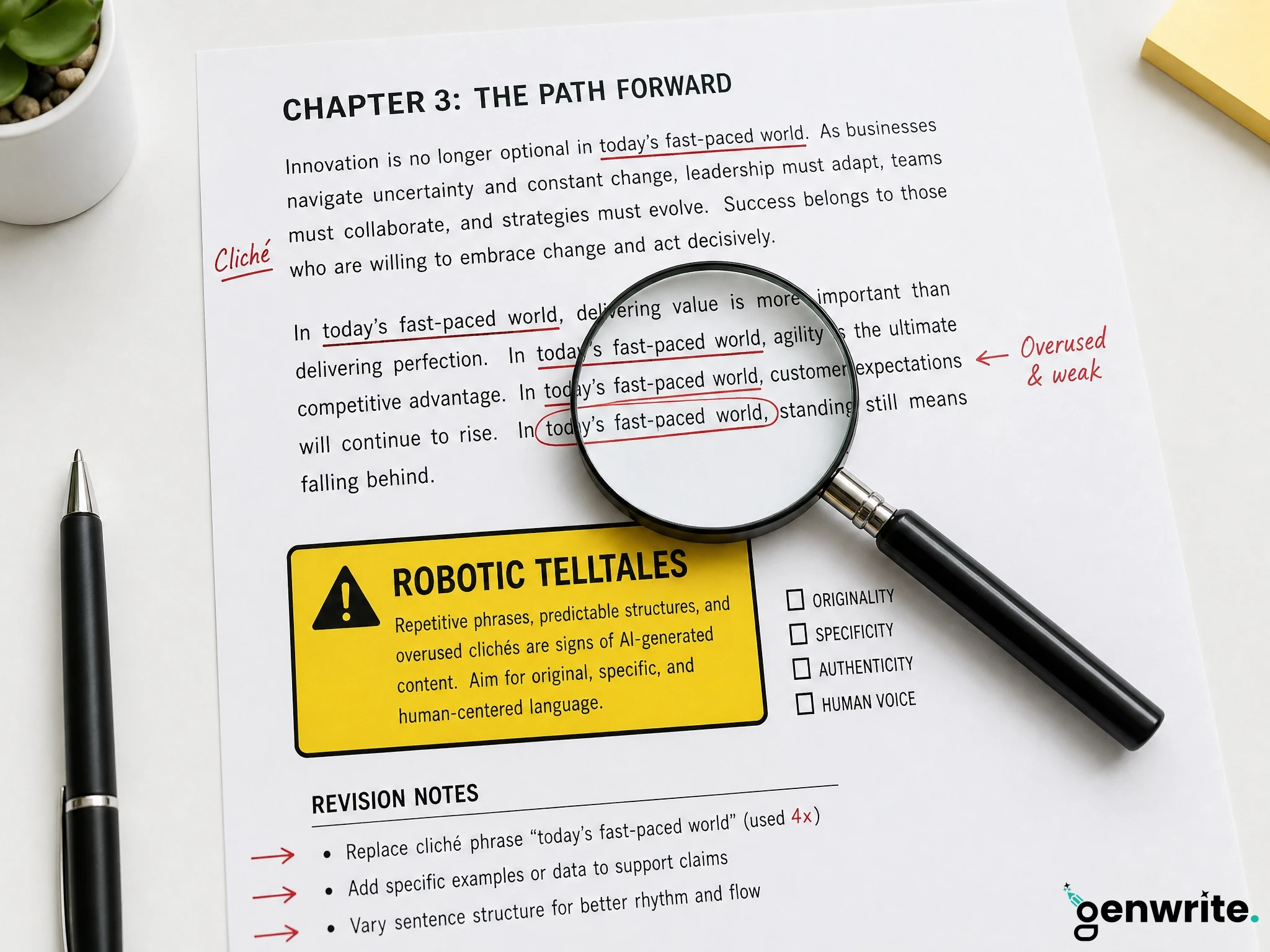
Your readers aren’t stupid. They know when a machine wrote your blog post in five seconds flat. When raw AI text goes straight to publish, it carries obvious footprints that scream “lazy.” Professional editors spot these robotic tells instantly and cut them without mercy to turn automated text into high-quality drafts.
The easiest giveaway is the predictable rhythm. AI loves a three-part list and sentences that all run the exact same length. It writes a medium sentence, then another medium sentence, and then another. It feels like a metronome. Real humans don’t talk like that. We write short. Sometimes very short. Then we expand with a longer, winding thought to let the reader breathe.
Another dead giveaway is the transition word tax. If your content writing workflows allow words like “furthermore” or “moreover” to slip through, you’re losing readers. These words exist only to glue weak paragraphs together. Real writers use simple transitions like “But,” “So,” or “And.” Or they just start the next sentence.
Then there’s the lack of actual opinion. AI is designed to be polite, balanced, and ultimately boring. It hedges every bet. If you ask it about a strategy, it tells you “results may vary.” That passive voice kills trust.
We also see this flat style fail in modern search. Standard keyword stuffing is dead, and search engines now prioritize direct, authoritative answers. If you want to rank today, you need to understand answer engine optimization to format your insights for conversational AI search.
The editor’s hit list
When you audit your automated drafts, look for these specific red flags:
- The compound sentence trap: Watch out for structures that try to balance two ideas with equal weight.
- Perfect summaries: Real articles don’t need a neat little bow at the end of every single sub-heading.
- Empty adjectives: Words like “groundbreaking” or “revolutionary” are just filler. Replace them with hard numbers.
If your draft sounds like a polite textbook, rewrite it.
A real-world framework for modern post-AI editing
The four-step framework for humanizing drafts
Raw machine text is like a rough slab of clay. It has the basic shape, but you need a human hand to shape it into something useful. To turn flat automated drafts into high-ranking pages, we use a systematic four-step approach. This process easily fits into existing content writing workflows without slowing down production.
Step 1: Rebuild the structural logic
Sometimes software gets the basic facts right, but it often builds articles with repetitive loops. It might say the same thing three times using slightly different words. Read the draft purely for flow. Move misplaced paragraphs, delete repetitive fluff, and make sure the introduction gets straight to the point. If a section doesn’t help with optimizing search intent, cut it entirely.
Step 2: Ruthlessly verify facts
But machines are trained to sound confident, even when they are wrong. They invent statistics or attribute quotes to the wrong people. So, check every single number, date, and name. If a draft claims a specific statistic, find the original study. If you can’t find the source, delete the claim.
Step 3: Inject your own data
This is where you build real trust. Add your company’s internal metrics, a quote from your support team, or a quick story about a customer mistake. For example, instead of letting the tool say “SEO takes time,” write: “When we launched our last campaign, it took 45 days to see a shift in rankings.” This unique data is what captures organic search traffic in a crowded market. If you want to learn how to do this quickly, you can read our guide on how to optimize AI blog posts for search.
Step 4: Format for scanners
Most people don’t read every word online. They scan. Break up blocky paragraphs into two or three sentences. Use bullet points for lists of tools or steps. Bold only the absolute most important takeaways so a skimming reader still gets the core message.
Moving from automated text to meaningful communication

A few months ago, I watched a colleague publish fifty raw AI drafts in a single afternoon. He was thrilled with the speed, expecting a massive wave of search rankings by morning. Instead, his analytics showed a flatline. The search engines quickly spotted the lack of depth, and actual human readers clicked away within seconds. It was a stark reminder that speed without substance is just noise.
That experiment proved something I now tell every marketer: raw outputs are just raw materials. When we rethink the relationship between seo and content creation, the goal isn’t to replace the writer’s brain. It is to free it up for the work that actually matters. True editorial oversight is not about resisting new technology, but about setting higher standards for what we publish.
By using an AI blog generator for the heavy lifting, you save hours of staring at blank screens. You get initial outlines, keyword maps, and basic drafts in seconds. But the real magic happens during the rewrite. That’s where you add the hard-won experience, the counter-intuitive advice, and the sharp brand voice that builds real trust. You turn static, generic text into a helpful resource that people actually want to read.
In our own workflow, we stopped looking at drafts as finished products. We started treating them as highly detailed briefs. This shift changed our entire outlook. Instead of spending four hours researching basic facts, our editors spend thirty minutes injecting personality, fixing clunky phrasing, and inserting real-world case studies.
And let’s be honest, this hybrid approach doesn’t always guarantee an instant ranking miracle. Sometimes search algorithms shift, or a competitor brings an even sharper angle to the table. But human-polished content consistently wins the long game for building sustainable organic search traffic. It converts casual visitors into loyal customers because it sounds like a real person wrote it.
So, don’t let automation make your brand lazy. Use smart tools to build the foundation, but always keep your hand on the steering wheel. Your readers,and your bottom line,will thank you for the extra effort.
Tired of spending hours fixing generic AI drafts? GenWrite handles the heavy lifting with built-in editorial quality so you don’t have to rewrite everything from scratch.
FAQ
Why do raw outputs from seo writing tools sound so robotic?
Most models rely on predictable token patterns and average phrasing. That’s why you get flat sentences that lack real point of view or distinct brand personality.
How long does it actually take to fix an AI-generated draft?
Honestly, editors often spend just as much time untangling a bad machine draft as they would writing it from scratch. It’s usually faster to build a better workflow upfront.
Does Google penalize content produced by seowriting ai?
Google doesn’t care if a tool helps you write, but it does penalize low-quality, unhelpful text. If your drafts don’t actually answer user intent, you won’t rank.
What’s the best way to keep my brand voice while using automation?
You’ll want to feed specific style guides, examples, and proprietary data into your process. Generic prompts yield generic results every single time.