
What is answer engine optimization and why does it change how we write?
The quiet end of the blue link era
A shift in how we find answers
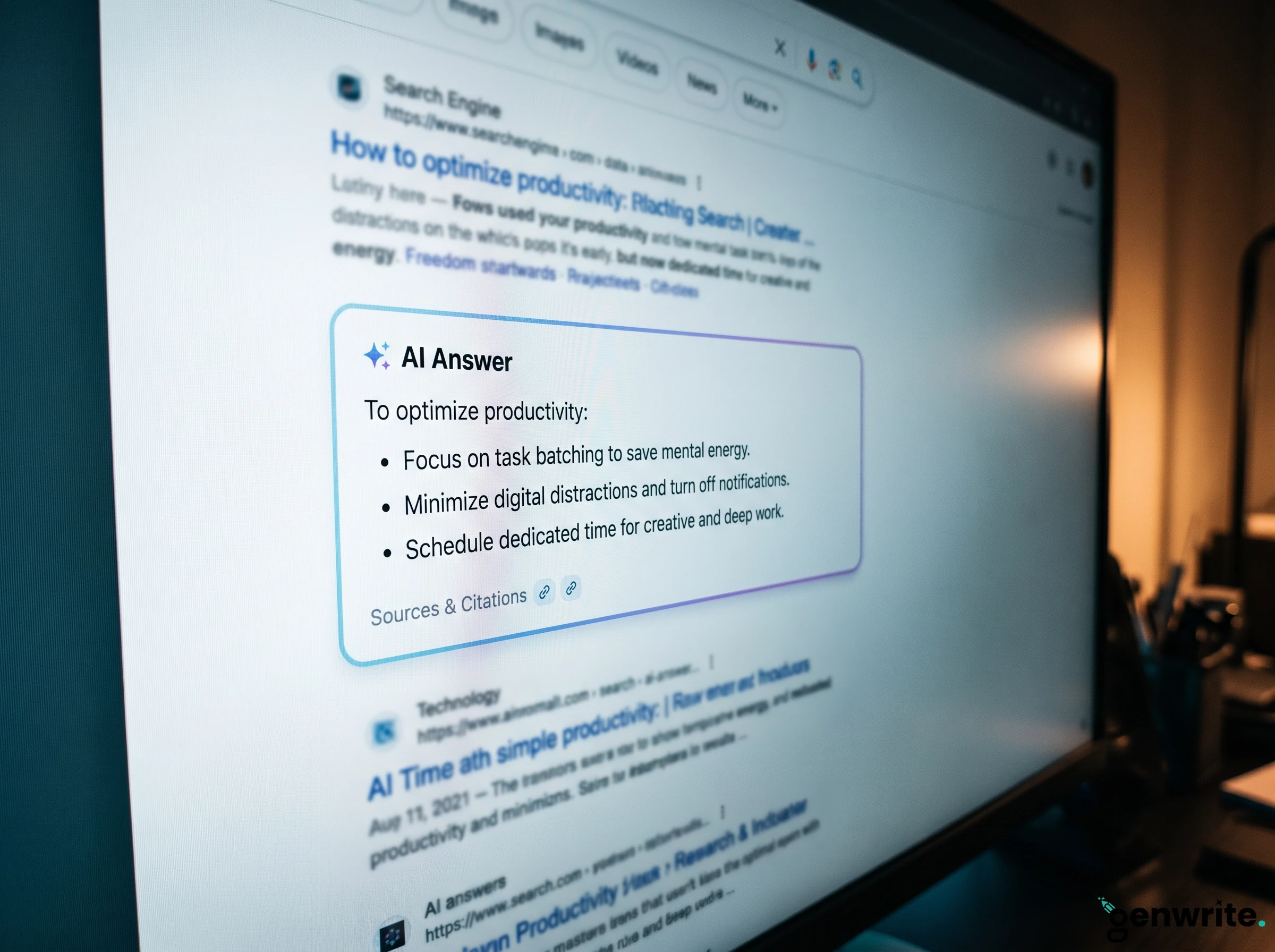
Something fundamental just broke in how we search the web. For decades, the deal was simple. You typed a query, Google gave you ten blue links, and you clicked one. Not anymore. According to SparkToro, over 68% of Google searches now end without a single click.
People don’t really want websites anymore. They want answers, and they want them immediately. With conversational search taking over, users get their solutions right on the results page, completely bypassing traditional sites thanks to AI-generated summaries. If your content isn’t built to feed these engines directly, your organic traffic is dead on arrival.
That’s where answer engine optimization (AEO) comes in. It isn’t about tricking an algorithm. It’s about structuring your knowledge so machines can actually use it.
Doing this manually for every piece of content is a massive time sink. It’s why many teams now rely on an AI blog generator to format and structure posts so AI models can easily cite them. The old playbook of stuffing keywords into 2,000-word essays is dead. If you aren’t the direct answer, you’re invisible.
Defining answer engine optimization for modern creators
What is answer engine optimization?
Answer Engine Optimization (AEO) is how you format web content so conversational AI can grab it and cite it. Forget ranking on page one of Google. AEO targets chat feeds, voice interfaces, and generative summaries.
The goal is simple. You want to be the footnote. When ChatGPT, Google Gemini, or Perplexity build an answer, they crawl the web for facts. If your content is clean and structured, the machine picks you as its source. If it’s messy, you get ignored.
This is a massive shift in how people find things online. ChatGPT and Google’s AI Mode both have over a billion monthly users. Nobody scans ten blue links anymore. They want one direct answer.
Traditional SEO focused on meta tags, keyword density, and backlinks to win a click. Modern answer engine optimization is different. It relies on direct semantic matching, structured data, and clear entity relationships. You aren’t writing for an index anymore. You’re writing for a synthesizer.
Here is how it works.
Old search engines rank pages on popularity and keywords. AI search engines use retrieval-augmented generation (RAG) to pull facts from multiple spots at once. If your point is buried in fluff or metaphors, the crawler skips it.
To win, change your formatting. Use clear Q&A setups. Define terms immediately. Back up claims with hard data. Make your content easy to extract. Stop trying to trick an algorithm with keyword stuffing and start feeding the machine exactly what it needs.
But don’t dump your traditional SEO yet. If search engines can’t crawl your site, an LLM won’t find it either. The index is still the foundation. But how you present that data determines whether an AI agent trusts you enough to quote you.
Why ranking first on Google doesn’t mean what it used to
The brutal math of the new search engine result page
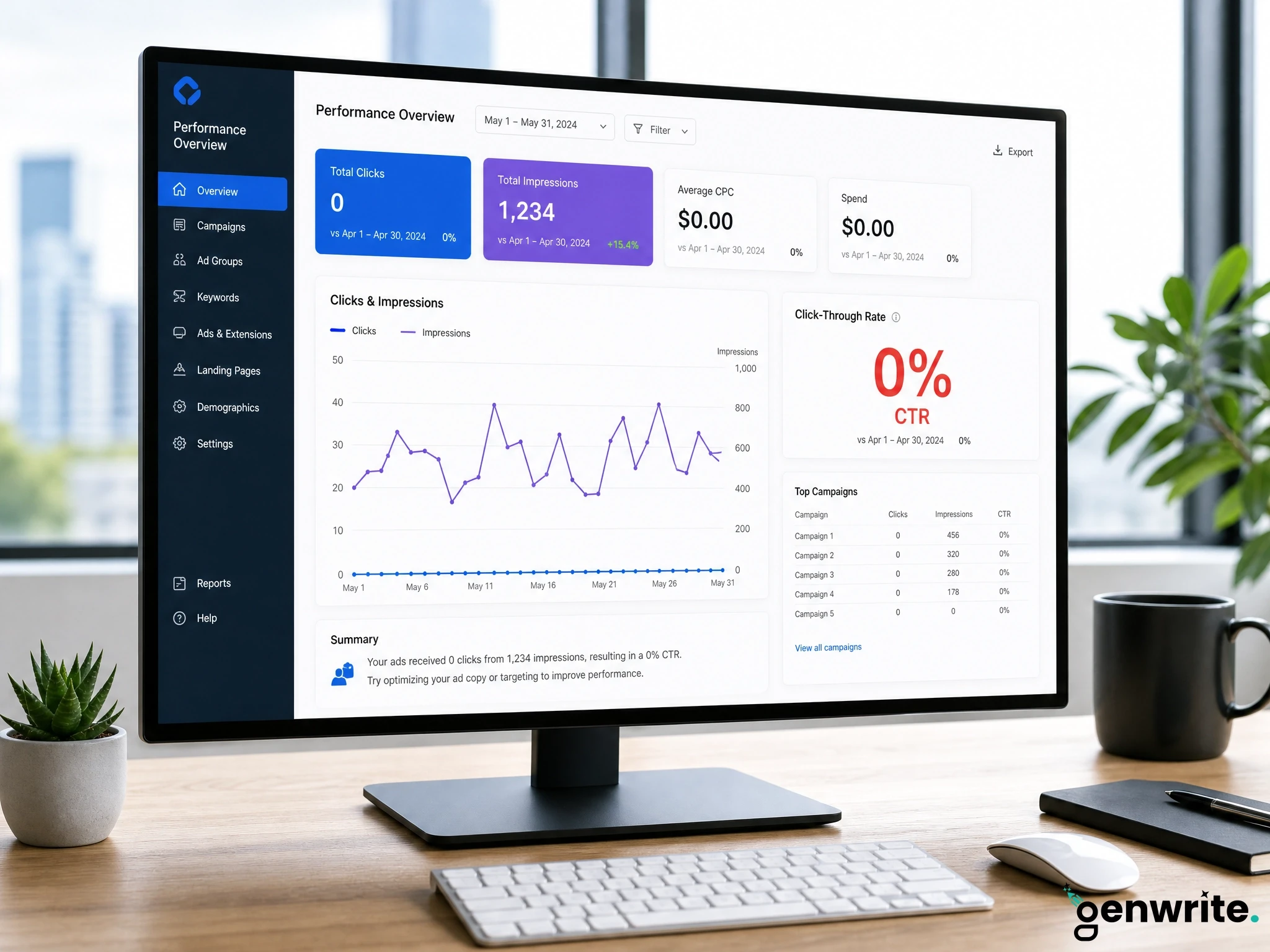
Hitting the number one spot on Google used to mean you won. For decades, that top slot captured roughly 30% of all clicks. Today, that math is broken. When Google’s search generative experience triggers an AI overview, the top organic spot loses about 58% of its expected clicks. The engine answers the query directly. Users don’t need to scroll down to find your link. It’s a quiet death for legacy playbooks that relied on steady search traffic.
But this isn’t just about lost traffic. The high-value users are simply going elsewhere.
While traditional organic clicks shrink, generative AI referral traffic is up by over 206% year-over-year. Users are bypassing standard search bars entirely, choosing to ask conversational engines for direct, personalized recommendations. They want answers. They don’t want a homework assignment of ten blue links.
Inside the highly lucrative citation economy
Here is the real shift: AI referrals are lower in volume, but the traffic is highly qualified. ChatGPT referrals convert at rates up to 15.9%. Compare that to traditional organic search, which usually hovers between 1% and 3%.
These users aren’t browsing. They’ve been pre-filtered by an AI agent that matched their specific intent with your brand. By the time they click through, they are ready to buy.
To survive, your content strategy has to change. Generic, high-volume fluff won’t rank. Using a structured AI blog generator helps automate the production of deeply researched, highly targeted articles that these AI engines actually cite. Modern AEO marketing isn’t about chasing raw, low-intent page views. It is about becoming the authoritative source that the large language model extracts to construct its answer.
Results will vary. Some highly technical B2B sectors might see slower adoption of conversational search than consumer brands. Yet, the trajectory is clear. The citation economy is replacing the traditional link list. Those who adapt their content architecture early will capture the highest-intent buyers on the web. Those clinging to old SEO metrics will find themselves ranking first for keywords that no longer send any traffic.
How do large language models decide who to cite?
How machines read: Inside the RAG pipeline
To understand how AI search engines choose their sources, we have to look past simple keyword matching. Traditional search engines crawl index pages looking for specific word strings. Large language models operate differently through a process called Retrieval-Augmented Generation (RAG). When a user inputs a query, the system doesn’t just scan for matching phrases. Instead, it converts the prompt into a mathematical vector,a string of numbers representing its semantic meaning in a high-dimensional space. The engine then scans its index for content vectors that sit closest to the query vector. This is semantic vector search, and it focuses on finding factual nodes rather than matching exact strings.
This mathematical shift explains why traditional search success doesn’t guarantee AI visibility. A study by Ahrefs highlighted a massive disconnect here: only 12% of the URLs cited by leading LLMs like ChatGPT, Gemini, and Copilot actually appear in Google’s organic top 10 search results. If you’re relying solely on old-school ranking signals, you’re likely invisible to these conversational engines. But Perplexity shows a slightly higher proximity to traditional Google rankings at 28%, though that still leaves nearly three-quarters of its citations coming from outside the top search results. The playbook for ai search optimization is fundamentally changing because the criteria for selection have shifted from page authority to direct semantic alignment.
But how does a crawler decide your content is the perfect factual node? During the retrieval phase of the RAG pipeline, the system evaluates how cleanly a piece of text answers a specific sub-question. It looks for structured, dense information blocks. If your page contains fluff or vague transitions, the mathematical distance between the user’s prompt and your text expands. The model simply bypasses you. Using specialized seo ai tools can help align your content’s structure with these vector models, ensuring your data is easily extractable. It is no longer about stuffing terms; it’s about building clear entity relationships that machines can parse in milliseconds.
So, is this mathematical matching process foolproof? Not quite. Retrieval systems still struggle with nuance, and sometimes highly relevant pages get ignored because their formatting is slightly non-standard. Results vary based on how frequently a model’s index is refreshed. Yet, the trend is clear: if your content doesn’t directly resolve the vector query, it won’t get cited. You must write for both the human seeking an answer and the neural network calculating cosine similarity.

Structuring your content for immediate extraction
Formatting for the machine’s eye
AI crawlers don’t read your blog posts the way humans do. They don’t appreciate poetic build-ups or slow-burn introductions. Instead, they scan your pages for immediate, extractable answers to specific user queries.
To win in this environment, your AEO content strategy must prioritize extreme structural clarity. The easiest way to do this is through an “answer-first” framework. When a section addresses a specific question, your text should answer it directly in the very first sentence.
Many standard seo writing tools churn out paragraphs of fluff before getting to the point, which is why human editing and structural refinement remain so important. Place your concise, 30-word direct answer right at the top of the block. Then, use the subsequent paragraphs to provide supporting data, context, and nuances. But if you don’t do this, the crawler will likely bypass your page in favor of a competitor who got straight to the point.
Next, look at how you present data. If you are comparing products or listing specifications, never embed this information as an image. AI search agents cannot reliably parse text locked inside a JPEG or PNG file. And always use clean, semantic HTML tables instead. Crawlers can scrape table rows instantly, pulling your structured comparisons directly into conversational search results. I have seen countless sites lose valuable citations simply because they hid their pricing tables inside graphics.
The rules of clean hierarchy
Your heading tags must follow a strict, logical sequence. Do not jump from an H3 directly to an H5 just because you prefer the font size. This hierarchy acts as an architectural map for LLM crawlers, helping them understand the relationship between parent topics and subtopics.
- Use bulleted lists for sequential steps or lists of items.
- Keep your paragraphs short to make extraction easier for scraping algorithms.
- Avoid complex nested layouts that confuse basic parsers.
While this rigid structure might feel restrictive to creative writers, it is the tax we pay for visibility in conversational search. Admittedly, this format doesn’t always feel natural at first, but the reality is clear. If a machine cannot easily extract your words, it will simply find another source that is easier to read.
Why you shouldn’t throw out your SEO playbook just yet
The foundational layer: traditional SEO meets AEO
People love to declare old marketing channels dead whenever a new technology emerges. But the rush to adopt answer engine optimization doesn’t mean you should abandon your core search strategy. In fact, doing so would be a critical mistake. Think of AEO not as a replacement, but as an advanced layer built directly on top of traditional technical search practices.
To understand why, we have to look at how large language models actually gather their information. They don’t magically invent data out of thin air. Instead, systems like Perplexity, Gemini, and OpenAI’s SearchGPT rely heavily on traditional search engine indexes to discover, crawl, and verify web pages.
If your site has crawl errors, poor site architecture, or terrible load speeds, these bots won’t even find your content. Traditional indexing remains the ultimate gatekeeper.
And let’s be honest: Google still drives the overwhelming majority of global web traffic. Standalone conversational engines are growing rapidly, but they still represent a fraction of daily queries. Granted, some informational niches are seeing faster shifts than others, but the math simply doesn’t support abandoning the classic search engine optimization playbook yet.
This is where the concept of E-E-A-T (Experience, Expertise, Authoritativeness, and Trustworthiness) becomes the ultimate bridge between the old way and the new. AI systems are programmed to avoid hallucinating false facts, meaning they prioritize highly trusted sources. They use traditional authority signals (like high-quality backlinks and structured schema data) to decide which domains are safe to cite in their generated responses. If Google doesn’t trust your site, an LLM won’t either.
Using modern AI SEO tools can help you bridge this gap by generating content that satisfies both traditional search crawlers and conversational algorithms. But tools alone won’t save a site with weak authority. You still need real-world trust. Traditional SEO builds that trust over time; AEO simply packages it for the machines to read.
| Traditional SEO Focus | Answer Engine Optimization (AEO) Focus |
|---|---|
| Crawlability and indexation | Entity recognition and semantic context |
| Keyword density and search volume | Natural language query resolution |
| Backlink volume and PageRank | E-E-A-T and factual verification |
| Click-through rate (CTR) to site | Direct extraction and citation placement |
So, instead of rewriting your entire digital strategy, focus on alignment. Ensure your technical SEO is flawless, your schema markup is clean, and your content is genuinely authoritative. Once those pieces are in place, adjusting your writing style for machine extraction becomes a natural next step rather than an uphill battle.
How does conversational phrasing rewrite exact-match keyword logic?
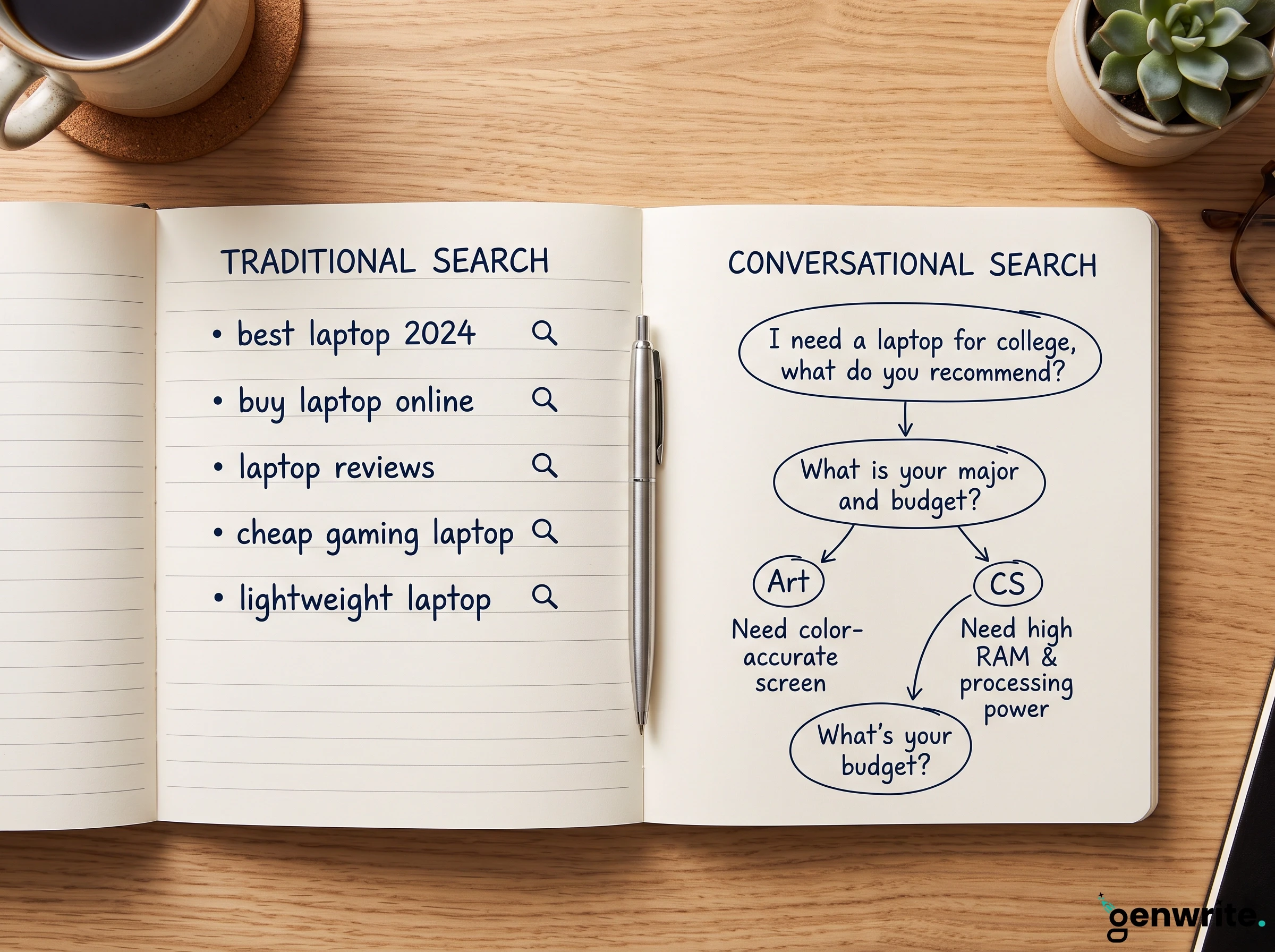
Why do we still write for search engines as if humans communicate in broken, disjointed fragments? When was the last time you actually spoke the words “best AEO tools” to another human being? The reality is that the era of typing robotic, two-word queries into a search bar is rapidly collapsing. That’s why we must adapt. As users increasingly type natural questions into LLMs or speak directly to their devices, how must our content adapt?
The shift lies in the fundamental architecture of the query itself. Traditional search relied on fragmented, high-volume keywords. But modern conversational search patterns are long-tail, highly contextual, and heavily structured around natural human phrasing. Consider the massive leap from a user typing “AEO tools” to asking, “How can my agency optimize for voice search on Siri and Alexa in 2026?” The second query isn’t just longer; it contains intent, a specific persona, and a clear timeline.
How do we capture this highly qualified traffic without stuffing our pages with clunky, unnatural sentences? We do it by structuring our prose to mirror the way people actually speak. This is where optimizing for voice search becomes less about gaming an algorithm and more about intuitive, question-and-answer formatting. If your content doesn’t directly answer the specific questions your audience is asking, AI crawlers will simply bypass your page.
Does this mean traditional exact-match keywords are completely dead? Not necessarily, but their dominance has certainly waned. The evidence suggests that while keyword volume still matters for basic indexing, semantic context is what wins the citation. By aligning your writing with natural, spoken inquiries, you’re not just optimizing for a machine,you’re writing for the actual human on the other side of the screen.
Where most marketing teams trip up
The technical blind spots hiding in your stack
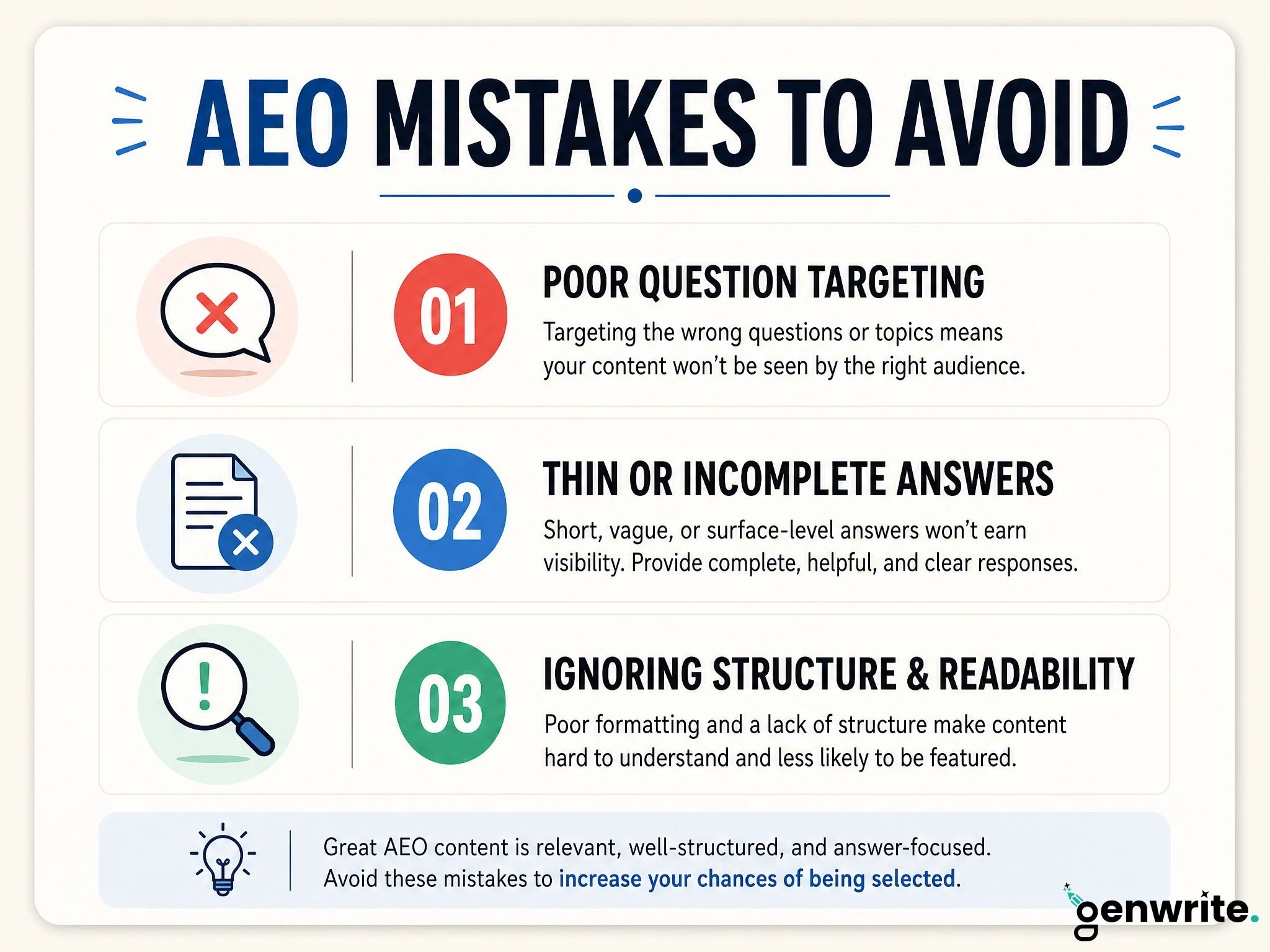
Most marketing teams are actively sabotaging their search visibility without realizing it. They spend months building an elaborate AEO content strategy and investing in AEO marketing campaigns, only to block the very systems they want to attract.
Look at your robots.txt file. In an attempt to protect proprietary data, many web developers accidentally block user-agents like GPTBot, ClaudeBot, or OAI-SearchBot. If these crawlers can’t read your pages, your brand won’t exist in the conversational index. It’s really that simple. You can’t optimize what you’ve locked away from the machine.
Another massive friction point is the classic “recipe blogger” intro. If your article starts with a 300-word personal anecdote or philosophical musing before answering the core query, an LLM scraper will likely skip your site entirely. These systems want immediate, structured data extraction. When you bury the lead under layers of fluff, you lose the citation to a competitor who gets straight to the point.
We also see brands failing to audit their own digital footprint. Have you actually tested how Gemini or Perplexity describes your product? Most teams haven’t. They assume their old keyword maps translate directly to conversational engines, but they don’t. Ignoring secondary search intent,the natural follow-up questions a user asks after their initial prompt,leaves massive gaps in your coverage.
To fix this, forward-thinking teams are moving away from slow, manual editorial audits. They’re using modern AI SEO tools to analyze competitor gaps and structure content for immediate machine retrieval. Admittedly, this shift won’t solve a broken technical foundation overnight, but it stops you from flying blind.
Stop guessing how engines see your brand. Check your crawler permissions today, cut the introductory fluff, and start structuring your data for direct extraction. If you don’t, your competitors will gladly take those conversational citations.
Your roadmap for the next search horizon
Navigating the new discovery environment
We are transitioning away from the era of sheer volume. For years, the winning playbook was simple: publish more pages, target more long-tail keywords, and wait for the traffic to roll in. That approach is officially dead. To survive the shift toward conversational search, your team must stop acting like a high-velocity assembly line.
The future belongs to creators who position themselves as primary sources of verified facts. Large language models do not care about fluff; they seek semantic precision and structured data that can be parsed instantly. This is where modern AI writing tools become indispensable. Instead of using technology to spam the web with generic text, smart marketers use an advanced AI blog generator to handle the heavy lifting of structural formatting, keyword mapping, and competitor analysis. This frees up human editors to inject unique data, proprietary insights, and real-world case studies that machines cannot invent.
Admittedly, this transition won’t happen overnight, and search engine algorithms will likely shift unpredictably along the way. But the core principle remains solid. Winning at modern ai search optimization requires a commitment to clarity. Structure your pages with clean schema, answer questions directly without dancing around the point, and treat your website as an authoritative database. The bots are scanning your site right now,give them something undeniable to cite.
Your roadmap must prioritize turning static articles into dynamic, highly structured entity assets. Think of your content as an API for search bots. If an algorithm cannot extract your key takeaways within three seconds of crawling, you do not exist in the conversational ecosystem. It is a harsh reality, but it forces us to write with greater intent and honesty.
Tired of spending hours updating your content for AI search? GenWrite automates keyword research and optimization so you don’t have to.
FAQ
How does answer engine optimization differ from traditional SEO?
Traditional SEO focuses on ranking blue links on a search engine results page. AEO aims to get your brand cited directly inside AI-generated summaries and conversational answers where users don’t even click through to a website.
Why are AI Overviews hurting organic click-through rates?
They answer the user’s question right at the top of the page. Most people get what they need immediately, meaning they’ve got zero reason to scroll down and click your link.
What kind of content structure works best for AI citation?
Clear headings, bulleted lists, and concise paragraphs make it easy for large language models to extract data. Honestly, writing straightforward answers right under your subheadings is usually your best bet.
Can I just use my old keyword strategy for AEO?
Not really. Exact-match keywords don’t cut it anymore because people type conversational, multi-clause questions into AI tools instead of choppy search phrases.