
How does seowriting ai hold up against classic editors?
The friction point: why we are suddenly questioning our writing setups

We’ve all stared down that blinking cursor. You sit there, glaring at a blank Google Doc, wondering how to kick off your next post. For years, this was just how writing worked. We did it all by hand. But the web is changing too fast for the old ways to keep up.
Google isn’t just a directory of blue links anymore. AI search engines now summarize answers right at the top of the page, which means searchers get what they need without ever clicking through to your site. It’s a massive shift. That’s why I keep telling creators that traditional SEO is dead in the water unless you adapt. We have to rethink our entire approach, especially now that generative engine optimization decides how these new engines extract and display our information.
Naturally, teams are questioning their setups. Do you stick with a basic text editor, or do you jump ship to specialized SEO writing tools? Platforms like Seowriting AI promise to handle the heavy lifting by researching keywords and drafting articles in seconds.
We see this friction every single day at GenWrite. Writers want to craft great pieces, but they also have to move fast enough to stay visible. Spend five hours writing a beautiful post that nobody ever finds? You lose. Publish a mountain of low-quality AI spam? You also lose, just faster. The real challenge isn’t choosing between humans and machines. It’s figuring out how to make them work together without losing your soul.
Seowriting ai vs classic editors: defining the boundary lines
Let’s draw a line in the dirt.
On one side, you have classic editors like Google Docs or WordPress’s Gutenberg. They’re blank canvases. They give you total control over every single comma, but they do absolutely nothing to help you rank on Google. You do all the heavy lifting. You type every word, research every keyword, and format every heading manually. It’s slow. If you need to scale, it’s exhausting.
On the other side, you have automated tools like SEOWriting AI. This is a dedicated seo content creator built to pump out articles in bulk. For $19 a month, it promises one-click drafts and direct publishing to your site. It’s built for speed, not deep creative reflection. But let’s be real here: those one-click drafts often sound like a robot wrote them because, well, a robot did. You still need to edit them if you want real humans to actually read them.
So, who wins?
It depends on your goal. If you’re writing a deeply personal essay, stick to Google Docs. But if you need to build search traffic fast, a blank page is just a massive bottleneck. Modern marketing demands volume. Using an ai seo content generator bypasses the blank-page panic by building the skeleton of your post in seconds.
Think of it as choosing between a hand shovel and an excavator. A classic editor lets you carve out precise details. But a modern seo writer ai clears the field so you can build faster. You still have to drive the machine, but you aren’t breaking your back doing the basic digging.
How the features stack up under the hood
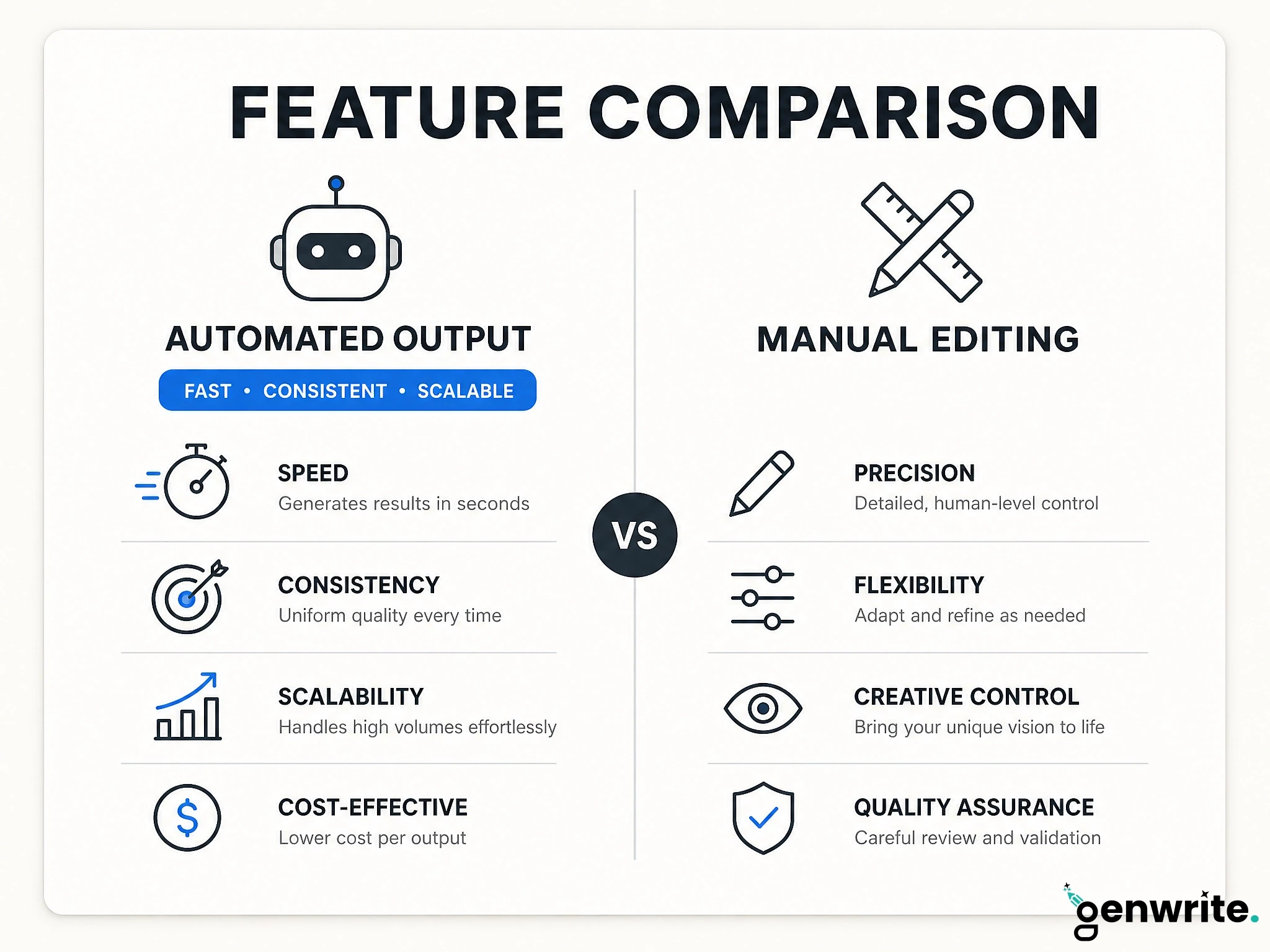
Strip away the interface, and the core difference between a classic editor and an AI writer is integration. A standard editor is just a blank page. It does not help you rank. To get a post ready for Google, you end up juggling tabs: Ahrefs for keywords, competitor pages for structure, and Canva or Unsplash for images. This constant context-switching kills your writing flow and drains hours of strategic time.
An AI writing seo tool like SEOWriting AI consolidates this workflow. It scrapes SERP data to generate an outline, maps keywords to specific sections, and renders images in a single run. Instead of manually mapping 50 LSI keywords from a spreadsheet, the engine distributes them across your H2s and body copy. You go from a blank page to a complete draft in minutes. But speed is not the only metric. Search is shifting toward machine synthesis. Your content needs to be structured so AI crawlers can easily parse and cite it.
| Feature | SEOWriting AI | Classic Editor (e.g., Google Docs) |
|---|---|---|
| Drafting Speed | 5-10 minutes per draft | 2-4 hours per draft |
| Keyword Insertion | Automated based on top SERP competitors | Manual research and insertion |
| Media Generation | Built-in AI image models | Manual stock photo search or design |
| Formatting | Auto-structured with schema-friendly headers | Manual formatting and styling |
This structure is the foundation of answer engine optimization. When search engines pull direct answers for featured snippets, they look for clean tables and bulleted lists. In Google Docs, you build these manually. AI writers format them out of the box. They tag H2 and H3 headers correctly, place target terms where search bots expect them, and generate clean HTML lists designed for machine readability.
But automation has a ceiling. SEOWriting AI builds drafts by analyzing what already exists online. If every competitor on page one misses a critical nuance, the AI will miss it too. You get a highly optimized echo chamber. A classic editor, on the other hand, gives you absolute control over the narrative. It forces you to rely on proprietary data, personal experience, and unique case studies. These are the exact elements that algorithms cannot invent.
Classic editors remain the best choice for deep, original thought. But if you need to build a solid, keyword-optimized foundation at scale, automated platforms eliminate the manual friction. They handle the repetitive formatting so you can focus on editing.
Where each platform hits its limit
Raw drafts from automated seo writing tools often produce generic, repetitive, or robotic text. Real editors frequently have to rewrite these drafts completely to avoid reader fatigue and maintain quality. Yet, relying solely on a blinking cursor in a blank document carries its own heavy tax. Let’s look at where both approaches break down under real production pressure.
the breaking point of raw automated drafts
AI content generators run on statistical probability. That means they pick the next most likely word, not the most insightful one. So you end up with paragraphs that sound confident while saying absolutely nothing new. Readers spot this manufactured tone instantly. And search engines are getting better at filtering out fluffy paragraphs built on empty keyword stuffing.
Another pain point is hallucinated facts. An ai seo writer might invent a statistic or misattribute a quote with terrifying confidence. If you publish without checking, your brand’s credibility takes a direct hit. But fixing every factual error across twenty articles a week defeats the speed advantage.
the hidden costs of the classic blank page
Classic editors like Google Docs or Microsoft Word give you total control over every single comma. But control has a price, and that price is time. Staring at a blank screen waiting for inspiration kills publishing velocity. You spend three hours debating an intro paragraph instead of building your business.
Manual optimization is also easy to mess up. You might forget to add internal links, miss a crucial semantic keyword, or leave out meta descriptions. By the time you research keywords, format headings, and source images, your content calendar is already weeks behind schedule. Results vary depending on how much coffee your team drinks, but pure manual output rarely scales.
finding the balance in the middle
Neither extreme works for modern publishing teams. Pure automation leads to bland output that readers bounce away from in seconds. Pure manual creation leaves you exhausted and outpaced by competitors publishing at high volume. The smart play is recognizing these limits before you pick your stack.
When to choose one-click engines over human-first blank pages

Choosing between a fast tool like seowriting ai and a classic blank page depends entirely on your goals. If you’re looking to build topical authority fast, one-click engines are excellent. They build solid outlines and draft basic guides in seconds.
But if you’re writing a deep case study or a high-converting sales page, start in a classic editor. Raw AI drafts often lack the personal stories and unique data that search engines love. If you publish raw drafts without editing, search performance usually drops. To keep your traffic up, you must learn how to rank AI generated content by adding real human value.
Here is a simple breakdown to help you decide which path to take.
Go with an automated seo writing tool when:
- You need to build topical authority quickly across dozens of basic keywords.
- You are creating straightforward listicles or simple dictionary-style definitions.
- You have an editor ready to polish the draft and inject first-party data.
Stick to a classic editor when:
- You are writing thought leadership or opinion columns.
- Your content relies on original research, interviews, or hands-on product reviews.
- You are targeting high-intent landing pages where every single word must convert.
If you want to scale up your output without losing that human touch, using a smart AI blog generator to build your initial drafts saves hours of staring at blank pages. But don’t just hit publish. The real magic always happens during the editing phase.
Real workflows: how modern teams use both without losing their minds
Sarah runs content for a growing online store. Last year, her team spent three weeks writing just four detailed product guides. They were exhausted, and their traffic was flat. She knew they needed to scale, but she feared losing her brand’s unique voice.
So, she changed the playbook. She brought in an AI blog generator to handle the heavy lifting. Now, her team uses an ai seo content generator to spin up first drafts of generic list articles and basic comparison posts in minutes. This quick start frees up her writers to focus entirely on polishing. They spend their energy adding real customer quotes and hands-on testing notes in Google Docs instead of staring at blank screens.
Their new pipeline is simple. First, they generate the bulk draft. Next, a writer takes that draft into a classic editor to inject original research and clean up the flow. Finally, they upload it directly to WordPress.
The hybrid model works because it respects the limits of both tools. For example, Sarah still drafts deep case studies manually from scratch. Why? Because AI cannot interview a client. But for high-volume keyword targeting, relying on the best seo ai writer saves her team over twenty hours a week.
This setup is not always perfect. Sometimes the AI drafts need heavy editing because the tone feels a bit too robotic. Yet, by separating bulk drafting from creative editing, her team increased their monthly publishing output by 300% without hiring more staff.
Finding the sweet spot
Another team we spoke with uses a different approach. They write their main thought-leadership pieces entirely in a classic editor. Then, they feed those finished pieces into an AI tool to spin off ten smaller, SEO-focused support articles. This hub-and-spoke method ensures the core ideas remain deeply human, while the automated engine builds out the search footprint.
Is it time to rewrite your content strategy entirely?

Can we honestly keep pretending that a blank page in a classic editor is the only way to build a credible brand? The truth is that search engines changed. People now ask conversational questions instead of typing clunky keyword strings into a search bar. If your current workflow relies on staring at a blinking cursor for three hours just to draft a single post, you’re fighting a losing battle against volume. But does trading the blank page for an automated tool mean abandoning your voice? Not necessarily. Winning today means treating an AI blog generator as a tireless first-draft assistant rather than a magic publishing button. You still need human oversight to inject real-world experience, but you no longer need to handle the tedious research phase alone. So how should you actually structure your next quarter? Stop treating AI tools and classic editors as enemies. Use automation to handle the heavy lifting of keyword clustering and competitor outlines. Then, bring that draft into your favorite editor to polish the rough edges and add personal anecdotes. When you align your strategy with answer engine optimization, you stop worrying about exact-match keywords and start answering actual user intent. Results vary depending on your niche, but the teams winning right now are the ones blending machine speed with human taste. What will your next publishing cycle look like?
Tired of wasting hours trying to balance AI drafts with manual edits? GenWrite handles the heavy lifting of SEO optimization and publishing so you don’t have to.
FAQ
Can SEOWriting AI completely replace a human editor?
Honestly, no. While it’s great for fast drafting, you’ll still need human eyes to catch tone issues and add original insights that search engines love.
How does an AI writer compare to Google Docs for daily blogging?
Google Docs gives you total blank-page freedom, whereas tools like SEOWriting AI churn out structured, keyword-optimized drafts in seconds. Most teams use both by generating the base with AI and polishing it in Docs.
Is AI-generated content penalized by search engines?
Not if it’s actually helpful. Google cares about quality, not whether a machine helped you write it. That’s why editing AI drafts before publishing is a non-negotiable step.
Why should I use an AI tool instead of writing from scratch?
It saves you from staring at a blinking cursor for hours. If you’re publishing at scale, automating the first draft frees up your schedule for high-level strategy.