
Scaling Content with AI: An Agency’s Guide to Smarter SEO in 2026
The Rise of the AI Automation Agency: Market Demand and Search Trends in 2026
The digital marketing landscape is undergoing an unprecedented shift as we head into 2026. The rapid evolution of search behavior and client expectations has fueled an explosive rise in interest for automated solutions. Recent search data highlights this massive transition: the ai automation agency search volume 2026 has experienced an exponential surge of over 210% year-over-year. This trend underscores a deeper market reality—traditional marketing agencies must adapt to autonomous workflows or risk obsolescence. As businesses demand faster execution and highly precise, data-driven strategies, specialized AI automation agencies are stepping in to capture this growing market share.
Industry projections indicate that the global market for AI automation services is expected to reach $18.4 billion by 2026, with SEO and content operations driving nearly 35% of this demand. For forward-thinking marketing agencies, integrating automated systems is no longer a luxury but a core operational requirement, with over 65% of mid-to-large-scale agencies already implementing autonomous workflows to scale their service delivery.
Traditional Agency vs. AI Automation Agency: Capturing Search Intent
To understand why this transition is occurring, we must look at how an AI automation agency operates differently from a legacy digital marketing agency. Traditional setups rely heavily on manual keyword mapping and static user personas, which fail to capture the real-time shifts in modern search intent.
| Operational Dimension | Traditional Marketing Agency | AI Automation Agency |
|---|---|---|
| Search Intent Analysis | Manual, periodic keyword research (monthly/quarterly) | Real-time, continuous intent tracking using LLMs |
| Content Generation | Human-only writing with slow turnaround times | AI-augmented production with tools like GenWrite |
| Technical Auditing | Scheduled monthly site crawls and manual fixes | Autonomous, self-healing code and instant schema deployment |
| Scalability | Linear (scaling requires hiring more headcount) | Exponential (scaling handled via automated workflows) |
Market Projections and Search Volume Trends in 2026
The astronomical growth of the AI automation agency is backed by strong market indicators. The rising interest reflected in the ai automation agency search volume 2026 points to a broader shift in how enterprises source marketing services.
This growth is driven by several key factors:
- Fragmentation of Search: Users no longer rely solely on Google. Search volume is split across traditional search engines, conversational AI engines, and social media search. An AI automation agency uses multi-channel optimization to capture intent across all these touchpoints simultaneously.
- Efficiency Demands: By adopting automated pipelines, marketing agencies can automate up to 45% of legacy SEO tasks, allowing teams to focus on high-level strategy.
- Algorithmic Adaptability: Real-time algorithm updates require instantaneous adjustments. Automated workflows monitor search engine fluctuations and automatically adjust meta tags, schema, and content structures within minutes of an update.
Redefining SEO with AI-Powered Workflows
This transformation is not about replacing human creativity, but augmenting it. AI is revolutionizing how we approach keyword research, content creation, on-page optimization, and link building. The sheer scale and precision that AI SEO optimization tools offer allow modern agencies to analyze vast datasets, identify trends, and generate highly optimized content at speeds previously unimaginable.
Consider how an AI blog generator like GenWrite can automate the end-to-end blog creation process. It researches keywords, analyzes competitor content, and crafts high-quality, SEO-friendly content designed to rank. This allows agencies to scale their content output dramatically without compromising on quality or search engine guidelines.
Agencies that embrace these advanced tools are poised to Outperform Competitors: How AI SEO Tools Achieve Faster Google Rankings by 2026. They gain a significant edge in visibility and market share. Those who hesitate risk being left behind, struggling to compete with the efficiency and analytical prowess of AI-driven strategies.
Why Can’t Traditional Content Strategies Keep Pace with 2026’s Search Engines?
The landscape of search has undergone a radical transformation, rendering traditional content strategies increasingly ineffective. What worked even a few years ago is now struggling to maintain relevance against the sophisticated, AI-driven algorithms of 2026. Marketing agencies relying solely on manual keyword research and content creation are finding themselves at a significant disadvantage, unable to scale content at the speed or precision required.
The Slow Demise of Manual Optimization
Traditional approaches are inherently slow and resource-intensive. Imagine the painstaking process of manual keyword research, competitive analysis, and then the lengthy cycle of human-led content creation, editing, and optimization. This model simply cannot keep pace with search engines that are now prioritizing content optimized with machine learning. While human creativity remains vital, the heavy lifting of data analysis and rapid content generation has shifted.
The agility offered by AI is no longer a luxury but a necessity for competitive ranking.
By 2026, AI is projected to automate up to 40% of SEO tasks, dramatically increasing efficiency for agencies. The chasm between manual and AI-powered strategies is widening, making it difficult for traditional methods to compete. Where manual processes might produce a handful of thoroughly optimized articles per week, AI can generate volumes of high-quality content tailored to specific semantic clusters, allowing agencies to truly scale content.
Data Deficiencies in Traditional Content
One of the biggest limitations of traditional content strategies is their struggle with data analysis at scale. Modern search engines evaluate content not just for keywords, but for semantic relevance, user intent fulfillment, and comprehensive topic coverage. Manually uncovering these intricate relationships across vast datasets is nearly impossible.
Traditional methods lack the deep, data-driven insights needed for superior ranking. This is why AI-optimized content ranks 30% higher on average than non-AI optimized content. Agencies find themselves playing catch-up, constantly reacting to algorithm changes rather than proactively shaping their content strategy.
The Urgency for SEO Content Automation Tools
For marketing agencies, the inability to adapt means losing market share. Without leveraging SEO content automation tools, agencies are missing out on the opportunity to reduce content creation costs by up to 60% while simultaneously boosting organic traffic. The market for AI in SEO is expected to hit $12 billion by 2026, signaling a universal shift towards these advanced solutions.
Consider the power of an AI blog generator like GenWrite, which automates keyword research, competitor analysis, and content creation, ensuring every piece is highly optimized for today’s search demands. This allows agencies to efficiently scale content that aligns perfectly with search engine guidelines and Large Language Models (LLMs).
Agencies relying on traditional methods risk being left behind by competitors leveraging AI for superior performance.
The choice is clear: embrace the speed, data-driven accuracy, and scalability that AI offers, or contend with diminishing returns from outdated content strategies. The future of content creation for marketing agencies lies in intelligent automation, not in the manual grind. As I’ve discussed in “Outrank Rivals: AI SEO Software vs. Traditional Methods for 2026 Speed”, the shift from manual SEO to AI-driven strategies is not just an upgrade; it’s a fundamental change in how we achieve visibility and drive results. If you’re an agency aiming for faster Google rankings, exploring how AI-driven content is the key to mastering SEO is paramount.
What Exactly is AI-Powered Content Generation and How Does It Work for SEO?
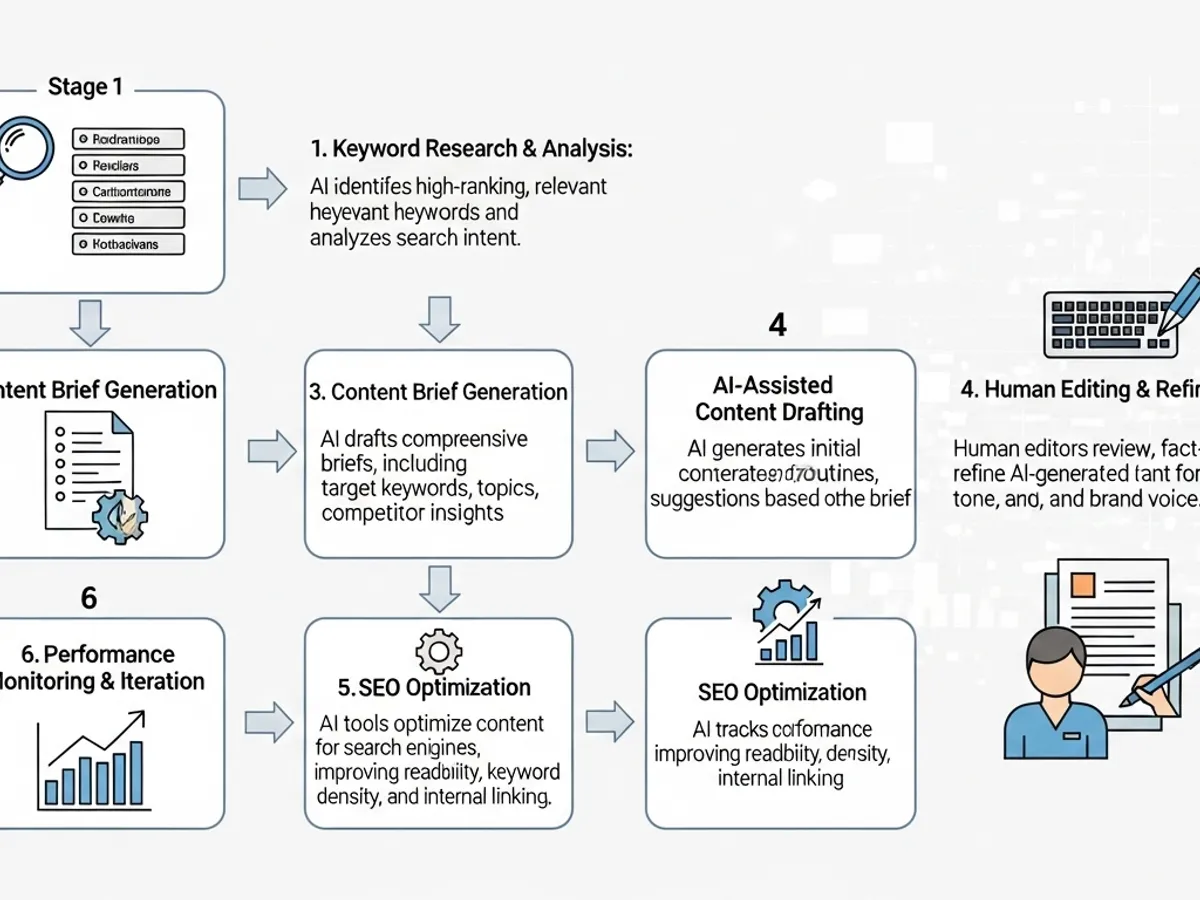
What exactly defines AI-powered content generation, and how has it become indispensable for modern SEO? At its core, AI-powered content generation leverages advanced Natural Language Processing (NLP) and machine learning models to create text that is not just readable, but also optimized for specific goals. This isn’t about simple spinning; it’s about intelligent synthesis.
These sophisticated systems analyze vast datasets, understanding linguistic patterns, factual information, and, critically for agencies, search engine algorithms. They identify semantic relationships and gaps in existing content, then construct comprehensive content outlines, draft paragraphs, and even suggest relevant internal and external links.
For SEO, this process begins with data. An AI SEO content generator ingests crucial information like target keywords, competitor content, search intent, and current trends. This systematic approach ensures every piece of content is built on a foundation of data-driven insights, making it inherently more likely to rank.
Imagine an AI SEO blog writing software that not only generates articles but also performs granular keyword research, competitive analysis, and identifies optimal content structures. This level of automation frees up agency teams to focus on strategy and client relationships, rather than repetitive content production tasks.
Tools like GenWrite automate the entire end-to-end blog creation process, from initial keyword research and competitor analysis to drafting, adding relevant links and images, and even publishing. This drastically reduces the time and cost associated with content production; in fact, AI-driven content generation can reduce content creation costs by up to 60%.
How does this translate to better SEO? By automating the optimization process, these tools ensure content consistently meets search engine guidelines and user intent. AI can identify trending topics and optimize content for specific keywords with a precision that’s difficult for human writers to maintain at scale.
AI-optimized content ranks 30% higher on average than non-AI optimized content. An AI writing tool doesn’t just create text; it crafts content designed to capture and convert search traffic, aligning with the evolving demands of answer engines and large language models (LLMs). This means superior performance in competitive search landscapes.
Ultimately, AI-powered content generation acts as an intelligent assistant, enabling agencies to produce high-quality, SEO-optimized content at an unprecedented scale, directly translating to increased organic reach and traffic. To learn more about how AI SEO software can accelerate critical optimization tasks and content creation, see our guide on AI tools for SEO optimization.
Which AI SEO Tools Are Essential for Agencies to Scale Content Effectively?
As agencies pivot towards 2026, the question isn’t whether to use AI, but which AI tools for SEO are truly indispensable for scaling content effectively. The era of manual, labor-intensive content production is quickly becoming a relic, replaced by sophisticated AI solutions that deliver both speed and precision.
AI-Powered Research & Strategy Tools
Effective content begins with insightful research. Traditional keyword research often misses the nuanced intent behind queries. Modern AI tools, however, delve deep into semantic relationships, competitive landscapes, and emerging trends to uncover high-potential topics. They don’t just provide keywords; they map out entire content clusters, helping agencies build comprehensive and authoritative topical coverage.
-
Benefit for Agencies: These tools reduce research time by up to 70%, allowing strategists to focus on innovative content angles rather than data sifting.
Understanding search intent is the bedrock of ranking success.
SEO AI Software for Content Writing
This category represents the core of content scaling. Agencies can no longer afford to draft every piece of content from scratch. SEO AI software for content writing automates the initial content generation, providing high-quality drafts that are optimized from conception. These platforms are not just spinning articles; they leverage sophisticated Natural Language Processing (NLP) to create engaging, human-like text.
For instance, platforms like GenWrite go beyond simple text generation. They automate the entire end-to-end blog creation process, from researching keywords and competitor content to adding relevant links and images, and even automatically publishing blogs. This level of automation ensures that content is not only generated quickly but is also intrinsically SEO-friendly and aligned with search engine guidelines and LLMs.
Advanced Content Optimization Platforms
Once content is drafted, optimization is crucial. These AI-powered SEO content tools analyze content for readability, SEO best practices, and semantic completeness. They provide actionable recommendations for improving on-page elements, ensuring content resonates with both users and search engine algorithms. This includes suggestions for title tags, meta descriptions, internal linking strategies, and even content structure.
-
Benefit for Agencies: AI optimization tools can increase content ranking potential by 30% on average, ensuring published pieces perform strongly from day one.
Optimization isn’t an afterthought; it’s an integral part of the content lifecycle.
Workflow Automation & Integration Tools
The true power of AI in an agency setting comes from seamless integration. Tools that connect research, writing, and optimization platforms create an efficient workflow. This allows agencies to manage large volumes of content, track performance, and make data-driven adjustments with minimal manual intervention. This holistic approach ensures consistency and quality across all content initiatives.
For a deeper dive into selecting the right generative AI tools, consider insights on comparing various options to maximize your agency’s return on investment. Exploring “Beyond Basics: Comparing AI SEO Blog Generators for Quality, Speed, and ROI” can provide valuable perspectives on making informed choices for your tech stack. The synergy between these tools is what truly drives scalable, high-performing content operations.
How Do Agencies Integrate AI Content Workflows for Maximum Efficiency and Quality?

Integrating artificial intelligence into established content workflows isn’t about replacing human talent; it’s about augmenting it to unlock unprecedented levels of efficiency and quality. For marketing agencies, the goal is to scale content production without compromising brand integrity or SEO performance. This requires a deliberate, phased approach that leverages the strengths of AI while preserving crucial human oversight.
Strategic Integration: Defining AI’s Role
The first step involves a clear definition of where AI can provide the most value. We’ve seen how AI can automate up to 40% of SEO tasks, but simply throwing AI at every stage isn’t effective. Agencies must identify specific bottlenecks in their existing content pipeline—such as keyword research, topic ideation, or first-draft generation—and strategically deploy AI tools there.
AI excels at data-driven tasks, freeing up human strategists for higher-level thinking.
This initial mapping helps agencies understand how AI can streamline repetitive, time-consuming activities, allowing their teams to focus on strategy, creativity, and client communication. It’s about designing a workflow where AI supports, rather than dictates, the creative process.
Building the AI-Powered Content Pipeline
Once strategic roles are defined, agencies can begin to construct an AI-powered content pipeline. This typically involves several key stages:
- Automated Research & Outlining: AI tools can rapidly analyze search trends, identify high-potential keywords, and even generate comprehensive outlines based on competitor analysis. This significantly reduces the time spent on initial groundwork. For example, an AI blog generator can quickly provide a strong foundation for an article.
- First Draft Generation:
SEO content automation toolsare invaluable for generating initial drafts. While these drafts require human refinement, they dramatically accelerate the content creation process, often reducing creation costs by up to 60%. - Optimization & Enhancement: AI-powered optimization tools analyze content for SEO best practices, readability, and semantic relevance, ensuring it aligns with Google’s algorithm updates that increasingly favor AI-optimized content. This can lead to content ranking 30% higher on average.
The right AI SEO tools act as a force multiplier for content teams.
Platforms like GenWrite offer end-to-end automation, handling keyword research, competitor analysis, and even publishing, allowing agencies to efficiently generate high-quality, SEO-friendly content that aligns with search engine guidelines and LLMs. This integrated approach is crucial for scaling content effectively.
Human Oversight, Quality Control, and Brand Voice
While AI provides the engine, human expertise remains the navigator. Every piece of AI-generated content must pass through a rigorous human review process to ensure:
- Accuracy and Factual Correctness: AI can sometimes hallucinate or misinterpret information.
- Brand Voice and Tone: Maintaining a consistent brand persona is critical, as AI might struggle with nuanced stylistic elements.
- Ethical Compliance: Ensuring transparency and avoiding unintentional plagiarism.
- Creative Polish: Adding unique insights, storytelling, and a human touch that resonates with the target audience.
Human refinement transforms AI-generated content into truly authoritative and engaging pieces.
This iterative process, where AI provides the speed and scale, and humans provide the strategic direction and quality assurance, is how marketing agencies can achieve maximum efficiency and maintain high content quality. It’s a symbiotic relationship that positions agencies to thrive in the evolving digital landscape, as explored in articles comparing various SEO blog generator tool options. To delve deeper into how different AI SEO blog generators compare in terms of quality, speed, and ROI, consider exploring options like the ones discussed in Beyond Basics: Comparing AI SEO Blog Generators for Quality, Speed, and ROI.
Can AI Truly Optimize Content for Answer Engines and LLMs in the New Search Era?
The emergence of answer engines and sophisticated Large Language Models (LLMs) has fundamentally shifted the goalposts for content optimization. No longer is it enough to simply rank for keywords; content must now be structured to directly answer complex queries and provide comprehensive context that LLMs can readily process and synthesize.
The AI Advantage in a New Search Landscape
Traditional SEO methods, while still foundational, often fall short in preparing content for these advanced systems. LLMs don’t just scan for keywords; they understand semantic relationships, context, and user intent at a deeper level. This is precisely where AI SEO tools shine, offering capabilities that go far beyond what human analysis alone can achieve.
We leverage AI-powered SEO content tools to analyze not only what users are searching for, but why they are searching. This deep intent analysis allows us to craft content that doesn’t just contain relevant keywords, but genuinely answers questions and provides valuable information in a structured, digestible format. Tools equipped with natural language processing (NLP) can identify common questions, related topics, and the most effective ways to present information for maximum AI comprehension.
Optimizing for LLMs means prioritizing clarity, accuracy, and structured data.
Structuring Content for AI Visibility
For content to be highly visible to answer engines and LLMs, it must be intrinsically optimized. This involves more than just well-written prose; it requires a strategic approach to information architecture and semantic markup. AI can guide the integration of schema markup, which provides explicit information about the content to search engines and LLMs, making it easier for them to understand and present your data.
Consider how an AI-powered platform like GenWrite approaches this. It doesn’t just generate text; it actively works to structure that content with features that LLMs favor. This includes clear headings, concise paragraphs, bulleted lists, and comprehensive topic coverage. It ensures that the content directly addresses the nuances of a query, making it a prime candidate for featured snippets or direct answers from an LLM-driven search result.
The Role of SEO AI Optimization Tools
SEO AI optimization tools are indispensable for navigating this new era. They can perform intricate competitor analysis to uncover what types of content LLMs are already drawing from, allowing us to reverse-engineer successful strategies. Furthermore, they can suggest content gaps and opportunities that align with emerging search patterns, ensuring our content is always ahead of the curve.
By automating the identification of relevant entities, relationships, and the optimal way to present information, AI significantly enhances content’s likelihood of being selected and surfaced by answer engines and LLMs. This proactive approach ensures content isn’t just ranking, but truly serving the sophisticated demands of modern search.
What Are the Key Performance Indicators (KPIs) for Measuring AI-Driven SEO Success?
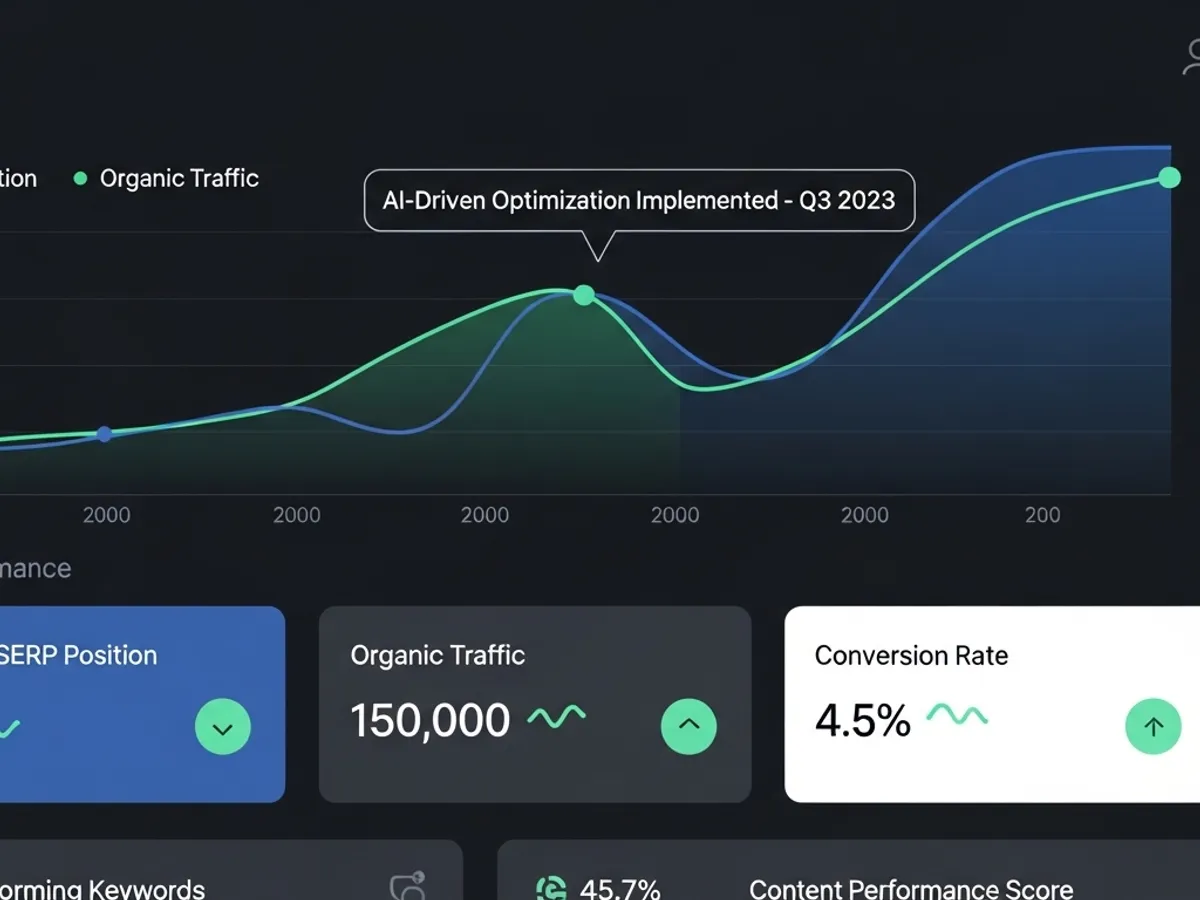
Measuring the true impact of AI-driven SEO initiatives is paramount for marketing agencies. It’s no longer enough to just implement SEO AI tools; we need to demonstrate their tangible return on investment (ROI). Key Performance Indicators (KPIs) act as our compass, guiding us through the data to confirm that our AI strategies are not just efficient, but genuinely effective.
Organic Traffic & Visibility Metrics
The most fundamental measure of any SEO strategy, AI-powered or not, remains organic traffic. However, with AI SEO optimization tools, we’re tracking a more nuanced picture. This includes not only raw organic sessions but also the quality and diversity of traffic sources.
- Organic Sessions & Users: A direct indicator of increased visibility and reach. AI helps scale content production, leading to more entry points for users.
- Keyword Rankings (and SERP Feature Presence): Beyond traditional top-10 rankings, AI helps us target and track visibility in rich snippets, featured snippets, and other SERP features, crucial for capturing attention in 2026. AI-optimized content ranks 30% higher on average than non-AI optimized content, underscoring the importance of this metric.
- Impression Share & Click-Through Rate (CTR): AI-generated meta descriptions and titles, crafted for optimal engagement, directly influence CTR. Monitoring this ensures our content doesn’t just rank, but also entices clicks.
Increased organic visibility is a direct result of AI’s ability to scale and optimize content effectively.
Engagement & User Experience KPIs
AI doesn’t just help get users to your site; it helps keep them there and encourages interaction. These metrics reflect the quality and relevance of the AI-generated content and the overall user experience.
- Time on Page/Site: Higher values indicate that users find the content valuable and engaging, a sign that AI-generated content is resonating.
- Bounce Rate: A lower bounce rate suggests content aligns well with user intent, reducing immediate exits. AI blog generator platforms like GenWrite focus on creating highly relevant content that meets specific search queries, directly impacting this metric.
- Pages Per Session: Users exploring multiple pages signal deeper engagement with the site’s content ecosystem, often a result of strong internal linking strategies enhanced by AI.
These engagement metrics confirm that AI is delivering not just quantity, but also quality content that holds user attention.
Conversion & Business Impact KPIs
Ultimately, SEO success translates into business growth. These KPIs tie our AI-driven efforts directly to the bottom line, proving the commercial value for marketing agencies.
- Lead Generation/Conversions: Whether it’s form submissions, downloads, or sign-ups, tracking conversion rates from organic traffic is critical. AI-optimized content often features clearer calls-to-action and better addresses user needs, driving higher conversions.
- Revenue from Organic Channel: The most straightforward measure of ROI. AI-driven content scaling should directly contribute to increased sales or revenue attributable to organic search.
- Cost Per Acquisition (CPA) Reduction: By automating content creation and optimization, marketing agencies can significantly lower the cost of acquiring new customers through organic channels. AI-driven content generation can reduce content creation costs by up to 60%.
AI-driven SEO success is ultimately measured by its tangible impact on an agency’s and its clients’ business objectives. By meticulously tracking these KPIs, agencies can continually refine their AI strategies, ensuring maximum efficiency and impact in a competitive digital landscape. Proper measurement ensures that the adoption of AI is a strategic advantage, not just a technological adoption. For agencies looking to streamline this process, platforms that offer integrated analytics and content generation capabilities are invaluable.
How Can Agencies Overcome Ethical Concerns and Challenges of AI Content Creation?
Navigating the Ethical Labyrinth of AI Content Creation
The rapid adoption of AI in content creation brings undeniable efficiency, but it also ushers in a new set of ethical considerations. Agencies, in their pursuit of scaling content with AI writing tools, must proactively address concerns around originality, authenticity, and potential biases to maintain trust and credibility. Ignoring these aspects isn’t an option in the evolving digital landscape.
Responsible AI content generation isn’t just good practice—it’s essential for long-term agency success.
At GenWrite, we understand that leveraging an AI SEO content generator means more than just producing text; it involves a commitment to quality and ethical standards. Our goal is to empower agencies to use AI responsibly, ensuring content aligns with both search engine guidelines and genuine user value, as outlined on GenWrite’s website.
Strategies for Ethical AI Content Production
Prioritize Transparency and Disclosure
One of the most straightforward ways to build trust is through transparency. Agencies should consider disclosing when content has been generated or significantly assisted by AI. This doesn’t diminish its value, but rather sets appropriate expectations for the audience. Transparency fosters a relationship built on honesty, critical in an era of information overload.
Implement Robust Human Oversight and Editing
AI excels at generating drafts and optimizing for keywords, but human oversight remains paramount. Every piece of AI-generated content should undergo thorough review, editing, and fact-checking by a human expert. This ensures factual accuracy, maintains brand voice, and injects the nuanced understanding only a human can provide. Think of AI as a powerful assistant, not a replacement.
Address Bias in AI-Generated Content
AI SEO blog writing software learns from vast datasets, and if those datasets contain biases, the AI’s output will reflect them. Agencies must be vigilant in identifying and mitigating these biases, particularly concerning sensitive topics. This involves using diverse data sources, refining prompts, and critically evaluating content for fairness and inclusivity. Regular audits of content generated by your AI writing tools can help identify and correct unintentional biases before they spread.
Uphold Originality and Avoid Plagiarism
While modern AI models are designed to generate original content, the risk of accidental plagiarism or unoriginal phrasing exists. Agencies should implement plagiarism checks as a standard part of their AI content workflow. This ensures that all content, whether human or AI-assisted, is unique and free from copyright infringement. Tools like GenWrite are built to support originality and help users create high-quality, SEO-friendly content.
By integrating these ethical safeguards, agencies can confidently harness the power of AI to scale content. This approach not only mitigates risks but also elevates the overall quality and trustworthiness of their digital presence. Agencies looking to pick the best tools for content that ranks while upholding these standards can explore options like those discussed in how to pick the best SEO writing tools for content that ranks in 2025 for guidance.
What Does the Future Hold: Preparing Your Agency for AI’s Continued Evolution in SEO?
The landscape of SEO is not static; it’s a dynamic ecosystem constantly reshaped by technological advancements, and AI is its primary architect. As we look beyond 2026, the evolution of AI in SEO will accelerate, demanding that marketing agencies not just adopt but proactively anticipate these shifts.
The Rise of Predictive & Proactive AI
We’re moving beyond reactive AI that optimizes existing content to a future where SEO AI tools predict search intent before it fully forms. Imagine AI identifying emerging topics, analyzing competitor strategies, and even forecasting algorithm changes with remarkable accuracy. This isn’t science fiction; it’s the natural progression of machine learning within the search domain.
Agencies will transition from optimizing for today to strategizing for tomorrow.
This predictive capability will allow agencies to create content that is not just relevant but prescient, dominating new niches as they emerge. It’s about being first to market with highly optimized content, rather than playing catch-up.
Hyper-Personalization at Scale
Beyond just ranking, the future of AI in SEO will heavily lean into hyper-personalization. AI will enable agencies to tailor content experiences for individual users based on their unique search history, preferences, and even emotional state, going far beyond basic segmentation. This means content will resonate more deeply, leading to higher engagement and conversion rates. The goal is to make every piece of content feel uniquely crafted for the person consuming it.
Strategic Imperatives for Forward-Thinking Agencies
To thrive in this evolving environment, agencies must cultivate an agile mindset and invest in adaptive technologies. The agencies that will lead are those that view AI not as a fixed solution, but as a continuously learning partner.
Continuous learning and adaptation are non-negotiable.
This involves continuous upskilling of human teams to work alongside increasingly sophisticated AI, focusing on strategic oversight, creative direction, and critical analysis. The human element shifts from execution to high-level strategy and ethical stewardship.
Embracing End-to-End Automation
The future will see AI automating even more complex tasks, freeing human experts to focus on truly strategic initiatives. This includes advanced keyword research that uncovers latent semantic relationships, sophisticated competitor analysis, and even dynamic, real-time content adjustments based on user behavior. Tools like GenWrite exemplify this shift, enabling marketing agencies to not only scale content generation but also to integrate SEO optimization, link building, and even publishing into one seamless, AI-driven workflow. By automating the end-to-end blog creation process, agencies can allocate valuable human resources to client relationship management and innovative campaign development.
Agencies must prepare for a future where AI handles the vast majority of repetitive and data-intensive SEO tasks, allowing them to focus on unique value propositions and strategic differentiation.
Are Agencies Who Don’t Embrace AI for SEO Destined to Fall Behind by 2026?
The question isn’t whether AI will reshape SEO; it’s whether your agency is ready to embrace that transformation or risk obsolescence. By 2026, the landscape of search engine optimization will be dramatically different, driven by AI’s pervasive influence on content creation, analysis, and strategy.
Failing to integrate AI is no longer a matter of maintaining a competitive edge—it’s about survival. Agencies relying solely on traditional methods will inevitably fall behind. We’ve seen how AI is projected to automate up to 40% of SEO tasks, translating into efficiencies and insights that human-only teams simply cannot match. This isn’t just about speed; it’s about depth and precision.
The shift is already evident. Agencies actively leveraging AI for SEO are reporting a 2x increase in organic traffic compared to those who haven’t adapted. This stark difference isn’t a fluke; it’s the direct result of AI’s ability to optimize content that ranks 30% higher on average. The market itself is speaking, with the AI in SEO sector projected to hit $12 billion by 2026. Ignoring these trends is akin to ignoring the internet in the late 90s.
The Cost of Inaction for Marketing Agencies
For marketing agencies, the consequences of not embracing AI are multifaceted:
- Lost Market Share: Competitors equipped with SEO AI tools can deliver faster, more effective results at a lower cost, making them more attractive to clients.
- Inability to Scale Content: Without AI, scaling high-quality, optimized content becomes a bottleneck. Traditional content creation simply cannot keep pace with the demand for personalized, data-driven narratives required by modern search engines and LLMs.
- Diminished Insights: AI platforms provide granular insights into keyword performance, competitor strategies, and content gaps that are difficult, if not impossible, to uncover manually.
- Inefficient Workflows: Repetitive tasks, from keyword research to initial draft generation, consume valuable human resources that could be better spent on strategic thinking and creative refinement.
Embracing the AI Advantage with GenWrite
This is where tools designed for the modern era become indispensable. An AI blog generator like GenWrite empowers marketing agencies to automate the end-to-end blog creation process. It handles keyword research, incorporates relevant links and images, analyzes competitor content, and even publishes blogs automatically.
GenWrite is more than just an automation tool; it’s a strategic partner for scaling content effectively. By aligning content with search engine guidelines and LLMs, it ensures that your output is not only efficient but also highly effective in increasing website traffic and organic reach.
Agencies that defer AI adoption risk losing clients, stifling growth, and struggling to remain relevant in a rapidly evolving digital ecosystem. The time to integrate AI into your SEO strategy is now, positioning your agency for sustained success and leadership.
The choice is clear: lead with AI or be left behind.
Ready to revolutionize your agency’s content strategy and SEO performance? Discover how GenWrite can automate your end-to-end blog creation process, driving traffic and organic reach.
Frequently Asked Questions about AI for SEO Agencies
How is AI changing SEO for marketing agencies in 2026?
AI is automating many SEO tasks like keyword research, content optimization, and link building. This allows agencies to focus on higher-level strategy, improve efficiency, and achieve better results. By 2026, AI is expected to automate up to 40% of SEO tasks, making it crucial for agencies to adapt.
Why are traditional content strategies no longer sufficient for 2026 search engines?
Traditional methods are too slow and lack the data-driven insights needed to compete with AI-enhanced strategies. Search engines are increasingly prioritizing AI-optimized content, making it difficult for traditional approaches to keep pace and achieve high rankings. AI enables scalability and real-time adjustments that traditional methods cannot match.
What are the benefits of AI-powered content generation for SEO?
AI-powered content generation uses NLP and machine learning to create SEO-friendly content at scale. It analyzes vast amounts of data to identify trending topics and optimize content for specific keywords, reducing creation costs by up to 60% and improving search engine rankings significantly.
Which AI SEO tools are essential for agencies to scale content effectively?
Essential tools include AI-powered keyword research platforms, content optimization software, and AI writing assistants. These tools help agencies automate repetitive tasks, enhance content quality, and personalize content for different audiences, leading to increased organic traffic and better performance.
How can agencies ensure ethical AI content creation?
Agencies can overcome ethical concerns by maintaining transparency with clients, implementing robust human oversight, and conducting thorough originality checks. It’s crucial to use AI as a tool to augment human creativity and expertise, rather than replace it entirely, ensuring bias mitigation and responsible content production.
What KPIs should agencies track to measure AI-driven SEO success?
Key performance indicators include organic traffic growth, improvements in keyword rankings, conversion rates, and user engagement metrics. Tracking these KPIs helps agencies understand the impact of their AI-driven strategies and demonstrate ROI to clients, showing how AI tools enhance overall business objectives.