
Boost Rankings with Top AI SEO Tools for 2026
What are AI SEO Tools and Why Are They Essential for 2026?

The digital landscape is in constant flux, but few areas have seen as rapid and profound a transformation as Search Engine Optimization (SEO). As we approach 2026, the question isn’t whether AI will impact SEO, but how deeply it’s already embedded in successful strategies. Understanding what Ai seo tool encompasses and why it’s become essential is the first step toward future-proofing your online presence.
Defining AI SEO Tools
At its core, an Ai seo tool leverages machine learning, natural language processing (NLP), and other artificial intelligence technologies to automate, analyze, and optimize various aspects of SEO. These are not merely data analytics platforms; they are sophisticated systems capable of predictive modeling, content generation, and intricate pattern recognition that far exceed human capacity for manual analysis.
AI SEO tools move beyond basic data crunching, providing predictive insights and automating tasks.
They transform traditional SEO by offering capabilities such as advanced keyword research, content optimization, technical SEO audits, and even competitive analysis, all driven by intelligent algorithms. The goal is to make SEO more efficient, accurate, and ultimately, more effective in achieving higher search rankings.
Why AI SEO Tools Are Essential for 2026
The importance of seo ai tools for 2026 cannot be overstated. Google’s continuous advancements in AI-powered search algorithms, such as BERT and MUM, mean that search engines are becoming incredibly sophisticated at understanding context and user intent. This increasing complexity demands a more advanced, data-driven approach than ever before.
The AI in SEO market is projected to reach an astounding $2.2 billion by 2026, highlighting its undeniable impact.
Manual SEO processes, while foundational, struggle to keep pace with the sheer volume of data and the nuanced understanding required for top rankings. This is where 2026 ai seo tools become indispensable. They can automate up to 80% of routine SEO tasks, freeing up human experts to focus on high-level strategy, creative problem-solving, and adapting to new search paradigms. This efficiency is critical for maintaining a competitive edge.
Consider how an Ai seo tool can dramatically improve keyword research accuracy by 40%, identifying high-potential keywords more effectively than traditional methods. This precision allows for content creation that directly targets user intent, leading to better engagement and higher rankings. For instance, platforms like GenWrite leverage advanced AI to automate the entire blog creation process, from keyword research to content optimization, ensuring your content aligns with search engine guidelines and LLMs. These ai tools enhance website ranking by an average of 25% through automated optimization, making them a cornerstone of any serious digital marketing strategy.
Embracing AI SEO tools ensures your strategy is proactive, not reactive, in a dynamic digital world.
This integration of AI allows for a level of precision and scale previously unattainable, positioning businesses to thrive in the evolving search environment. To delve deeper into how these tools are revolutionizing rankings, you might want to explore how to Achieve Top Google Rankings with Today’s Most Powerful AI SEO Software.
How Do AI SEO Tools Transform Keyword Research and Intent Detection?
Traditional keyword research often felt like sifting through sand, painstakingly identifying individual terms with varying degrees of relevance. The true revolution in 2026, however, lies in how Ai seo tools are fundamentally transforming this entire process. They don’t just find keywords; they unlock the why behind the search, providing a level of depth and accuracy previously unattainable.
This deep dive into keyword intent detection is where the real value emerges. AI algorithms analyze vast datasets, far beyond human capacity, to identify not just isolated keywords but entire semantic clusters. This ensures your content addresses the full spectrum of user queries and the underlying needs driving those searches.
AI algorithms can improve keyword research accuracy by 40%, making it easier to pinpoint high-potential terms that align with genuine user intent.
Instead of making educated guesses, we now leverage predictive analytics. This capability allows us to anticipate shifts in search behavior and identify emerging keyword opportunities long before competitors even spot them. This proactive approach drastically reduces wasted effort on irrelevant terms, allowing for a more strategic allocation of resources.
Online seo ai tools streamline this complex process, enabling quick identification of trends, grouping of related queries, and a comprehensive understanding of topical authority. This means less time spent on manual spreadsheet analysis and more on strategic content development that genuinely resonates with your audience.
Consider an AI-powered tool like GenWrite, which automates the end-to-end blog creation process, starting with precise keyword research and intent understanding. We understand that effective content begins with knowing exactly what your audience is searching for and why.
By understanding the nuanced intent behind queries, we can build content strategies that are not just keyword-rich but also contextually relevant and highly engaging. AI-driven intent detection ensures every piece of content you create serves a clear purpose for your audience, driving stronger engagement and better rankings. This capability to map keywords to specific stages of the customer journey is unparalleled, helping guide users from initial awareness to conversion.
For a deeper dive into the specific tools making this possible and their impact, explore how various seo ai tools are impacting rankings this year.
Can AI Tools Really Automate Content Generation and Optimization for SEO?
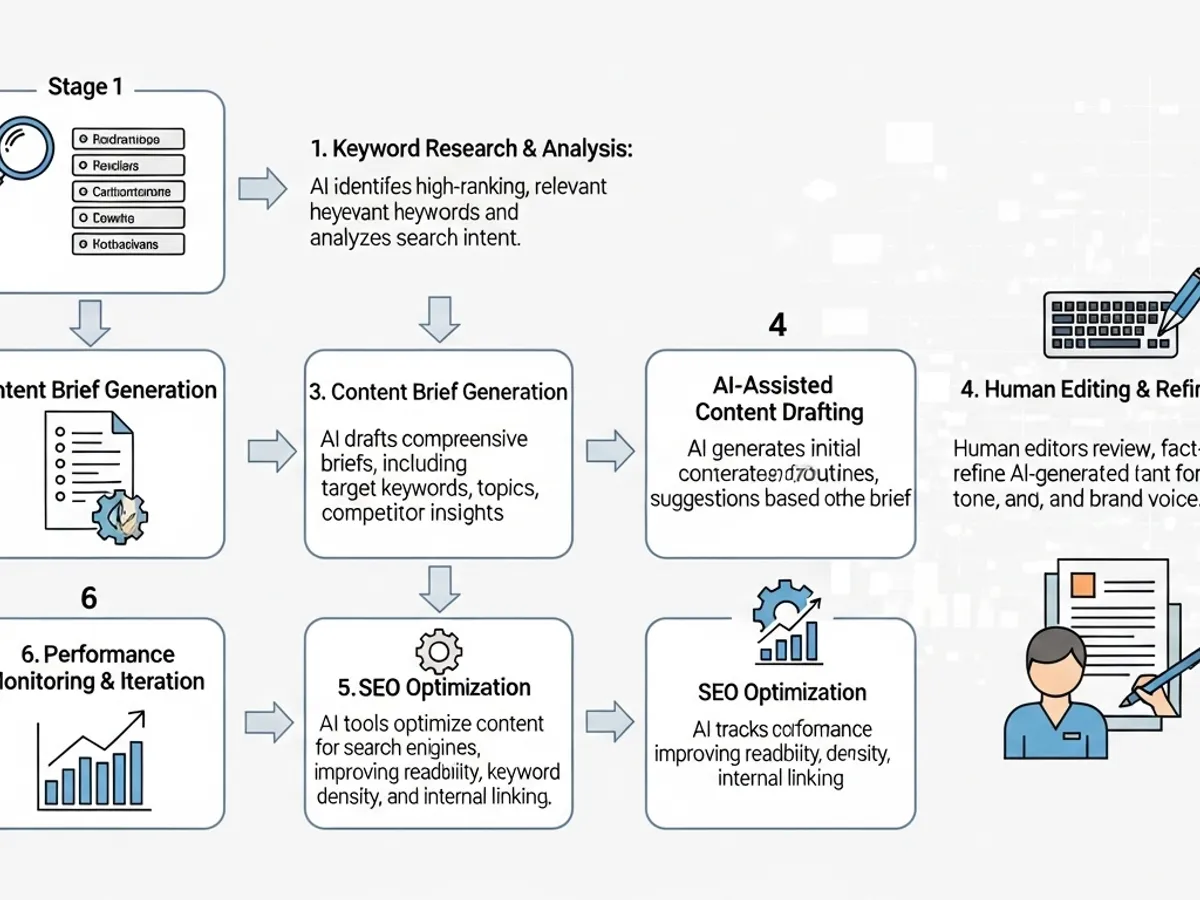
The question of whether AI tools can truly automate content generation and optimization for SEO is less about if and more about how much and how well. As an advocate for efficient content creation, I’ve seen firsthand how far these tools have come, especially with the rapid evolution of large language models (LLMs).
The AI Role in Content Generation: From Outline to Draft
Modern ai writing tools are no longer just simple rephrasers. They are capable of generating comprehensive outlines, drafting entire articles, and even producing variations of content tailored for different platforms. This isn’t just about speed; it’s about consistency and scalability. For instance, a tool like GenWrite automates the end-to-end blog creation process, taking an initial idea and transforming it into a full-fledged, SEO-optimized post. This includes everything from initial keyword research to drafting content and even suggesting relevant images.
AI excels at handling the heavy lifting of content creation, freeing human writers for strategic refinement.
While AI can generate content, the true value emerges when it’s built with SEO intelligence. This means integrating keyword research, competitor analysis, and understanding of search intent directly into the generation process. This ensures that the generated content isn’t just readable, but also primed for search engines.
Optimizing for NLP Signals and SERP Structure
Beyond mere generation, AI’s prowess in content optimization is transformative. Search engines like Google increasingly rely on Natural Language Processing (NLP) to understand content context, sentiment, and relevance. AI tools can analyze existing top-ranking content for specific keywords, dissecting its structure, readability, and the semantic entities it covers. They then provide recommendations to ensure your content aligns perfectly with these complex NLP signals.
Tools like Surfer SEO and Scalenut are prime examples, guiding users to incorporate relevant terms, adjust content length, and structure headings to match what’s performing well on the Search Engine Results Page (SERP). They analyze competitor content, highlighting gaps and opportunities for improvement, ensuring your article is not just well-written, but also semantically rich and comprehensive.
AI-powered optimization helps content align with sophisticated search algorithms, improving discoverability.
This level of data-driven insight was once incredibly time-consuming, requiring manual analysis of dozens of top-ranking pages. Now, seo ai tools can perform this analysis in minutes, providing actionable steps to enhance content for better ranking potential.
The Automation Threshold: Collaboration, Not Replacement
While AI can automate significant portions of content generation and optimization, it doesn’t entirely eliminate the need for human input. AI excels at repetitive tasks and data analysis, but human creativity, nuanced understanding of brand voice, and strategic oversight remain crucial. The goal isn’t to replace writers but to augment their capabilities, enabling them to produce higher volumes of higher-quality, SEO-friendly content more efficiently.
From generating initial drafts to fine-tuning for SEO optimization, AI significantly reduces the effort involved, allowing content teams to focus on strategy and creativity. For businesses looking to scale their content efforts, exploring AI blog generation tools is no longer optional but a strategic imperative. Tools like GenWrite streamline the entire process, including WordPress auto posting and bulk blog generation, fundamentally altering how businesses approach digital marketing and traffic generation. To learn more about how to effectively leverage these innovations, consider delving into “Your Guide to the Best AI Blog Generators for High-Ranking Content in 2026” and “Which AI SEO Tools Offer the Biggest Impact on Rankings This Year?” to understand the full scope of their capabilities.
Which Top AI SEO Tools Should You Consider for Comprehensive SEO Automation in 2026?
The path to dominating search rankings in 2026 is paved with advanced AI-driven SEO automation. As I’ve observed in the rapidly evolving digital landscape, relying on manual processes or fragmented tools simply won’t cut it anymore. Businesses need comprehensive platforms that offer more than just data; they need predictive insights and actionable strategies.
The Rise of All-in-One AI SEO Solutions
Identifying the Best Ai seo tool means looking for platforms that consolidate various SEO functions into a seamless, intelligent workflow. These aren’t just glorified keyword trackers; they are sophisticated systems designed to provide a holistic view of your SEO performance and future opportunities. The goal is to move from reactive adjustments to proactive, data-informed optimizations.
True comprehensive automation frees up invaluable time for strategic thinking.
Such tools excel at tasks like deep competitive analysis, content gap identification, and technical SEO auditing. They leverage machine learning to analyze vast datasets, forecasting potential ranking shifts and identifying areas for immediate improvement before your competitors do.
Leading Tools for Predictive Audits and Ranking Forecasts
When we talk about comprehensive Ai seo tool 2026, platforms like SE Ranking stand out. They offer a robust suite of features, from detailed keyword research and competitor monitoring to technical site audits and backlink analysis. The real power, however, lies in their ability to synthesize this data into actionable recommendations and predictive insights.
For instance, an AI-powered platform can not only tell you where your site has technical issues but also prioritize them based on their projected impact on your rankings. This level of foresight is critical in a fast-paced environment. To truly boost rankings with top AI SEO tools for 2026, understanding these predictive capabilities is key. You can delve deeper into these strategies by exploring how to Ai seo tool 2026 can integrate AI search and geo-targeted SEO.
GenWrite: Automating Your Content Engine for SEO Success
While many tools provide analytics and audits, the actual creation and optimization of content remain a significant bottleneck for many. This is precisely where an AI-powered content automation platform GenWrite differentiates itself. We focus on automating the entire blog creation process, from keyword research and competitor analysis to drafting, optimizing, and publishing high-quality, SEO-friendly content.
GenWrite ensures your content aligns with search engine guidelines and LLMs from the ground up.
By leveraging AI blog writing tools, we can significantly reduce content production costs and time, as AI can automate up to 80% of SEO tasks. This allows you to scale your content strategy efficiently, ensuring every piece is optimized for organic reach and traffic generation. The integration of AI for content means not just generating text, but crafting engaging blogs that are semantically rich and engineered to rank. Learn more about how you can AI Blog Writer can craft engaging blogs in under a minute.
Choosing the right AI SEO tools in 2026 isn’t just about features; it’s about a strategic partnership that augments human expertise, drives efficiency, and provides a clear competitive edge through superior automation and predictive intelligence.
Are There Specialized AI SEO Tools for Backlink Analysis and Technical SEO?

While much of the AI SEO conversation centers on keyword research and content generation, the bedrock of a high-ranking website lies in its technical foundation and robust off-page signals. The good news for 2026 is that AI-powered tools have evolved significantly to tackle these complex, often tedious, aspects of SEO. They are no longer just for content; they’re revolutionizing how we approach backlink analysis and technical SEO.
AI’s Edge in Backlink Analysis
Historically, understanding a website’s backlink profile was a laborious process, often involving manual checks and rudimentary data sorting. Today, seo ai tools bring unparalleled efficiency and depth to this crucial task. AI algorithms can sift through colossal datasets, identifying patterns that human analysts might miss.
Consider a tool like Ahrefs, which has long been a staple for link building. Its AI capabilities now go beyond simple link discovery. AI can detect spammy or toxic links with greater accuracy, helping you disavow them before they harm your site’s authority. More importantly, AI identifies genuine, high-quality link opportunities by analyzing content relevance, domain authority, and anchor text usage across millions of websites.
AI automates up to 80% of SEO tasks, freeing experts for strategic link building.
This means less time spent sifting through mountains of data and more time focusing on outreach and relationship building. The ability to quickly identify competitor backlink strategies and uncover previously unknown niches for link acquisition is a game-changer. This specialized application of AI in backlink analysis is a significant reason why the AI in SEO market is projected to reach $2.2 billion by 2026.
Elevating Technical SEO Audits with AI
Technical SEO is the unsung hero of search engine optimization, ensuring that search engine crawlers can efficiently access, crawl, and index your website. Issues here can derail even the best content strategies. Traditional technical SEO audits are meticulous and time-consuming, requiring deep expertise.
However, AI is transforming this domain. Tools like Screaming Frog, which offers extensive crawling capabilities, are integrating AI to enhance their diagnostic power. AI excels at anomaly detection, pinpointing subtle technical issues that might otherwise go unnoticed. This includes identifying broken internal links, crawl budget inefficiencies, duplicate content issues, and even predicting potential site speed bottlenecks.
AI-powered tools enhance website ranking by 25% through automated SEO optimization.
AI can analyze log files to understand how search engine bots interact with your site, offering insights into crawl patterns and areas for optimization. This predictive and diagnostic capability allows for proactive fixes, rather than reactive damage control. From identifying mobile-friendliness issues to uncovering structured data errors, AI makes technical SEO audits faster, more comprehensive, and more actionable.
The Strategic Advantage of Specialized AI
These specialized seo ai tools for backlink analysis and technical SEO are not just about automation; they provide a strategic advantage. They allow SEO professionals to move from manual checks to data-driven insights, optimizing foundational elements that directly impact rankings. While tools like GenWrite excel at creating SEO-optimized content, ensuring that content lands on a technically sound website with a strong backlink profile is paramount for maximizing its impact and visibility. To learn more about leveraging comprehensive AI tools for your overall strategy, explore how you can boost your website visibility with essential AI SEO tools for 2026.
By integrating these advanced AI functionalities, businesses can ensure their sites are not only producing great content but are also technically robust and authoritative in the eyes of search engines. This holistic approach, powered by seo ai tools, is crucial for navigating the evolving AI search landscape. For a deeper dive into how AI is shaping the future of search, consider how to rank higher with integrating AI search and geo-targeted SEO for 2026.
What are the Best AI SEO Tools for Small Businesses and Budget-Conscious Users?
For many small businesses and individual entrepreneurs, the promise of AI SEO tools often comes with the unspoken concern of cost. The good news? You don’t need an enterprise-level budget to harness the power of artificial intelligence to boost your search rankings.
Leveraging Affordable and Free AI SEO Tools
The landscape of AI-driven solutions is evolving rapidly, making sophisticated tools more accessible than ever. The key is to identify platforms that offer robust features without breaking the bank, often through freemium models or highly specialized, cost-effective offerings.
Smart choices can make a big difference.
One excellent starting point for any budget-conscious user is Diib. Diib offers a compelling free tier that provides a comprehensive growth plan, SEO performance tracking, and even keyword suggestions. It acts as a digital marketing assistant, giving you actionable insights without the hefty price tag. Its dashboard can highlight critical issues and opportunities, making it an invaluable AI SEO tool for small business owners who need clear direction.
Another highly effective, yet specialized, option is RankIQ. While not free, its unique focus on uncovering ultra-low competition, high-traffic keywords for specific niches can deliver immense value for its price. This allows small businesses to target keywords they can actually rank for, providing a distinct competitive edge.
Maximizing Free Tiers and Trials
Many leading AI SEO platforms offer generous free trials or limited free tiers. This allows you to test their capabilities, understand their workflow, and identify which features are most beneficial for your specific needs before committing financially. Tools like Rytr and Scalenut, for instance, provide excellent AI-powered content creation and optimization features that are often more accessible for smaller budgets.
Don’t underestimate the power of a well-chosen free tool.
As an advocate for efficient content creation, I’ve seen firsthand how AI can democratize SEO. Platforms like GenWrite aim to automate the end-to-end blog creation process, which is a game-changer for small teams. Imagine generating high-quality, SEO-optimized blogs, complete with keyword research and competitor analysis, without extensive manual effort. This content automation is critical for maintaining an active online presence.
Whether you’re exploring free AI SEO tools or investing in a specialized platform like Diib or RankIQ, the goal remains the same: achieve measurable progress and increased organic reach. These tools are designed to augment your efforts, not replace them, allowing you to scale your content strategy effectively.
By strategically using an AI blog writing tool like GenWrite, small businesses can streamline their content pipeline, ensuring a consistent flow of high-ranking material. This approach allows them to compete effectively in crowded markets, turning budget constraints into a strategic advantage.
To see how advanced AI can transform your content output, learn how to Craft Engaging Blogs in Under a Minute with Advanced AI Writers.
How Can AI SEO Tools Help You Navigate the Evolving AI Search Landscape (GEO)?

The landscape of search is undergoing a profound transformation, moving beyond traditional keyword matching to embrace sophisticated AI-driven interactions. This shift introduces Generative Engine Optimization (GEO), a new frontier for SEO professionals. Unlike classic SEO, which focused on ranking websites in a list of ten blue links, GEO emphasizes optimizing for visibility and influence within AI-generated search results, conversational interfaces, and AI Overviews.
Understanding Generative Engine Optimization (GEO)
GEO is about ensuring your content is not just found by search engine crawlers, but understood and synthesized by large language models (LLMs) and generative AI systems. These systems power experiences like Google’s AI Overviews, ChatGPT responses, and Perplexity’s detailed summaries. Our goal shifts from merely appearing on page one to becoming the authoritative source an AI chooses to cite or summarize.
Optimizing for GEO means your content must be clear, precise, and easily digestible by AI.
This demands a new approach to content structure, factual accuracy, and semantic richness. It’s no longer enough to target keywords; you must answer questions comprehensively and provide context that AI can readily interpret and present.
Navigating AI Overviews and Conversational Search
AI Overviews, Google’s generative AI feature, fundamentally change how users interact with search results. Instead of clicking through multiple links, users often receive a synthesized answer at the top of the SERP. For businesses, this means the battleground for visibility moves to being included in these AI-generated summaries.
Tools are emerging to help us track this new form of visibility. Platforms like Rankscale.ai are specifically designed to monitor how your content performs within these AI-driven environments, offering insights into your presence in AI Overviews and other generative outputs. These specialized AI SEO tools provide data on which queries trigger generative results and whether your content is being featured.
AI Search demands a deeper understanding of semantic relationships and factual accuracy.
This is where the principles of content automation and SEO optimization truly shine. For instance, an AI-powered tool like GenWrite can help craft content that is inherently structured for clarity and rich in semantic entities, making it more amenable to AI understanding. By automating the creation of well-researched, semantically optimized articles, we can systematically improve our chances of appearing in these crucial AI Overviews. Learn more about integrating AI search and GEO-targeted SEO for 2026 by exploring our insights on rank higher integrating AI search and GEO-targeted SEO for 2026.
The Role of AI Tools in GEO Strategy
AI SEO tools are indispensable for adapting to GEO. They can analyze competitor content featured in AI Overviews, identify knowledge gaps, and suggest content enhancements that align with AI’s summarization capabilities. They also help in refining AI search strategies, ensuring our content is tailored for both human readers and generative models.
By leveraging these advanced tools, we can proactively shape our digital footprint to thrive in an era where AI doesn’t just assist search, but actively generates answers.
Will AI SEO Tools Replace Human SEO Expertise, or Do They Collaborate?
The question of whether AI will replace human expertise in SEO is a recurring one, often sparking concern among professionals. However, from our perspective as developers of AI-powered solutions, the reality is far more nuanced: it’s a powerful collaboration, not a replacement.
AI SEO tools excel at automating repetitive, data-intensive tasks. Consider that AI can automate up to 80% of routine SEO tasks, from extensive keyword research to technical audits. This unprecedented efficiency frees human experts from the mundane, allowing them to focus on what truly requires their unique abilities.
The Indispensable Role of Human Expertise
While AI can process vast amounts of data and identify patterns, it lacks the intuitive understanding of human psychology, cultural nuances, and the ability to craft truly compelling narratives. Strategic thinking and creative problem-solving remain squarely in the domain of human expertise. An AI SEO expert leverages these tools, but doesn’t let them dictate the entire SEO strategy.
For instance, an AI tool can identify a high-volume keyword, but a human understands the intent behind it, the emotional triggers, and how to weave it into content that resonates deeply with an audience. This strategic layer is crucial for long-term success and adaptability in a constantly evolving search landscape. AI simply isn’t equipped to anticipate the next algorithm update or interpret subtle market shifts with the same strategic foresight.
The Synergy of AI and Human Skill
The true power emerges when human expertise guides advanced AI tools. AI becomes an extension of the SEO professional, a tireless assistant capable of executing complex analyses and generating content drafts at scale. For example, platforms like GenWrite can automate the end-to-end blog creation process, handling keyword research, linking, and initial content generation. This allows AI SEO experts to dedicate their time to refining messaging, shaping brand voice, and developing high-level SEO strategy.
This collaborative model means professionals can achieve more impactful results faster. They can experiment with different strategies, analyze performance with AI-driven insights, and iterate quickly, all while maintaining a human touch that builds trust and authority. The future isn’t about AI replacing us; it’s about AI elevating our capabilities.
What Key Factors Should You Consider When Choosing an AI SEO Tool for 2026?
Navigating the rapidly evolving landscape of AI SEO tools can feel like a complex endeavor, especially when aiming to identify the Best AI SEO Tool in 2026 for your specific needs. The market is projected to reach $2.2 billion by 2026, signaling both immense opportunity and a daunting array of choices. Making an informed decision requires a strategic approach, considering your unique goals, resources, and operational context.
Define Your Core SEO Objectives
Before evaluating any AI SEO software, clearly outline what you aim to achieve. Are you primarily focused on scaling content creation, enhancing technical SEO audits, refining keyword research and intent detection, or improving backlink analysis? Each tool often excels in particular areas. For instance, if your priority is end-to-end blog creation and SEO optimization, a solution like GenWrite, which automates research, content generation, and publishing, would be highly relevant.
The right tool aligns with your strategic vision, not just current tasks.
Assess Feature Set and Depth
Look beyond surface-level features. Does the tool offer sophisticated semantic keyword clustering, predictive analytics for ranking, or advanced content optimization capabilities that align with modern LLM guidelines? Consider the depth of its AI integration. Tools that can automate up to 80% of SEO tasks, freeing up your team for strategic work, offer significant value. Evaluate whether the features truly enhance efficiency or merely add complexity.
Prioritize Accuracy and Data Reliability
AI’s strength lies in its ability to process vast datasets, but the quality of its output hinges on the accuracy of its algorithms and the data it’s trained on. For 2026 AI SEO tools, scrutinize how a tool sources its data for keyword trends, competitor analysis, and content insights. Unreliable data leads to flawed strategies and wasted effort. Look for evidence of continuous model updates and robust data validation processes.
Evaluate Ease of Use and Integration
Even the most powerful AI SEO tool is ineffective if your team can’t use it efficiently or if it creates workflow bottlenecks. Consider the user interface: is it intuitive? Does it offer clear reporting? Furthermore, assess its integration capabilities. Can it seamlessly connect with your existing SEO stack, CMS (like WordPress for auto posting), or analytics platforms? Smooth integration is critical for maximizing productivity and avoiding data silos.
Consider Scalability and Cost-Effectiveness
Your chosen AI SEO solution should be able to grow with your business. Does the pricing model accommodate increased usage as your needs expand? While AI-driven content creation can reduce production costs by up to 60%, it’s crucial to balance the upfront investment with the long-term return on investment. Compare subscription tiers, user limits, and feature access to ensure it fits your budget without compromising essential functionalities. For example, some tools are tailored for bulk blog generation, which can be highly cost-effective for larger content strategies.
Choosing the optimal AI SEO tool for 2026 is a strategic decision that impacts your entire digital presence. By meticulously evaluating factors like objective alignment, feature depth, data accuracy, usability, and scalability, you can confidently select the AI SEO software that truly propels your rankings and growth. Thoughtful selection ensures you leverage AI as a strategic partner, not just another piece of software.
What is the Future of AI in SEO and How Can You Stay Ahead?
The landscape of SEO is undergoing a profound transformation, with AI at its core. From refining keyword research to automating content generation and optimizing technical aspects, AI is reshaping how we approach search visibility. What truly lies ahead for the Future of AI in SEO? We can anticipate an era defined by sophisticated algorithms, deeply personalized content experiences, and highly predictive strategies.
The future isn’t about if you use AI, but how effectively you wield it.
Staying ahead in this rapidly evolving environment demands continuous learning and proactive adaptation to emerging AI SEO trends. Google’s advancements, like BERT and MUM, clearly demonstrate AI’s power in understanding nuanced search intent. This shift prioritizes unique value and demands content that genuinely serves user needs, moving beyond basic keywords to rich, semantically optimized narratives.
For truly effective digital optimization, the focus must be on unparalleled efficiency and strategic insight. Today’s AI tools integrate seamlessly into workflows. Imagine an AI autonomously generating an SEO-optimized blog post: it researches keywords, analyzes competitors, embeds relevant links and images, and even auto-publishes. This level of end-to-end automation is precisely what GenWrite delivers, fundamentally streamlining your entire content strategy.
Embracing these advanced SEO AI tools is no longer optional; it’s a strategic imperative. With the AI in SEO market projected to hit $2.2 billion by 2026, AI is poised to automate up to 80% of routine SEO tasks. This frees human experts to concentrate on high-level strategy and creative problem-solving. This powerful human-AI collaboration is not just an advantage—it defines the next era of search dominance.
To remain competitive and thrive, mastering these technologies is paramount. Experiment with new tools, understand their integration potential, and always prioritize creating high-quality, valuable content that aligns with both search engine guidelines and the demands of large language models (LLMs). The future of content delivery is intelligent, automated, and hyper-relevant.
Ready to dominate search in 2026? Discover how GenWrite can automate your blog creation and SEO optimization for unparalleled organic growth.
Frequently Asked Questions about AI SEO Tools
What exactly are AI SEO tools and why are they crucial for 2026?
AI SEO tools use machine learning to automate and enhance SEO tasks like keyword research, content optimization, and technical analysis. They are essential for 2026 due to increasingly complex search algorithms and the need for data-driven, efficient strategies to stay competitive.
How do AI SEO tools improve keyword research and understanding user intent?
AI tools analyze vast amounts of data to identify relevant keywords with high potential and predict trends. They excel at detecting subtle nuances in user search intent, allowing for more targeted content creation that resonates with your audience.
Can AI tools truly automate content generation for SEO?
Yes, AI can automate significant parts of content generation, from drafting articles and blog posts to optimizing them for SEO factors like readability and keyword usage. Tools can help scale content production while maintaining quality and relevance for search engines.
Will AI SEO tools replace human SEO experts?
AI SEO tools are designed to collaborate with human experts, not replace them. They automate repetitive tasks and provide data insights, allowing SEO professionals to focus on strategic planning, creative problem-solving, and complex analysis.
What are the key factors to consider when choosing an AI SEO tool for 2026?
When choosing an AI SEO tool, consider your specific objectives, the tool’s features and accuracy, ease of use, integration capabilities with other platforms, and overall cost-effectiveness. Scalability is also important as your needs grow.
How can AI SEO tools help with the rise of AI-generated search results like Google’s AI Overviews?
AI SEO tools are adapting to the rise of AI-generated search results by focusing on creating precise, factual, and semantically rich content that AI models can easily synthesize. They help track performance in this new landscape and optimize content for AI understanding.