
Why does nobody talk about the factual accuracy of your seo ai writer?
The silent trade-off of rapid-fire publishing

We’ve all been there. You click a button, wait thirty seconds, and your new blog post is ready. It looks perfect on the surface. The keywords are all in the right spots, the headings look great, and the word count hits the sweet spot. But when you actually read the sentences, something feels off.nnMost generic writing tools are built to do one thing: make text look pretty. They focus on keyword density (how often a search term appears in your text) and layout but completely ignore whether the facts are true. This creates a silent trade-off. You get speed, but you lose trust. If your article claims that a product has a feature it actually lacks, your readers will leave immediately.nnAnd this is where standard tools fail. When you compare a generic assistant to a specialized seo ai writer, the difference is clear. Basic tools rely on old templates and generic filler. They don’t look at real-time search data. At GenWrite, we believe that automation shouldn’t mean sacrificing accuracy. But most basic tools just end up guessing facts to fill the page.nnI’ve seen this happen with simple product guides. A cheap generator might write that a software tool has a free trial, even if that trial ended three years ago. It does this because the words “free trial” frequently appear near that software’s name online. The AI doesn’t know it’s lying; it’s just matching patterns. Sometimes, these errors are small, but they still damage your credibility.nnBut search engines are getting smarter. They don’t just count keywords anymore. If your content is full of factual errors, your rankings will eventually drop. Speed is great, but publishing false information is a fast way to kill your organic traffic.
Why your AI engine is mathematically built to lie to you
Using a best seo ai writer feels like querying an omniscient librarian. It isn’t. Under the hood, these engines don’t actually “know” facts, nor do they query a database of verified truths when generating text.
Instead, they rely on next-token prediction. A token is just a word fragment. By analyzing your prompt, the model calculates the mathematical probability of the next logical character sequence—essentially operating as a highly scaled autocomplete.
How probability leads to lies
Because these models guess the next token based on statistical likelihood, they prioritize syntactic coherence over factual truth. Ask for a marketing metric, and the engine might instantly spit out “organic traffic grew by 47% last year.”
Where did that “47%” originate? The model didn’t query an index or reference an actual study. It simply calculated that “47%” resolved the mathematical equation of that sentence structure based on training weights. This is a hallucination. The machine isn’t trying to deceive you; it’s just solving a probability puzzle.
Grounding the mathematical guesser
Preventing these statistical guesses from tanking your search rankings requires strict grounding. You must force the LLM to generate text constrained by verified source documents or live retrieval-augmented generation (RAG) feeds.
We engineered our seo writer ai to ingest real-time data and live competitor analysis to anchor its outputs. Even so, parser errors happen. A complex table or a sarcastic review can easily throw off the math, which is why human-in-the-loop validation is non-negotiable. You still need an editor to audit those metrics before they go live.
What happened when Google changed the rules on AI-generated metadata

On October 1, 2026, Google quietly shifted the goalposts for search engine optimization. They added a blunt warning to their official guidelines: generative AI models predict word sequences; they don’t retrieve facts. If you rely on an ai seo content generator, the rules just changed.
Google now explicitly requires manual fact-checking. It’s no longer a suggestion. But the real surprise is where search crawlers are actually looking. They aren’t just scanning your main body copy for hallucinations anymore. They’re targeting automated metadata, including your SEO titles, meta descriptions, image alt text, and structured data schema.
Why does this matter? Most older seo content writing tools auto-generate these hidden code snippets with zero human oversight. If an AI hallucinates a statistic in your meta description, Google’s systems can flag it as low-quality content. Say your meta description claims a software tool ‘saves users 40 hours a week’ but the actual article body never mentions that figure. Google’s systems flag the inconsistency instantly.
The mechanics of metadata penalties
Think about how search crawlers process structured data. If your schema markup claims a product has a 4.9-star rating based on 500 reviews, but your actual page content shows zero reviews, Google flags it as deceptive.
When automated metadata fails, it usually goes wrong in three ways:
- Automated alt text describes an image incorrectly, causing relevance mismatches.
- The AI writes a catchy title with a fabricated statistic to boost click-through rates.
- Structured data templates output broken code or false product data.
At GenWrite, we found that even minor mismatches between metadata and page body copy can trigger a swift drop in organic rankings. Does this make scaling impossible? We don’t think so. But it means the era of clicking ‘generate’ and instantly publishing without a second glance is over. Writers must treat metadata with the same editorial rigor as the main article.
The bottleneck of verifying everything yourself
I remember the exact moment my team realized our new content strategy was completely broken. We had just onboarded a shiny new seo content creator to help us scale up our blog production. On paper, it was a dream. The tool spat out five 2,000-word drafts in under ten minutes. But when my managing editor actually sat down to read them, the dream quickly evaporated.
Every single draft was packed with tiny, confidently written lies. For instance, the AI claimed a specific software integration was free when it actually cost $200 a month. It quoted statistics from 2018 as if they happened yesterday.
So, we did what any traditional editorial team would do. We built a manual quality assurance pipeline. We assigned two full-time editors to fact-check every single sentence, link, and claim before anything hit WordPress.
It was a total disaster. Our editors became human bottlenecks almost overnight. Instead of writing new pieces or planning strategy, they spent hours chasing down obscure sources to verify if a random AI claim was true. We wanted to publish twenty posts a week, but we could barely push out three.
And here is the kicker: while our editors were busy fixing minor typos and checking dates, they missed bigger issues. They didn’t notice when the search intent of an article drifted completely off-track. The old-school way of line-by-line proofreading simply falls apart when you try to scale up.
That’s exactly why we stopped trust-testing our seo content creator manually. We realized that chasing a subjective, perfect edit was hiding systemic structural flaws. If you use a basic seowriting ai tool without structured validation guardrails, you’ll eventually face the same frustrating choice. You either slow down to a crawl, or you publish unchecked errors that destroy your search visibility.
Do you know the true cost of editing bad AI facts?

Let’s look at the math.
A cheap AI tool costs maybe $20 a month. It pumps out 50 articles in minutes, which feels like an easy win for your marketing budget. But what happens when those articles are full of fake statistics, broken links, and made-up quotes? You spend hours cleaning up the mess.
The real cost of using an unchecked ai writer seo isn’t the software subscription itself. It’s the human editing hours. If an editor has to spend two hours fact-checking and rewriting a single AI draft, you aren’t saving money. In fact, you’re paying more than you would have to hire a human writer to build the piece from scratch.
Let’s compare the two paths side-by-side:
- The cheap AI path: You pay $0.50 per draft for software. But your editor spends 90 minutes fixing hallucinations and fake quotes at $30 an hour. Your real cost per post is $45.50.
- The optimized AI path: You use advanced seo content writing tools with built-in factual verification. The tool costs more upfront, but your editor only spends 15 minutes polishing the formatting. Your real cost per post drops to $12.50.
When we analyzed ai blog generation pricing, we found that agencies often lose their entire profit margin in this hidden editing bottleneck. A cheap tool that makes up facts is a financial trap.
You aren’t just paying for words. You’re paying for trust. If you publish unverified claims, the cleanup cost gets even higher when your search traffic drops. Honestly, the math only works when your software does the heavy lifting of factual research before it writes a single word.
How inaccurate facts destroy your SaaS search visibility
If your software-as-a-service (SaaS) website publishes wrong information, Google will eventually bury you. It’s that simple. Many teams use a cheap seo writer ai to pump out dozens of blogs a week, thinking quantity wins the game. But search engines are smarter now.
In March 2024, Google baked its helpful content system directly into its core ranking algorithm. Now, if your page claims a tool does something it cannot do, or cites a fake statistic, readers leave immediately. This high bounce rate signals to search engines that your content is junk. Once Google flags your site for spreading misinformation, your rankings across all pages can tank overnight.
I have seen SaaS companies lose half their traffic in a single week because their ai seo content generator hallucinated product features. When software buyers realize your blog contains false details, they don’t just close the tab. They lose trust in your actual product. Why would they buy your software if you can’t even get your blog posts right?
Google uses human evaluators and automated systems to check if content matches real-world facts. If your site claims a competitor lacks a feature they actually have, you might even face legal issues alongside SEO penalties. The reality is that search algorithms track user satisfaction metrics very closely. If visitors find errors, they go back to the search results instantly.
The damage is incredibly hard to reverse. If you have already taken a hit, you will need a systematic approach to cleaning up your old posts. We mapped out this exact process in our guide on rebuilding your saas organic visibility after a major ranking drop.
So, how do you avoid this trap without spending forty hours editing? At GenWrite, we believe the solution isn’t to stop using AI. It’s about using tools that prioritize factual guardrails. If your automation tool doesn’t verify its sources, you’re just building a house of cards. One algorithm update is all it takes to knock it down.
Setting up a bulletproof factual verification workflow
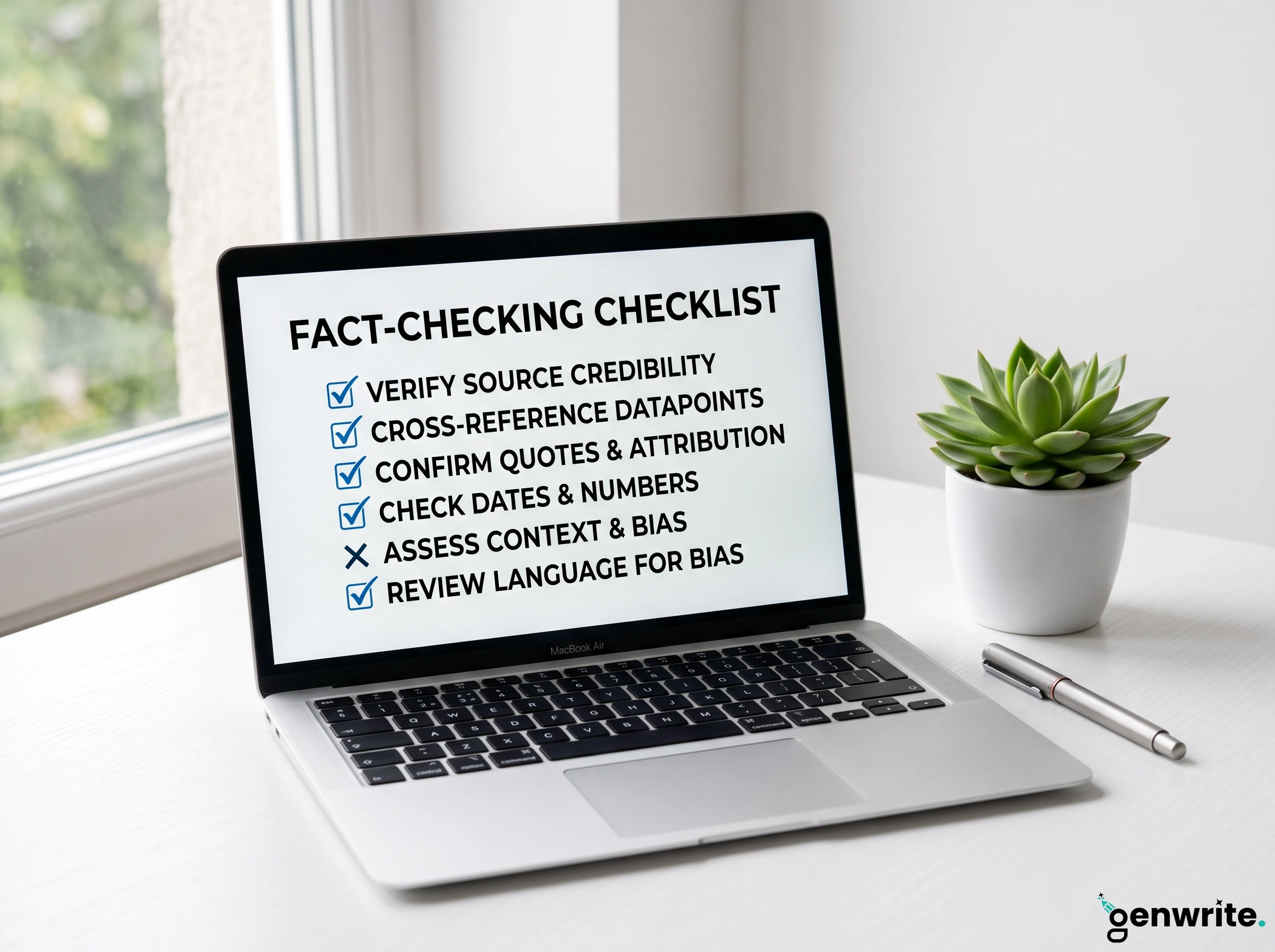
You can’t just hit publish on raw AI drafts anymore. To protect your search rankings, you need a repeatable system that catches errors before Google does. Let’s build a simple, three-step workflow that blends the speed of automation with human oversight.
First, change how you prompt your AI. Instead of asking for general information, feed the system specific, verified source documents. When you use advanced seo writing tools, restrict the AI to only write from the background links and PDFs you upload. This limits the software’s urge to make up numbers or invent studies. But remember, even the smartest tools can slip up, so setting strict boundaries is your first line of defense.
Second, run every draft through a strict verification checklist. Your team shouldn’t waste time fixing grammar or changing sentence structures. Instead, have them focus purely on facts.
- Verify every number: Every statistic, date, and percentage must have a direct source link. For example, if a draft claims “73% of marketers use AI,” find the original report.
- Check the product claims: If the text says a competitor’s software has a specific feature, open that software and confirm it.
- Test the outbound links: Make sure every link goes to a live, authoritative page.
But what if your team gets bogged down in editing? The trick is to keep their role highly focused. They aren’t rewriting the piece; they are acting as fact-checkers. If a paragraph is wrong, they don’t edit it line-by-line. They simply flag it for regeneration or delete it.
This keeps your production line moving fast. By pairing a smart best seo ai writer with a tight human review process, you get the volume you need without sacrificing accuracy. It’s the only way to scale safely in a world where search engines punish sloppy content.
Tired of editing hallucinated facts and broken links in your drafts? GenWrite builds factual accuracy and automated SEO right into the publishing pipeline.
FAQ
Why do SEO AI writers invent facts and statistics?
They’re built on next-token prediction rather than a database of absolute truths. That’s why they guess the most statistically likely word sequence instead of checking if a study actually exists.
Does Google penalize sites for AI-generated content with fake data?
Google doesn’t penalize content simply because it’s AI-made, but it heavily flags low-quality, inaccurate information under its helpful content and E-E-A-T guidelines.
How can you stop an AI content tool from hallucinating?
Honestly, you can’t completely stop the model from guessing, but you can connect it to verified data sources or use tools that cross-reference live search results before drafting.
What’s the easiest way to fact-check bulk AI articles without losing speed?
Set up an automated verification layer that checks cited URLs and statistics against live indexes before the draft ever reaches your human editors.