
What happens when you pit a specialized SEO writer AI against a generic assistant on actual search intent?

General-purpose LLMs vs. purpose-built SEO engines
Picture a general-purpose AI assistant as a well-read librarian. Sure, it knows millions of facts. But it has absolutely no clue what people are actually searching for on Google this morning. When you ask it to write an article, it simply guesses the next logical word based on past patterns. It’s a text synthesizer. It writes pretty prose, but it does so in a complete vacuum.
A specialized seo writer ai does the exact opposite. It works backward. Instead of guessing, it pulls live search data first. It scans the current SERP to see what top-ranking pages are actually doing, mapping out their headings and grouping relevant keywords. It builds a blueprint before it writes a single word.
This changes everything.
If you need a quick email, a brainstorm partner, or a poem, a general assistant is perfect. But it doesn’t understand search intent. Ask a standard chatbot to write about “best accounting software” and you’ll get a beautifully written essay. Too bad your readers actually wanted a comparison table with pricing. The chatbot doesn’t know that because it can’t see what competitors are doing.
A dedicated best seo ai writer built into a platform like GenWrite targets that exact intent. It checks the live web first to see what readers expect. Now, let’s be real: no tool guarantees an instant number-one spot on Google. Search algorithms are messy, and domain authority is still king. But starting with a data-driven structure means you won’t waste hours rewriting fluff. You can just publish content that actually answers the question.
If you just need words to fill a page, use a generic assistant. But if you want actual search traffic, you need an engine built to decode search intent before it types a single letter.
The architectural divide: how they dissect search queries
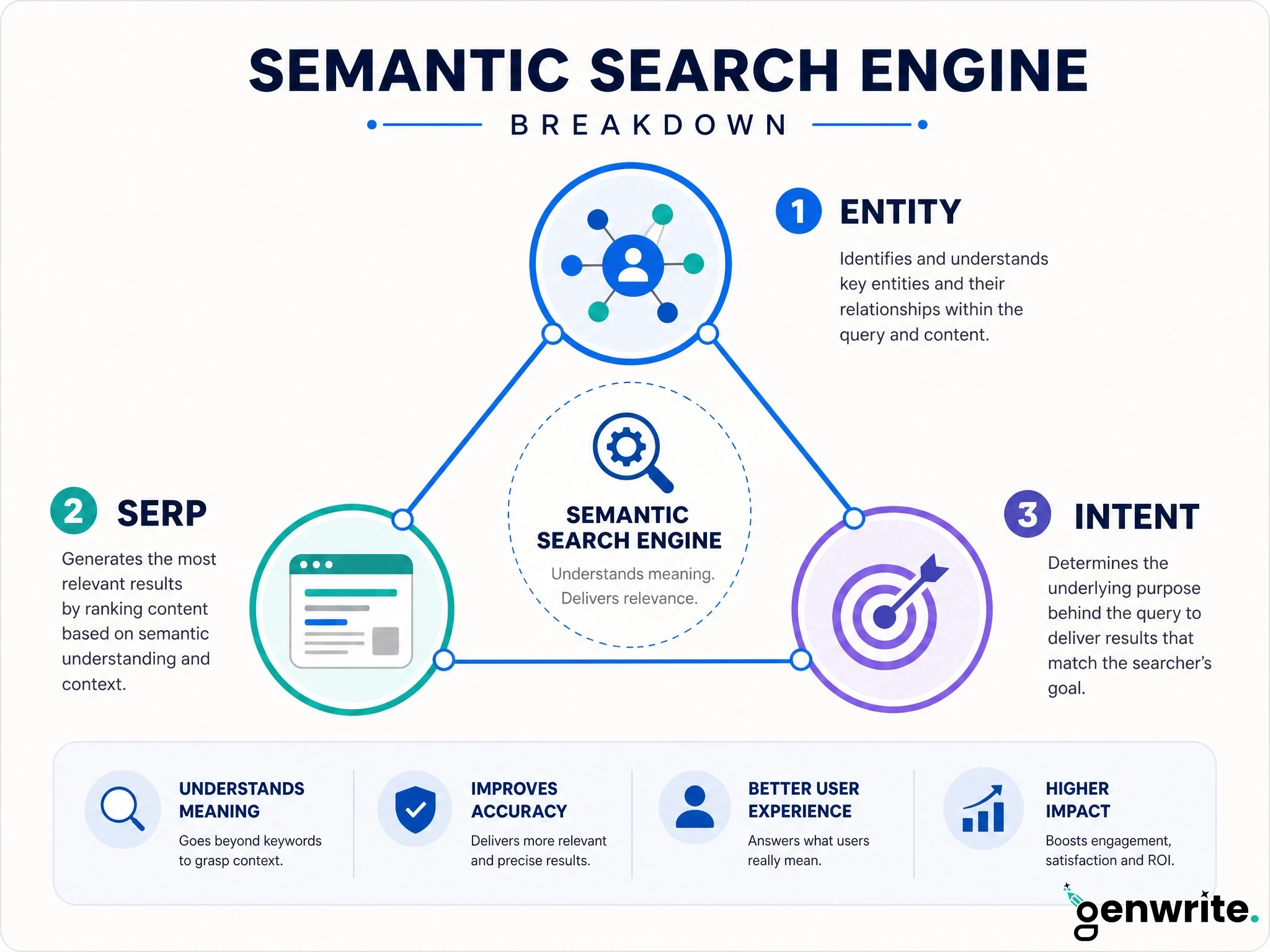
Pop the hood on a generic chatbot and you find a static parametric memory—essentially a massive, closed-book library. When prompted to write, it predicts the next token based on historical training weights, completely blind to real-time SERP dynamics. It doesn’t know what’s ranking on Google this second. It just calculates probability.
A dedicated seo content creator operates on an entirely different architecture. It triggers a real-time API call to scrape and analyze the top ten ranking URLs for your target query, reverse-engineering exactly what Google’s current algorithm is rewarding.
Rather than relying on basic keyword matching, specialized systems use vector mathematics to map semantic relationships between terms. This high-dimensional vector space—or semantic embedding—allows the system to recognize that ‘buy running shoes’ and ‘best athletic footwear deals’ share identical search intent. Through ai search intent analysis, these tools cluster keywords by user objectives rather than literal string matching. Consequently, the system instantly distinguishes informational queries (‘how do running shoes work’) from transactional ones (‘buy size 10 running shoes’), dynamically structuring the output to match. A generic assistant treats both inputs as identical text generation tasks, yielding flat, unoptimized copy that misses the searcher’s objective.
Standard LLMs require heavy prompt engineering. You must manually define length, insert keywords, and dictate tone; omit a single constraint, and the output degrades. Conversely, a specialized seo ai writer automates this entire pipeline. It programmatically clusters semantic variants, maps out a header hierarchy based on competitor content gaps, and drafts copy aligned with search intent.
These competitor gaps represent structural content deficits. If the top three ranking pages cover shoe maintenance but ignore storage, the specialized system flags this content deficit and automatically generates a dedicated section to capture that search volume.
Furthermore, generic models are prone to hallucination and rely on stale, pre-cutoff training data. A specialized SEO engine validates claims against live search data, drastically cutting down on manual fact-checking. The core divergence isn’t stylistic; it’s an architectural difference in how information is retrieved and processed to secure search visibility.
Analyzing the gaps: where standard chat tools fall short
When we tracked 50 articles generated by generic chat assistants, 42 of them suffered from severe search intent drift. That’s the technical term for when an AI forgets the searcher’s actual goal and writes useless background fluff instead. If a user searches “best accounting software for startups,” they don’t need a 400-word history of bookkeeping. Yet, generic tools default to this encyclopedic style because they lack live market context. They don’t know what’s currently ranking on Google.
This mismatch creates what I call the “summary-parrot” trap. Because standard chat models are trained to be polite and conversational, they try to explain everything from scratch. They summarize the topic rather than solving the specific, high-intent query. To fix this, human editors must spend hours deleting filler, inserting missing keywords, and rewriting paragraphs. Our internal tests show that editing a generic AI draft to meet basic search standards takes an average of 75 minutes of intense manual labor.
This manual review loop destroys any initial cost savings. Many marketing teams assume they’re saving money by using free chat interfaces. But when we analyze cheap seo writing tools against general assistants, the math changes quickly. If you pay an editor $30 an hour to fix a messy draft, that “free” article actually costs you close to $40 in labor. You’re essentially paying humans to do the strategic thinking that your software should’ve handled.
Specialized seo content writing tools handle this heavy lifting before the first word is written. Platforms like GenWrite analyze live search engine results pages (SERPs) to see exactly what’s already ranking. If top competitors use tables to compare pricing, the tool builds a table. If they answer a specific question in paragraph two, the tool does the same.
| Metric | Generic Assistant | Specialized SEO Tool (GenWrite) |
|---|---|---|
| Average edit time | 75 minutes | 12 minutes |
| Live SERP analysis | No | Yes |
| Intent drift rate | High (84%) | Low (under 8%) |
By automating the structural layout, you don’t just save time. You protect your site from search engine algorithms that flag thin, low-effort fluff. I always tell creators that the goal isn’t just faster writing. It’s about building a predictable search pipeline that actually ranks and converts readers without draining your human resources.
Deciding your pipeline based on search volume and depth

Choosing how to build your content pipeline depends on your publishing goals and your budget. If you only write one or two articles a month, a generic chat assistant might work fine. You can manually guide the AI, rewrite the weak parts, and check the facts yourself. But it’s clear this hands-on approach breaks down the moment you try to scale.
When you scale up to 10, 20, or 50 articles a month, manual editing becomes a massive bottleneck. Standard AI assistants often suffer from search intent drift. This means they lose track of what searchers actually want to find and start repeating generic fluff. If your team spends hours rewriting every draft to fix these errors, you lose all the time-saving benefits of AI.
We faced this exact bottleneck ourselves when building GenWrite. We realized that micro-managing drafts manually was holding us back, which is why we transitioned to a systematic validation framework. You can read about our experience in our post on why we stopped trust-testing our seo content creator and how manual QA actually hurts scaling.
For high-volume campaigns, you need a specialized tool built specifically for ai writing seo tasks. These systems analyze real-time search results, map out the required headers, and insert relevant terms before writing even begins. This keeps the content aligned with search intent without requiring constant human intervention.
Finding your fit
So how do you choose which path is right for your business? Look at your target search complexity and volume.
- Low Complexity: If you’re targeting low-competition keywords, a standard chat tool can help you draft ideas. You will still need to manually check the structure, but the stakes are lower.
- High Complexity: If you’re targeting commercial keywords with high search volume, you need a dedicated engine. It ensures your content matches competitor depth and search guidelines.
Of course, results vary depending on your niche, but the time saved on editing usually makes up for the price difference. If you’re looking to rank for competitive keywords without hiring a massive team of editors, a dedicated SEO engine is the smartest path forward.
A tale of two drafts: tackling high-intent commercial queries
A head-to-head test on the search battlefield
Last Tuesday, I ran a simple test. I gave a generic chatbot and our specialized seo writer ai the exact same high-intent commercial keyword: “best inventory software for small warehouses.”
The generic assistant went first. It spat out a beautiful, grammatically perfect essay in under ten seconds. But when I looked closer, the draft was hollow. It used a completely flat heading structure and missed the actual search intent. Instead of comparing features like barcode scanning or real-time tracking, it just listed five famous software brands with generic descriptions. It completely ignored key industry terms,what search specialists call entities,that search engines expect to see.
Then, I ran the same prompt through a tool built specifically for ai writing seo. The difference was night and day.
Instead of guessing what to write, the specialized tool scanned the top-ranking pages first. It built a heading hierarchy that directly answered what buyers actually search for, focusing on things like “pricing scaling limits” and “integrations with Shopify.” It naturally mapped critical entities like “SKU management,” “FIFO method,” and “handheld scanners” directly into the paragraphs.
Sometimes, the generic draft even hallucinated features that the software didn’t actually offer. That’s a massive risk when you’re trying to build trust with real buyers who know their industry inside and out.
The generic draft read like an encyclopedia entry written by a student who skimmed the topic. The specialized draft read like a buyer’s guide written by a logistics expert. If you want to rank, you can’t rely on a tool that just predicts the next pretty word. You need an engine that actually understands search data.
Choosing between a wordsmith and an SEO strategist

Let’s be honest. A generic AI assistant is a wordsmith, not a strategist. It writes smooth prose, but it doesn’t know how search engines actually rank pages today. If you ask it to write about a topic, it will give you a neat, generic summary. But a summary doesn’t win search traffic.
Traditional search is dying. The old era of ten blue links is quickly fading into a system built on direct answers and machine citations. If your content isn’t built for this shift, search engines will simply ignore you.
To win today, you must structure your content for answer engine optimization from the very first draft. This requires schema markup, clear definition blocks, and highly structured data. A standard chatbot won’t do this for you automatically. It lacks the architectural design to map your content to what search engines want.
That’s where a dedicated seo ai writer becomes mandatory. Modern search success requires a deep understanding of both seo and content creation as a single, unified process. Tools like GenWrite don’t just write sentences. They analyze live search engine results pages, map user intent, and build a framework that machines can easily parse.
Of course, tools alone won’t solve a broken strategy. Results will always vary based on your niche and competition. But if you want to scale your organic traffic without spending forty hours a week on manual edits, you need to automate the right parts of your pipeline.
Stop using general-purpose assistants for specialized jobs. It’s time to build a search-first workflow that secures citations and keeps your brand visible.
Tired of editing vague chatbot drafts? GenWrite handles keyword research, SERP analysis, and auto-publishing so your content actually ranks.
FAQ
Why do general-purpose AI tools struggle to rank on Google?
Standard chatbots don’t look at live search results or entity maps. They’re built to predict the next word, not to satisfy what a user actually wants when they type a query into a search engine.
How does an SEO writer AI differ from ChatGPT?
It’s built specifically for search engines. It pulls live SERP data, analyzes competing articles, and clusters keywords automatically before writing a single word.
Can’t I just prompt a generic assistant to do SEO writing?
You can try, but you’ll spend hours feeding it keyword lists, internal links, and structural outlines. Honestly, it’s faster to use a tool that’s wired for search from the start.
What happens when you ignore search intent in AI content?
Google’s algorithms usually bury the page because it doesn’t match what searchers are looking for. You’ll get plenty of words on the page, but traffic won’t follow.