
What is answer engine optimization and how do you get started?
The invisible change rewriting how people search online

How often do you actually click a blue link these days? If you’re like most people, you probably scan the AI-generated summary at the top of your screen and move on. It’s a quiet shift, but Google now reports that its AI Overviews serve over 2.5 billion monthly active users. Roughly 60% of U.S. adults now read these quick summaries instead of visiting individual websites.
While this shift doesn’t mean traditional SEO is dead, the old playbook is cracking. If your traffic relies solely on ranking first in standard organic results, you’re likely losing eyeballs to instant answers. But building a sustainable future of search strategy requires adapting to how these large language models extract information. You must learn to optimize for ai search engines directly, rather than just optimizing for traditional keyword algorithms. This is about ensuring your brand’s expertise remains visible as search engines transform into answer engines. By aligning your content with how machines read, you can secure your place in these summaries.
What is answer engine optimization anyway?
How do search engines talk to us these days? They don’t just point to websites anymore. They answer us directly. This massive shift created answer engine optimization (AEO),the art of structuring your content so AI agents can instantly extract, trust, and serve it up as a single, factual response.
Let’s look at how this differs from what you already know. Traditional SEO fights for a spot in a list of blue links. AEO, on the other hand, focuses entirely on optimizing for answer engines to feed immediate, bite-sized facts to voice assistants and chatbots. Then there’s GEO (Generative Engine Optimization), which handles the longer, multi-paragraph syntheses.
| Strategy | Primary Goal | Output Format |
|---|---|---|
| Traditional SEO | Rank pages in SERPs | List of links |
| AEO | Provide direct facts | Single-sentence answers |
| GEO | Align with AI summaries | Multi-paragraph syntheses |
You don’t need a manual overhaul to get this right. Smart AI SEO tools can restructure your existing pages to fit these new formats. But remember: if your data is messy, AI bots will ignore it. Clear schema markup and crisp formatting are your only real defense against being left out of the answer box entirely.
Why being a ranked blue link is no longer enough
The reality of zero-click search
Ranking first on Google used to guarantee traffic. Now, it often guarantees nothing. More than 50% of web searches end without a single click because Google’s AI Overviews and engines like Perplexity answer queries directly on the results page.
The numbers back this up. Gartner projects a 25% drop in traditional search volume by 2026 as users shift to conversational assistants. If your business relies entirely on blue-link clicks, your traffic is on a timer. You need to pivot to generative engine optimization so LLMs actually cite your brand in their answers.
This changes how we measure performance. Keyword positions matter less than Share of Answer.
Figuring out how to rank in ai overviews isn’t an R&D project anymore—it’s standard operations. If LLMs don’t cite your site, you lose access to a quarter of your market. You have to optimize for these engines now, before the traditional search funnel shrinks further.
Your four-step roadmap to start optimizing for AI answers
A practical AEO search strategy
Transitioning your site for generative search optimization doesn’t require rebuilding your entire tech stack from scratch. You can make your content instantly extractable for AI bots with a few tactical shifts that fit right into your existing workflow.
Start by placing a direct-answer block at the very beginning of your articles. Write a clear, 40-to-60-word summary that answers the primary search query without any fluff. LLMs scrape these blocks because they need quick, accurate summaries to serve to users.
Next, you’ll want to implement structured schema markup. Using Q&A and FAQ schema explicitly guides bots to your answers, removing the guesswork for crawler algorithms. But don’t stop there. You should also increase named-entity density. Instead of writing “our software helps you write better,” name the actual tools, people, or platforms you mean. AI models rely on these explicit relationships to map their knowledge.
Lastly, keep the writing natural. While optimizing technical structures is important, engines still prioritize authentic text. If you use generative tools to scale, focus on humanizing content without losing your SEO rankings to maintain reader trust. These small adjustments turn standard pages into highly readable data sources for AI crawlers.
The mistakes that block AI bots from reading your site
Technical walls blocking AI bots from your site
Most businesses block the very AI bots they want to attract. It’s usually because of broken robots.txt files or ancient spam tactics. Stop hiding stuffed keywords in your footer. LLMs spot these cheap tricks instantly and will filter your site out without a second thought.
The bigger issue is treating optimization like an isolated silo. Too many brands buy a generic website seo optimization package and expect magic. It doesn’t work that way. Those cookie-cutter services are built for old search engines, completely ignoring how LLMs actually parse data.
Fixing this is straightforward. Stop hiding content behind heavy JavaScript or aggressive paywalls that bots can’t read. Your schema markup needs to be flawless. If an AI agent can’t scrape your core facts in under a second, it’s gone. It will just cite your competitor instead. Implementing geo SEO techniques isn’t rocket science, but you have to get these technical basics right first.
Clean code won’t save garbage content, but bad code guarantees you’ll stay invisible.
Where to focus when you’re ready to transition
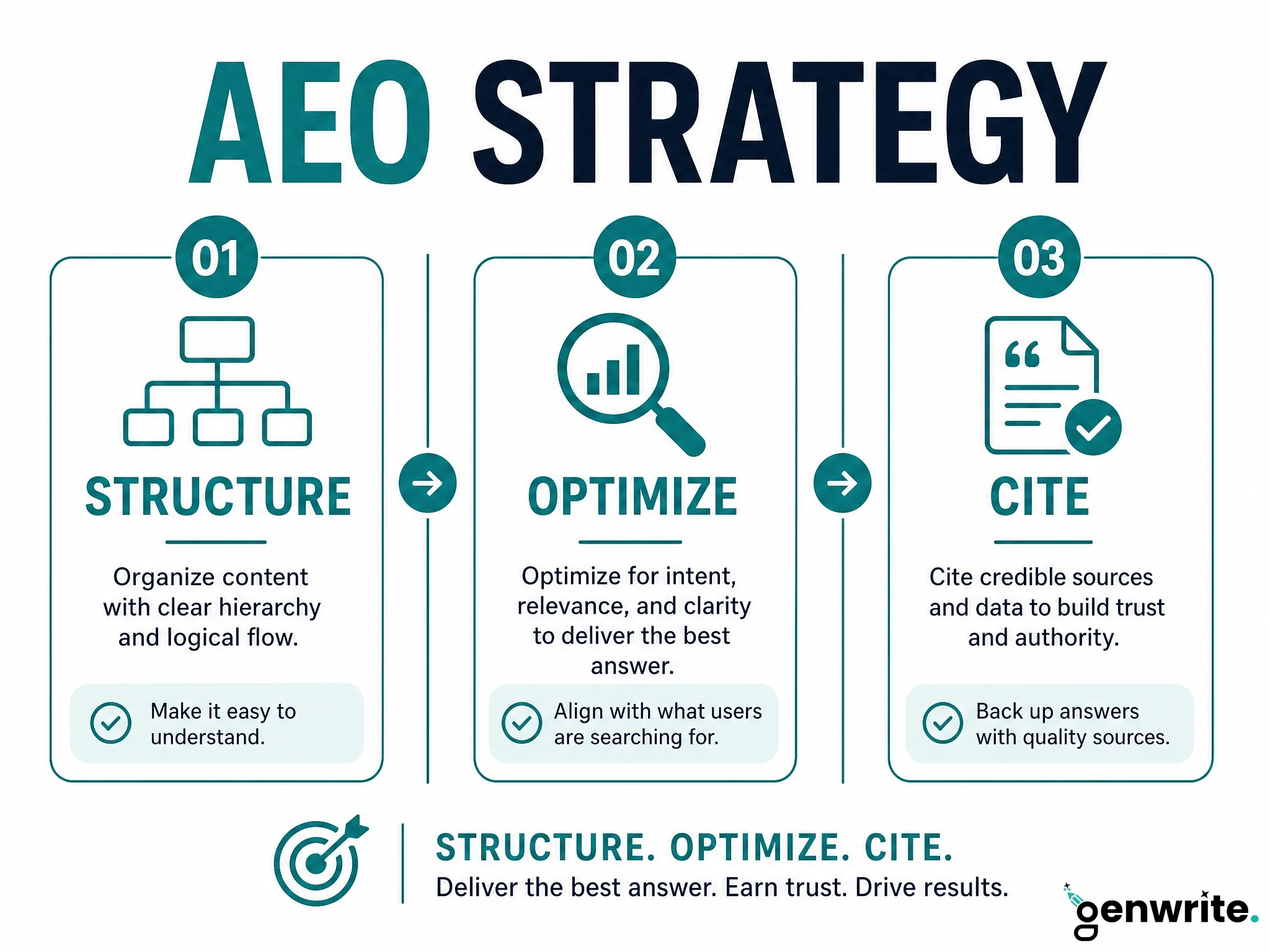
Moving toward answer engine optimization doesn’t mean binning your current SEO playbook. They work hand in hand. While traditional SEO establishes your site’s authority, AEO packages that authority so large language models can actually read and use it. It’s basically translating your hard-won search rankings into conversational answers that AI engines can easily grab.
Don’t let the technical jargon scare you off. It’s a skill you can build over time. Start small today by picking just one high-traffic FAQ page and rewriting it into a direct, conversational Q&A format.
Of course, trying to manually restructure every single piece of content to fit this new way of searching gets exhausting. That’s where an AI blog generator comes in handy to format your posts correctly right from the draft stage. Try it on your next article and see how search bots respond.
Tired of watching AI search tools bypass your website? GenWrite handles the heavy lifting of modern search strategy so your content gets cited.
FAQ
How does answer engine optimization differ from traditional SEO?
Traditional SEO focuses on getting your page to rank as a blue link in search results. AEO specifically targets AI systems that extract information and give users direct answers without a click.
Can small websites actually rank in AI search overviews?
Yes, they can! AI search tools care more about direct answers and clear page structure than domain authority alone. That’s why smaller sites often win the citation spot if their formatting is clean.
What is the best way to make content readable for AI bots?
Use clear headers, bullet points, and straightforward definitions right at the start of your sections. It’s honestly just about making it as easy as possible for a machine to scan and quote you.
Does schema markup really help with generative search?
It’s pretty much essential nowadays. Schema gives search engines exact context about your content, making it much easier for AI models to pull accurate details into their summaries.