
A beginner-friendly checklist for humanizing content without destroying your SEO
Why raw machine drafts are clogging the web (and how to stand out)

Imagine pasting a basic prompt into ChatGPT and watching it spit out 800 words of perfectly structured, utterly soul-crushing text. It has the right headers, but zero pulse.
The web is currently drowning in this exact output. Generative AI traffic has surged, flooding search results with predictable statistical patterns and neutral phrasing. When beginners fire up an ai blog writer, they often publish the raw first draft immediately. They obsess over content generation speed, terrified that editing the text will somehow ruin their SEO optimization for blogs. They assume search engines are hunting for machine text to penalize.
The reality is exactly the opposite. Search engines don’t penalize the tool; they penalize the commodity. If your article reads like a superficial summary of public data, reader trust plummets. While results vary across industries, hollow drafts usually destroy conversion rates long before a search crawler flags them. People bounce, and the algorithm notices.
To humanize content effectively, you have to treat GenWrite or any other AI writing tool as a structural partner, not the final author. You need to inject specific operational scenarios,like fixing a broken approval workflow for a three-person team,rather than accepting vague marketing definitions. Break up rigid paragraph lengths. Use contractions heavily. Swap formal, robotic phrases for direct, conversational rhythms that reflect actual keyword-driven blog writing tactics used by human experts. The goal is never just to pass an AI content detector. It’s to build genuine trust with the person reading on the other side of the screen.
What does it actually mean to humanize content?
So we know raw drafts fall flat, but how do you fix them? Beginners assume they just need to run text through an ai humanizer to trick a detection scanner.
Honestly, that completely misses the point.
To truly humanize content, you aren’t just swapping “furthermore” for “also” to pass a software check. You’re taking sterile, predictable text and giving it a heartbeat. When you use an ai seo content generator, it produces a baseline summary of public data. But search engines don’t reward commodity information. They reward specific, people-first insights.
Think about your own workflow. You might rely on a solid seo content optimization tool to draft a post. The machine gives you structure. But humanization happens when you inject a real operational scenario,like fixing a broken workflow,instead of repeating a standard definition.
Even when running seo ai tools for scale, the final polish requires your perspective. You dictate the conversational rhythm. You add contractions. You break up rigid paragraphs.
Founders often rush to hire expensive seo optimization companies because they fear they can’t balance automation with quality. The evidence here is mixed, as internal teams often know the brand better anyway. Tools like GenWrite prove you can bridge that gap internally. When you oversee automated on page seo writing, you still control the narrative. You ensure your content structure internal linking makes logical sense to a human reader.
This mindset applies everywhere. From long-form content writing down to the snippets built by your meta tag generator, humanizing means prioritizing the reader’s experience over output speed.
The search engine reality check: why helpfulness beats robotic optimization

Moving past relatable phrasing means addressing the elephant in the room: search rankings. Major search engine guidelines recently clarified a simple truth. They evaluate the quality of the content, not the specific tool used to produce it. But beginners still obsess over beating every ai content detector, convinced that algorithms automatically penalize machine-assisted writing on sight. They waste hours tweaking synonyms just to score a passing grade on third-party software.
This defensive strategy misses the point entirely. Algorithms target low-value commodity text,the kind of hollow, repetitive fluff that floods the web when people publish unedited first drafts. If your page relies on neutral phrasing, predictable statistical patterns, and superficial summaries of public data, your traffic will flatline. Search engines reward people-first resources that solve real problems with genuine empathy. Admittedly, this doesn’t always hold true for heavily regulated medical or financial niches, but for general marketing, helpfulness easily beats robotic optimization.
The key is treating automation as an efficient research and structuring partner, rather than a final author. An intelligent seo friendly blog generator like GenWrite handles the heavy lifting of competitor analysis, link placement, and keyword integration, giving you a strong structural foundation. From there, you must layer on specific operational scenarios, clear expert points of view, and natural conversational rhythms.
When you strip out personality to sound overly formal, reader trust drops significantly. Consistent website seo optimization requires more than just hitting technical targets and publishing on a schedule. It demands transforming sterile machine output into engaging, verifiable resources that actually answer the searcher’s intent. So if you focus solely on gaming software scores rather than building a long-term SEO strategy, your content will simply blend into the noise and fail to convert.
Your step-by-step editing pipeline to strip the robot away
So you understand that search engines care about human-centric value, not the tool you used to type the words. But how do you actually bridge that gap? You are staring at a wall of machine-generated text, and it feels completely lifeless. I see beginners freeze up here all the time. They either publish the raw output and pray, or they rewrite the whole thing from scratch. That totally defeats the purpose of automation.
Let’s fix that workflow. Here is my exact pipeline for editing AI text so it actually sounds like you.
Break the robotic rhythm
AI writes in a predictable cadence. Subject, verb, object. Next sentence. Subject, verb, object. It puts people to sleep. To develop a natural writing style, you have to read the draft out loud. Where do you stumble? Where do you run out of breath? Chop those 30-word sentences in half. Then follow them up with a three-word punch. Like this. (And please, delete words like “furthermore” or “additionally”,nobody talks like that over coffee.)
Inject real-world friction
Machines do not have bad days at the office. They do not know what it feels like when a client ghosts you or a server crashes. So, you need to add the friction yourself. Find a generic claim in your draft and attach a specific, slightly messy example to it. If the draft says “content creation is hard,” change it to “managing an editorial calendar when your writer calls in sick is a nightmare.” This is how you genuinely humanize content. It is the single biggest difference between commodity text and a resource people actually trust.
Protect your SEO foundation
You still need to rank. When you are slashing repetitive fluff, make sure you don’t accidentally delete your core search terms. The trick is keeping your primary keywords in the subheadings and introductory paragraphs, then letting the rest flow naturally. Honestly, this doesn’t always hold perfectly,sometimes you have to force a slightly awkward phrasing for strict search intent,but 90% of the time, conversational language wins.
Using an AI blog generator like GenWrite gives you a structurally sound, keyword-optimized draft in seconds. But it’s your job to add the soul. You might even be wondering if paying for a traditional monthly SEO optimization service makes sense when you can automate the heavy lifting. The reality is, if you master this quick editing pass, you can produce highly competitive articles internally at a fraction of the cost.
Where most self-editing efforts go sideways
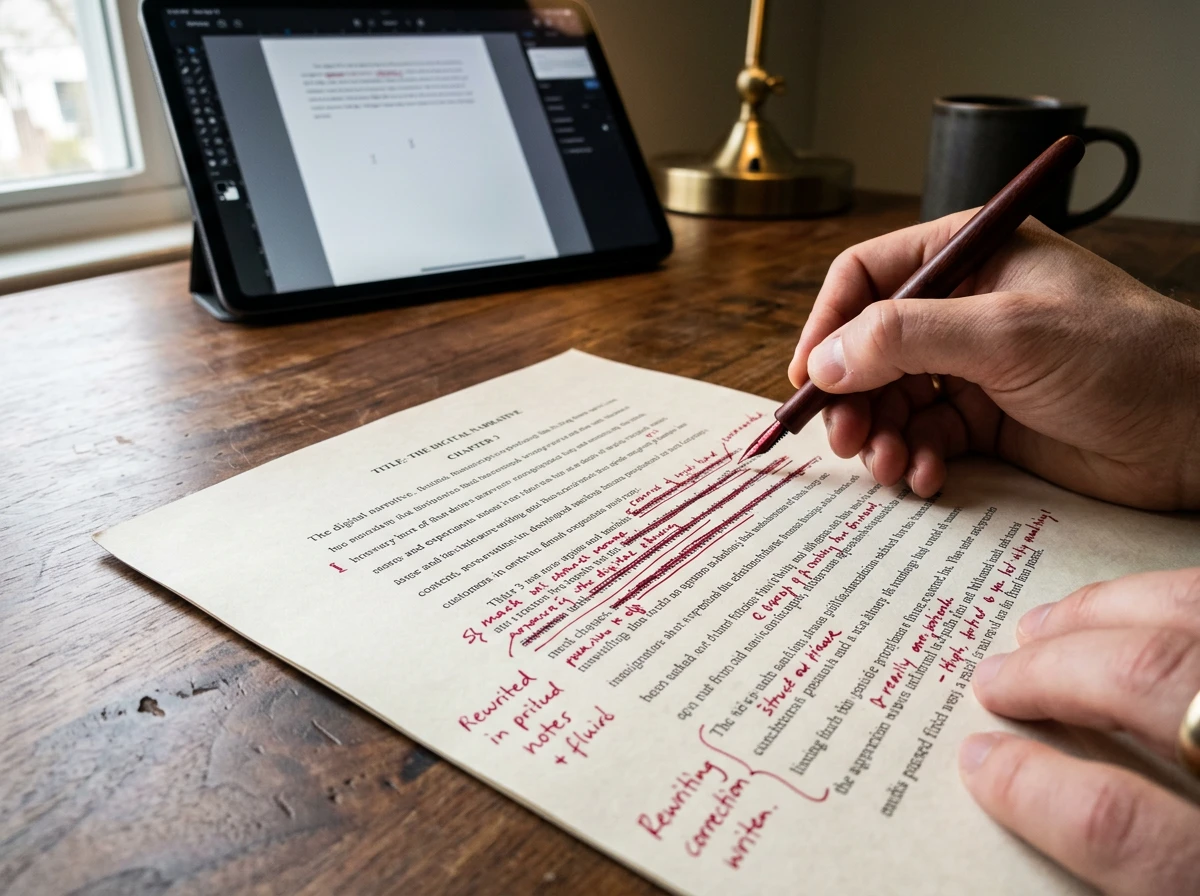
You have the editing checklist. You know the steps. But execution is where the process breaks down. Beginners make the same three mistakes when they edit machine-generated text.
First, they obsess over AI detection scores. This is a massive waste of time. Chasing a perfect “human” score destroys readability. You start mangling perfectly good sentences just to trick a flawed scanner. Search engines do not care if you drafted your post using an ai content writer. They care if the text solves the reader’s problem. Stop managing the score. Manage the value.
Second, editors default to a stiff corporate tone. They think professional means boring. It does not. They strip out all the personality and replace it with formal, dry language. The result reads like a legal disclaimer. If the writing puts you to sleep, it puts your buyer to sleep. Read the text out loud. If you sound like a robot reading a manual, rewrite it.
Third, they leave hollow transitional phrases untouched. This is the worst offense. AI models love predictable filler. Phrases like “As we consider this” or “Moving forward” kill your momentum. They add absolutely zero value to the page. Delete them immediately. The best content optimization tips focus on density and momentum, not padding the word count. Force every sentence to earn its place.
Tools like GenWrite handle the heavy lifting of keyword research, competitor analysis, and bulk drafting. We automate the structure and SEO foundations so you can focus entirely on the core message. But the final editorial filter belongs to you. Do not ruin a solid automated draft with terrible editing habits. Cut the fluff. Drop the formal act. Focus entirely on the reader.
The transformation: breaking down a robotic sentence into real-world talk
So you know what not to do. But what does the actual fix look like when you’re staring at a blinking cursor?
Let’s look at the text itself. Raw machine drafts usually lean on predictable statistical patterns. They sound like a college freshman trying to hit a word count on a term paper. To really humanize content, you have to break those rigid structures, kill the passive voice, and inject a little real-world friction.
Think about how you actually talk to a colleague over coffee. You don’t say, “It is necessary to execute integrated strategies for optimal outcomes.” You say, “We need a plan that actually works.”
Here is a breakdown of how we shift from that sterile, automated tone to a natural writing style.
| The Robotic Output (Before) | The Real-World Talk (After) | Why It Works Better |
|---|---|---|
| “In the modern digital era, it is important to prioritize extensive keyword research.” | “If you want anyone to read your blog, you need to know exactly what they’re searching for.” | Drops the cliché intro. Speaks directly to the reader’s actual goal instead of abstract concepts. |
| “Maintaining a consistent brand voice builds trust with your target demographic.” | “But sounding like yourself is what actually gets people to trust you.” | Kills the robotic transition word. Uses a simple conjunction to connect the thought. Swaps jargon for plain English. |
| “By employing advanced content tools, users can speed up their creation processes.” | “A smart AI tool handles the heavy lifting of research, freeing you up to add your unique perspective.” | Replaces generic phrasing with a concrete benefit. Frames AI as a partner, not a magic button. |
And honestly, this doesn’t mean you have to manually rewrite every single sentence. Sometimes a basic, straightforward definition generated by the machine is perfectly fine. The evidence on what triggers spam filters is mixed, but readers definitely tune out when every paragraph is a dense wall of corporate speak. But for your main arguments? You need to step in and own the voice.
This is where your workflow matters. A reliable setup gets you 80% of the way there. If you’re evaluating AI blog generator pricing to scale up your production, look for platforms like GenWrite that handle the heavy lifting. GenWrite maps the keywords, analyzes the competitors, and builds the initial structure automatically.
That automation buys you the time to focus on the final 20% of polish. You take that solid, SEO-optimized draft and you make it sound like you. You add your own messy, real-world examples. Because that is the part the algorithm simply cannot fake.
Starting your next draft with a human touch

Imagine you just pulled a 1,200-word draft from your usual workflow. You read the first paragraph and immediately feel that familiar, hollow echo. The structure is mathematically perfect, yet completely lifeless. This is exactly where the real work begins.
Instead of panicking and running the text through another flawed ai content detector, you need to shift your mindset. An ai blog writer is a structural partner, not your final voice. When you use an AI blog generator like GenWrite, you already have the heavy lifting handled. The keyword research, competitor analysis, and formatting are locked in. So your only job left is injecting the pulse.
Pick one section of your current project right now. Find a generic claim and replace it with a specific failure your team experienced last quarter. Swap out a rigid transition for a simple “But” or “So”. Add a parenthetical aside that admits where a strategy falls short. The evidence is mixed on whether search engines explicitly measure conversational tone, but readers absolutely bounce when they don’t feel it.
Humanizing isn’t a mystical talent. It’s an editing filter you apply over a solid foundation. If your current draft feels sterile, don’t scrap it. Stop worrying about software scores and start asking if the text actually sounds like you.
Tired of spending hours editing robotic AI drafts? GenWrite handles the heavy lifting so you get natural, SEO-ready posts instantly.
Frequently Asked Questions
Does Google penalize AI-generated content?
No, search engines don’t penalize content just because it’s made with AI. They care about quality, accuracy, and whether the text actually helps the reader.
What’s the easiest way to make AI writing sound more human?
You’ll want to swap out robotic transition phrases for everyday language, add real-world examples, and mix up your sentence lengths so it reads like a real conversation.
Should I worry about AI content detectors?
Honestly, obsessing over detection scores usually leads to awkward phrasing. Focus on making your content genuinely useful instead of trying to trick a piece of software.
Can I keep my SEO keywords while humanizing a draft?
You bet. Natural writing actually helps your SEO because search algorithms reward context and readability over keyword stuffing.