
Do cheap SEO writing tools actually beat the expensive ones?
Are expensive SEO writers a waste of money?

Let’s be honest. We’ve all stared at those $100-a-month SEO tools and wondered if they’re actually worth the cash. Why pay a premium subscription when a cheap alternative spits out two thousand words for the price of a coffee? But here’s the catch. Search engines don’t care about walls of text anymore. The game has completely changed.
Now that AI-driven search is taking over, keyword stuffing is dead. If you want people to actually find your site, you have to adapt to generative engine optimization. Your content can’t just sit there looking pretty. It has to serve up direct, clear answers that search engines can easily parse and feed to users. Cheap tools usually just churn out generic fluff that fails this test completely.
Does that mean you need to buy the most expensive suite on the market? Not at all.
The real battle isn’t about the price tag. It’s about the price-to-performance ratio. You want a setup that builds highly structured, machine-readable articles without draining your budget or forcing you to spend hours editing the final draft.
At GenWrite, we see this headache every day. Teams get stuck spending hours fixing cheap AI output, which completely defeats the point of automation. But overpaying for bloated platforms isn’t the answer either. The sweet spot is finding a tool that handles the heavy lifting—like competitor analysis and structured formatting—without charging you a premium tax.
Let’s look at what actually separates the budget draft engines from the high-end platforms.
The content landscape: budget tools vs premium suites
The software market is split right down the middle. On one side, you have budget tools starting around $19 a month, like SEOWriting.ai or NeuronWriter. They’re built for speed. You can churn out a draft in seconds, but the output is often flat because these tools miss the deeper context search engines look for.
On the other side are premium suites like Clearscope, which starts at $129 a month, and Surfer SEO, starting around $49. These systems don’t just spit out text. They analyze semantic mapping—which is just a fancy way of saying they find the exact related terms Google expects to see in a high-quality piece. They also score your work against top competitors in real time. But they’re expensive.
Budget drafting engines
If you just need words on a page quickly, finding cheap seo content writing tools feels like a massive win. They work fine for simple topics that don’t require deep research.
But there’s a catch.
Cheap tools often produce thin, generic content that struggles to rank. You save money on the monthly subscription, sure, but you’ll likely spend hours rewriting the draft just to make it sound human.
Premium intelligence suites
Premium suites are built for teams targeting highly competitive keywords. They analyze search intent and show you exactly what questions users want answered.
But paying $100 or more every month hurts. It’s hard to justify if you only publish a few posts a month. Plus, the learning curve is steep. You’ll often end up paying for complex features you never actually touch.
At GenWrite, we don’t think you should have to choose between cheap, low-quality drafts and overpriced optimization suites. A smart advanced AI SEO content generator should handle both. It should balance speed with deep semantic mapping automatically, giving you high-ranking articles without the premium price tag.
Climbing the content ladder: what your subscription actually buys
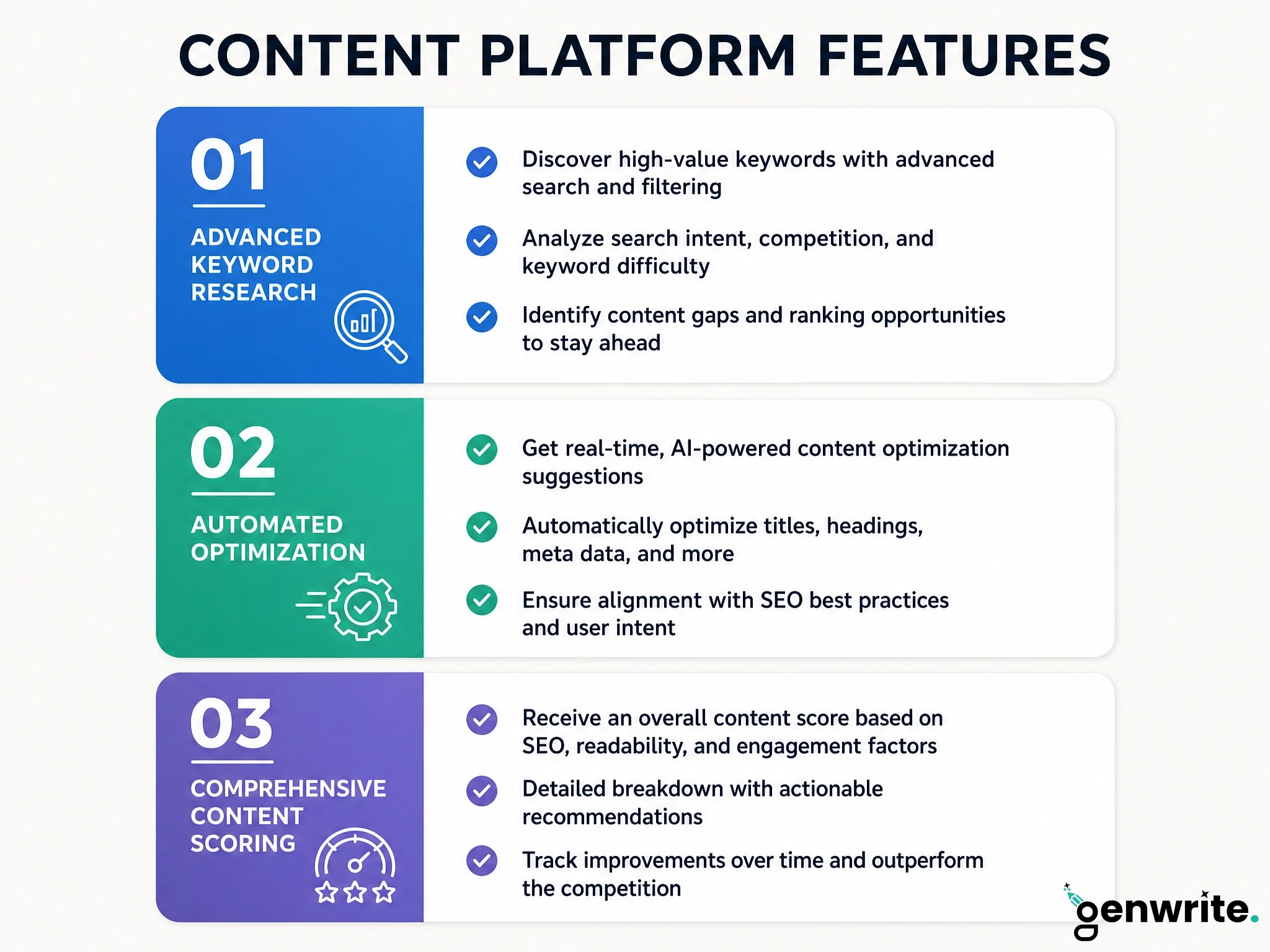
Ten bucks a month gets you a basic text box and a keyword counter. That’s it. When you scale up to premium suites costing $100 or more, you’re buying complex mathematical modeling.
Take text analysis. Surfer SEO calculates real-time numeric scores from 0 to 100 by benchmarking your draft against the top-ranking SERP competitors, while Clearscope distills relevance down to simple letter grades. These platforms don’t just count strings. Instead, they run Natural Language Processing (NLP) to map semantic relationships. If your topic is “cold brew,” the algorithm expects to see “extraction time” and “coarse grind” nearby.
Cheap tools miss these latent semantic connections. A budget ai seo writer might just flag “coffee” for a ten-time repetition, a crude approach that risks keyword stuffing penalties. Conversely, a premium seo content creator maps conceptual relationships.
Here is how these features stack up in practice:
- Semantic analysis: High-end suites extract entities—actual real-world concepts—using systems modeled on Google’s NLP API, whereas cheap tools rely on raw TF-IDF or basic keyword density.
- Internal linking: Premium platforms crawl your entire index to suggest exact, contextually relevant target pages. Cheap tools leave you to query your own site manually.
- Search visibility tracking: Premium suites monitor rank fluctuations over time, correlating drops with known algorithm updates.
Search engines don’t inherently penalize AI-generated text, but they do filter out low-effort, repetitive spam. Premium tools integrate quality-assurance checks to ensure natural syntax and flow. Advanced platforms like GenWrite automate this entire pipeline, combining semantic keyword research, programmatic internal linking, and content automation into a single execution loop.
Ultimately, you’re paying for workflow integration. You can stitch together a working pipeline using cheap, disparate tools, but you’ll waste hours copying data across browser tabs. The premium price tag buys you an integrated system.
The raw reality of going cheap vs paying the premium
Let’s be honest about cheap seo writing tools. They look like a great deal at ten dollars a month, but they come with a massive hidden labor tax. You pay this tax in hours spent fixing bad drafts, hunting down fake facts, and correcting weird phrasing. If you spend three hours rewriting a single automated article, your cheap software just became incredibly expensive.
On the other side, premium suites cost a fortune and tempt you into a different trap. Writers get obsessed with hitting a perfect 100/100 optimization score. This score-chasing often ruins the natural flow of your writing. In fact, it makes articles painful for humans to read. You end up stuffing random keywords into paragraphs where they make absolutely no sense, just to please a computer algorithm. For example, a writer might force the phrase “best widgets near me” into a beautiful story about family history. It sounds terrible.
Neither path works perfectly out of the box. To make your content rank, you have to roll up your sleeves and clean up the output manually. If you want to bypass search engine filters, you must learn how to edit AI text so it actually bypasses detectors and ranks. You need to strip out the repetitive words that AI loves to use and inject your own real-world expertise.
We tried a five-dollar writer last week to draft a post about local plumbing. It invented a plumbing code that doesn’t exist, which could have gotten our clients into legal trouble. That is the raw reality. Cheap tools require constant babysitting, while expensive tools can make your writing sound stiff and robotic.
So, what’s the solution? The answer is to find a tool that balances automation with human control. You don’t need a thousand-dollar suite to win at seo and content creation. You just need a system that builds clean drafts so you can focus on adding real value.
Sizing up your real constraints

How do you choose between a cheap tool and an expensive one? It comes down to two things: your publishing speed and your team size. If you are a solo blogger writing two posts a month, you don’t need a three-figure monthly subscription. Cheap or even free seo content writing tools will serve you just fine. You can easily manage the manual work yourself.
But things change fast when you scale up. I often see businesses throw money at a generic website seo optimization package only to watch their traffic stall because they ignored their actual workflow bottlenecks.
Match your tool to your team size
For solo creators, tools like NeuronWriter or basic plans on Frase work beautifully. You have the time to manually copy, paste, and edit each draft. It is a slow process, but it costs very little.
But if you run an agency or manage multiple writers, those cheap tools become a massive headache. You end up spending hours moving text between Google Docs, optimization software, and WordPress. That extra friction eats up your day and slows down your publishing schedule.
Calculate the hidden labor cost
A cheap ai seo writer might save you fifty dollars a month on software. But if your editor spends three hours cleaning up formatting errors and fixing weird AI phrasing for every single post, you’re actually losing money. The cheap tool turns into an expensive problem.
This is why we built GenWrite. We wanted to bridge this gap by automating the entire process from research to WordPress posting. Sometimes, paying for an integrated system is actually the cheapest path because it saves your team hours of manual work.
The evidence here is mixed for mid-sized teams, though. Some teams still prefer a highly manual, high-touch editing process, which makes automated tools less of a fit. But if your goal is steady, hands-off growth, look at your weekly calendar before you look at your wallet.
How two teams took entirely different paths to page one
Two paths to page one
Sarah runs a lean agency with three writers. They couldn’t afford a $500 monthly enterprise suite, so they built a budget stack. They chose GenWrite as their core seo content creator. Instead of just clicking “publish” on raw drafts, they used a strict editing process. They knew that search engines don’t hate AI tools; they hate lazy, unedited spam. Sarah’s team learned how to generate blogs with AI without spam penalties by keeping a human editor in the loop. Each draft got custom data, real customer quotes, and a quick formatting polish. It took them about 30 minutes per post. Within three months, they landed five competitive keywords on page one.
On the other side of town, David’s enterprise team went the premium route. They paid $800 a month for a high-end collaborative workspace. This tool offered real-time grading, deep semantic analysis, and built-in team task boards. David’s writers spent hours tweaking every single article to hit a perfect “95/100” optimization score before publishing.
Which team won? Both actually reached page one. But Sarah’s team did it at a fraction of the cost and twice as fast. David’s team got bogged down in complex features they barely used, like advanced workspace permissions. Sometimes, the best seo ai writer isn’t the most expensive one. It’s the one that actually fits your daily workflow and keeps your production moving without draining your budget. Of course, this fast-paced budget approach might not fit massive corporations with strict legal sign-off steps. But for most agile teams, the simpler route wins.
Choosing your pipeline over the price tag

Let’s look at the hard numbers behind content production. Many teams focus only on the monthly software subscription fee. But the real metric you need to track is Total Cost of Ownership (TCO).
If you buy a cheap $15 monthly SEO tool, it looks like a bargain. But what happens after the draft is generated? Your writer spends 45 minutes formatting the text, manually finding images, and uploading everything to WordPress. If you pay that writer $30 an hour, every single post carries a $22.50 manual labor tax. This manual friction slows down your entire production schedule.
Compare this to an integrated AI blog generator that handles keyword research, image insertion, and auto-publishing in one step. Suddenly, your labor cost drops to near zero.
| Metric | Fragmented Cheap Stack | Integrated AI Pipeline |
|---|---|---|
| Monthly Software Cost | $15 | $99 |
| Manual Labor Hours per Post | 1.5 hours | 0.1 hours |
| Labor Cost per Post ($30/hr) | $45.00 | $3.00 |
| Monthly Cost for 30 Posts | $1,365 | $189 |
So, those fragmented seo writing tools requiring manual transfers are actually 50x to 200x more expensive in lost hours. The math is clear. Saving $80 on a monthly subscription while wasting over $1,000 in labor is a bad business decision.
We often see teams get stuck in this cheap software trap. They buy five different single-feature tools to save money. But they end up spending all their time copy-pasting text between browser tabs. This disjointed process also introduces formatting errors and broken links.
When choosing your ai writing seo setup, look at the entire workflow. The best tool isn’t the cheapest one on paper. It is the one that removes the most steps between a blank page and a published, ranking post. Focus on the pipeline, not the price tag.
Tired of wasting hours fixing cheap output? GenWrite automates end-to-end SEO blogging so you can skip the tedious edits.
FAQ
Do expensive SEO tools actually guarantee higher Google rankings?
Not really. High prices usually just buy you deeper keyword databases and automated integrations, but you still need a solid strategy to rank.
What’s the hidden cost of using cheap or free SEO writing tools?
You’ll spend hours fixing generic text, doing manual internal linking, and formatting. That’s time you’re paying your team for anyway.
How do I know if I’m paying too much for my current SEO stack?
Check your actual publishing volume against your monthly subscription fee. If you’re paying enterprise prices for basic keyword checks, it’s time to downsize.
Can budget AI writers produce content that actually ranks on page one?
They can, but only if you’re willing to do the heavy lifting on research and editing that premium tools usually handle automatically.