
Why did we stop trust-testing our seo content creator?
The bottleneck of the endless review loop

We all bought the AI speed hype. You install a new seo content creator, expecting to push out dozens of great articles overnight, but then reality hits. You can’t just hit publish blindly. So, you start doing what QA folks call “trust-testing.”
This isn’t just about fixing typos or bad grammar. Trust-testing means checking facts, protecting your brand, and catching bizarre hallucinations. If your software claims an integration with a competitor that doesn’t actually exist, that’s a massive trust issue. You have to catch those blunders before your readers do.
Here’s the problem. When you manually fact-check every single sentence, your publishing pipeline completely freezes. I’ve watched marketing teams spend three hours rewriting a single AI draft just to verify basic details. It defeats the purpose. Why pay for automated tools if your editors are still working late nights?
That’s the bottleneck. You wanted speed, but you ended up with a massive backlog instead. This endless review loop completely ruins the efficiency of automated SEO. We knew we had to change our validation process. We didn’t want to stop checking altogether, but we had to stop creating human traffic jams. Frankly, being too cautious will kill your organic growth. While your team is busy reading every sentence twice, your competitors are simply out-publishing you.
The illusion of the self-correcting AI writer
I remember chatting with a marketing director who thought they had cracked the code. They had just onboarded what they believed was the best seo ai writer on the market. For the first two weeks, the articles were sharp, on-brand, and cleanly formatted. Confident that the machine had learned their exact style, the team stopped reviewing the drafts entirely. They went straight from generation to live publishing.
By week six, things started looking weird. The friendly, conversational tone they wanted had slowly shifted into dry, corporate jargon. Phrases like “it’s important to remember” and “in order to succeed” started creeping back into every single post. The team fell into a classic trap: assuming that modern LLMs are self-correcting.
The reality is that raw AI models don’t hold their shape over time without constant guardrails. When providers update their base models, the underlying prompts you spent weeks perfecting can behave differently overnight. This is what we call prompt drift. Your carefully tuned ai seo content writing workflow suddenly starts spitting out generic fluff because the model’s internal weights changed.
But it gets trickier. Brand voice isn’t static. Your business goals change, your product features evolve, and your audience’s pain points shift. An unmonitored ai seo generator doesn’t know you decided to stop targeting enterprise buyers and start focusing on small startups. It just keeps churning out what it was originally trained to do.
So, we learned the hard way that you can’t just walk away. At GenWrite, we always tell teams that automation works best when you combine automated guardrails with light, strategic human touchpoints. If you treat your generator like a magic box that never needs calibration, your content will eventually slide back into the sea of generic, AI-sounding noise.
Where standard editorial QA breaks under high volume
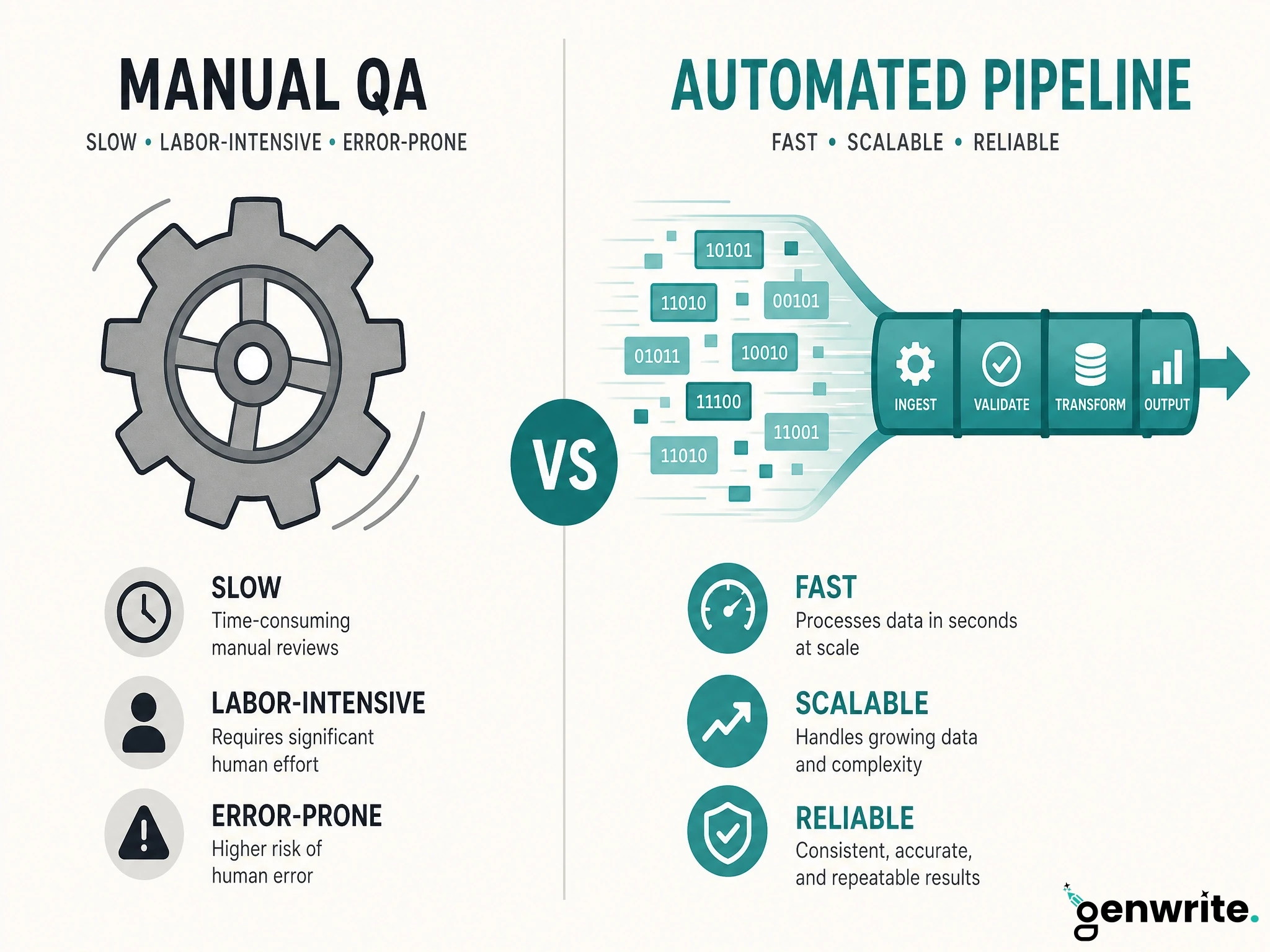
When you scale your publishing from five articles a month to fifty, your editorial team hits a wall. Many teams think they can solve this by buying cheap seo writing tools to churn out drafts. But they quickly find themselves trapped in a costly cycle of manual editing that drains their energy.
Let’s compare two different paths. On one hand, you have the “budget draft” pipeline. You use a basic seo writer ai to generate dozens of cheap articles. On paper, you saved money. But in reality, your editors now spend three hours rewriting each draft to fix weird phrasing and factual errors (which happens way more often than you think). The editing cost alone makes those cheap drafts incredibly expensive. You are essentially paying your team to rebuild a broken house from the ground up.
We often see teams hire three extra editors just to keep up with twenty AI drafts a week. This defeats the whole purpose of using AI. Instead of saving money, you end up spending your entire budget on correcting bad machine-written text.
On the other hand, you have advanced pipelines that handle formatting, internal linking, and facts automatically. This keeps your editors focused on high-level strategy rather than fixing basic grammar.
| Metric | Cheap Draft Pipeline | Advanced Automated Pipeline |
|---|---|---|
| Editor Time per Post | 2 to 3 hours | 15 to 20 minutes |
| Primary Focus | Fixing basic facts and grammar | Checking brand voice and strategy |
| Bottleneck Risk | Extremely high | Very low |
Another major trap is score-chasing on optimization platforms. Editors get stuck trying to hit a perfect score by stuffing random keywords into the text. They waste hours trying to satisfy an arbitrary grading system instead of writing for real human readers. This score-chasing behavior turns your skilled editors into expensive proofreaders who focus on metrics rather than actual content quality.
And honestly, search engines are smart enough to spot keyword-stuffed content from a mile away. When your editors spend all their time chasing scores and fixing bad drafts, they become the ultimate bottleneck. The flow of content stops completely because human hands cannot keep up with the sheer speed of modern seo content writing tools without proper automated guardrails.
Why generative engine optimization demands a new testing framework
Keyword density and readability scores used to be the gold standard for auditing an seo content creator. That era of trust-testing is over. Modern search engines don’t just match strings; they parse semantic relationships.
LLMs and retrieval-augmented generation systems prioritize explicit entity relationships and clean factual structures. If your seo ai writer relies on legacy keyword stuffing, search engines will simply bypass your pages during retrieval.
This architectural shift forces us to measure entirely different metrics. We have to evaluate factual grounding and entity clarity. Entity clarity determines how easily an LLM maps your core topic to a known knowledge graph. Think of it as resolving ambiguity, like distinguishing Apple Inc. from the fruit. If the model’s parser trips over ambiguous phrasing, your page won’t get cited.
The shift to structured answers
As search engines transition into direct answer engines, legacy editorial QA falls short. Standard copyediting won’t tell you if your content schema aligns with what an AI crawler expects.
An LLM will readily extract data from a clean markdown table while completely ignoring a dense, unstructured paragraph. To maintain search visibility, you have to pivot to a GEO SEO strategy built around structured data and explicit answers. It’s the only way to stay visible when users query AI engines directly.
We designed GenWrite around this exact constraint. It doesn’t just output raw text; it structures information so search parsers can easily ingest and attribute it.
Measuring factual grounding
Factual grounding isn’t about style, it’s about verification. If your seowriting ai hallucinates a statistic or invents a source, search crawlers will flag the domain as low-trust.
You need to run drafts through verification pipelines that cross-reference claims against trusted knowledge bases. Skip this step, and even the most polished prose will get buried by modern search algorithms.
Are your automated drafts targeting the wrong search intent?

Why do so many automated blogs rank well at first, only to crash a month later? Could it be that your generator’s targeting the exact same search intent across five different articles?
When you scale up your blog output, manual keyword sorting fails. A human reviewer might look at “how to choose CRM software” and “best CRM options” and think they need separate articles. But Google might see them as the exact same search intent. That’s where semantic keyword cannibalization starts. Your pages end up fighting each other for rankings, and both lose.
Can a human editor spot these overlaps across 50 drafts? Honestly, they probably can’t. It is simply too much data to hold in your head at once. That’s where manual reviews fail us. But you can solve this issue by using advanced AI keyword targeting to group terms based on actual search engine results page (SERP) overlaps.
And this isn’t just about avoiding duplicate topics. Are your informational guides accidentally trying to sell a product? Or are your product pages missing the educational answers searchers actually want?
When we built our system for seo and content creation, we realized that intent testing must be programmatic. An automated system can compare your draft’s core themes against live search results in seconds. It flags when two drafts overlap before you hit publish, saving you from wasting valuable crawl budget.
But does this automated clustering solve every single ranking issue? Of course not. Results vary based on how fast search trends shift. Yet, relying on manual eyes to catch semantic overlaps in a high-volume pipeline is a losing battle.
So, how do you verify that your automated drafts are actually targeting unique buyer intent? You stop trusting manual checks and let algorithms do the heavy lifting.
The silent cost of going completely on autopilot
When we turned off all review processes for our AI content, we expected a massive spike in traffic. We thought we had found the ultimate shortcut. Instead, we quickly realized that letting an AI writer run completely on autopilot is a massive risk.
Without automated guardrails, even the best seo ai writer can generate false facts or broken reference links. For example, during one of our early test runs, an unmonitored draft cited a fake marketing study from 2021 that never actually existed. If we had published that, our brand credibility would have tanked instantly.
But the damage goes far deeper than just looking silly. Search engines are getting smarter at spotting unverified content. If your blog posts contain factual errors or lack clear data structures, search crawlers will simply stop indexing your pages.
This is especially true as search shifts toward AI-driven answers. If your content isn’t structured correctly, modern search engines won’t cite you. To survive this shift, you must apply answer engine optimization to ensure your pages remain machine-readable and authoritative.
We learned that the solution isn’t going back to slow, manual editing. Instead, we need smart programmatic rules. When using modern seo content writing tools, you need a system that checks facts and verifies links automatically. At GenWrite, we build these quality checks directly into the generation process. This ensures that every piece of content is structured correctly before it ever hits your live site.
Sometimes, a raw draft might look perfect on the surface. But without programmatic validation, you risk losing your hard-earned rankings overnight. It’s simply not worth the gamble.
Rebuilding a faster validation pipeline that actually works

Manual editing is a massive bottleneck. If your team spends hours fixing every single draft, your automation is broken. We need to replace manual gatekeeping with a programmatic validation pipeline. This shifts your role from a tired line editor to an efficient system architect.
Build a three-step validation pipeline
You don’t need to read every sentence to ensure quality. Instead, set up automated checks that flag errors before they ever go live. First, run programmatic schema checks. You must verify that your draft contains the correct heading hierarchy. If your seo content creator misses a key structured data tag, your system should automatically bounce it back for a quick rewrite.
Second, automate your link and anchor verification. You can easily check that all outbound links are live and use descriptive anchor text. Broken links destroy search rankings, so this check keeps your site healthy. Third, apply intent matching filters. You should cross-reference the generated headings against actual search results. If the search intent is informational, but your draft reads like a sales pitch, flag it immediately.
Set up a structured feedback loop
But here’s the hard truth: no automated pipeline is 100% perfect. Your results will vary depending on your specific niche. When an error slips through, don’t just fix it in WordPress and move on. You must update your master ruleset in your seowriting ai tool so the mistake never happens again.
So, stop reading drafts like a copyeditor. And start building rules that let your systems police themselves. This is how you scale content without losing your mind. It’s about building a system that learns from every run, turning your seo ai writer into a self-improving asset.
Tired of wasting hours on manual editorial reviews? GenWrite automates your validation pipelines and scales your organic traffic effortlessly.
Frequently Asked Questions
Why do traditional QA checklists fail when scaling AI content?
Manual reviews can’t keep up once you cross a certain volume threshold. Editors end up chasing minor stylistic tweaks instead of catching actual technical issues like outdated stats or broken search intent.
How does search intent drift happen with automated writers?
It happens when prompts stay rigid while audience queries evolve. Your tool might generate grammatically sound paragraphs that answer the wrong core question.
Can you rely entirely on an AI writer without any human checks?
Honestly, running completely on autopilot is risky. You’ll need automated validation guardrails to check facts and citations before anything goes live.
What is generative engine optimization and why does it matter?
GEO focuses on making your content machine-readable so AI search engines can parse and cite it accurately. It’s the natural evolution of standard SEO writing.