
What happens when you pit legacy SEO tools against new AI options?
The great search engine shakeup: why standard databases are no longer enough

We are witnessing a fundamental shift in how people find information online. For more than two decades, search engine optimization relied on a simple agreement: users typed queries, search engines displayed a list of blue links, and publishers received traffic. Today, that agreement is broken. With over 68% of Google searches ending without a click in early 2026, the traditional SEO playbook feels increasingly outdated.
Legacy database-driven tools were built for a search landscape that no longer exists. They excel at scraping historical keyword data and analyzing backlink profiles, but they struggle to interpret how modern search engines use machine learning to answer queries directly on the results page. When Google displays an AI-generated overview, the value of ranking in the top three organic spots changes instantly. You might hold the top spot, yet still lose the vast majority of your traffic to an on-screen answer.
This shift forces us to rethink our approach to optimization. Modern AI SEO tools address this gap by focusing on semantic relevance and intent mapping rather than simple keyword matching. While legacy platforms show you what people searched for three months ago, AI-driven platforms analyze how search engines parse natural language in real time.
But this doesn’t mean you should throw away your classic tracking tools just yet. The reality is that both systems have distinct strengths. Legacy databases offer an unmatched historical record, while generative options provide the speed and contextual understanding required to compete in a zero-click world. Navigating this transition isn’t about choosing one side; it’s about understanding how to bridge the gap between static data and dynamic, generative search environments.
Two different philosophies: legacy databases versus the generative wave
Legacy SEO platforms treat the web like a massive, indexable filing cabinet. They crawl billions of pages to map backlink profiles and catalog historical search volumes. It is a backward-looking approach. While it offers incredible precision for historical data, it struggles to adapt when search engines shift how they interpret human intent.
Modern seo ai tools operate on a completely different premise. Instead of indexing the past, they analyze semantic relationships and generate actual answers. They don’t just tell you what people searched for last month. They help you build the actual content that matches what search engines want to serve right now.
The backward-looking index vs. active generation
Traditional databases excel at validation. If you need to know exactly how many backlinks a competitor has, or the precise search volume of a commercial keyword over the last twelve months, legacy tools are your best bet. But they are passive. They show you the battlefield, but they don’t help you fight the war.
The best ai for seo shifts the focus from analysis to execution. These platforms analyze topical gaps across the web and immediately generate structured drafts to fill them. Instead of spending hours analyzing search intent manually, you can use generative models to map out semantic clusters and write highly targeted content in minutes.
| Capability | Legacy Databases | Generative AI Tools |
|---|---|---|
| Primary Data Source | Historical search indexes & backlink graphs | LLMs & real-time semantic analysis |
| Core Strength | Domain authority tracking & exact search volume | Rapid content creation & intent mapping |
| Weakness | Slow to adapt to zero-click search behavior | Can hallucinate search demand without data |
But this generative approach doesn’t always guarantee immediate success. Sometimes search engines still favor an older domain with a massive backlink profile, even if their content is outdated. The reality is that search algorithms are caught in the middle of this same transition. So, while legacy databases keep you tethered to traditional ranking metrics, generative tools prepare your site for a future dominated by conversational search engines.
And this is where the real division lies. Legacy tools assume search is a solved problem of matching keywords to links. AI tools recognize that search is an evolving conversation where context, structure, and rapid deployment dictate who wins the click.
Rankings vs citations: comparing the core capabilities side-by-side
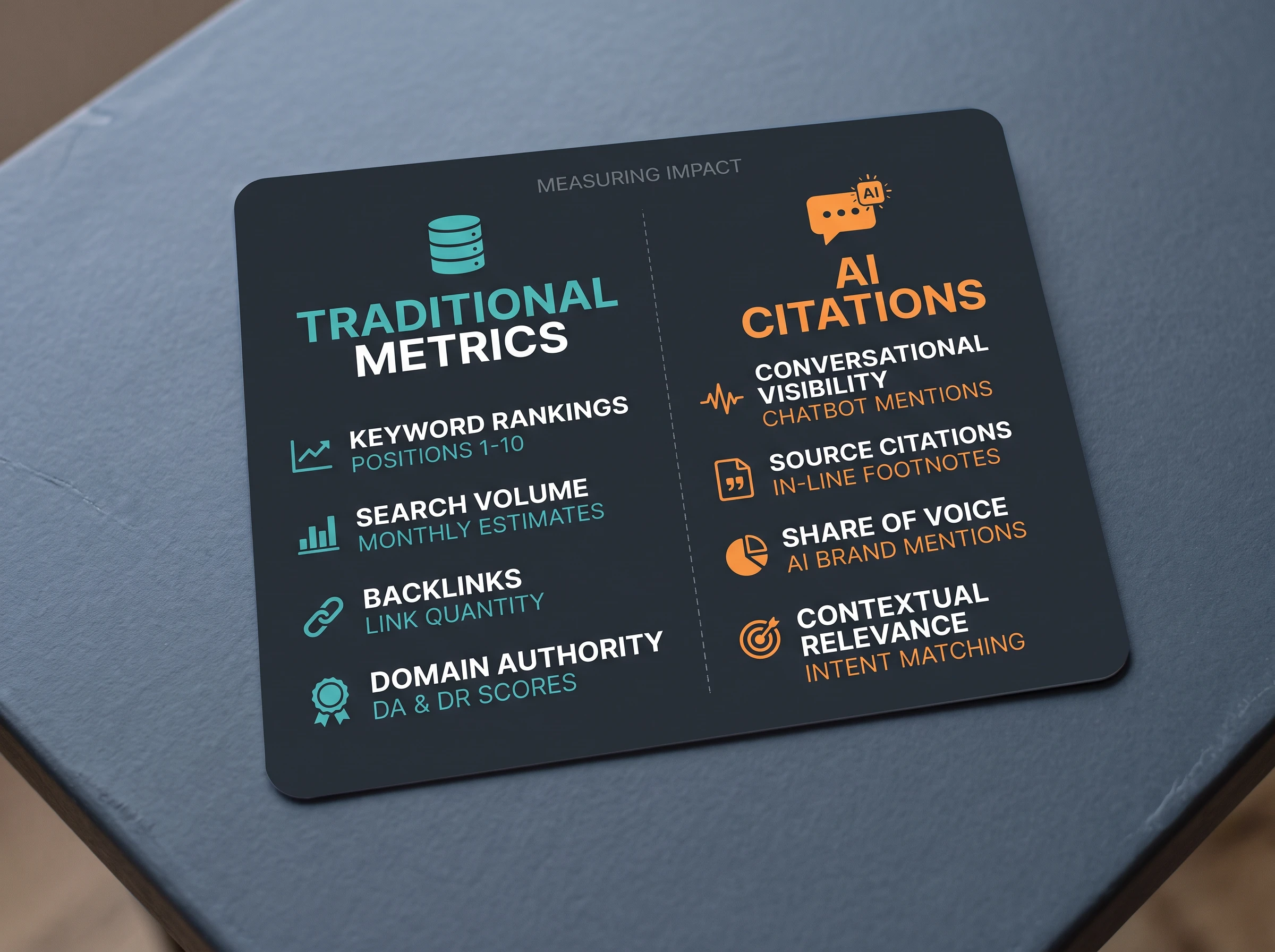
The battleground for organic visibility has split into two distinct fronts. On one side, we have traditional search engine result pages (SERPs) governed by blue links; on the other, we have generative engines that synthesize answers on the fly. To keep pace, legacy platforms are rapidly retrofitting their systems. For instance, Semrush now includes an integrated AI Visibility Score, and Ahrefs features a dedicated Brand Radar add-on starting at $129 per month. These traditional suites are building brand tracking features to monitor mentions inside ChatGPT, Gemini, and Google’s AI Overviews, where traditional rankings don’t always align with AI citations.
But a fundamental mismatch remains. Legacy suites treat AI tracking as an expensive add-on layer built on top of historic keyword databases. In contrast, dedicated best ai seo software treats the modern, semantic search landscape as the default starting point. The table below outlines how these two approaches stack up across critical execution pillars.
| Feature | Legacy SEO Suites (with AI Add-ons) | Specialized AI SEO Platforms |
|---|---|---|
| Primary Metric | Keyword rank position (1-100) | Share of voice in generative answers (citations) |
| Data Freshness | Scheduled crawls (daily to weekly) | Real-time SERP scraping and LLM analysis |
| Content Execution | Manual writing assistants with basic prompts | Automated, end-to-end semantic draft generation |
| Competitor Analysis | Backlink gaps and domain authority metrics | Intent mapping and entity relationship analysis |
| Pricing Model | High base fee + expensive modular add-ons | All-inclusive generation and optimization credits |
This structural divergence creates real-world friction. If you rely solely on legacy tools, you might see your site ranking third for a high-volume keyword, yet lose 60% of the actual traffic because a generative overview answered the user’s query before they ever scrolled down.
And the reality is that tracking a citation requires a completely different technical approach than tracking a ranking. A traditional crawler looks for a specific URL in an HTML element. An AI-focused engine must analyze whether a brand is mentioned as a recommended solution within a complex, dynamically generated paragraph.
So, while legacy platforms excel at mapping out the historical competitive landscape, they often fail to help you execute at the speed of modern search. If your goal is to build topical authority quickly, using specialized ai tools for seo allows you to bypass the manual bottleneck of drafting and structuring content. Legacy systems can tell you that a gap exists, but they cannot write the highly structured, contextually relevant content needed to fill it.
The brutal truth about what both options fail to deliver
Let’s stop pretending either side has this completely figured out. If you rely solely on legacy SEO platforms, you’re brought to a crawl by manual processes. These older systems are built on static databases that can’t write a single line of copy, leaving you to spend hours manually turning keyword lists into outlines. They fail to understand the nuanced intent behind search queries, leaving you with dry search volume metrics but no real path to scaling production. In a world that demands rapid content deployment, relying purely on manual workflows is a recipe for getting left behind.
But the alternative isn’t a magic bullet either. The uncomfortable truth about most modern AI platforms is their tendency to produce incredibly generic, repetitive content. Because many of these engines simply scrape the top results on Google, they end up repackaging and regurgitating the exact same ideas. You end up with a blog that sounds just like every other competitor on page one. To break this cycle of mediocrity, you have to actively train your systems. If you want to stand out, you must learn how to train an AI SEO tool to bypass these repetitive patterns and inject unique, primary data.
Without strict editorial guidance and custom data inputs, an off-the-shelf ai seo tool will default to the average. It lacks the critical context of your specific business, your brand voice, and your proprietary insights. The result? A beautifully formatted, highly optimized piece of content that says absolutely nothing new. Search engines are getting smarter, and they easily spot these copycat patterns.
So where does that leave us? Legacy platforms keep you accurate but incredibly slow. Many newer seo writing tools keep you fast but dangerously generic. The real failure isn’t the technology itself; it’s the blind trust we place in either extreme. If you don’t actively bridge the gap between traditional data depth and automated execution, your organic search strategy will inevitably stall.
Making the call: when to lean on traditional metrics and when to automate

Choosing where to invest your marketing budget isn’t about finding a single, perfect platform. It’s about matching your software stack to your team’s actual operational limits. If you have a dedicated data analyst who spends forty hours a week dissecting backlink profiles and historical search trends, a legacy SEO optimization service is irreplaceable. But for most lean marketing teams, those massive databases turn into expensive shelfware that nobody has the time to configure, let alone use daily.
When your immediate goal is scaling production without hiring an army of writers, relying solely on manual research slows you down. This is where an AI blog generator bridges the gap. It transforms SEO from a passive research project into an active publishing pipeline. Instead of spending days mapping keywords to search intent, you can automate the heavy lifting of content creation and publish directly to your site.
Deciding by team size and budget
Your choice generally comes down to your primary bottleneck. Are you starved for data, or are you starved for execution?
- The Enterprise Playbook: If you manage a high-authority domain with complex technical challenges, you need legacy databases. Their strength lies in clinical data quality, site audits, and competitor backlink monitoring. However, keep in mind that these platforms require a dedicated specialist to turn raw metrics into actual content.
- The Lean Marketing Playbook: If your main challenge is producing enough high-quality, search-optimized content to build topical authority, you should automate. Modern AI SEO tools handle competitor analysis and semantic structuring in seconds, allowing a single marketer to run a high-volume blog.
The operational longevity trap
Before committing to any new software, you must look past the flashy dashboard. Many teams rush to adopt what they believe is the best AI for SEO only to realize they don’t actually own their data, or that the tool’s underlying models are completely opaque.
What happens to your automated workflows if the platform changes its API pricing overnight? Finding the best ai seo software requires looking beyond the initial pitch. The reality is that tools relying on simple wrappers around public models often struggle with long-term stability. You need to ask tough questions about data ownership and model transparency before integrating any tool into your core publishing workflow. Balance the deep, historical metrics of legacy platforms with the execution speed of automation, but always maintain control over your content strategy.
How to safely audit new tools without risking your site’s health
Deploying untested automation on your main production domain is a recipe for catastrophic organic traffic drops. When you integrate a new tool, you aren’t just testing software; you are testing how search engine algorithms react to its output. To protect your brand’s hard-earned authority, you must establish a rigorous, isolated testing protocol to evaluate these new ai tools for seo before letting any automated system publish directly to your site.
The sandbox protocol
Never run initial tests on your primary domain. Instead, spin up an isolated staging environment or a completely separate sandbox subdomain. This setup lets you observe how search engines index and rank the generated content without risking your core business metrics.
I recommend launching 10 to 15 test articles on this sandbox domain to monitor indexing speed, initial keyword impressions, and user engagement metrics. During this phase, you can safely evaluate the software’s performance without fear of algorithmic penalties. For a detailed, step-by-step breakdown of this isolation strategy, read our guide on how to use ai for seo without risking your primary domain authority. Finding the best ai for seo requires running these controlled experiments where failure has zero impact on your bottom line.
Auditing for model hallucinations
Generative models are notorious for inventing facts, statistics, and even source URLs. Your audit process must include a manual editorial pass to verify every single claim.
- Verify source data: Cross-reference all cited statistics against original research papers or trusted databases.
- Analyze keyword intent: Ensure the tool isn’t targeting mismatched search intents (e.g., serving transactional content to informational queries).
- Check internal linking: Verify that automated internal links point to live, contextually relevant pages rather than hallucinated URLs.
Quantifying the output quality
Establish a baseline scoring system to grade the automated drafts. Rate the content on structural flow, factual accuracy, and alignment with search engine helpful content guidelines. If a tool consistently scores below your baseline, it requires tighter prompting, custom templates, or a different platform altogether.
This systematic approach takes time, but the safety it provides is invaluable. By treating automation as a candidate that must pass a probation period, you ensure that only high-quality, safe content ever reaches your main audience.
Real workflows in action: how actual teams are blending both pipelines

A few months ago, I watched a mid-sized marketing team nearly tear itself apart. Half the team wanted to stick to their expensive, database-heavy legacy suite. The other half was ready to automate everything using an AI blog generator. The breakthrough didn’t come from choosing a side. It came when they realized these systems work best as a tag team.
Today, their workflow is a highly coordinated pipeline. They use legacy platforms for what they do best: deep backlink audits and historical keyword analysis. This research establishes the domain authority necessary to feed primary search trust signals directly into their content strategy. But instead of manual execution, they pass those insights to a dedicated blogging agent to handle the bulk of the drafting and semantic structure.
The hybrid pipeline in practice
To see how this works, look at how they target high-intent keywords. A traditional tool flags a rising search term but offers no help in writing the content. The team takes that keyword, plugs it into an automated workflow, and lets GenWrite build out the structure, analyze competitor gaps, and draft the post.
Here is how they divide the labor:
- Legacy tools: Backlink profile monitoring, competitor keyword gap discovery, and rank tracking.
- AI content tools: Semantic clustering, draft generation, image addition, and automated publishing.
This setup cut their production time from twelve hours per article to under forty-five minutes. But it isn’t entirely hands-off. The team still spends fifteen minutes reviewing the AI-generated drafts to inject unique brand insights and verify data points.
Sometimes, the automated draft needs a slight tone adjustment or a specific product screenshot. The evidence is mixed on whether fully automated sites can survive Google’s core updates long-term without this human layer. By blending the analytical precision of old-school seo search engine optimization with the speed of modern seo writing tools, they get the best of both worlds: high-velocity publishing backed by solid data.
Where do we go from here?
Will your organic traffic actually survive when the traditional search box is no longer the main gateway to the web? It is a question that keeps digital marketers awake at night. We are watching search engines transform into answering engines in real time. With Semrush research predicting LLM-directed brand traffic will outpace traditional search, sticking to old playbooks is a recipe for irrelevance.
So, how do we build a search strategy that satisfies both Google’s index and the LLMs pulling data behind the scenes?
The answer lies in combining indexing precision with generative compliance. You cannot simply abandon keyword research, but you can no longer rely on it exclusively. Your content must serve two masters: the traditional crawler looking for structural signals, and the AI model looking for semantic relationships and direct answers to complex user prompts.
This is where an advanced AI blog generator becomes indispensable. By automating the heavy lifting of content creation while respecting strict technical SEO guidelines, you can scale your output without sacrificing quality. But automation without strategy is dangerous. You must audit your AI-generated content to ensure it answers real user pain points, contains original insights, and naturally integrates semantic variations that LLMs crave.
Are you prepared to shift your focus from tracking simple blue links to securing citations inside generative AI summaries? The transition is not optional. The brands that win the next decade will be those that use intelligent automation to dominate search, ensuring their content is both highly visible on Google and deeply integrated into AI training datasets. What step will you take today to bridge that gap?
Tired of juggling separate keyword trackers and content writers? GenWrite handles research, writing, and SEO optimization in one automated pipeline.
FAQ
Can AI tools completely replace Ahrefs or Semrush?
Honestly, no. AI handles drafting and optimization, but it doesn’t track raw backlink profiles or historical domain authority like legacy platforms do.
Why do AI-generated drafts often sound generic?
Most tools train on the same public web data, meaning they just regurgitate what’s already ranking. You’ll need unique data or strong prompts to fix that.
How do zero-click searches change keyword tracking?
Traditional tools focus heavily on click-through traffic, but modern search engines answer queries right on the results page. That’s why tracking AI citations matters just as much as standard rankings now.
What’s the best way to combine legacy data with AI writing?
Use legacy platforms for hard keyword research and gap analysis, then feed those insights into an automated workflow for faster content production.