
Before buying an AI SEO tool, ask these three non-technical questions
Why shopping for AI SEO software is a massive trap

We’ve all been there. You’re sitting through a polished sales demo, watching a representative click a single button to generate a 2,000-word blog post complete with headers, images, and meta tags. The charts on the screen only go up and to the right. It looks incredibly easy, almost like magic.
But this is exactly where the trap snaps shut.
When you shop for software based purely on feature checklists and shiny dashboards, you’re setting yourself up for a painful wake-up call. The real challenges of implementing these platforms don’t show up during the sales call. They show up three weeks later when your team is drowning in robotic drafts that require hours of heavy editing, or worse, when your organic search traffic starts to nose-dive.
The truth is that finding the best ai for seo isn’t about finding the tool with the most knobs, sliders, or proprietary metrics. It is about understanding how the software actually behaves when applied to your specific business model. If you aren’t careful, you might end up buying a glorified wrapper that simply queries a basic large language model and spits out generic content that search engines will quickly ignore.
To avoid this, you have to shift your perspective. You don’t need to be a software engineer or a data scientist to evaluate these platforms effectively. In fact, focusing too much on the technical specifications often distracts you from the questions that actually matter for your business.
We need to start looking at [ai tools for seo] through a non-technical lens. This means asking hard questions about editorial control, content quality, and long-term viability. It is about protecting your brand’s reputation and your hard-earned search rankings from automated mediocrity. This isn’t always easy when vendors are pushing hard to close a deal, but it is the only way to safeguard your digital presence.
Let’s look at why the standard purchasing process is fundamentally broken, and how you can protect your budget by changing the questions you ask before signing any contract.
What does an AI SEO tool actually do behind the scenes?
Strip away the sleek branding and flashing dashboards. What you actually have in an AI SEO tool isn’t a sentient search genius, but a highly specialized digital translator. It sits right between the chaotic way humans search and the rigid, mathematical algorithms of Google, trying to predict what will satisfy both sides.
Traditional SEO software is basically an interactive spreadsheet. It counts keywords, tracks backlink metrics, and flags meta descriptions that are too long. But it leaves all the actual thinking and writing to you. Modern AI platforms do something different. They synthesize information. By analyzing the structural DNA of top-ranking pages, they can generate outlines, suggest semantic entities, and draft entire paragraphs of optimized text.
How does this happen? Under the hood, these platforms run on predictive models trained on billions of web pages. When you enter a target keyword, the software doesn’t start researching from scratch. It instantly scans the current search engine results pages (SERPs), breaks down competitor headers, and identifies the exact subtopics you need to cover to be deemed relevant. Then, it uses large language models to write prose that mimics the authoritative tone search engines favor.
But there is a catch.
Because these algorithms learn from existing search data, their default setting is to copy what is already out there. Without manual intervention, they produce generic, repetitive copy that fails to offer new value. To stand out, you have to learn how to train your AI SEO tool to avoid regurgitating search results and instead inject original insights.
Ultimately, these platforms are pattern-matching engines. They are great at mapping out the structural requirements of a ranking page, predicting search intent, and formatting data for search bots. But they still need human direction to make sure the final output is actually worth reading.
Why the non-technical questions protect your site (and budget)
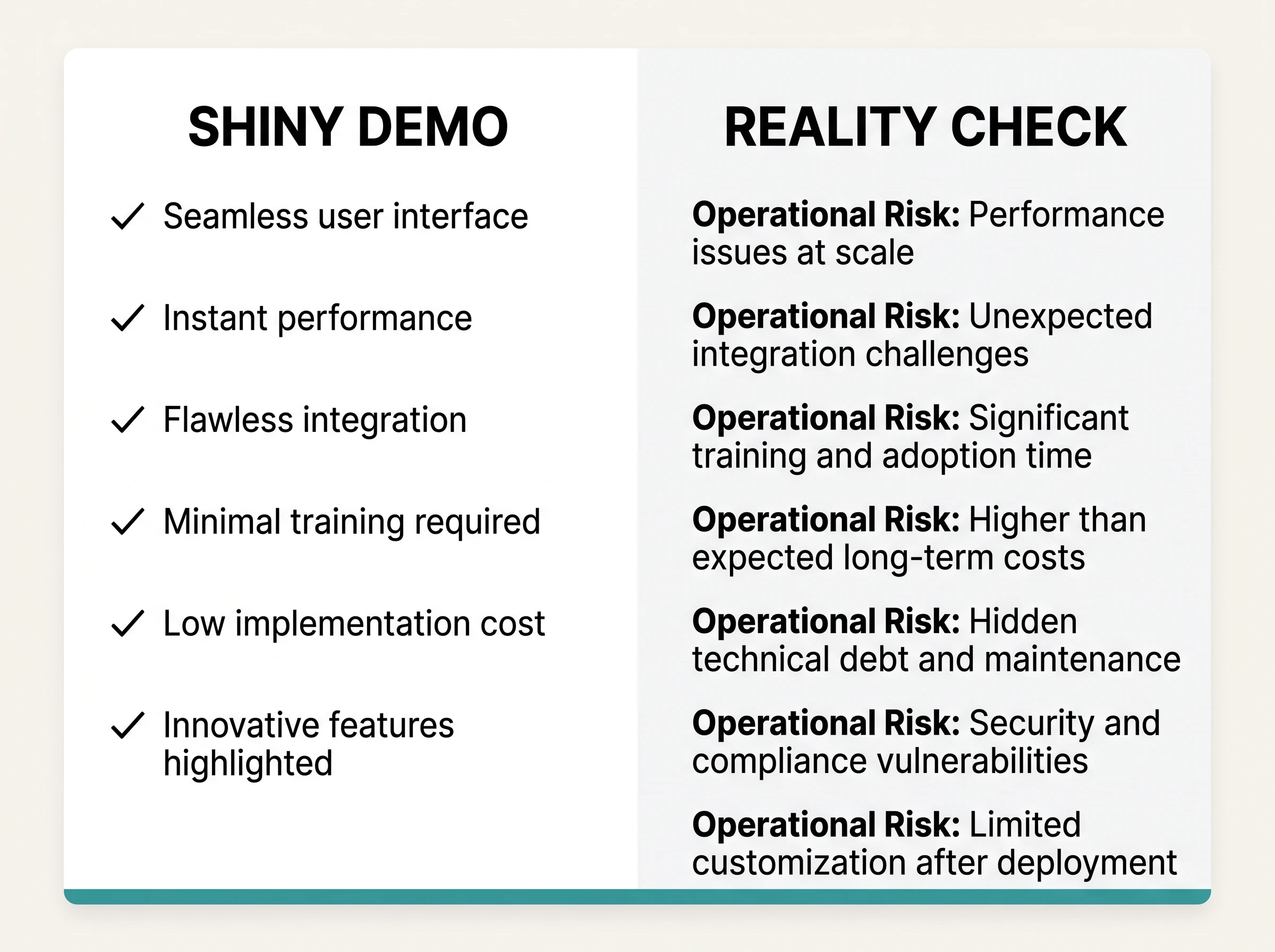
Buying software based solely on a flashy feature list is a fast track to wasted budget and damaged domain authority. With search engine optimization, the true cost of a bad tool isn’t just the monthly SaaS subscription. It’s the catastrophic drop in organic traffic when search engines flag your automated content as low-quality spam.
Many marketing teams rush to adopt seo writing tools without asking how the vendor manages quality control or data accuracy. The reality is simple: search engines are increasingly sophisticated at identifying low-effort, mass-produced content that offers zero unique value. If your tool simply scrapes existing search results and reformats them without adding new insights, your organic performance will eventually suffer.
Consider the operational risks. A tool that hallucinates key facts or generates outdated advice forces your editors to spend hours fixing errors. This completely defeats the purpose of automation. Instead of saving time, your team gets bogged down in heavy developmental editing.
| Operational Metric | Technical-Only Focus | Non-Technical Strategic Focus |
|---|---|---|
| Content Quality | Plagiarism-free but generic | Unique perspective with high factual accuracy |
| Resource Allocation | High editing overhead per draft | Minimal review needed before publishing |
| Risk Exposure | High vulnerability to algorithm updates | Long-term stability and brand safety |
| ROI Realization | Negative due to editing bottlenecks | Positive through efficient scale |
We’ve seen organizations lose up to 40% of their organic visibility overnight after deploying unchecked automation. This happens because they treated website seo optimization as a purely mechanical process of keyword stuffing rather than a strategic exercise in authority building.
Before signing a contract, you must look beyond the interface. Understanding how a vendor sources their training data and handles algorithmic volatility is what actually protects your brand. It ensures you build a sustainable pipeline that survives search engine updates rather than a temporary traffic spike that quickly fades.
The three non-technical questions you must ask every vendor
When you sit down with an AI vendor, it is easy to get lost in demonstrations of rapid generation. But the real friction of using automated software always happens after the contract is signed. To protect your workflow and budget, you need to move past the surface features.
Before committing to a platform, put these three non-technical questions to your sales representative.
1. “If we cancel our subscription next year, what happens to our data?”
Many platforms operate as closed ecosystems. They hold your keyword maps, content briefs, and historical performance metrics hostage inside their proprietary dashboard. If you decide to migrate to a different system, you might discover that your data is locked away or only exportable in cluttered, unusable formats.
Ask the vendor directly: “Can we export our entire content history, keyword research maps, and metadata into a clean CSV or JSON format at any time without penalty?” A vendor committed to true partnerships will have clear, self-serve export tools. If their retention strategy relies on data lock-in, walk away.
2. “Who owns the liability when the tool hallucinates facts or targets bad keywords?”
AI models occasionally invent facts, cite dead links, or suggest search terms with inflated search volumes. If your brand publishes inaccurate information, the search engines and your customers will hold you responsible, not the software.
Ask the representative: “How does your platform flag potential inaccuracies, and what is your process for verifying search intent?”
This is particularly critical when evaluating how the tool handles ai keyword research. If the software targets low-value queries that fail to drive real revenue, you are the one losing valuable resources. You need to know if the vendor has built-in guardrails to verify search intent or if they expect your team to catch every single error manually.
3. “How does this tool change our team’s daily workflow, or does it just dump drafts?”
Many tools promise to save time but actually create more work. If an application simply dumps thousands of raw, unedited drafts into your content management system, your editors will spend all their time cleaning up generic text.
Use this script on your next sales call:
“Walk me through the exact steps our editor takes from the moment a keyword is selected to the moment the post goes live. Does your platform integrate directly with our existing CMS, or does it require manual copy-pasting? How does it assist with actual seo optimisation during the editing phase?”
Ideally, you want a solution that supports content automation by handling the heavy lifting of competitor research and structure, while fitting cleanly into your team’s existing review pipeline. If the vendor cannot show you a clear, friction-free workflow, their tool will likely become shelfware.
Where most beginners get tripped up in the purchase process

Buying software based on a brand name is the fastest way to flush your budget down the drain. Most beginners fall for flashy marketing campaigns and assume that a household name guarantees a seamless workflow. It does not. A tool might have millions in venture backing, but if its output requires three hours of manual editing to sound human, it is not saving you time. You are simply paying to become an underpaid editor for a machine.
Another common trap is relying on a single, rigid artificial intelligence engine. Search algorithms change daily, and LLMs (Large Language Models) update their training data constantly. If your chosen platform is hardcoded to one specific model, you are stuck with its blind spots. The best AI tools for seo remain model-agnostic, letting you leverage different engines depending on whether you need deep research, creative phrasing, or rapid data processing.
The hidden cost of setup and static prompts
Many buyers ignore the setup timeline. They buy a subscription on a Tuesday, expecting to rank on Google by Friday. In reality, configuring integrations, setting up brand voice guidelines, and connecting your CMS (Content Management System) takes actual work. If a vendor promises instant, one-click miracles with zero onboarding friction, they are lying.
- The static prompt trap: Avoid tools that use the exact same prompts for every user in your niche. If you and your competitors use the same software with the same default settings, you will end up publishing identical, generic content.
- The traffic vanity metric: Do not get blinded by tools promising massive traffic increases without showing how they filter out low-intent search queries. High traffic that does not convert is just an expensive vanity metric.
- Ignoring the human-in-the-loop necessity: Software should automate the heavy lifting, but completely removing human oversight is a recipe for factual errors.
To bypass these traps, start with a limited pilot. Test the tool on a small cluster of articles rather than committing to an annual enterprise plan. You can often find a seo ai free trial or a low-cost sandbox tier to run these tests. If the software cannot prove its value on five pages, it will not magically work on five hundred. Keep your initial evaluation small, demanding, and highly focused on actual output quality.
Comparing a bad AI vendor pitch to a good one
I recently sat through a demo with a vendor who promised their platform was the absolute best ai for seo because it could generate 500 articles in three clicks. The salesperson eagerly clicked a button, and within 90 seconds, a shiny dashboard filled with perfectly formatted articles on generic topics. It looked miraculous on screen. But when I asked how the tool handled real-world customer friction or unique search intent, the room went quiet. Their system was just a thin wrapper over a basic LLM, pulling generic search volume data that every competitor already owns.
That is the classic bad pitch. It treats search engine optimization as a pure volume game, relying on automated databases that spit out copycat content. If you publish those articles, you are just joining a race to the bottom.
Now, contrast that with a much better approach. A sophisticated vendor won’t promise magic buttons. Instead, they will show you how to inject raw customer reality into the machine. For instance, instead of relying on sterile keyword databases, a smart integration lets you feed actual customer support logs, sales transcripts, or unique product angles directly into the workflow.
This makes a massive difference in your output. When you use an advanced ai seo content generator that prioritizes this level of customization, you stop publishing the same generic fluff as everyone else. You start targeting the highly specific, low-competition phrases your competitors completely miss because they are too busy running basic automated exports.
| Pitch Characteristic | The Superficial Wrapper | The Strategic Integration |
|---|---|---|
| Data Source | Static, public keyword databases | Custom customer data & unique insights |
| Content Quality | Generic, highly repetitive summaries | Nuanced, brand-specific answers |
| Workflow | Rigid “one-click” automation | Flexible, iterative generation |
| Long-term Value | High risk of search engine penalties | Sustainable, high-converting traffic |
We have found that the tools worth your budget are the ones that respect the complexity of your actual business. They don’t hide behind flashy, instantaneous mockups. Instead, they give you the levers to guide the AI, ensuring the final output actually sounds like it was written by an expert who understands your customer’s pain points.
Our handpicked resources for diving deeper

Evaluating an ai seo tool shouldn’t feel like studying for a computer science degree. If you want to make an informed decision without getting bogged down in technical jargon, I suggest looking into a few specific areas that most software sales reps won’t bring up voluntarily. Navigating this space requires a shift in how we think about search, moving away from simple keyword counts and toward actual user intent and system architecture.
First, you need to understand how search engines and large language models (LLMs) actually read your site. I highly recommend spending an hour reading up on LLM crawlers,like GPTBot or ClaudeBot. These are the automated agents scanning your content to train models and serve answers in AI search summaries. Knowing how to block or permit these crawlers gives you immediate control over your brand’s AI footprint, which is a key consideration when selecting modern seo ai tools.
Second, look into AI visibility checkers. These emerging platforms show you how often your brand appears in AI-generated search answers on platforms like Perplexity or Google’s Search Generative Experience (SGE). It’s a completely different metric than traditional keyword rankings, and tracking it early will put you miles ahead of your competitors.
Third, shift your focus toward search-driven content planning. Instead of just looking for a tool that spits out generic articles, you want a system that understands topical authority and handles the heavy lifting. For example, platforms like the GenWrite AI blog generator help automate this entire lifecycle,from finding semantic keyword gaps and conducting competitor analysis to automatically publishing optimized posts directly to your CMS. Seeing how an automated pipeline handles these steps in real-time will show you what a true, modern content creation workflow looks like.
Finally, keep an eye on Google’s Search Quality Rater Guidelines. It’s a long document, but even skimming the section on Experience, Expertise, Authoritativeness, and Trustworthiness (E-E-A-T) will change how you evaluate any software you test. If a vendor’s tool can’t produce content that meets these human guidelines, it’s not worth your budget. Start with these areas, and you’ll quickly spot the difference between a superficial wrapper and a tool built for long-term organic growth.
Take a breath and request a sandbox test
You do not need a degree in machine learning to buy software that works. The marketing gloss around neural networks, vector databases, and proprietary algorithms is designed to make you feel underqualified, pushing you to trust the vendor’s claims blindly. But the reality is that software evaluation comes down to three practical pillars: workflow integration, data freedom, and editing quality. If a tool cannot respect your team’s time, let you export your data, or produce text that passes human editorial standards, its underlying technology is irrelevant.
Before signing any contract, ask the vendor for a sandbox environment. A safe sandbox trial is your best defense against buyer’s remorse. Run a limited test using a handful of target keywords to see how the tool handles your niche. Does it generate generic fluff, or does it actually help you build a structured content pipeline? During this trial, pay close attention to how the platform handles website seo optimization and whether it genuinely simplifies your publishing flow.
The sandbox checklist
When you run your pilot, do not just look at the final output. Assess the friction points in the entire process. Use this quick checklist to grade your experience:
- Data portability: Can you export your generated drafts and keyword research in standard formats like CSV or Markdown without losing formatting?
- Editorial control: How easy is it to reject a generated outline, rewrite specific paragraphs, or inject your own brand voice guidelines before publishing?
- Integration speed: Does the tool connect directly to your CMS, or are you stuck copying and pasting text and manually uploading images?
If a vendor hesitates to give you sandbox access or pressures you into a long-term commitment based on a canned demo, walk away. Good software speaks for itself in a live environment. By focusing on these non-technical fundamentals, you protect your budget, preserve your site’s search reputation, and ensure your team actually uses the tool you buy. Take a breath, ignore the technical jargon, and demand a trial that proves real-world value.
Tired of sorting through bloated software demos? GenWrite handles automated keyword research and publishing without locking away your data.
FAQ
How do you know if an AI SEO tool is actually making up search volumes?
Honestly, most tools won’t admit when they’re guessing. You’ll want to cross-check their keyword numbers against a trusted baseline like Google Search Console to see if they’re even close.
Why do vendors hide their data ownership policies?
It’s usually because they train their public models on your custom prompts and niche strategies. If you switch platforms later, you’ll find out your proprietary content history stayed behind.
Can small marketing teams realistically manage an enterprise AI writing platform?
Most of them can’t, unless the tool fits into existing workflows without needing a developer on standby. That’s why picking a straightforward setup like GenWrite matters so much for lean teams.