
How to tell if your new AI SEO tool is actually choosing profitable search queries
The shiny new promise of automated keyword curation

Marketing teams are rapidly abandoning legacy spreadsheet workbooks in favor of modern seo ai tools. The promise is incredibly seductive: instead of manually filtering thousands of rows of raw database exports, you click a single button, and a machine learning algorithm hands you a curated, clustered, ready-to-write roadmap. It saves dozens of hours. But this speed introduces a quiet, expensive failure mode.
The core issue is that many ai tools for seo are built to optimize for metrics that algorithms can easily measure, such as search volume, topical authority, and semantic density. What they cannot easily measure is your specific business model, your sales cycle, or the actual willingness of a searcher to open their wallet. When you rely entirely on automated curation, you often end up targeting terms that look mathematically perfect on paper but are commercially dead on arrival.
Classic databases like Ahrefs or Semrush simply gave you raw, unfiltered data. You had to do the heavy lifting of analysis, which naturally forced you to think about search intent. Modern best ai seo software attempts to bypass this step by doing the thinking for you. It groups keywords into neat clusters and assigns priority scores based on algorithmic relevance.
But a machine learning model doesn’t understand that a high-volume informational query like “how do search engines work” is incredibly difficult to monetize compared to a low-volume transactional query like “enterprise log monitoring pricing.” The algorithm sees a massive traffic opportunity and a high semantic match to your site’s broad theme, so it flags the high-volume term as a priority.
If your content engine blindly follows these automated suggestions, you will likely see your organic impressions and even your raw traffic numbers climb. Yet, your pipeline will remain stubbornly flat. You are essentially paying to host traffic that has zero intention of ever buying your product. To build a sustainable, automated pipeline, you must learn how to audit these algorithmic recommendations before they enter your production queue.
The anatomy of an empty keyword suggestion
Let’s look at a real-world warning sign. Your tool flagships a high-volume keyword like “free templates for b2b sales agreements.” On paper, it looks like a goldmine. The search volume is high, and the keyword difficulty score is low. But if you sell enterprise-level contract lifecycle software, this keyword is a trap.
Why did your best ai for seo tool flag this? Because LLMs and basic keyword scrapers look at semantic relevance and competitive gaps, not business models. The algorithm identifies that your site writes about sales contracts. It sees a massive search volume for “free templates” with low competition. It assumes you should bridge this gap. But the search intent is fundamentally mismatched. A user searching for a “free template” wants a quick, zero-cost download. They are not looking to buy an enterprise software suite.
This happens because ai keyword research tools struggle with three structural limitations:
- Lack of margin awareness: The tool does not know your customer acquisition cost (CAC) or customer lifetime value (LTV). It treats a user looking for a free PDF the same as a user looking for an enterprise demo.
- Historical bias: Algorithms rely on past search data. They cannot predict if a search term is shifting from informational to transactional, or if the traffic is dominated by students and researchers.
- Surface-level semantic matching: The AI groups words that look similar, ignoring the commercial context of those words.
If you blindly trust these automated lists, you will end up spending your content budget on traffic that inflates your analytics dashboard but does nothing for your bank account. You cannot pay your team with vanity pageviews.
And it gets worse when you consider the opportunity cost. Every hour your team spends writing, optimizing, and promoting a piece of content for a dead-end query is an hour they are not spending on high-intent transactional keywords. You end up with a blog full of traffic-heavy, revenue-zero articles that look great in quarterly reports but fail to move the needle on actual sales pipelines. This is the classic trap of trusting raw algorithmic suggestions without applying a strict filter of commercial reality to every single keyword your tool spits out.
Audit step 1: verifying the real-world search intent

Most AI blog generator platforms claim they can read the room. They’ll slap a label on a keyword, call it transactional or informational, and expect you to build an entire strategy around that guess. Don’t fall for it. Software categorizations often miss the messy reality of human search behavior. When you’re evaluating modern seo writing tools, you can’t just trust their internal classifications. You have to test each suggestion against what actual humans expect to see when they type those words into a search box. Think of this manual verification as your sanity check before you spend a single dollar on content creation.
Start by plugging the keyword into an incognito browser window. Look at the top three results. Are they long-form educational guides, product category pages, or direct software reviews? If your tool flagged a query as transactional, but Google serves up three Wikipedia-style definitions and a forum thread, the algorithm got it wrong. It’s chasing surface-level semantic matches instead of understanding real-world intent. Building a product pitch for a query driven by pure curiosity is a quick way to waste your content budget. Those visitors have zero intention of opening their wallets.
Next, look closely at the SERP features dominating the page. Do you see shopping carousels, pricing tables, or software comparison widgets? Or is the screen packed with “people also ask” boxes and video carousels? These visual cues tell you far more about intent than any software dashboard. Platforms that handle automated content automation need clear signals, yet modern search is shifting toward answer engine optimization where conversational queries blur traditional lines. If your tool can’t distinguish between a researcher and a buyer, you’ll end up targeting ghosts.
Proper seo optimisation also requires looking beyond simple labels. Check the modifier words trailing behind the core head term. Words like “free”, “template”, or “how to” scream informational intent, no matter how hard an AI tries to twist them into commercial opportunities. Yet teams often ignore these modifiers because the search volume looks massive. Don’t fall for that trap. If the query demands a free guide, you won’t rank a pricing page. Period. Force your software to justify its intent tags by cross-referencing the live search results yourself before committing resources.
Audit step 2: exposing hallucinated search volumes and dead metrics
Most modern marketers assume that their chosen AI tool queries live search databases in real-time. But the reality is that many generative tools guess search volumes based on linguistic patterns, or pull from stale, third-party databases cached months ago. When you use generative models for ai keyword research, you are often looking at mathematical approximations rather than live market demand. This mismatch is why understanding why grounding your content in verified data matters is so vital before you commit your budget to writing.
To protect your budget, you need a manual verification loop. Start by exporting your AI’s recommended keyword list and uploading it directly into Google Keyword Planner (GKP). GKP isn’t perfect, and its numbers are heavily grouped for advertisers, but it provides a necessary baseline of actual search query volume. If your AI tool claims a hyper-specific long-tail phrase has 1,200 monthly searches, but GKP shows zero or “no data,” your AI is likely hallucinating demand based on semantic similarity.
Next, cross-reference these terms with Google Trends to see if the topic is actually alive. A static keyword difficulty (KD) score of 12 from even the best ai seo software can be incredibly misleading. KD is usually calculated using simple backlink averages of the top ten ranking pages, completely ignoring search intent shifts or SERP feature crowding. If a SERP is dominated by Reddit threads, video carousels, and AI Overviews, the actual difficulty of securing a click is far higher than a low KD score suggests.
Why does this metric inflation happen? LLMs are trained to predict the next logical word, meaning they naturally group semantically related concepts together. If “how to scale enterprise sales” has high search volume, the AI might assume “how to scale enterprise sales with automated outbound workflows” must also have high volume. It invents a number based on that proximity. So, you end up targeting a ghost keyword that sounds highly profitable but has zero actual search interest.
Run a manual search for your target term in an incognito window. Look at the actual organic real estate. Are there four Google Ads at the top, followed by a local pack and a giant “People Also Ask” block? If so, even a ranking of position two or three will yield negligible organic traffic. This visual audit is something automated metrics simply cannot calculate.
Granted, this manual verification takes time, and some niche B2B queries with zero recorded search volume can still yield highly profitable leads. But blindly trusting automated dashboards is a fast track to producing content that ranks for keywords nobody is actually typing.
Audit step 3: calculating actual profit potential over traffic vanity metrics
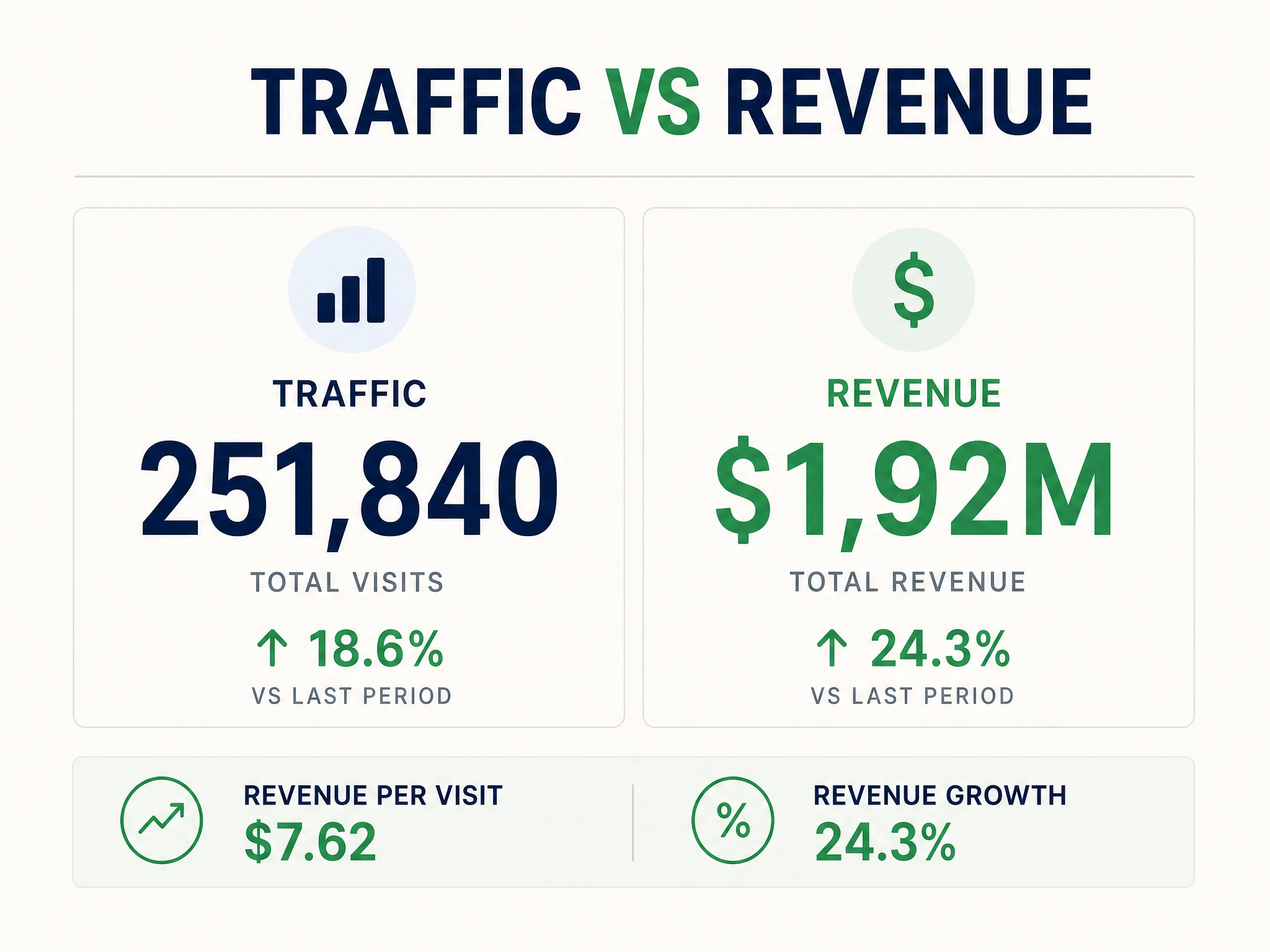
Most search tools nudge you toward high-volume terms because big numbers look impressive in monthly reports. But traffic is a vanity metric if those visitors never convert. To keep your ai tools for seo grounded in commercial reality, you need to calculate the actual profit potential of a keyword before writing a single word of content.
The cold math of keyword ROI
We can calculate this using a simple formula that strips away the hype. To find the estimated value of a target query, multiply its monthly search volume by the click-through rate (CTR), your expected conversion rate, and your average customer lifetime value (LTV).
$$text{Estimated Monthly Value} = text{Volume} times text{CTR} times text{Conversion Rate} times text{LTV}$$
Let us look at how this plays out in practice with two different keywords recommended by an ai seo content generator:
| Metric | Keyword A: “free productivity tips” | Keyword B: “best enterprise task manager” |
|---|---|---|
| Monthly Volume | 5,000 | 200 |
| Estimated CTR (Position 3 ~10%) | 500 clicks | 20 clicks |
| Expected Conversion Rate | 0.1% (mostly free seekers) | 3.0% (high-intent buyers) |
| Customer Lifetime Value (LTV) | $0 (no immediate purchase) | $1,200 |
| Estimated Monthly Value | $0 | $720 |
Keyword A looks dominant on paper with 5,000 monthly searches. Yet, the business value is virtually non-existent because the search intent does not align with a commercial offering. Keyword B, despite its tiny search volume, yields actual revenue because it targets decision-makers ready to spend money.
Mapping queries to the balance sheet
AI models are excellent at finding patterns, but they do not understand your business margins. They do not know if your SaaS product has a high churn rate or if your consulting services require a three-month onboarding process.
To bridge this gap, assign a commercial intent score (from 0 to 1.0) to every AI-generated keyword roadmap. High-intent terms (like “alternative to [Competitor]”) get a 1.0, while purely informational terms (like “what is [Concept]”) get a 0.1. Multiply this score by the estimated traffic to get a realistic picture of commercial viability.
Sometimes, a low-volume informational keyword is worth targeting if it builds trust early in a long sales cycle. But these decisions should be conscious strategic choices, not accidents caused by blindly trusting software defaults. If your software cannot distinguish between a curious student and a qualified buyer, you will end up burning your budget on empty traffic.
Failsafes and pro habits to keep your tool grounded
Last quarter, I watched a marketing team sink three weeks of budget into a campaign targeting “free cloud migration templates.” Their automated planner flagged it as a high-intent, low-difficulty goldmine. The content went live, traffic spiked by 40%, but demo sign-ups didn’t budge. The tool missed a basic human reality: people looking for free templates rarely have the authority or budget to buy enterprise software.
To stop your software from leading you down these expensive dead ends, you need to establish strict operational guardrails. We can’t treat modern seo writing tools as autonomous decision-makers. Instead, think of them as highly efficient research assistants that require a human sign-off before any action is taken.
Build a manual verification gate
Before any keyword enters your content calendar, run a manual search for it in an incognito window. Look closely at the actual search engine results page. Are the top results commercial landing pages, or are they academic forums and government PDFs? If the results are dominated by free tools and non-profit resources, your commercial offer won’t convert. This simple five-minute check saves dozens of hours of wasted writing.
Establish strict seed constraints
Most engines hallucinate when given too much creative freedom. If you let an automated generator scrape the web without boundaries, it eventually suggests generic terms with high search volume but zero conversion potential. You should restrict your tool’s discovery phase by using strict negative keyword lists. Block terms like “free,” “cheap,” “what is,” or “salary” if your goal is pure product sign-ups.
Pair selection with structural editing
Finding the right search term is only half the battle. If your execution is flat, readers will leave the page before they ever see your call to action. When you use automated systems for ai seo content writing, you must dedicate time to structure, flow, and unique perspectives. A well-chosen keyword is useless if the resulting page reads like a generic database scrape.
This hybrid approach keeps your strategy grounded. By combining automated discovery with human commercial judgment, you ensure your content drives actual revenue, not just empty vanity metrics.
What to do when traffic goes up but revenue stays flat

Your analytics dashboard shows a steep upward curve. Organic impressions are climbing, and those shiny new blog posts generated by your brand-new seo ai tools are indexing rapidly. Yet, your Stripe account or CRM remains stubbornly quiet. This is the classic disconnect of the automated content era: high search volume, zero commercial intent.
When traffic rises but revenue flatlines, you are likely looking at a deep misalignment between informational queries and transactional realities. Let’s compare how high-performing content behaves versus vanity-driven automated content:
| Metric / Behavior | Vanity Automated Content | High-Conversion Content |
|---|---|---|
| Primary Query Type | Broad definitions (“what is…”) | Comparison & high-intent (“alternative to…”, “how to solve…”) |
| User Action | Reads definition, leaves immediately | Clicks internal links, signs up, reads product docs |
| Engine Positioning | Standard search results (often low CTR) | Cited inside LLM answers and AI summaries |
| Conversion Rate | Under 0.1% | 2% to 5% or higher |
When you look at the differences, the source of the problem becomes obvious. The reality is that many of the best ai for seo platforms optimize for search volume because it is an easy metric to prove success. But a user searching “how to write a blog post” is in a completely different stage of the funnel than someone searching “automated blog posting tool for WordPress.” The first is looking for free education; the second has a credit card ready. If your software defaults to the highest volume keywords without checking intent, you end up paying to host traffic that will never buy from you. It is a costly mistake that looks great on a traffic report but looks terrible on a balance sheet.
This problem is compounding as search engines evolve. It is no longer just about ranking in traditional blue links. You also need to optimize for how modern searchers find information. To convert modern searchers, your assets must be structured so that they are pulled into conversational answers. Understanding how to show up inside ChatGPT and AI search answers is now just as critical as ranking on page one of Google. If your AI tool ignores these conversational dynamics, you are building for a search environment that is quickly disappearing.
To pivot your flatlining assets, audit your highest-traffic pages immediately. Are they offering a clear next step, or are they just answering a trivia question? Add direct calls-to-action, introduce clear comparison tables, and swap out broad informational keywords for high-intent variations that map directly to your product’s core features. You do not need thousands of visitors to make a sale; you just need fifty of the right ones. If a page gets 10,000 visits but zero conversions, it is time to rewrite it or delete it entirely.
Reclaiming human oversight in automated SEO
Relying blindly on software defaults is the fastest way to drain a marketing budget. While an AI blog generator can dramatically accelerate your content pipeline, it cannot understand your balance sheet. The technology excels at parsing vast datasets and identifying hidden patterns, but it lacks the business context that only you possess.
We have seen too many teams celebrate a 200% increase in organic traffic while their sales pipelines remain completely flat. This happens when we treat software as an autonomous decision-maker rather than a powerful research assistant. The tool doesn’t know if a specific search query attracts high-intent buyers or curious students who will never spend a dollar with your company. That distinction requires human judgment.
To build a sustainable strategy, you must combine the scale of machine discovery with manual validation. Use automated systems to surface hundreds of potential ideas, but force every high-priority recommendation through a strict human filter. When conducting your ai keyword research, always ask: Does this search query align with our current product capabilities? Is the searcher ready to buy, or are they just looking for a free template?
Don’t let your seo optimisation strategy run on autopilot for another quarter. Take active control of your software’s inputs today. Pull the list of the top ten keywords your AI tool currently recommends for your pipeline. Run them through the intent and volume audits we discussed, and ruthlessly cut any terms that do not map directly to business revenue. The combination of smart automation and sharp human oversight is where real search engine visibility is won.
Tired of sorting through dead-end keywords by hand? GenWrite handles the heavy lifting so your content targets actual revenue.
Frequently Asked Questions
Why do automated keyword tools suggest terms with zero buyer intent?
Most platforms rely heavily on pattern matching and raw search volume rather than looking at what users actually want to buy. They’ll hand you broad queries that look great on a monthly report but don’t convert.
How do you spot hallucinated search volumes in SEO software?
Cross-reference your platform’s numbers with actual search engine results pages and competitor rankings. If a tool claims massive volume for a hyper-niche phrase that has zero forum discussions or active ads, it’s usually fabricated.
Are expensive SEO platforms actually better at finding profitable queries?
Not automatically. Price tags usually reflect UI polish and database size, not smarter intent analysis, so you still have to audit the suggestions yourself.