
What actually happens to bounce rate when you put a cheap seo writer ai on autopilot?
The seductive trap of automated content publishing

Imagine waking up to fifty new blog posts on your site, all written while you slept. It feels like magic. For a lot of business owners, the promise of a cheap, set-and-forget SEO writer AI is just too tempting to pass up. You connect an API, flip a switch, and watch your publishing volume skyrocket.
It feels like you’ve hacked the system. You’re bypassing the slow, expensive process of hiring actual humans. But there’s a massive catch.
While your site fills up with words, a silent disaster is brewing right under your nose. Sure, your analytics dashboard might show a quick spike in impressions. But those people are leaving just as fast as they arrive. This is where your bounce rate, the percentage of visitors who click away after viewing only one page, starts climbing. When visitors leave your site in seconds, search engines notice.
Cheap autopilot tools usually churn out generic, repetitive fluff. They don’t understand what your audience actually cares about. When a real person lands on a post that reads like a dry encyclopedia entry, they close the tab. They wanted answers. Instead, they got a wall of robotic text.
I’ve seen this happen dozens of times. Companies get hooked on the rush of publishing bulk content, only to realize they’re paying for empty sessions. True content automation should build your business, not scare your visitors away. If your automated pipeline lacks smart keyword research and competitor analysis, you’re simply building a digital ghost town. You get the traffic, but you lose the trust.
Why immediate traffic spikes hide a silent engagement crisis
Hook up a cheap AI writer, queue 100 drafts, and hit publish. Within two weeks, your organic search traffic curves upward. It looks like an instant win. Google’s crawlers index the new pages quickly because search engines crave fresh text. But that early spike is a mirage.
The real test starts when actual humans arrive. A user searches for an answer, clicks your link, and hits a wall of repetitive fluff. Within five seconds, they click back to find something useful. That’s a bounce. When thousands of visitors do this daily, search engines notice. They get a clear signal that your page lacks value.
Many marketing teams miss this danger entirely because they rely on outdated dashboards. Traditional tracking software shows keyword positions but ignores real-time user engagement. If you’re still relying on legacy platforms, you might think your strategy is working while your actual user signals are dying. That’s why modern teams are looking for the best seo tools for agencies to monitor actual performance rather than just raw indexation numbers.
The mathematical reality of the crash
Google’s algorithms don’t need months to spot this pattern. They track dwell time, which is the exact number of seconds a user spends on your page before leaving. If your average dwell time drops to twelve seconds instead of two minutes, your search visibility will plummet. Results vary depending on your niche, but the downward trend is bound to happen when you use unoptimized SEO writing tools on autopilot. You can’t fool search engines with raw volume anymore. Human engagement is what actually drives rankings.
The mechanical fingerprints that drive readers away

People spot cheap AI text instantly. Even if they can’t name the exact tool, they feel the laziness. It starts with the layout. You get blocky paragraphs, identical bullet points, and bolded keywords stuffed into every single heading. It looks like a template because it is one. When a real human lands on that wall of gray text, they bounce. Fast.
Then there’s the actual writing. Cheap seo writing ai tools rely on basic next-token prediction, meaning they always choose the most statistically probable word. The result? A flat, monotonous drone that puts readers to sleep. There are no sudden shifts in pace, no weird analogies, and zero sharp opinions. Just clean, sterile, useless prose.
This predictability kills engagement. If you don’t actively stop an automated seo content creator from writing repetitive fluff, your site quickly becomes a graveyard of generic definitions. Nobody searching for “how to fix a leaky pipe” wants a history lesson on municipal water systems. They want to know what size wrench to grab. But AI doesn’t know what a wrench feels like.
So it hides behind fluff. It uses abstract, high-level terms to describe dead-simple tasks. Readers smell this lack of real-world experience immediately. They know the author has never actually done the work, so they leave. Your bounce rate spikes, and your rankings tank.
The math here isn’t complicated. If visitors leave in five seconds, Google notices. They mark your page as useless junk. If you want to keep people reading, you have to break these robotic patterns with actual data, blunt opinions, and direct answers.
When Google spots the high bounce rate pattern
Google doesn’t just read your text to rank your site. It watches how human beings act when they land on your pages. Imagine a reader searches for “how to fix a leaky pipe.” They click your link, look at the page for three seconds, and immediately click the back button.
That quick exit is a bounce. When this happens thousands of times, your bounce rate climbs to ninety percent or higher. To Google, this behavior is a loud, clear signal. It tells the search engine that your page didn’t solve the reader’s problem. You probably served them generic, unhelpful text instead of real answers.
Search engines use these signals to adjust their rankings. If users keep running away from your site, Google will quietly push your pages down the search results. Eventually, those pages might get dropped from the index entirely. It’s a fast track to absolute zero traffic.
This downward spiral is incredibly common when brands use a cheap autopilot tool instead of the best seo ai writer to generate bulk content without human review. We’ve seen companies lose all their rankings in a matter of weeks because their pages felt robotic. But you can recover from this kind of crash. If you find yourself in this position, you can follow our guide on saas organic visibility recovery to fix indexation issues and rebuild your search traffic.
The reality is that Google wants to show helpful content. If your automated pages don’t offer real value, no amount of technical tricks will save them. At GenWrite, we believe AI should help you write better and faster, but you still need to keep an eye on quality. A smart tool helps you build trust, while a cheap autopilot setup usually just builds a high bounce rate. And yes, a page might rank well for a few days, but poor user signals will almost always catch up with it.
The math behind the autopilot content trap
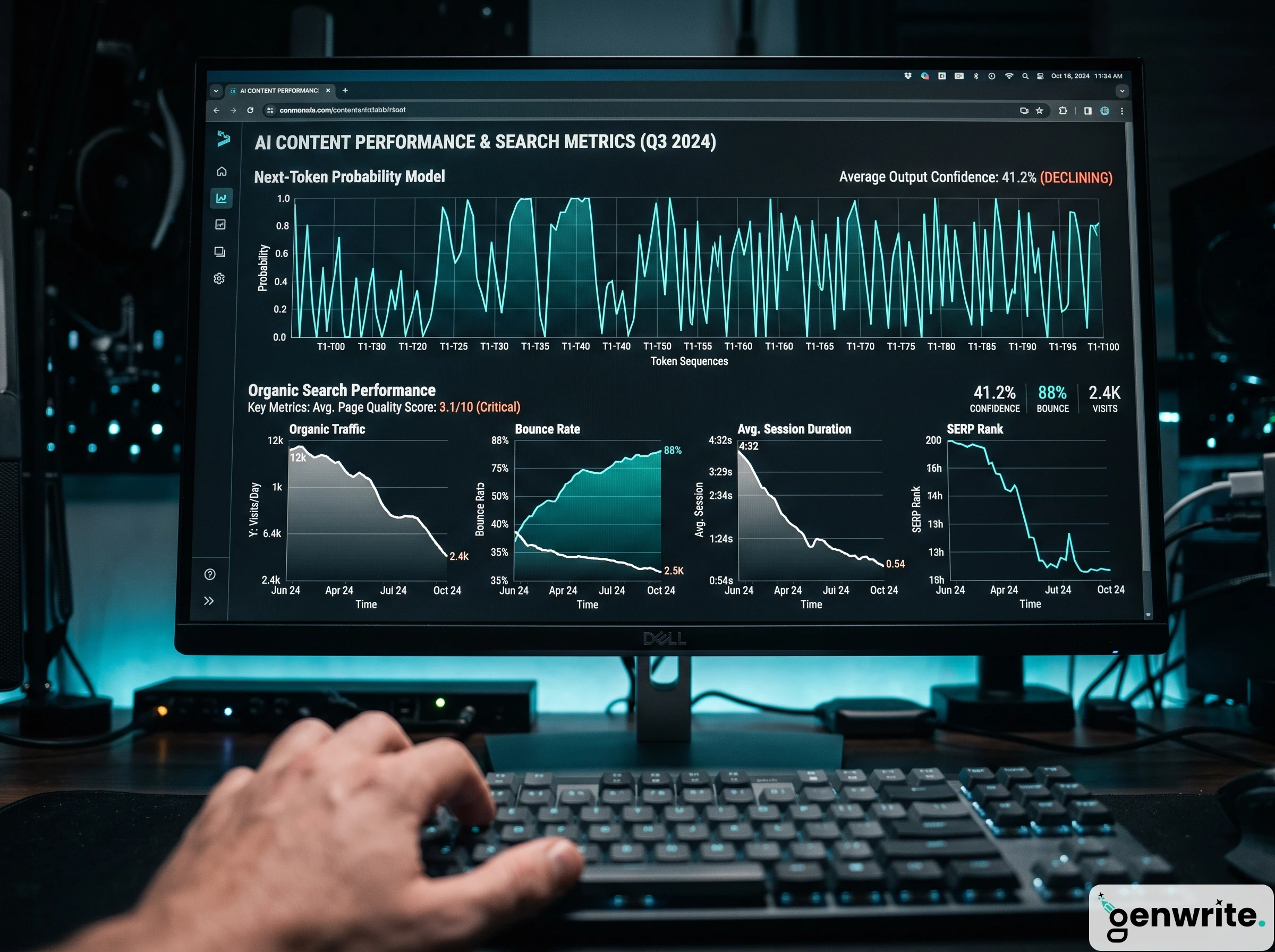
To understand why cheap autopilot bots fail, we have to look at how large language models actually work. They don’t think like humans do. Instead, they calculate mathematical probabilities to guess the very next word in a sentence. This process is called next-token prediction. It works great for basic grammar, but it’s terrible for factual precision. If a cheap prompt lacks strict boundaries, the model simply invents plausible-sounding lies to finish the sentence.
When you run a budget ai seo generator on pure autopilot, these errors compound fast. The system has no built-in way to verify if a statistic from five years ago is still true today. It just matches words that frequently appear together in its training data. If you don’t actively check the factual accuracy of your seo ai writer, you’ll publish posts loaded with outdated or entirely made-up numbers. And alert readers spot these errors within seconds.
But the technical breakdown goes deeper than just bad facts. Cheap prompts usually lack proper context constraints. This means the AI doesn’t understand the searcher’s true intent behind a specific query. For instance, if someone searches for “how to fix a leaky pipe,” they want quick, step-by-step instructions. A basic ai writer seo might write a long, boring history of plumbing instead because it matches high-frequency keywords without understanding the user’s actual goal.
So, the visitor lands on your page, realizes the content doesn’t answer their question, and leaves immediately. This sudden exit sends a bad signal to search engines. While some automated setups might get lucky occasionally, the math shows that unchecked next-token prediction almost always leads to a high bounce rate. You need smart filtering and deep prompt guardrails to keep readers engaged and on your site.
Reclaiming your organic search traffic with strategic intervention
You don’t have to delete your automated blog posts to save your site. Instead, you can rescue your leaking content funnel with a few smart, manual edits. Start by opening Google Analytics and sorting your pages by high traffic and high bounce rates. These are your biggest opportunities. If a page gets 1,000 visits a month but everyone leaves in five seconds, it is begging for help.
Next, install a free heat-mapping tool like Microsoft Clarity to track scroll depth. This shows you exactly where readers lose interest. Do they flee after the first paragraph? Or do they scroll halfway down and get bored? Often, they bounce right at the top because your introduction looks like a dry wall of text. To fix this, you need to align your content with what the user actually wanted to buy or learn. You can easily fix this by learning how to optimize weak H1 tags and match transactional intent, which immediately reassures readers they are in the right place.
Now, rewrite the first 150 words yourself. Add a bold claim, a quick question, or a concrete example. If you use automated software, make sure you choose smart seo content writing tools that let you guide the outline and tone. This ensures your automated drafts don’t sound like generic robots. A few quick adjustments to your headers and intro paragraphs will turn cold bounces into warm leads, protecting your hard-earned organic search traffic over the long haul. Sometimes a simple 10-minute rewrite is all it takes to keep a visitor reading. This hybrid approach gives you the speed of automation with the trust of human editing.
Moving from headless scale to sustainable authority

Cheap autopilot pipelines treat content like a numbers game. You press a button, and a basic seo writer ai spits out hundreds of generic pages. Sure, your publishing queue is full, but your bounce rate will likely soar because readers spot lazy writing instantly. I’ve seen websites lose half their search traffic in weeks by letting unmonitored bots do all the talking. It’s a painful lesson in why raw volume without quality control fails.
But you don’t have to choose between slow manual writing and spammy automation. The secret lies in a smart, guided approach. By using a sophisticated AI blog generator to handle the heavy lifting of keyword research, competitor analysis, and initial drafting, you save dozens of hours. You get the scale of automation, but you keep your hand on the steering wheel.
Then, a quick human edit ensures the facts are right and the tone matches your brand. This hybrid model turns a simple tool into the best seo ai writer setup for your business. It respects search intent instead of just chasing search volume. Sometimes, even the smartest algorithms miss subtle industry context, which is why that final human touch is so important. Results will vary depending on your niche, but adding a human editor usually cuts bounce rates in half.
So, stop running your content engine on headless autopilot. Use smart automation to draft, but use human eyes to polish. That’s how you build real authority that keeps readers on the page.
Tired of editing low-quality drafts that ruin your metrics? GenWrite handles automated publishing while keeping content genuinely engaging.
FAQ
Why do cheap AI writers cause a high bounce rate?
Cheap AI tools spit out repetitive phrasing and surface-level fluff that doesn’t actually answer what the reader searched for. When visitors land on your page and realize it’s generic robotic text, they bounce immediately.
Does Google penalize sites using unedited AI content?
Google doesn’t penalize content just because it’s AI-generated, but it heavily penalizes low helpfulness and poor user signals. If your bounce rate spikes and people immediately return to the search results, your rankings will drop.
Can you successfully put SEO writing on autopilot?
You can automate the heavy lifting, but running it completely hands-off usually backfires. You’ll need a system that handles research and drafting while leaving room for real human insight.
What are the common signs of unedited AI text?
Look for predictable sentence lengths, overuse of words like ‘delve’ or ‘testament’, and a distinct lack of original examples or data. Real readers spot these patterns instantly.