
New to AI Humanization? Make Your Content Sound Natural in 2026
Why is Humanizing AI Content Crucial for Your Success in 2026?

In 2026, the digital landscape is saturated with content generated by artificial intelligence. While the speed of creation has accelerated dramatically, the bar for what actually connects with an audience has risen just as fast. The critical challenge is no longer about producing content, but about producing authentic content that resonates with human readers and satisfies sophisticated search engine standards.
Raw output from AI often lacks the nuanced perspective, unique voice, and firsthand experience that builds trust. Google’s continued emphasis on E-E-A-T (Experience, Expertise, Authoritativeness, and Trustworthiness) makes it clear: content must provide genuine value, not just rehashed information. This is where the practice to humanize content becomes a non-negotiable part of any successful digital strategy.
The Shift from Generation to Refinement
Achieving true content authenticity means moving beyond the initial draft. It involves a strategic, human-in-the-loop process where AI-generated text is infused with your brand’s unique voice, personal anecdotes, and proprietary data. The goal isn’t to trick detectors but to create a final product that is genuinely helpful and engaging.
This is why powerful ai writing tools are designed to handle the heavy lifting of research, structure, and initial drafting. For example, an AI blog generator like GenWrite automates the foundational steps, freeing up creators to focus on the high-impact task of refinement. Your role evolves from writer to strategic editor, ensuring every piece reflects true expertise.
This guide will provide you with the essential frameworks to transform robotic drafts into compelling articles that build authority and drive organic traffic.
What Exactly Does ‘AI Humanization’ Mean for Your Content?
Many people mistakenly believe that to humanize content is to simply run text through a tool that swaps synonyms and rephrases sentences. While this manipulates syntax, it misses the entire point. True AI humanization in 2026 is about strategically infusing a machine-generated draft with value that only a human expert can provide.
It’s not about tricking an ai content detector; it’s about creating genuinely helpful, authentic content. The core principle driving this shift is a concept called “Information Gain.”
What is Information Gain?
Information Gain refers to the unique insights, personal experiences, or proprietary data you add to a topic that isn’t already part of the AI’s training data. An ai content writer excels at using natural language processing to summarize existing information, but it cannot invent a novel perspective from your unique industry experience or share a personal case study.
Consider this contrast:
- Robotic AI Output: A generic list of the top five marketing tactics.
- Humanized Content: The same list, but enhanced with a sixth tactic you personally tested, complete with performance data and a lesson learned.
This is the crucial step that transforms generic summaries into authoritative resources.
This strategic enhancement is what elevates your content and satisfies Google’s E-E-A-T guidelines. Platforms that offer an AI blog generator, like GenWrite, are designed to handle the heavy lifting of initial SEO research and drafting. This frees you to focus on the high-value humanization layer where you add irreplaceable expertise.
Ultimately, humanization is the bridge between a competent AI draft and authentic, high-ranking content.
How Does Humanized Content Impact Your SEO and Reader Trust?

The Direct Link Between Humanization, SEO, and E-E-A-T
It’s a common misconception that using AI for content creation automatically harms your SEO. The reality is more nuanced. Google’s Helpful Content system doesn’t penalize content for being AI-generated; it penalizes content that is unhelpful, generic, and lacks the signals of human experience. This is where humanization becomes a non-negotiable part of any modern content strategy.
Humanizing your content directly fuels the core components of Google’s E-E-A-T guidelines,Experience, Expertise, Authoritativeness, and Trustworthiness. A generic AI draft, no matter how well-written, struggles to demonstrate these qualities. When you refine that draft with unique insights, you are essentially translating your value into a language search engines are built to reward. Optimizing for this is a key part of how to secure a top Google AI ranking.
Humanized content is inherently optimized for E-E-A-T because it provides unique value.
Forging Reader Trust Through Content Authenticity
Beyond search algorithms, there’s a more critical audience: your human reader. Today’s online audience is incredibly adept at spotting robotic, soulless content. When text feels predictable and lacks a distinct voice, it breaks trust before it even has a chance to form. This is where the concept of content authenticity becomes your most valuable asset.
Authentic content, refined from a draft created by an seo friendly blog generator, builds a direct connection with your audience. It uses personal anecdotes, brand-specific examples, and a consistent voice to show there is a real expert behind the screen. While an ai content detector analyzes patterns, your readers analyze intent and value. By investing in humanization, you create content that not only ranks but also converts readers into a loyal community.
Ultimately, humanization transforms AI-generated text from a simple commodity into a strategic asset that builds both search authority and genuine reader trust.
How Can You Transform Robotic AI Text into Engaging, Human-Like Prose?
An advanced ai content writer can produce a structurally sound draft in seconds, but that raw output often lacks a critical ingredient: a human pulse. The text can feel sterile, predictable, and devoid of the nuance that builds reader trust. Transforming this draft into engaging prose doesn’t require rewriting from scratch; it requires strategic refinement.
Think of it as moving from a blueprint to a finished building. The foundation is solid, but now you need to add the details that make it livable. Here are practical methods to humanize content for beginners.
1. Convert Passive Voice to Active Voice
One of the fastest ways to inject energy is to eliminate the passive voice. AI models often default to passive constructions, which can sound distant and overly academic.
- Robotic (Passive): The content was optimized by the marketing team.
- Human-Like (Active): The marketing team optimized the content.
The active voice is direct, confident, and easier for readers to process. It assigns clear responsibility and creates a more dynamic reading experience.
2. Introduce Sentence Variety (Burstiness)
AI-generated text often exhibits low burstiness, meaning sentences are uniform in length and structure. This creates a monotonous rhythm that feels unnatural. Human writing, in contrast, is varied,a mix of short, punchy statements and longer, more complex sentences.
- Robotic: The system analyzes the data. The results are then generated. The report is created based on these findings.
- Human-Like: The system analyzes the data to generate immediate results. Based on these findings, it creates a comprehensive report.
Pro-Tip: Read your content aloud. If it sounds robotic or singsong, it’s time to vary your sentence lengths.
3. Inject Personality and Contextual Examples
AI provides facts, but humans provide context. To truly humanize content, you must infuse it with your unique voice and real-world examples that an AI cannot invent.
- Add Anecdotes: Share a brief, relevant story or personal experience.
- Use Analogies: Compare a complex topic to something simple and relatable.
- Incorporate Specific Data: Replace generic claims with hard numbers. Instead of “improves efficiency,” say “boosted team productivity by 25% in Q1.”
4. Refine for Clarity and Flow
AI tools are masters of natural language processing, but they can sometimes produce convoluted sentences or use unnecessarily complex words. Your job is to be the final editor, ensuring the text is simple and clear.
- Break down jargon: If you must use technical terms, explain them simply.
- Use transition words: Words like “however,” “therefore,” and “in addition” guide the reader and create a logical flow.
- Cut redundant words: AI often repeats ideas. Be ruthless in trimming the fat to make every word count.
By systematically applying these techniques, you can elevate a standard AI draft into a piece of content that not only informs but also connects with your audience. This manual refinement is crucial for building trust and authority. For those looking to streamline this process, an ai humanizer can help automate the initial steps of improving burstiness and simplifying language, giving you a better draft to start with.
What Common Pitfalls Should You Avoid When Humanizing AI Content?
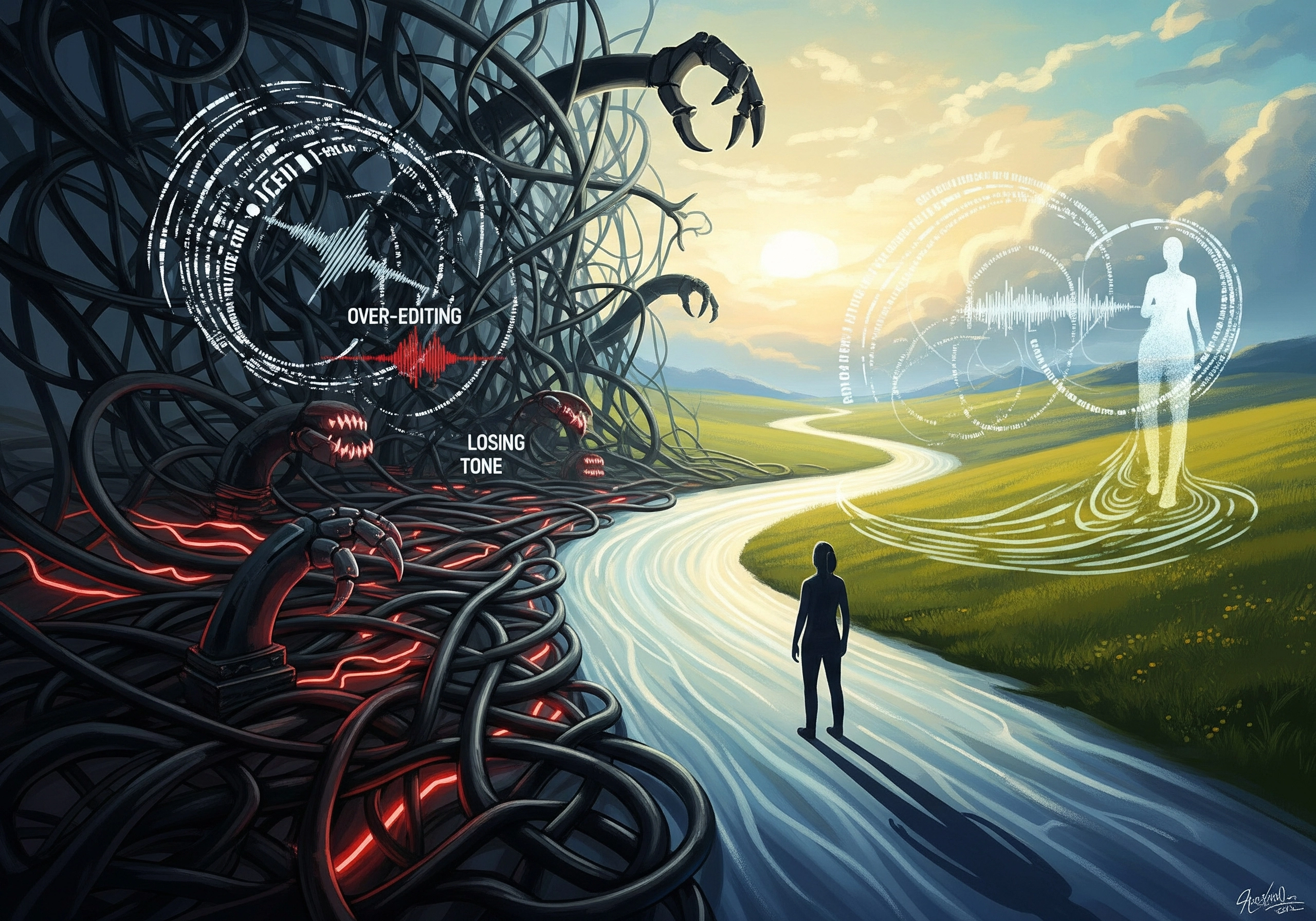
The Trap of Over-Editing and Losing Meaning
One of the most common mistakes is treating humanization like a game of synonym swap. Beginners often meticulously replace words and rephrase sentences, believing this will trick an ai content detector. The result? The content loses its original clarity, sounds awkward, and the core message gets diluted. Instead of improving the text, this approach often makes it worse.
True humanization is about enhancing meaning, not just changing words.
The goal isn’t to disguise the AI’s origin but to elevate its output. Focus on improving the narrative flow, clarifying complex points, and ensuring every sentence serves the reader’s intent. This preserves the efficiency of using an ai blog writer while adding irreplaceable human value.
Ignoring Your Audience’s Voice
An AI model doesn’t know your audience. It doesn’t understand their specific pain points, their inside jokes, or the language they use. A huge pitfall is accepting the AI’s generic tone without tailoring it to the people you’re trying to reach. This creates a disconnect and undermines the content authenticity you’re working to build.
Before you edit a single word, ask yourself:
- Does this sound like something my ideal customer would say?
- Does it address their problems in language they understand?
- Is the tone appropriate for my brand (e.g., authoritative, witty, empathetic)?
Skipping the Integrity and Fact-Check
AI models can,and do,make things up. This phenomenon, known as “hallucination,” can destroy your credibility. Publishing AI-generated content without a thorough integrity check is a critical error. You must verify all statistics, claims, and factual statements against reputable sources. This step is non-negotiable for building authentic content that aligns with Google’s E-E-A-T guidelines.
By avoiding these common pitfalls, you shift from being a simple editor to a strategic content enhancer, ensuring your AI-assisted workflow produces high-quality, trustworthy results.
Can AI Humanizer Tools Really Help You Bypass AI Detection?
How AI Humanizers Aim to Create Undetectable AI
As AI content detectors become more sophisticated, a new class of AI writing tools has emerged to counter them: the AI humanizer. The central premise is simple but effective: these tools analyze robotic-sounding text and systematically reintroduce the natural imperfections and variations characteristic of human writing, all while preserving the core message. They aren’t just synonym swappers; they are designed to manipulate the underlying structure of the text.
An effective ai humanizer works by reverse-engineering what makes AI-generated content so predictable. Instead of uniform sentence lengths and common phrasing, it strategically modifies the text to increase its complexity and unpredictability.
This process typically involves:
- Varying Sentence Structure: Alternating between short, punchy sentences and longer, more complex ones to break the monotonous rhythm of AI output.
- Adjusting Word Choice: Replacing common AI-favored words with less predictable synonyms or more nuanced phrasing.
- Modifying Cadence and Flow: Introducing grammatical constructions that mimic human speech patterns, making the text feel less clinical.
The Mechanics: Replicating Human Imperfection
The ultimate goal of these tools is to create what many call undetectable AI by increasing two key metrics that an ai content detector scrutinizes: perplexity and burstiness. Perplexity measures the complexity of the text, while burstiness evaluates the variation in sentence length. Raw AI-generated content often has low scores in both, making it easy to flag.
By algorithmically adjusting these elements, an AI humanizer makes the text appear less uniform and more organic. The key is that human writing is inherently inconsistent, and these tools are built to replicate that valuable inconsistency. Platforms like GenWrite’s own AI humanize tool integrate this step into the content creation workflow, ensuring the final output not only reads naturally but also aligns with the standards of modern search engines.
In essence, these tools automate the stylistic editing process, helping content pass detection by making it statistically closer to text written by a person.
Ready to Make Your AI Content Undetectable and Truly Resonate?

The Path to Authentic, High-Performing Content
The journey from a raw AI draft to genuinely authentic content that connects with readers and ranks on search engines is no longer a mystery. We’ve explored how success in 2026 isn’t about abandoning AI but elevating its output. The goal is to move beyond the predictable rhythms that trigger an ai content detector and instead infuse your work with real Information Gain and the E-E-A-T signals Google rewards.
Mastering this skill is entirely achievable. It begins with viewing AI as a powerful collaborator, not a final author. Your unique voice, personal anecdotes, and expert insights are the essential final layers that transform a generic draft into a valuable asset. This is the core of how you humanize content effectively.
True mastery lies in focusing your energy on the highest-value tasks,the human touch.
This is where a modern, automated workflow becomes a competitive advantage. Instead of getting bogged down in foundational SEO tasks, an advanced AI blog generator like GenWrite can manage the entire process, from keyword research and competitor analysis to structuring a complete first draft. This strategic automation frees you to focus exclusively on refining, personalizing, and elevating the final piece.
Your first step is practical and immediate. Take one piece of AI-generated text and apply a single principle from this guide. Add a unique perspective, vary the sentence structure in a key paragraph, or link a concept to a real-world example. By leveraging a powerful AI SEO content generator for the groundwork, you reserve your creative energy for what matters most. This synergy is the key to creating content that builds trust, drives traffic, and establishes lasting authority.
Ready to elevate your AI content? Discover how GenWrite can automate your blog creation, ensuring SEO-optimized, humanized content that drives traffic.
People Also Ask
What is the main goal of AI humanization in 2026?
The main goal of AI humanization in 2026 is to transform AI-generated text from sounding robotic and generic into content that is authentic, engaging, and resonates with human readers. This involves adding unique insights, personal experiences, and a natural flow that satisfies both user intent and search engine quality guidelines like E-E-A-T.
How do AI content detectors work, and how does humanization help bypass them?
AI content detectors analyze metrics like perplexity and burstiness. Robotic AI writing often has low burstiness (uniform sentence length and structure). Humanizing content involves intentionally varying sentence length and complexity, reintroducing natural linguistic patterns, and adding unique ‘Information Gain’ to mimic human writing styles and evade detection.
Is ‘Information Gain’ important for humanizing AI content?
Yes, ‘Information Gain’ is crucial for AI humanization. It means adding unique insights, personal anecdotes, or real-world data that wasn’t readily available in the AI’s training data. This goes beyond simple synonym swapping and provides genuine value, making the content more authoritative and less likely to be flagged as purely machine-generated.
How does humanizing AI content improve SEO performance?
Humanizing AI content improves SEO by aligning with Google’s emphasis on Helpful Content and E-E-A-T. Authentic, engaging content that demonstrates experience and expertise naturally ranks better. By satisfying user intent with unique value and a human touch, your content becomes more trustworthy and authoritative, leading to better search visibility.
What are the risks of not humanizing AI-generated content?
The risks of not humanizing AI content include low reader engagement due to its robotic tone, poor search engine rankings as search engines prioritize authentic, helpful content, and potential flagging by AI detectors. In 2026, relying solely on unedited AI output can lead to content being perceived as low-quality or spammy, harming your online presence.
Can AI humanizer tools guarantee undetectable content?
While AI humanizer tools can significantly help in making content sound more natural and less detectable by manipulating sentence structure and word choice, they cannot guarantee 100% undetectability. The most effective approach involves using these tools as a starting point and then applying human editing to add genuine insights and ensure brand voice consistency.