
Why Google’s AI Summaries Pick Some Sites: Your 2026 Strategy
What is Google’s AI Overview and Why Does it Matter for Your 2026 Strategy?

The Search Page Is Not What It Used To Be
The era of aiming for the “ten blue links” is officially over. At the top of today’s search results, you’ll find the Google AI Overview (AIO), an AI-generated summary that synthesizes information from multiple websites to provide a direct answer. This feature, a core component of the search generative experience 2026, represents the most significant shift in search behavior since the introduction of mobile-first indexing.
Unlike traditional featured snippets that pull from a single source, AIOs construct a new, composite answer. For businesses and content creators, this is a monumental change. Your content is no longer just competing for a click; it’s auditioning to become a foundational piece of Google’s own answer.
Why Your Old SEO Playbook Is Obsolete
The most jarring statistic for marketers is this: nearly 70% of sources cited in AI Overviews do not appear in the top three organic search results. Let that sink in. A high ranking no longer guarantees you a spot in the most visible part of the SERP. The future of SEO is not about ranking,it’s about being citable.
This fundamentally alters content strategy. Google’s AI prioritizes information gain, structured data, and demonstrable E-E-A-T (Experience, Expertise, Authoritativeness, and Trust). If your content doesn’t provide unique value or isn’t structured for easy parsing by a machine, it will be overlooked, regardless of its traditional ranking.
Adapting to AI search is no longer optional; it’s essential for survival.
This new reality demands a strategic pivot toward creating content specifically designed for AI consumption. It requires a deep understanding of how to structure articles, use schema, and present data in a way that makes your website an authoritative source. This is precisely why we built GenWrite,our AI blog generator is engineered to produce content that meets these new, stringent requirements for AI visibility. Success in 2026 depends on optimizing for AI summaries and leveraging the right tools for the job.
How Do AI Overviews Differ from Traditional Search Results and Featured Snippets?
For over a decade, SEO success was defined by two primary goals: climbing the ladder of the ‘ten blue links’ or capturing the prized ‘position zero’ with a featured snippet. Both were about winning the click. Google’s AI Overviews, however, operate on a completely different logic.
Unlike featured snippets, AI systems don’t just extract information from a single best answer; they synthesize it from multiple sources to create a new, comprehensive response. This fundamentally alters the competitive landscape.
This table breaks down the core distinctions:
| Feature | Traditional Organic Result | Featured Snippet | AI Overview |
|---|---|---|---|
| Source Model | Single Webpage | Single Webpage | Multiple Webpages (Synthesized) |
| Content Type | Title & Meta Description | Direct Quote/Extraction | AI-Generated Summary |
| User Goal | Click to find answer | Get a quick answer | Get a comprehensive answer |
The Citation vs. Ranking Disconnect
Here lies the most critical distinction for your 2026 strategy: AI Overviews decouple citations from traditional top rankings. Data consistently shows that a majority of sources featured in Google AI results are not pulled from the top three organic positions. The AI is looking for the most citable, authoritative information, regardless of whether it ranks #1 or #7.
This dynamic fuels the reality of zero-click search. When users get a complete answer directly on the results page, the immediate need to click diminishes. Your brand’s value shifts from attracting traffic to achieving visibility within the AI’s summary. Being cited becomes a powerful signal of authority and trust, even without a direct visit.
To thrive, your content must be engineered for citability. This means prioritizing direct answer formatting, leveraging structured data, and building information gain into every piece. For businesses scaling their content, leveraging an AI SEO content generator becomes a strategic advantage. Tools like GenWrite are designed to produce content that meets these new technical and qualitative demands for content ranking AI systems.
The transition is clear: featured snippets rewarded the best single-source answer, but AI Overviews reward the most credible constellation of sources.
What Core AI Ranking Factors Drive Google’s AI Summary Selections in 2026?

Forget the old playbook of keywords and backlinks. The core of Google AI ranking in 2026 operates on a different set of principles designed to evaluate content quality and trustworthiness at a machine level. To win a citation, you need to think less like an SEO and more like a data source for an intelligent system.
Information Gain: The Value of Novelty
Google’s AI prioritizes content that introduces new information or a unique perspective not found in the existing corpus. This concept, known as “Information Gain,” is critical. If your article simply rehashes what’s already published, it offers zero incremental value to the AI’s summary. Data shows that websites with high Information Gain scores,those publishing original data or novel analysis,are 40% more likely to be cited.
Direct Answer Formatting and Structural Clarity
Clarity is king. Google’s AI favors content that provides a concise, direct answer to a query at the very beginning of the page. Think of it as an executive summary for the machine. This formatting, combined with structured data like Schema.org, makes your key points computationally accessible and highly citable.
Proper structure isn’t a suggestion; it’s a requirement for AI summary optimization.
The Primacy of “Experience” in E-E-A-T
While Expertise, Authoritativeness, and Trustworthiness remain foundational, the “Experience” component of E-E-A-T has become a primary signal. The system actively seeks out content demonstrating first-hand use, featuring original imagery, and presenting authentic case studies. This is a direct countermeasure to generic content and a key area where high-quality, AI-assisted content can excel by structuring expert insights effectively.
Citation Authority (Citations per Mille)
A powerful emerging metric is what we call Citations per Mille (CPM), which measures how often your brand or domain is mentioned across other authoritative third-party sites. High CPM functions as a powerful trust signal, increasing your citation authority and making you a more probable source for an AI Overview, even without a top organic rank. This is where effective content automation becomes a strategic advantage for building brand presence at scale.
These factors signal a clear shift toward rewarding genuine value and authority. Successfully Navigating Google’s AI Search means building content that is engineered for citation from the ground up, a process that can be streamlined with the right AI SEO writing tools.
How Can Structured Data (Schema.org) Unlock Your Content for AI Overviews?
Master Procedural Content with HowTo Schema
Traditional SEO focused on making content readable for humans and discoverable by crawlers. In 2026, the game has changed. To get cited in AI Overviews, your content must be machine-intelligible, and this is where structured data becomes non-negotiable. Using the Schema.org vocabulary, it adds a layer of explicit context that tells search engines not just what your words say, but what they mean. With 80% of AIO-featured content using it, ignoring schema is a critical mistake.
For the massive volume of informational queries seeking instructions, implementing HowTo Schema is essential. This markup explicitly defines each step, tool, and material required for a process. It effectively spoon-feeds your guide to Google’s AI, removing ambiguity and making your content a perfect, citable source for a procedural summary. This is a foundational tactic for capturing visibility for “how-to” intent.
Connect to the Knowledge Graph with Entity-Based SEO
Beyond instructions, AI needs to verify the concepts you discuss. This is the core of entity-based SEO: connecting topics in your content to real-world entities within the Google Knowledge Graph. Instead of just mentioning a company or a person, you use structured data to link that text to its unique, recognized identifier. This process validates your claims and weaves your content into the web of trusted information Google’s AI relies on.
Connecting your content to established entities builds instant credibility with AI systems.
Manually implementing comprehensive schema can be time-consuming. This is where using an AI SEO content generator provides a significant advantage. Platforms like GenWrite can help identify key entities and automate the inclusion of appropriate schema, streamlining a critical technical task. Properly implemented structured data turns your webpage from a flat document into a verifiable knowledge asset, making it far more likely to be selected as a source for AI Overviews.
What Content Strategies Are Essential for ‘Direct Answer’ & ‘Information Gain’ Optimization?

In the AI-driven search landscape of 2026, the old rules of content engagement no longer apply. The goal has shifted from simply ranking high to being citable,having your content selected, synthesized, and presented by Google’s AI. This requires a precise SGE content strategy built on two pillars: providing immediate clarity and offering unique value.
The Inverted Pyramid for AI: Direct Answer Formatting
AI models, much like busy executives, prioritize efficiency. They need the most critical information delivered upfront. Traditional content often builds to a conclusion, but for AI summary optimization, you must invert this structure. Start with a dense, 50-word summary that directly answers the primary user query before you elaborate.
This approach, known as direct answer formatting, ensures the AI can immediately grasp the core value of your page. Structure the rest of your content with clear H3/H4 headings, bullet points, and numbered lists. This makes your content modular and easily parsable, increasing the odds of being featured.
Your content must be engineered for quick extraction and synthesis.
This isn’t just about readability; it’s about machine-consumability. By structuring content with clear headings and direct answers, you provide the signals AI needs to validate and cite your information confidently.
Beyond Summary: Achieving High Information Gain
While direct answers get you noticed, Information Gain gets you chosen. This metric evaluates whether your content adds new perspective, data, or insight to the existing conversation. Simply rephrasing what’s already on page one is a losing strategy. To achieve a high score, focus on originality:
- Original Research: Present unique data from surveys, studies, or internal analysis.
- First-Hand Experience: Share case studies, personal anecdotes, or expert insights that demonstrate genuine experience (the ‘E’ in E-E-A-T).
- Novel Synthesis: Combine existing ideas in a new way to create a unique framework or conclusion.
This is where AI-powered platforms provide a critical edge. Tools like GenWrite can perform a rapid competitor analysis, identifying content gaps and over-saturated topics. This allows you to focus your efforts on creating truly differentiated assets that AI will prioritize for its novelty.
Ultimately, improving search visibility in 2026 hinges on this dual approach: answer the question directly, then provide a unique perspective that no one else has.
Why is Multimodal Content and Cross-Platform Presence Critical for AI Citations?
The Shift from Text-Centric SEO to Multimodal Understanding
For years, SEO was a text-driven discipline. Success meant optimizing articles and web pages. In 2026, that model is fundamentally incomplete. Google’s AI doesn’t just read the web; it perceives it. This is the new reality of multimodal search, where AI models synthesize information from text, video transcripts, audio files, and images to form a comprehensive answer.
This evolution means your content strategy cannot live solely on your website. Recent data reveals that platforms like YouTube and Reddit account for a significant percentage of all AI Overview citations. Why? Because AI systems prioritize experience-driven, practical answers found in user-generated discussions and visual demonstrations.
Adapting to AI search requires expanding your content’s surface area across multiple formats.
Expanding Your Reach: Why Platforms and Formats Matter
Your brand’s authority is no longer measured by its domain rating alone. It’s measured by its presence in the diverse ecosystems where Google’s AI is learning. A cross-platform presence directly influences AI citation likelihood because it generates more brand mentions and signals widespread relevance.
Consider this strategic framework:
- YouTube and Video SEO: With Google’s AI now parsing video content, your video transcripts are as important as your blog posts. A well-optimized video with a clear, accurate transcript provides a direct, citable source for how-to queries.
- Podcasts and Audio: Similarly, audio content can be transcribed and indexed, making your expert interviews and discussions available for AI citation.
- Community Platforms (Reddit, Quora): These forums are treasure troves of authentic, first-hand experience,a key component of E-E-A-T that AI models are trained to find.
This isn’t about abandoning your blog; it’s about using it as a central hub. A powerful AI blog generator can create the foundational, SEO-optimized article, which you then “atomize” into videos, audio clips, and discussion points for other platforms.
The goal is to build a web of interconnected, authoritative content. The integration of multimedia, video, and images in AI summaries is not a future trend; it’s the current standard for earning visibility. By leveraging a comprehensive SEO content optimization tool, you can ensure every piece of content, regardless of format, is engineered for citability.
How Do You Monitor and Adapt Your Generative Engine Optimization (GEO) Strategy?
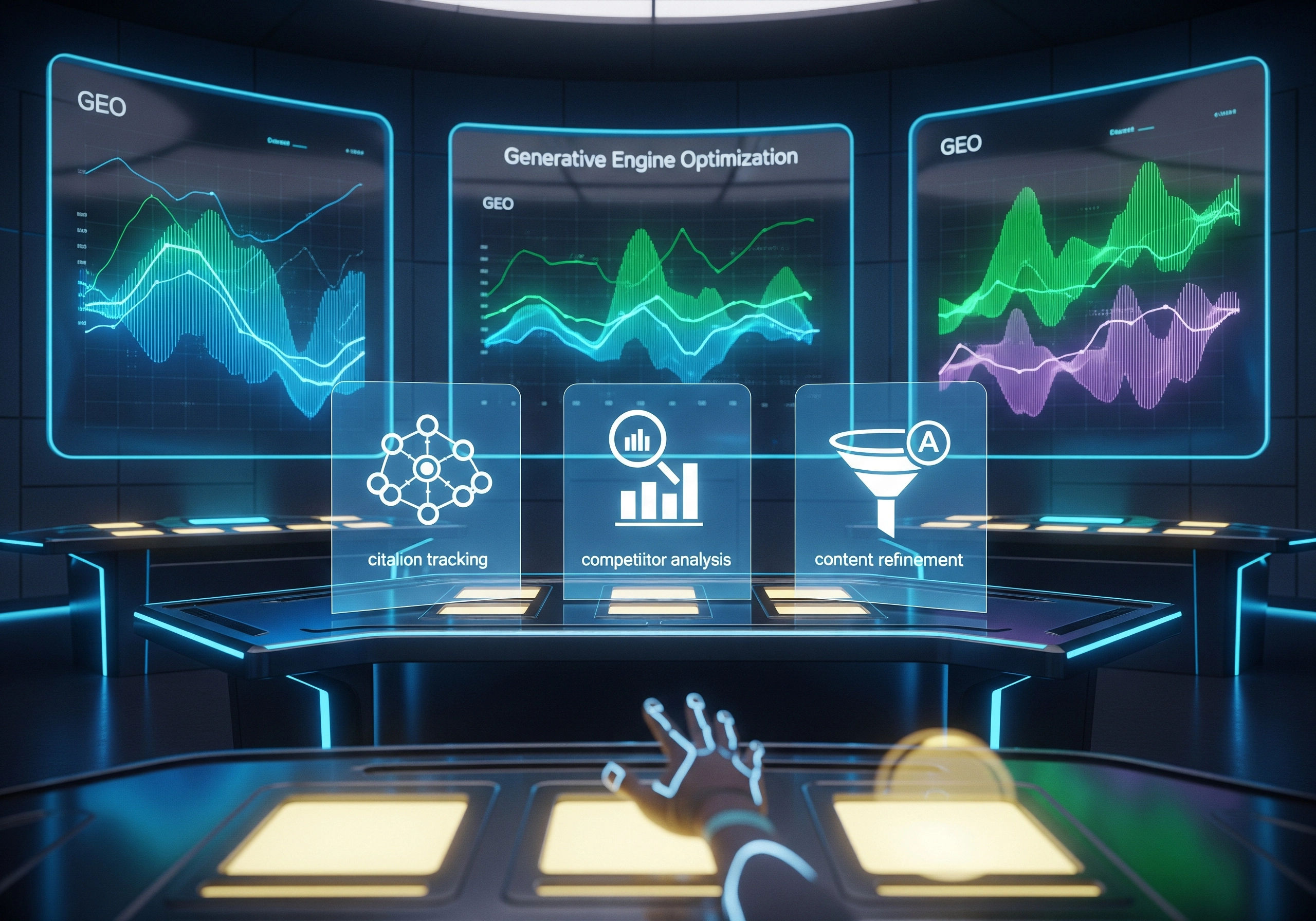
A successful Generative Engine Optimization (GEO) strategy isn’t a one-time setup; it’s a continuous feedback loop. Unlike traditional SEO where rankings might hold steady for weeks, AI summary selections can shift rapidly as the underlying models are refined. The old model of quarterly reporting is obsolete; dynamic monitoring is now essential for survival.
Your goal is to move from reactive fixes to proactive adaptation. This requires a systematic approach to tracking what Google’s AI is citing and, more importantly, why. Are you appearing in AI Overviews for your target queries? If not, who is? Analyzing these patterns reveals the evolving preferences of the content ranking AI.
The GEO Feedback Loop: Track, Analyze, Adapt
To maintain visibility, you must treat GEO as an iterative process. This loop ensures your content strategy remains aligned with how AI models evaluate and synthesize information, which is key for long-term AI summary optimization.
-
Track Citation Performance: Regularly query your target keywords in Google to see if your domain appears as a source in AI Overviews. While manual checks are a start, the next step is implementing a robust monitoring infrastructure using emerging AI visibility tools to track your citation share over time.
-
Analyze Citation Patterns: Document which competitors are being cited. Deconstruct their content: Do they use a specific schema? Is their answer formatted as a list or a concise paragraph? Identify the structural and semantic traits the AI consistently rewards.
-
Adapt and Refine Content: Use your findings to iterate. This might mean reformatting an introduction into a ‘Direct Answer’ block, adding unique data to boost ‘Information Gain,’ or updating statistics. Leveraging an AI blog generator can streamline this refinement process, ensuring your content is consistently optimized for machine readability.
Staying ahead in GEO means constantly learning from the AI’s behavior and refining your approach.
By systematically monitoring these signals, you can adjust your content strategy in near real-time, ensuring you are always adapting to the future of SEO rather than reacting to it.
What’s Next? Future-Proofing Your Brand in a Dominant AI Search Landscape
The Future is Citable, Not Just Clickable
The search generative experience of 2026 isn’t a distant forecast; it’s the operational reality we navigate today. The old playbook of chasing the #1 spot is being replaced by a more nuanced goal: becoming the most citable, authoritative source in your niche. This shift from a click-centric to a citation-centric model is the core of future-proofing your brand.
Those who win in this new landscape will master the foundational pillars that drive Google’s AI selections. It’s no longer about a single ranking factor but an integrated strategy built on:
- Information Gain: Delivering unique data and novel perspectives that don’t exist elsewhere.
- Direct Answer Formatting: Structuring content for immediate machine comprehension.
- Structured Data: Using Schema.org to explicitly define entities and relationships.
- Multimodal Presence: Extending your brand’s authority into video and audio formats.
- Citation Authority: Building brand mentions across authoritative third-party sites.
These are not temporary tactics; they are permanent principles for the future of SEO.
Embracing Automation for Sustainable Growth
Consistently executing this sophisticated strategy across all your content requires immense resources. This is where automation transforms from a convenience into a critical strategic advantage. The demands of modern SEO optimization are perfectly suited for AI-powered platforms that can handle the heavy lifting of research, structuring, and deployment at scale.
Tools like GenWrite automate the creation of high-quality, AIO-ready content, ensuring every article is engineered for citability. This allows your team to focus on high-level strategy instead of getting bogged down in manual execution.
The path to improving search visibility 2026 is paved with adaptation and intelligent automation. By embracing these new principles and leveraging the right tools, you position your brand not just to compete, but to become a definitive source in Google’s AI-driven ecosystem. For a deeper dive into the mechanics, understanding how to start optimizing for AI Overviews is a critical next step.
Ready to dominate AI-driven search? Discover how GenWrite automates end-to-end blog creation, ensuring your content is optimized for Google AI Overviews and drives organic traffic.
People Also Ask
How often do Google AI Overviews appear in search results?
As of early 2026, Google AI Overviews (AIO) are appearing for approximately 15 to 20 percent of all search queries. They are particularly prevalent for informational and ‘how-to’ search intents, significantly impacting user interaction with search results.
Are traditional SEO rankings still important for Google AI Overviews?
Traditional SEO rankings are becoming less critical for AI Overviews. Data shows that nearly 70 percent of sources cited in AI Overviews do not appear in the top three organic search results. This highlights a shift towards content ‘citability’ rather than just high organic placement.
What is ‘Information Gain’ and why does it matter for AI Overviews?
Information Gain refers to content that provides unique data or perspectives not readily found elsewhere. Websites with high Information Gain scores are 40 percent more likely to be cited in AI Overviews, as Google seeks to offer novel and valuable insights to users.
How can structured data (Schema.org) help my content get selected for AI Overviews?
Structured data, such as HowTo Schema and entity mapping to the Google Knowledge Graph, is crucial. Approximately 80 percent of content featured in AI Overviews utilizes structured data to clearly define entities and relationships, making it easier for AI to understand and cite your content.
What is ‘Experience’ in E-E-A-T and how does it relate to AI Overviews?
The ‘Experience’ component of E-E-A-T emphasizes first-hand knowledge and practical application. For AI Overviews, this means demonstrating expertise through first-person case studies, original imagery, and authentic user experiences, which Google’s RAG system favors.
Why is multimodal content important for AI summary optimization?
Google’s AI now synthesizes information from various formats, including video transcripts and audio files. Therefore, creating and optimizing multimodal content across platforms like YouTube is critical for discoverability and increasing the chances of your brand being cited in AI Overviews.