
Navigating Google’s AI Search: Steps to Appear in 2026 Summaries
Why is Appearing in Google AI Summaries Critical for Your Content Strategy?

The traditional SEO playbook is becoming obsolete. For years, the goal was to secure the top organic spot, but the future of search SEO 2026 is defined by a new battleground: Google’s AI-generated summaries.
These AI Overviews are dynamic, synthesized answers that appear above all traditional results, pulling information from multiple sources to directly address a user’s query. Already triggering for 15-20% of searches in the US,with much higher rates in sectors like tech and healthcare,their presence is fundamentally changing how users discover content.
The AI Overviews impact is profound. If your content isn’t cited within that summary box, your website can become functionally invisible, even if it ranks on the first page. This shift makes achieving high AI content visibility a non-negotiable part of any modern content strategy.
However, this disruption creates a unique opportunity. While most AI-cited sources come from top-ranking pages, research shows nearly 16% are pulled from lower-ranking content that provides superior relevance and specificity. This means the best answer,not just the highest authority site,can win.
This guide will walk you through the essential tactics for Google AI summary SEO, detailing how to structure your content to earn a place in these coveted summaries. By focusing on principles that align with how AI models process information, you can secure your visibility. Tools like GenWrite’s ai seo content generator are engineered for this new era, automating the creation of content structured for AI consumption and SEO success.
How Does AI Search Truly Differ from Traditional SEO Efforts?
For years, the goal of Search Engine Optimization (SEO) was clear: climb the search engine results pages (SERPs) to secure that coveted #1 spot. Success was measured in clicks and traffic volume. But as Google’s AI Overviews reshape the landscape, that entire paradigm is shifting. The new objective isn’t just to rank,it’s to be cited as a definitive source within an AI-generated summary.
This marks the fundamental difference in how AI search differs from traditional efforts. We’re moving from a game of visibility to a game of authority and extractability.
From Ranking for Clicks to Being Cited for Answers
Traditional SEO focused on convincing an algorithm that your page was the most relevant result for a keyword. SEO for generative AI, however, is about convincing a large language model (LLM) that your content contains the most accurate, concise, and trustworthy answer to a user’s underlying question.
The focus has pivoted from ranking keywords to answering questions comprehensively.
This evolution changes the core metrics and tactics we use to measure success. What once worked is now just the baseline.
| Metric | Traditional SEO (The Old Way) | AI Search Optimization (The New Standard) |
|---|---|---|
| Primary Goal | Achieve a high ranking on the SERP | Become a cited source in the AI Overview |
| Key Signal | Backlinks and keyword density | Information Gain and entity relationships |
| Content Focus | Long-form, keyword-optimized content | Modular, easily extractable answer blocks |
| Success Metric | Organic traffic and click-through rate | Citation frequency and brand mentions |
New Metrics for a New Era
The most critical change is the emergence of new performance indicators. Concepts like “Citation Velocity”,how often your brand is mentioned by other reputable sources,are becoming central to establishing authority for Google AI search ranking. Another key factor is providing unique insights or data, which Google identifies as a high Information Gain score.
To adapt, your content strategy must prioritize creating sourceable, modular information. Platforms like an ai seo content generator are designed for this new reality, helping structure articles with the clarity and authority needed to be picked up by AI. The goal is no longer just to attract a click but to provide an answer so complete and trustworthy that Google’s AI uses your content as a primary source.
Ultimately, the shift is from optimizing for a list of links to optimizing for a direct, synthesized answer. Your success now depends on becoming an indispensable part of that answer.
What Foundational Principles Drive Google AI Summary Ranking Factors in 2026?

From Keywords to Knowledge Graphs: The New Foundation
The era of optimizing for keywords is over; the era of optimizing for understanding has begun. To achieve dominant Google SGE rankings, you must shift your focus from isolated search terms to building a web of interconnected concepts. Google’s AI doesn’t just scan for words; it maps entities,the people, places, and ideas your content discusses,and their relationships. This is the core of modern semantic SEO for AI.
This new paradigm is built on three foundational pillars that dictate whether your content gets cited or ignored. Mastering them is non-negotiable if you want to optimize for AI Overviews in 2026.
| Old Principle (Traditional SEO) | New Principle (AI Overview SEO) |
|---|---|
| Keyword Density & Placement | Entity Definition & Relationships |
| General Authority (Backlinks) | Verifiable Experience (E-E-A-T) |
| Content Volume | Information Gain & Uniqueness |
Principle 1: Entity-Based Authority and Semantic Context
Google now prioritizes how clearly you define concepts and connect them. Effective content for SGE ranking explicitly establishes these relationships through structured data (like JSON-LD schema) and clear, logical content flows. For instance, instead of just mentioning “SEO,” your content should connect it to related entities like “SERPs,” “Google Gemini,” and “Generative Engine Optimization (GEO).” This deep contextual linking signals to the AI that your content is a comprehensive resource, not just a surface-level article. Platforms like GenWrite automate this process, using an AI blog generator to weave these connections into your content structure from the start.
Principle 2: Verifiable E-E-A-T and Information Gain
Experience, Expertise, Authoritativeness, and Trustworthiness (E-E-A-T) are more critical than ever, with a heavy emphasis on the first ‘E’. Google’s AI actively seeks content that provides unique, first-hand insights. This includes original research, proprietary data, case studies, or expert commentary that cannot be found elsewhere. Generic, rewritten content is easily ignored. To stand out, you must contribute novel information to the topic, a concept known as Information Gain. By focusing on a strong google AI summary ranking strategy, you prove your value as an original source worthy of citation.
Ultimately, the goal is to structure content for direct answers that are rich with unique data and clear semantic connections, making your pages indispensable to Google’s summary-generation process.
How Can You Structure Your Content to Maximize AI Extractability?
To get featured in Google AI summaries, you must shift your mindset from writing articles to engineering answer modules. The old model of long, narrative-driven paragraphs is inefficient for machine consumption. The new model requires content structured for direct answers, making every section a potential source for a citation.
This is where a clear, repeatable system becomes essential. We call it the Modular Answer Framework, a set of AI summary best practices designed for maximum extractability. It’s not about rewriting your content; it’s about repackaging it for Google’s generative engine.
The Question-Based Heading
Start by treating your H3 and H4 headings as direct user queries. Instead of a vague title like “Content Formatting,” use a specific question: “How Should I Format Content for AI?” This aligns perfectly with search intent and creates a clear signal for AI crawlers looking to match questions with answers. This simple change primes your content to be seen as a direct solution.
The Immediate “Atomic Answer”
Directly below your question-based heading, place a concise, two-to-three-sentence paragraph that answers the question directly. This concept, often called the “Atomic Answer” framework, provides a self-contained, snippet-friendly block of text. It’s the perfect, extractable summary that AI Overviews are built to find. Think of it as the TL;DR for every single section of your article.
Your goal is to make it effortless for an AI to lift your answer verbatim.
The Structured Elaboration
After the atomic answer, provide supporting details using highly structured formats. This is where you elaborate with:
- Bulleted Lists: Break down features, benefits, or components.
- Numbered Steps: Outline a process or a “how-to” guide.
- Simple Tables: Compare data points or specifications clearly.
This modular approach turns a single blog post into dozens of potential micro-assets. By leveraging an AI SEO content generator, you can automate this structuring process, ensuring every piece of content you produce is optimized for AI extraction from the start.
Structuring your content this way makes it scannable for humans and perfectly parsable for machines, dramatically increasing your chances of being cited in AI-driven results.
What Specific Schema Markup Will Boost Your Content’s AI Visibility?
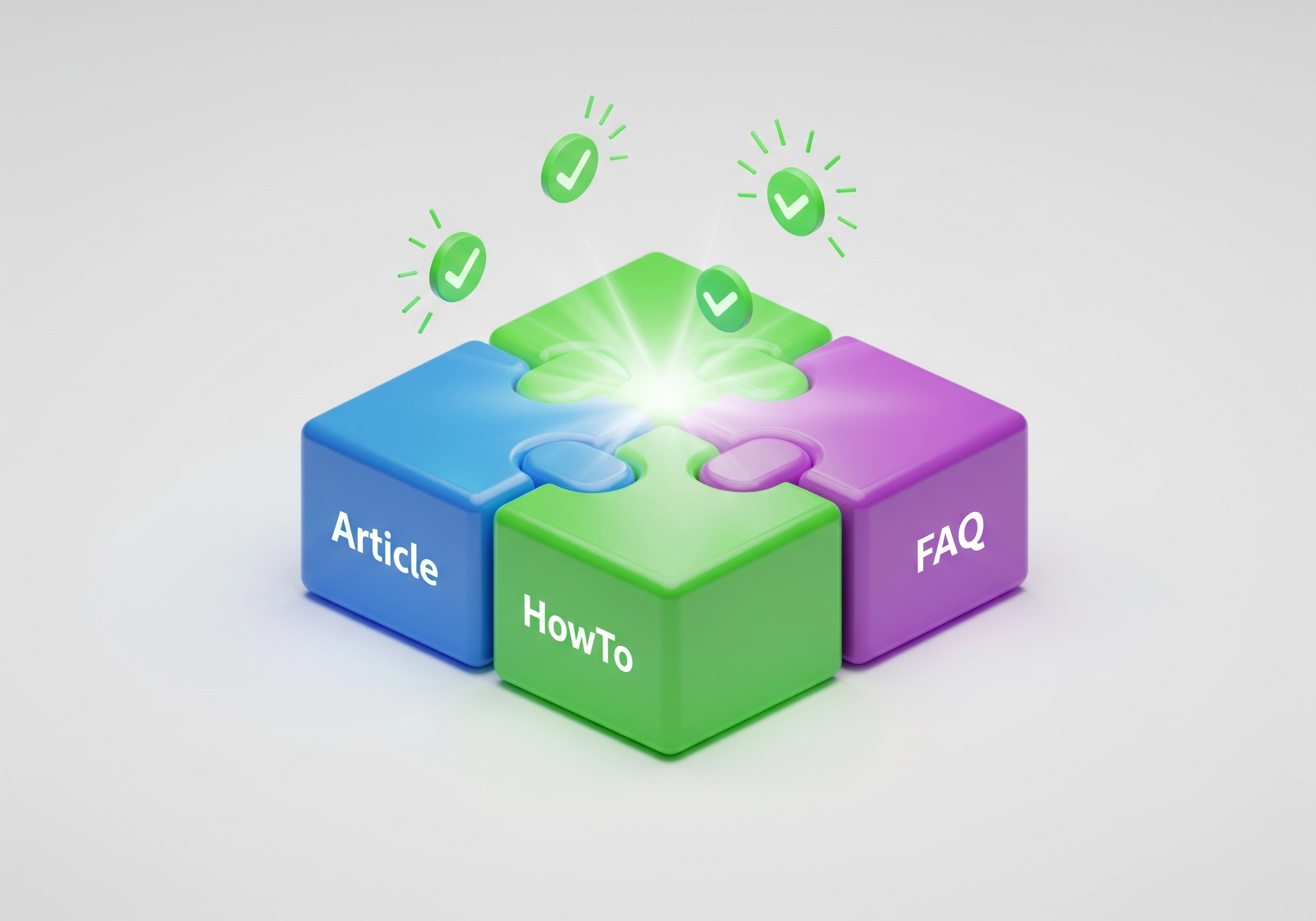
Why Schema is Your Content’s Technical Handshake with AI
While well-structured content is your first line of offense, structured data,specifically schema markup,is the technical handshake that confirms your content’s meaning to Google’s AI. It’s the difference between telling an AI “this is a block of text” versus “this is a step-by-step guide written by an expert.” This explicit labeling with JavaScript Object Notation for Linked Data (JSON-LD) removes ambiguity, making your content a prime candidate for citation.
For AI visibility, not all schema is created equal. A few specific types have emerged as critical for securing a place in AI Overviews, directly impacting your schema for AI summaries strategy.
Core Schema Types for AI Summaries
1. Article Schema
This is your foundation for establishing E-E-A-T (Experience, Expertise, Authoritativeness, Trustworthiness). Article schema explicitly tells Google who wrote the content, who published it, and when it was last updated. For an AI model weighing sources, a page with a clearly defined author and a recent dateModified tag is inherently more trustworthy than one without.
Implementing this schema is a non-negotiable trust signal for AI.
2. FAQ Schema
If you want a direct path into AI summaries, FAQPage schema is your vehicle. This markup structures content into a clear question-and-answer format that AI models are designed to parse. By wrapping a common user query and its concise answer in FAQ schema, you are essentially pre-packaging a snippet for Google’s AI to grab and cite. This works perfectly with the Modular Answer Framework discussed earlier.
3. HowTo Schema
For any content that explains a process, HowTo schema is essential. It deconstructs your instructions into a sequence of distinct steps (HowToStep). When a user asks “how do I do X,” Google’s AI can directly extract these structured steps to build a clear, actionable summary. Without this markup, the AI is left to interpret your paragraphs, increasing the chance of misinterpretation or being overlooked entirely. A powerful ai seo content generator can help create content perfectly formatted for this.
| Schema Type | Primary Use Case for AI | Key Benefit |
|---|---|---|
| Article | Validating authoritativeness and freshness. | Builds E-E-A-T trust signals. |
| FAQPage | Providing direct answers to specific queries. | High likelihood of direct citation. |
| HowTo | Structuring procedural or step-by-step guides. | Clarity for process-based summaries. |
Ultimately, implementing these targeted schema updates can make a meaningful difference without a massive technical overhaul. They serve as a clear, machine-readable layer that confirms your content’s purpose and boosts its credibility for AI-driven search.
Can Originality and Authority Really Secure Your Spot in AI Overviews?
In the traditional SEO landscape, “originality” was often a subjective goal. But in the era of AI Overviews, it has become a quantifiable signal. Simply rewording existing information or publishing generic listicles is a direct path to invisibility. AI models are designed to synthesize, and they actively penalize content that adds no new value to the conversation.
This is where Google’s E-E-A-T framework,Experience, Expertise, Authoritativeness, and Trustworthiness,transitions from a guideline into a technical necessity. To be cited by an AI, your content must serve as a reliable source of truth. The most critical element here is the first ‘E’: Experience. AI systems are increasingly trained to identify and prioritize content that demonstrates first-hand, verifiable knowledge.
The Currency of AI Search: Information Gain
AI models are engineered to seek out information gain, a measure of how much new, unique information a document provides on a topic. If ten sources repeat the same statistic, the eleventh source that provides a new data point, a proprietary case study, or a novel analytical framework is exponentially more valuable.
This is why original insights and first-party data are your most powerful assets. Consider the difference:
- Low Information Gain: A blog post titled “5 Benefits of Cloud Computing” that summarizes common knowledge.
- High Information Gain: A report titled “Our 2026 Cloud Adoption Survey: 72% of CFOs Are Prioritizing Hybrid Models,” featuring your company’s unique survey data.
Building Trust Through Citation Velocity
When you consistently publish content with high information gain, you naturally attract mentions and links from other authoritative platforms. This creates what is known as citation velocity,a powerful signal that tells AI models your domain is a primary source. Each citation acts as a vote of confidence, reinforcing your E-E-A-T for AI search.
True authority isn’t just claimed; it’s demonstrated through unique, data-backed expert insights.
While an AI blog generator like GenWrite excels at building a scalable, SEO-optimized content foundation, your competitive advantage comes from layering that foundation with proprietary data and expert analysis. This human-AI collaboration creates content that is not only discoverable but also defensible, making it a prime candidate for citation in AI Overviews.
What Troubleshooting Steps Should You Take When Content Isn’t Appearing in AI Summaries?

When your meticulously crafted content is not cited by AI, the experience can be incredibly frustrating. You’ve followed the rules, built a great page, yet it remains invisible in the most valuable SERP real estate. This isn’t a black box problem; it’s a diagnostic challenge. The solution lies in systematically troubleshooting the potential disconnects between your content and the AI’s extraction models.
A Diagnostic Framework for AI Visibility
Before overhauling your entire strategy, approach the issue methodically. Most visibility problems stem from one of three areas: technical structure, content relevance, or perceived authority. By isolating the cause, you can apply a precise fix rather than guessing.
Here’s a simple framework for troubleshooting AI ranking issues:
| Phase | Key Questions to Ask |
|---|---|
| 1. Technical Audit | Is the page properly indexed? Does the schema markup (e.g., FAQPage, HowTo) validate without errors? Is the content structured with clear, question-based H3s and concise answer paragraphs? Are there any crawlability issues blocking AI access? |
| 2. Relevance Gap | Does the content provide superior “Information Gain” compared to cited sources? Does it directly answer the user’s query and anticipated follow-up questions? Is it generic, or does it contain unique data, expert commentary, and original insights? |
| 3. Authority Check | Does the content demonstrate strong E-E-A-T signals? Is the author clearly identified with credible expertise? Is the brand mentioned in authoritative contexts elsewhere online, boosting its “Citation Velocity”? |
This structured approach moves from the easiest fixes (technical errors) to the most complex (authority building), ensuring you don’t waste resources.
Tools and Strategies to Monitor AI Visibility
Solving the problem requires data. While traditional analytics show traffic, you need specific tools to understand your performance within AI summaries. Start with Google Search Console to check for indexing and schema errors, as these are common culprits.
For a deeper dive, specialized AI overview analytics platforms are emerging that help track when and how your pages are cited. These tools can monitor AI visibility and compare your citation frequency against competitors, revealing patterns in the content that AI models prefer. Proactively using AI SEO tools like GenWrite helps prevent these issues by building structurally sound, SEO-optimized content from the outset, aligning with AI extractability principles.
Ultimately, troubleshooting AI invisibility is about ensuring your content is not just the best answer, but the most accessible and trustworthy one.
What’s the Next Step to Ensure Your AI Search Success Beyond 2026?
Mastering entity-based SEO, implementing precise schema, and showcasing E-E-A-T are no longer optional,they are the table stakes for visibility. However, the most critical step to ensure your AI search success beyond 2026 isn’t a single tactic but a strategic commitment to continuous iteration. The AI search future won’t stand still, and neither can your content.
This means shifting from a “publish and pray” model to a “publish and refine” cycle. The real work begins after your content goes live. Are you tracking which of your pages get cited? Are you analyzing the structure of competitor content that AI models prefer? This ongoing vigilance is what separates fleeting visibility from sustained authority.
Building a System for Long-Term AI SEO
The core of a successful strategy is treating your content as a dynamic asset. The principles of Generative Engine Optimization (GEO) demand a proactive approach to maintaining relevance and authority. This iterative loop involves:
- Regular Audits: Periodically review your content’s modular structure and answer clarity.
- Citation Velocity Monitoring: Track how often your brand and data are mentioned across authoritative platforms, as this is a key signal for AI.
- Intent Evolution: Stay ahead of the conversational queries in your niche and create content that answers the “next” question.
This continuous optimization cycle is where automation provides a decisive advantage. The sheer scale of analysis and content refreshing required is immense. This is precisely why tools like our own AI SEO content generator exist,to automate the heavy lifting of research, structuring, and optimization, ensuring your content remains consistently aligned with AI extraction patterns.
Your long-term AI SEO strategy must be built on resilience. By consistently publishing original data and structuring content to be easily digestible, you create a “sourceable” brand that AI models learn to trust. This transforms your website from just another search result into a foundational source for AI-generated answers.
The path forward is clear: integrate these advanced AI content strategies into a sustainable, always-on optimization workflow. This is how you secure your place not just in today’s search results, but in the AI summaries of tomorrow.
Ready to dominate AI search? Discover how GenWrite automates SEO optimization and content creation to ensure your brand is cited in Google AI Overviews.
People Also Ask
What are Google AI Overviews and how do they impact search results?
Google AI Overviews, also known as AI-generated search results, provide concise summaries at the top of search results, directly answering user queries. They significantly impact traditional SEO by shifting focus from click-based rankings to being cited as a source within these AI-generated answers, affecting content visibility for over 60% of searchers.
How is optimizing for AI search different from traditional SEO?
AI search optimization prioritizes being cited for direct answers and demonstrating expertise, moving beyond simple keyword matching. Key differences include focusing on ‘citation velocity,’ ‘information gain,’ and ‘entity-based SEO’ rather than just keyword density and backlinks. Content needs to be structured for easy extraction by AI models.
What are the key ranking factors for Google AI summaries in 2026?
Foundational principles for 2026 AI summary ranking include entity-based SEO, verifiable E-E-A-T (Experience, Expertise, Authoritativeness, Trustworthiness), semantic context, structured data (like JSON-LD), and providing unique ‘information gain.’ Content must be structured for AI extractability, often using question-based headings and concise ‘atomic answers’.
How can I structure my content to be easily extracted by AI?
Structure your content using a ‘Modular Answer Framework.’ Employ question-based H2/H3 headings, provide concise ‘Atomic Answers’ at the beginning of sections, and use bulleted lists, numbered steps, or tables for detailed explanations. This makes your content easily digestible and quotable for AI models.
What specific schema markup is most beneficial for AI visibility?
Crucial schema markup types for AI visibility include Article schema for context, FAQPage schema for direct question-answer pairs, and HowTo schema for procedural content. Implementing these helps AI models understand and cite your content more effectively within AI Overviews.
Why are originality and authority so important for AI Overviews?
Originality and authority are paramount because AI models like Google’s Gemini prioritize content demonstrating first-hand experience and unique insights. Providing original case studies, proprietary data, and expert commentary increases ‘information gain’ and ‘citation velocity,’ making your content a more valuable and trustworthy source for AI summaries.