
How to take the artificial edge off your drafts without spending hours rewriting
The structural trap making your drafts sound like a dishwasher manual

Around 47 percent of content marketers regularly use AI for drafting, yet most of what gets published reads exactly like the instruction manual for a mid-range dishwasher. Why does this happen? The problem isn’t a lack of complex vocabulary. The real issue is mathematical consistency.
When you fire up an ai blog writer, the output is statistically engineered for low burstiness and perplexity. Every sentence matches the length of the one before it. Transitions become entirely predictable. You start seeing “furthermore” and “it is important to note” acting as robotic glue between perfectly symmetrical paragraphs.
So, what do most writers do? They panic and attempt a heavy, line-by-line rewrite. Or worse, they do a superficial synonym swap, changing words while leaving the rigid sentence structure completely intact. But this manual overhaul defeats the entire purpose of automated content generation.
Think of your initial draft as structured clay, not a finished sculpture. You don’t need to spend hours rewriting it from scratch. Instead, focus on surgical cadence breaks. Turn a uniform three-sentence paragraph into a single, punchy statement. Then follow it with a detailed, multi-clause explanation.
And honestly, this doesn’t always hold up if the initial prompt was garbage, but a rapid five-minute humanization pass usually fixes the rhythm. If you’re building a scalable automated on-page seo writing workflow with GenWrite, the goal is to satisfy human reader expectations for natural voice. You just need to break the machine pattern so it stops triggering every ai content detector on the market.
Where software helps speed up the heavy lifting
We know that fixing robotic cadence manually is a massive time sink. Around 47 percent of content marketers regularly rely on AI for drafting, which has saturated the internet with mathematically consistent, perfectly boring paragraphs. You don’t have to rewrite every uniform sentence by hand. Instead, you can run the raw draft through an ai humanizer to handle the bulk structural pass.
Think of the initial output from an AI SEO content generator as wet clay rather than a finished sculpture. Software scrambles the baseline perplexity and varies the sentence lengths before you ever touch the keyboard. But there’s real friction here. The evidence on automated text replacement is mixed, and leaning entirely on an AI writing tool to bypass AI detection often results in awkward phrasing or factual errors. Superficial synonym swaps simply don’t work.
You still need a surgical manual pass. When you’re managing high-volume content writing, the goal is to humanize content so it actually sounds like you, rather than just chasing an arbitrary detector score. We built GenWrite to automate the heavy lifting of research and structure, giving you back the hours needed for this final polish.
Using a dedicated SEO content optimization tool gets the foundation right. From there, effective keyword-driven blog writing requires sharp, human-led cadence breaks. Automated SEO optimization for blogs handles the structural formatting, freeing you to inject actual perspective. Ultimately, if you want to optimize content for AI search, you have to start with software that breaks predictable machine patterns, then finish with a human editor who knows exactly where to add the punch.
Surgical edits to break the machine rhythm
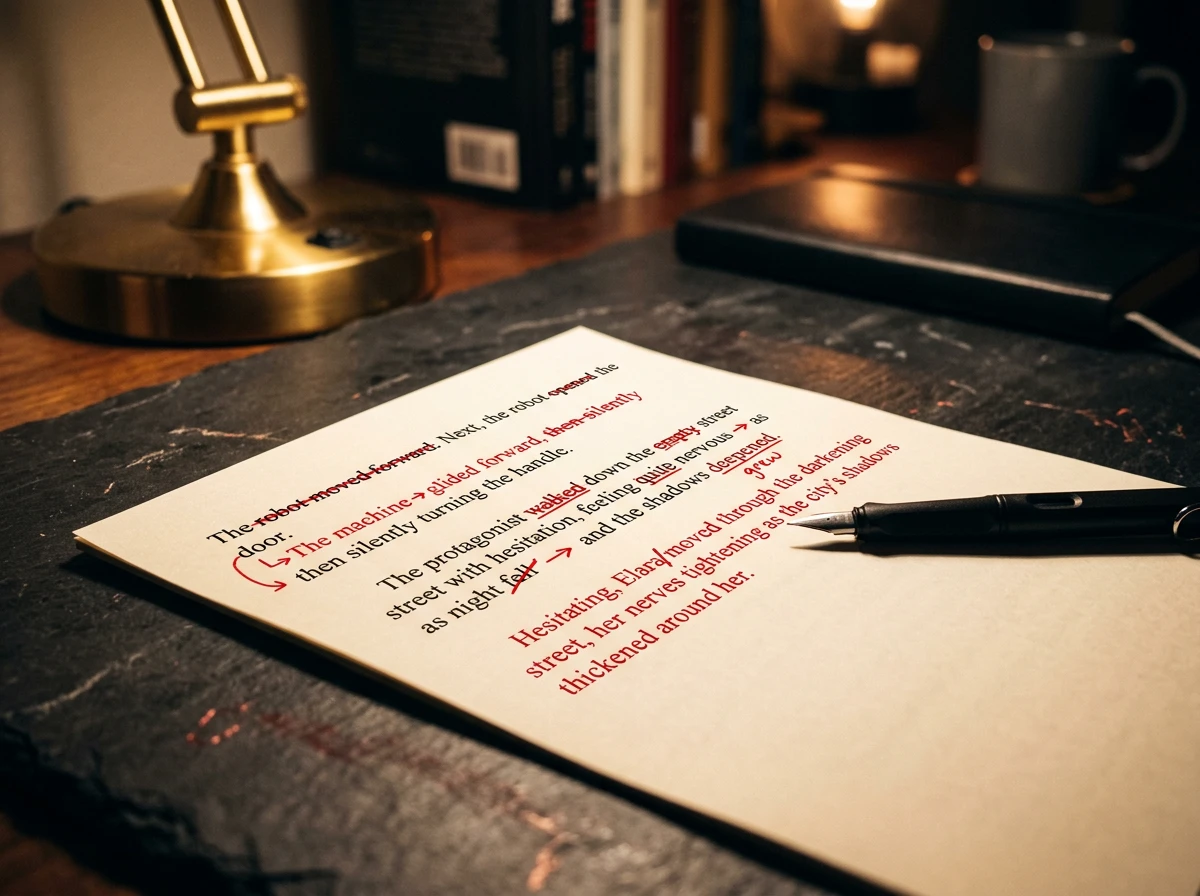
Even after running your draft through a humanizer, you’re looking at structured clay. Software gets you most of the way there by clearing out the worst algorithmic patterns. Now you need to break the mathematical consistency that remains. Around 47 percent of content marketers regularly use AI for drafting, meaning the internet is drowning in paragraphs that share the exact same rhythmic heartbeat.
Start by hunting for uniform blocks of text. AI naturally produces output with low burstiness, meaning sentence lengths are mathematically flat. You’ll often see three 15-word sentences stacked together. Break them. Chop the first one down to three words. Make it punchy. Then let the second sentence run long, connecting multiple clauses so the idea has room to breathe. This deliberate manipulation of cadence creates a genuine natural writing flow.
Next, target the connective tissue. Machines love to bridge thoughts with predictable phrases. Delete them entirely. Start sentences with “But,” “And,” or “So” instead. If you run your edited draft through an ai content detector, you’ll notice scores drop significantly just by removing these robotic transitions. Honestly, this doesn’t always guarantee a perfect human score, but it strips away the sterile vibe. While you’re tweaking the flow, review your content structure and internal linking to ensure your manually inserted thoughts connect logically to your broader site architecture.
You don’t need to rewrite every single line. If a section works, leave it alone. We built GenWrite to handle the heavy lifting of drafting and research so you can spend your time on these high-impact edits. When you use the right SEO AI tools to generate the baseline, formatting for readability takes just minutes. In fact, if you’re adapting your strategy for AI search optimization, rhythmic breaks keep readers engaged longer. For more advanced formatting tactics, checking out a dedicated content automation blog can help you bypass AI detection without spending hours agonizing over a keyboard.
Injecting the human experiences a model cannot hallucinate
Picture a draft about local search visibility. You’ve just chopped up the sentence lengths and stripped out every robotic transition word. The rhythm finally breathes. But read the actual advice. It still says exactly what 400 other generic articles say. An ai blog writer can predict the most mathematically probable next word, but it cannot remember the panic of a client losing their map pack ranking overnight.
That lived friction is your competitive advantage. The reality is, even the most capable language models struggle here. They default to safe averages. If you ask them for google my business optimization, they will reliably tell you to “fill out your profile completely.” A human expert knows you actually need to dig into secondary categories, hidden dashboard menus, and specific customer review replies. Perfect-sounding, frictionless advice is usually a red flag for readers wanting actual help.
You don’t need to rewrite the whole piece to fix this. Just surgically inject your brand’s specific perspective into the existing structure. Drop in a one-sentence anecdote about a recent project failure or an edge case you solved last week. Name the exact software stack you use, rather than referencing a vague category. These micro-injections of reality act as trust signals that algorithms simply cannot fake.
When you let an seo friendly blog generator like GenWrite handle the heavy lifting of initial drafting and baseline SEO optimization, you stop wasting hours staring at a blank page. Instead, you buy back the fifteen minutes needed to add these specific, human details. Sure, this manual injection doesn’t always hold the secret to a guaranteed top ranking on its own. But it proves to the reader that a real practitioner is behind the screen. And that is what actually keeps them reading until the end.
Fixing your inputs so you write less garbage downstream

Injecting human anecdotes works. But if you’re constantly fighting the underlying structure of a raw LLM output, your workflow is broken. The most efficient way to reduce the time spent editing ai drafts is to stop generating mathematically average text in the first place. You have to constrain the model’s probabilistic tendencies before it outputs a single token.
Stop using generic persona prompts like “act as an expert.” They yield high-volume but sterile copy. Instead, deploy strict negative constraints within your system instructions. Tell the ai content writer exactly which transition words to blacklist. Ban specific rhythmic patterns. Force it to alternate between declarative statements and complex dependent clauses. By artificially inflating the required perplexity at the prompt level, you disrupt the default machine rhythm.
Few-shot prompting is non-negotiable here. Feed the context window three examples of highly varied, asymmetrical paragraph structures. This anchors the output distribution, mathematically forcing the model away from its low-burstiness default. If you’re scaling this across hundreds of articles, maintaining these strict parameters manually becomes a bottleneck. That’s why AI SEO tools like GenWrite manage the underlying architecture. We embed these structural guardrails directly into the generation process, mapping search intent to complex structural templates rather than open-ended text completion.
Even with aggressive negative prompting, this doesn’t always hold perfectly. Models occasionally regress to their training mean over long outputs, slipping back into predictable cadence blocks. You’ll still need a rapid manual pass. But by tightening the inputs, you transform that pass from a heavy line-by-line rewrite into a fast, surgical formatting job. Whether you run a single Python script or evaluate bulk blog generation pipelines, front-loading the friction is the only way to scale without sacrificing structural integrity.
What to do when the scanner flags your actual writing
Even with tight prompts and careful persona constraints, an ai content detector will eventually flag your actual, human-written draft. Don’t panic. And absolutely don’t rewrite it.
Most detection tools are bad at nuance. They look for low burstiness and mathematically consistent sentence structures. So if you write clear, concise, well-structured paragraphs, you look like a machine to them. Professional writers use parallel structures to make complex ideas digestible. But scanners read that clarity as artificial. Punishing yourself for writing clearly is a terrible strategy.
Writers waste hours trying to bypass ai detection by inserting typos, awkward phrasing, or bizarre vocabulary. This destroys readability. You lose the reader. You tank your engagement. The scanner score goes up, but the content quality plummets. It’s a losing trade.
Stop chasing arbitrary human scores. Search engines don’t penalize content simply because a third-party scanner claims it looks synthetic. They penalize unhelpful, poorly structured garbage.
Focus on the structural elements that actually drive traffic. Fix your formatting. Ensure your keyword density is natural. Generate a precise, compelling snippet using an SEO meta tag generator to secure the click from the search results. That’s where the battle is won.
At GenWrite, we automate the end-to-end blog creation process because efficiency matters more than passing a flawed Turing test. We optimize for SEO, competitor gaps, and reader retention. We don’t optimize for scanners. The goal is ranking and reading, not pleasing a random algorithm.
If your draft flows well, answers the user’s question, and holds attention, publish it. A false positive is just a mathematical guess based on averages. Trust your editorial judgment over a red warning box. Move on to the next piece of content.
The final polish that turns generic drafts into high-performing content

Forget the scanner for a minute. What happens when a real person actually lands on your page? If they hit a wall of mathematically perfect but completely lifeless text, they bounce.
That’s where your real job begins. Think of yourself less as a writer starting from scratch and more as a sculptor working with pre-mixed clay. You can let a capable AI blog generator like GenWrite handle the tedious stuff,pulling the keyword research, analyzing competitor gaps, and spinning up that initial draft. But that output is just your baseline. It’s the raw material.
So, how do you actually humanize content without spending hours rewriting everything?
You stop trying to fix every single word. Honestly, you don’t always need to touch every sentence to make a piece feel authentic. Sometimes the original logic is perfectly fine. The real friction comes from the rhythm. You just need to break the predictable machine cadence.
Turn a uniform three-sentence paragraph into a punchy one-liner. Then follow it up with a detailed, messy, real-world example that a language model could never invent. Swap out those robotic transitions for how you actually speak.
And this is where the magic happens for retention. Readers don’t stick around because your sentence structures are flawless. They stay because the voice feels familiar, authoritative, and human.
Are you ready to stop treating AI drafts as finished products and start treating them as clay? Grab your next generated post, set a five-minute timer, and start breaking the rhythm.
Tired of spending hours fixing robotic AI drafts? GenWrite handles keyword research, competitor analysis, and natural drafting so you don’t have to.
Frequently Asked Questions
Why do AI-generated drafts sound so repetitive and robotic?
AI models rely on mathematical averages that make every sentence roughly the same length and complexity. That lack of variation creates a predictable rhythm that reads like a manual.
Can I just use a thesaurus to swap out words and fix the tone?
Honestly, simple synonym swaps don’t work because the underlying sentence structure stays the same. You have to actively break up uniform paragraphs and change up your punctuation instead.
What are the biggest dead giveaways that text was written by an AI?
Watch out for overly formal transition words like furthermore, in conclusion, and testaments to things. Humans rarely talk like that in everyday conversations.
Is it worth stressing over AI detectors flagging my authentic writing?
Don’t panic if a scanner flags your stuff, because false positives happen all the time. Focus on making your content engaging for actual humans rather than trying to please a bot.