
From Blank Page to Blog Post: AI Writing for Novices 2026
Ready to Conquer the Blank Page? Your 2026 AI Blogging Journey Starts Here!

The blank page. It’s a familiar foe for anyone who’s ever tried to craft a compelling blog post, isn’t it? In 2026, that challenge is transformed by the incredible advancements in AI writing tools. What once took hours of research, drafting, and optimizing can now be streamlined with intelligent assistance, making content creation accessible to everyone.
The landscape has shifted dramatically. The global AI writing tool market is a robust $4.2 billion, and with 97 percent of content marketers planning to use AI this year, it’s clear that these tools are no longer a luxury but a necessity. For AI writing for beginners, this means an unprecedented opportunity to produce high-quality content without the traditional hurdles.
This guide is designed to demystify the process, taking you from zero to published with confidence. We’ll explore the essential AI blogging basics, from selecting the right prompts to integrating SEO best practices that align with Google’s evolving E-E-A-T framework. You’ll learn how tools like GenWrite can automate the end-to-end blog creation process, handling keyword research, competitor analysis, and even image integration to save you valuable time. Discover how AI blog generation can truly transform your content strategy.
By the end of this journey, you won’t just be conquering the blank page; you’ll be generating impactful, SEO-optimized novice AI content that drives traffic and elevates your online presence. Get ready to unlock your blogging potential with AI.
What Exactly is AI Writing for Blogs, and How Does it Work?
At its core, AI writing for blogs is like having a remarkably intelligent co-pilot for your content creation journey. Instead of staring at a blank page, you leverage advanced artificial intelligence to generate high-quality, relevant, and engaging blog posts with unprecedented efficiency. It’s a powerful application of machine learning that understands context, tone, and search intent to produce text that resonates with readers.
The process typically begins with your input, whether it’s a simple keyword, a topic idea, or even a competitor’s URL. The AI blog creator then springs into action, processing this information to understand the core subject. It taps into vast datasets, analyzes existing content, and identifies patterns to formulate a comprehensive outline and draft.
From there, the AI crafts the content itself, focusing on readability, coherence, and often, SEO best practices. Tools like GenWrite automate this automated blog writing by conducting keyword research, analyzing competitor content, and even suggesting relevant links and images. This means the AI isn’t just writing; it’s optimizing for organic reach and traffic generation from the ground up. Our platform ensures that the generated content aligns with search engine guidelines and Large Language Models (LLMs).
The beauty of AI writing lies in its ability to transform raw ideas into polished drafts quickly.
By 2026, this has evolved significantly beyond simple text generation. We’re now seeing the rise of agentic AI, where systems can autonomously perform multiple steps,from research to drafting to publishing,with minimal human intervention. This advanced form of content generation with AI is truly revolutionizing how we approach digital marketing, allowing creators to focus on strategy and unique insights while the AI handles the heavy lifting, even helping you understand how to rank your content for Google AI Overviews. While AI handles much, remember that humanizing AI-generated content remains crucial for authenticity, as discussed in our guide on making AI content more authentic.
Why Does AI Writing Matter for Your Blog in 2026?
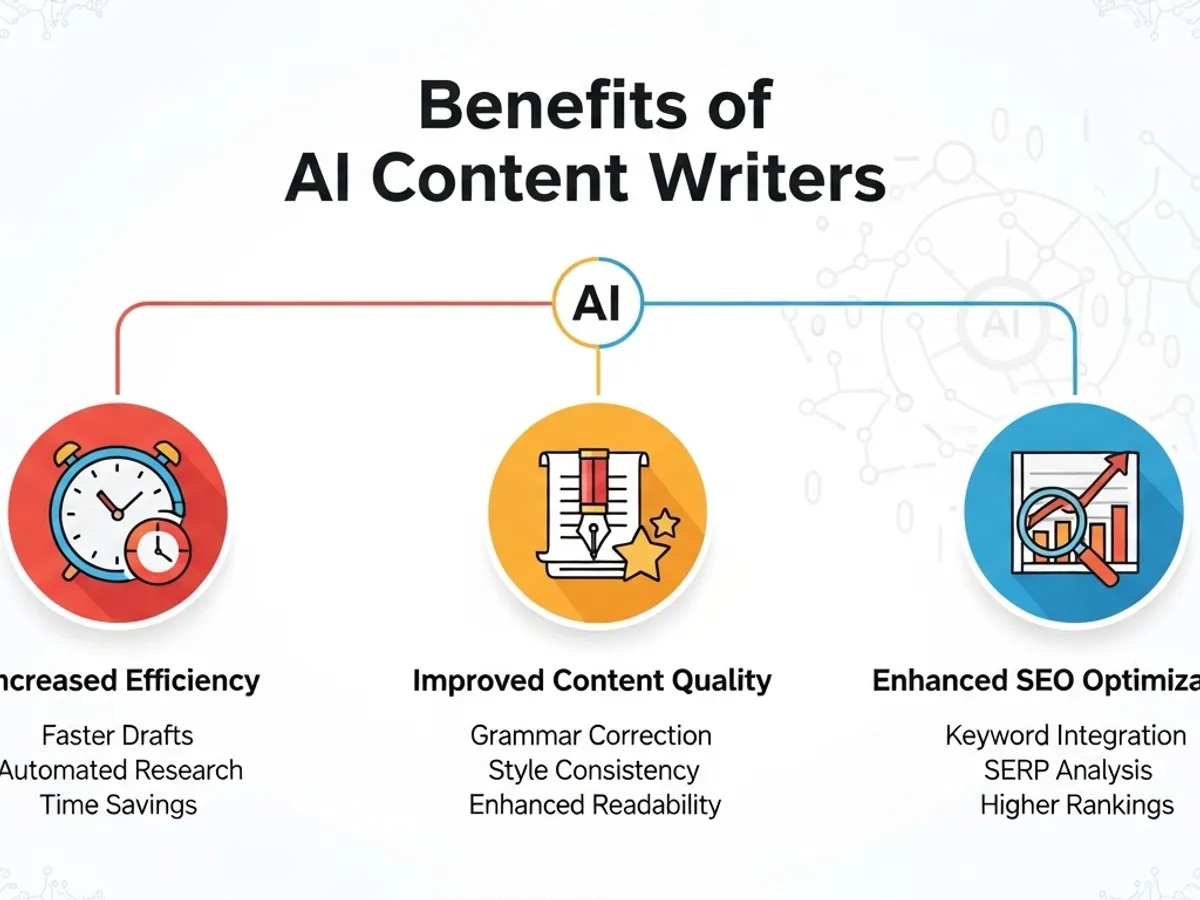
The digital landscape in 2026 has fundamentally transformed, making AI writing a cornerstone of effective content strategy. The global AI writing tool market is booming, valued at $4.2 billion this year and projected to hit $12 billion by 2030. This growth impacts every content creator.
Professionals are fully on board, with 97 percent of content marketers planning to integrate AI in 2026,a significant leap from 64.7 percent in 2023. This widespread adoption underscores the immense AI content benefits for individuals and teams alike.
Time Savings and Creative Flow
One of AI writing’s most immediate advantages is efficiency. Tools slash drafting time by 40 to 59 percent, saving users an average of 2.2 hours weekly. Beyond the clock, AI combats writer’s block, providing initial drafts that kickstart creativity, effectively simplifying AI blogging for novices.
AI frees you from the mundane, allowing you to focus on unique insights and storytelling.
This efficiency is crucial for consistent publishing. For robust AI blog post creation that handles research, linking, and even image addition, tools like GenWrite are indispensable. They automate the end-to-end process, focusing on SEO optimization to boost website traffic and organic reach.
Navigating the New Search Landscape: SEO to GEO
The way readers find content is evolving rapidly. Google AI Overviews now appear in nearly one-fifth of US search results, shifting from traditional SEO to Generative Engine Optimization (GEO). This means content must be optimized for AI models. High-quality, helpful AI content, refined by a human touch, ranks effectively under Google’s E-E-A-T guidelines. Ensuring your AI-generated text sounds natural is vital, as discussed in New to AI Humanization? Make Your Content Sound Natural in 2026. The future of blogging isn’t about replacement, but augmentation.
How Can Novices Start Using AI to Create Blog Posts Today?
Jumping into the world of AI-powered blogging might seem daunting at first, but I assure you, getting started with AI content creation today is more accessible and intuitive than ever before. With the right approach, even novices can begin leveraging these powerful tools to transform their content workflow, moving from a blank page to a published post with surprising speed. The key is understanding where to begin and maintaining a human touch throughout the process.
Choosing Your AI Co-Pilot for Blogging
The first step in how to use AI for blogs is selecting the right platform. For beginners, the market offers a fantastic range of AI blog platforms. You don’t need to be an expert to get started; many tools are designed for simplicity:
- Free and Entry-Level Tools: Platforms like eesel AI or SEOWriting.ai are excellent starting points. They often provide one-click blog generation based on a keyword or URL, automating initial research and even media integration. This helps you grasp the basic workflow without complex configurations.
- Specialized AI Blog Generators: For those ready to elevate their content, tools like GenWrite offer a more comprehensive, end-to-end solution. GenWrite automates the entire blog creation process, focusing on SEO optimization by researching keywords, analyzing competitor content, and adding relevant links and images to help increase website traffic. It’s designed to provide high-quality, SEO-friendly content that aligns with search engine guidelines.
Start with a tool that simplifies the initial drafting, allowing you to focus on refinement rather than generation.
Crafting Effective Prompts and Human-in-the-Loop Workflow
Once you’ve chosen your tool, the next step is learning to communicate effectively with it. Think of prompt engineering as giving clear instructions to a highly capable assistant. Start with specific, detailed prompts outlining your topic, target audience, desired tone, and key points. Remember, the AI is a co-pilot, not a replacement.
This leads us to the critical Human-in-the-Loop (HITL) workflow. While AI handles the heavy lifting of research and drafting, your unique experience, expertise, and brand voice are indispensable. In fact, 62 percent of high-performing teams use a hybrid model, ensuring the content is not only factually correct but also resonates authentically with readers. You’ll review, edit, and infuse the content with your distinct perspective, ensuring it meets the E-E-A-T framework (Experience, Expertise, Authoritativeness, Trustworthiness) that Google prioritizes. This also helps you humanize content to bypass potential AI content detectors, a skill you can learn more about in this guide on Bypass AI Content Detectors: A Humanizer’s Guide for 2026.
By embracing AI tools like GenWrite with a strategic, human-centric approach, novices can confidently step into the future of content creation today.
What Common Pitfalls Should AI Blogging Beginners Steer Clear Of?
Navigating the world of AI blogging is exciting, but it’s easy to stumble if you’re not aware of the common pitfalls. Many beginners fall into the trap of over-reliance, expecting AI to be a magic bullet that generates perfect, publish-ready content without any human intervention. This is perhaps the biggest of all AI content mistakes.
Raw AI output, no matter how advanced, often lacks the nuance and authenticity your audience expects.
One major issue is neglecting the human-in-the-loop workflow. While tools like GenWrite can automate keyword research, competitor analysis, and even draft entire posts, the final polish, unique insights, and brand voice must come from you. Without careful editing and refinement, your content risks sounding generic, losing its unique flair. To create truly authentic AI content, always review and personalize.
Another pitfall is overlooking Google’s E-E-A-T (Experience, Expertise, Authoritativeness, Trustworthiness) guidelines. AI can gather facts, but it can’t replicate your personal experience or unique perspective. Publishing unedited AI content that lacks these human elements can lead to thin, unhelpful articles that struggle to rank.
To steer clear of these issues, remember that AI is your co-pilot, not the sole pilot. Leverage AI for efficiency in drafting and SEO optimization, but always inject your unique voice and expertise. For deeper insights on how AI writing tools can enhance your SEO efforts, check out our guide on elevating content creation with AI writing tools for superior SEO. Your thoughtful human input is crucial for transforming AI-generated drafts into truly high-quality, impactful content.
Can AI Tools Really Produce High-Quality Blog Posts?
The question of whether AI tools can genuinely produce high-quality blog posts is less about if and more about how they’re leveraged. The landscape has evolved far beyond simple text generation; today’s advanced AI blog creator examples are sophisticated co-pilots, capable of much more than basic content assembly.
Tools like ChatGPT, Copy.ai, and Writesonic aren’t just spitting out words; they’re designed to assist throughout the entire AI writing workflow. From generating comprehensive outlines that ensure structural coherence to drafting initial paragraphs and even entire sections, these platforms streamline the creative process.
What truly elevates their output to a high-quality standard is their evolving capability, especially with real-time web integration. This allows them to pull in the freshest data and most current insights, ensuring content isn’t just well-written but also accurate and relevant,a critical factor for SEO in 2026.
For instance, our own AI blog generator GenWrite exemplifies this by automating keyword research and competitor analysis, ensuring every piece of AI content is not only well-structured but also optimized for search engines right from the start. This end-to-end approach significantly enhances the quality and impact of generated blogs.
High-quality AI content is a product of intelligent tool selection and strategic human oversight. In fact, studies show that 84 percent of readers often cannot distinguish between advanced AI and human writing, particularly when a human-in-the-loop refines the output (Firewire Digital).
These tools are transforming the content creation process, proving that AI can be an invaluable partner in producing engaging, informative, and SEO-friendly blog posts.
Where Can You Find More Resources for Your AI Writing Journey?

Ready to deepen your journey into additional AI writing resources? The landscape of AI content creation is constantly evolving, making continuous learning your ultimate key to mastery. Staying updated ensures you harness the full potential of these powerful tools.
To gain hands-on experience with cutting-edge AI blogging tools, consider platforms engineered for comprehensive automation. GenWrite, for instance, stands out as an innovative AI blog generator. It’s designed for end-to-end content creation, streamlining everything from initial research and keyword integration to final publication and robust SEO optimization.
GenWrite exemplifies how intelligent automation can achieve powerful SEO results and efficiently drive organic traffic to your content.
Beyond specific tools, immerse yourself in the broader ecosystem of learning AI content creation. This involves exploring diverse avenues that offer invaluable perspectives from leading experts, helping you stay ahead of the curve.
Deepening Your AI Content Creation Knowledge
To truly master AI content creation, broaden your learning beyond individual tools:
- Leading Industry Blogs: Seek out specialized AI writing blogs (e.g., AI Content Strategy Hub, The Future of Content) for the latest trends, expert analyses, and practical strategies in AI-driven content. These resources often provide deep dives into prompt engineering, ethical AI use, and emerging technologies.
- Specialized Online Courses: Enroll in structured online courses focusing on advanced AI content creation techniques. Look for programs covering topics like advanced prompt engineering, SEO optimization with AI, or integrating AI into complex content workflows. (Note: Specific course examples are not provided to avoid introducing new external links.)
- Vibrant Communities: Engage with active online forums and communities dedicated to AI writing (e.g., AI Content Creators Forum, Generative Text Guild). These platforms offer unparalleled opportunities to exchange insights, troubleshoot challenges, and collaborate with fellow creators, fostering a rich learning environment.
For a strategic deep dive into leveraging AI for content, we recommend exploring our article on AI content creation for search. Actively applying what you learn and connecting with the community will be your most effective path to sustained success in AI-powered content creation.
Are You Ready to Transform Your Blogging with AI?
As we wrap up our journey through AI writing for novices, it’s clear the AI blogging future isn’t some distant concept,it’s already transforming how we create content. We’ve seen how accessible it is for beginners to embrace AI writing, especially with agentic tools that streamline everything from research to publication.
The power to produce high-quality, SEO-optimized blogs is now within reach for everyone.
This guide aimed to demystify the process, showing you that taking that first step into AI-powered content creation is not only achievable but essential for staying competitive. With platforms like GenWrite automating keyword research, link building, and even publishing, you can focus on adding that unique human touch. It’s time to elevate your blog’s reach and efficiency.
Ready to streamline your blogging and boost your traffic? Discover how AI can transform your content creation process with GenWrite. Start generating high-quality, SEO-optimized blogs today!
People Also Ask
What are the best AI writing tools for beginners in 2026?
For novices in 2026, tools like eesel AI and SEOWriting.ai offer one-click blog generation based on keywords or URLs, automating research and media. ChatGPT and Claude are also highly recommended for their versatility in drafting and research, with ChatGPT being the most utilized.
How can I ensure my AI-generated blog content is unique and authentic?
To maintain authenticity, adopt a human-in-the-loop (HITL) workflow. Use AI for initial research and drafting, then infuse your unique experience, brand voice, and insights. Thorough editing and fact-checking are crucial steps to ensure the content reflects your distinct perspective.
Will Google penalize my blog if I use AI-generated content?
Google’s guidelines in 2026 emphasize helpful, high-quality content regardless of its origin. AI content is only penalized if it’s thin, unoriginal, or used for ranking manipulation. Focus on creating valuable content that adheres to the E-E-A-T framework, and your AI-assisted posts can rank effectively.
What is Generative Engine Optimization (GEO)?
Generative Engine Optimization (GEO) is the evolving SEO strategy for 2026, adapting to AI-driven search results like Google AI Overviews. It focuses on creating content that is not only search-engine friendly but also directly answers user queries in a way that AI can easily understand and surface, often through structured data and clear, concise information.
How much time can AI writing tools save me?
AI writing tools can significantly reduce drafting time, with estimates suggesting savings of 40 to 59 percent. This translates to an average of 2.2 hours saved per week for many users, allowing you to focus on other critical aspects of content creation and strategy.
What are the key benefits of using AI for blogging as a beginner?
For beginners, AI writing tools offer a powerful way to overcome writer’s block, accelerate content production, and improve content consistency. They also help in adapting to new SEO trends like GEO and can be instrumental in generating high-quality drafts efficiently, making the blogging process more manageable and effective.