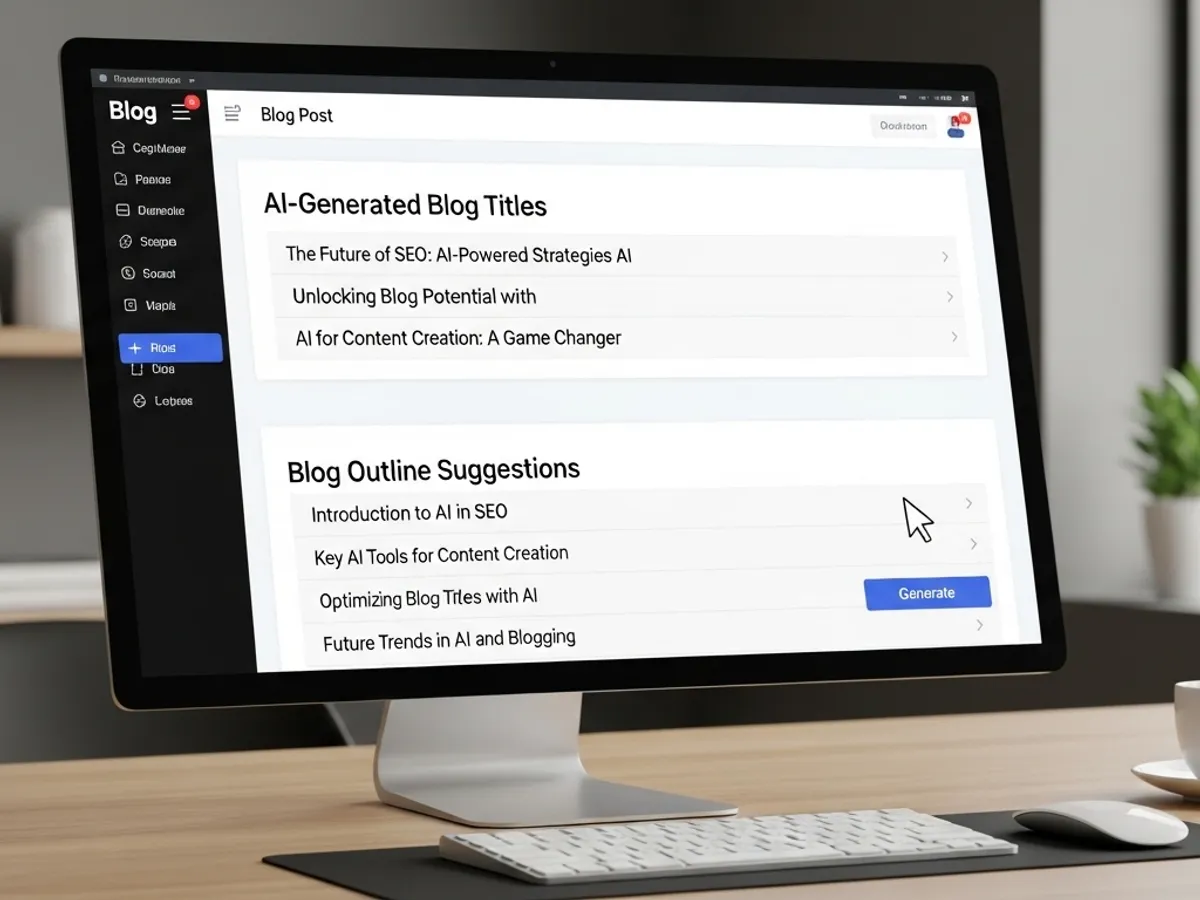
Your Simple Starting Point for AI Blog Generation in 2026
What’s the Buzz About AI Blog Generation in 2026 and Why Should You Care?

Walk into any content marketing discussion today, and you’ll quickly realize that AI blog generation isn’t just a buzzword; it’s the engine driving content strategy in 2026. The AI writing assistant market is projected to soar to over $4 billion, with a staggering 90% of content marketers already integrating these tools into their daily workflow. But why should you, especially as a beginner in the world of content creation, care?
It’s simple: AI empowers you to bypass frustrating writer’s block and scale content production by 2.5 times, transforming you from a content creator into a strategic editor. This shift alone can save an average of 2.2 hours per week per employee. No longer is quality content creation a slow, manual grind.
AI blog generation allows beginners to produce high-quality content at scale, saving time and resources.
For those just starting their journey in beginner AI writing, understanding these tools is no longer optional,it’s essential. AI-generated content now appears in nearly 20% of top Google search results, proving its mainstream impact. This guide is your simple starting point to demystify AI content writing and equip you with the knowledge to succeed.
We’ll dive into practical workflows, help you choose your first AI tools, and reveal how platforms like GenWrite AI blog generator automate end-to-end blog creation, focusing on SEO optimization, keyword research, and automatic publishing. You’ll learn how to craft high-quality, SEO-friendly content that aligns with search engine guidelines and LLMs, ultimately boosting your website traffic and organic reach. Get ready to master automated blog post generation and truly elevate your online presence.
What Exactly is AI Blog Generation and How Does It Work?
Imagine having a tireless co-writer that never experiences writer’s block. That’s the essence of AI blog generation: leveraging artificial intelligence to create compelling written content for your blog. It’s a game-changer for anyone looking to scale their content efforts.
At its core, AI writing software uses advanced algorithms and machine learning models, often called Large Language Models (LLMs), to process and understand vast amounts of text data. These models learn patterns, styles, and tones from the internet, enabling them to generate human-like prose. When you provide a prompt,a topic, keywords, or a brief outline,the AI gets to work.
It’s truly automated blog writing, transforming your initial ideas into full-fledged articles. Think of it like a highly skilled digital assistant. You give it the core concept, and it drafts the content, complete with introductions, body paragraphs, and conclusions.
This technology isn’t just about speed; it’s about smart assistance. Tools like GenWrite take this automation further by integrating features like keyword research, competitor analysis, and even suggesting internal links. This comprehensive approach helps ensure the generated content is not only coherent but also optimized for search engines right from the start.
AI empowers you to shift from a pure creator to a strategic editor.
The efficiency is remarkable; our data shows that businesses using AI tools report content creation is 59% faster. This allows content marketers to focus on refining their strategy and ensuring their content truly resonates with readers and search engines. Learning to leverage these tools is a crucial step for any beginner looking to boost their website’s rank and ultimately boost your website traffic effectively in today’s digital landscape.
Why is AI-Powered Blog Writing a Must-Have Skill for Bloggers in 2026?

The landscape of content creation has fundamentally shifted, and for bloggers in 2026, embracing AI isn’t just an advantage,it’s a core competency. Think of it as the new literacy for digital publishing. If you’re looking to enhance your personal growth and professional success, mastering ai content writing is no longer optional.
Why the urgency? The numbers tell a clear story. The AI writing assistant market is set to soar, projected to reach between $2.74 billion and $4.2 billion by 2026, growing at a remarkable 32% CAGR. This isn’t niche technology; it’s mainstream, with 82% of businesses and 90% of content marketers leveraging AI tools daily. These ai writing statistics underscore a significant industry-wide transformation.
From a practical standpoint, learning to write blogs with ai means far more than just generating text. It transforms your workflow, allowing you to bypass common hurdles like writer’s block and scale content production by 2.5x. Organizations are already reporting 59% faster content creation and a 30% reduction in cost per piece. This efficiency allows you to shift from being solely a creator to a strategic editor, saving an average of 2.2 hours per week.
AI isn’t replacing human creativity; it’s augmenting it, freeing you to focus on unique insights.
This shift is also about staying relevant in an evolving search landscape. With AI-generated content appearing in roughly 19.1% of top Google search results, understanding how to effectively use ai for writing blogs ensures your content remains competitive. Tools like GenWrite, for instance, automate end-to-end blog creation, focusing on SEO optimization by researching keywords, analyzing competitors, and adding relevant links and images. This means you can create high-quality, SEO-friendly content that aligns with both search engine guidelines and large language models (LLMs), boosting website traffic and organic reach.
Beyond basic drafting, the skill involves humanizing AI output. While AI drafts content, the crucial next step is adding your unique voice and anecdotes, a process essential for meeting Google’s E-E-A-T (Experience, Expertise, Authoritativeness, and Trustworthiness) requirements. Learning to “humanize” AI content is key to avoiding detection by advanced content scanners and ensuring genuine reader engagement. To dive deeper into making your AI content truly human, explore resources like Craft Truly Human-Sounding AI Content: A Starter’s Guide to AI Humanizers in 2026 and Make AI Writing Undetectable by Content Scanners: A 2026 Humanization Guide.
How Can Beginners Start Writing Blogs with AI Effectively in 2026?
Getting Started: Your First Steps with AI in Blog Creation
Starting your journey with beginner ai writing in 2026 might seem daunting, but it’s remarkably straightforward thanks to advanced tools and established workflows. The goal isn’t to replace you, but to empower you to scale content production by as much as 2.5x, shifting your role from a pure creator to a strategic editor. This saves an average of 2.2 hours per week, allowing you to focus on high-value tasks.
Choosing Your Ideal AI Article Writer
The first step for any beginner is selecting the right ai article writer. For those mindful of budget, tools like Rytr ($9/month) remain excellent entry points. If brand voice consistency is paramount, Jasper is often considered the gold standard. However, for real-time, factual SEO content, Writesonic and KoalaWriter excel due to their integration with live SERP data. For initial brainstorming and complex outlining, ChatGPT (GPT-5.2) and Claude 4.5 offer unmatched versatility.
The right tool can dramatically accelerate your content creation process.
Mastering the AI-Powered Content Workflow
Once you have your tool, the next phase involves a proven content writing using ai workflow. Begin with ideation (74% of users leverage AI for this) and then move to outlining (61%). This structured approach ensures your content has a solid foundation. From there, draft section-by-section, using the AI to generate initial text. The critical ‘Personality Injection’ phase follows, where you infuse unique anecdotes and insights to meet Google’s E-E-A-T (Experience, Expertise, Authoritativeness, and Trustworthiness) requirements. Remember, only 1% of content relies on 100% automated output; human oversight is key.
Leveraging AI for SEO and E-E-A-T
Effective ai powered writing isn’t just about speed; it’s about smart SEO. Google doesn’t penalize AI content itself, but it does target ‘scaled content abuse’,mass-publishing low-value pages. To succeed, your content must demonstrate genuine E-E-A-T. This is where tools like GenWrite shine, offering features for SEO optimization and keyword research that guide the AI to produce high-quality, relevant content that aligns with search engine guidelines. GenWrite helps automate competitor analysis and link building, ensuring your content is not only well-written but also strategically positioned to rank.
Starting your AI blogging journey means embracing a future where technology enhances your creative and strategic capabilities, making quality content more accessible than ever. For a comprehensive AI blog generator that handles everything from research to publication, explore GenWrite’s AI blog writer.
What Common Mistakes Should New AI Blog Writers Absolutely Avoid?
Jumping into AI blog generation in 2026 is undoubtedly exciting. However, new writers must proactively avoid common AI blog generation pitfalls to truly succeed. Remember, the goal isn’t just speed , it’s creating effective, high-quality content that truly connects with your audience.
Over-Reliance on Raw AI Output
The cardinal sin of AI blog generation? Publishing raw, unedited AI output. While AI undeniably accelerates content creation by 59%, a mere 1% of marketers fully automate their content. This approach consistently produces generic, soulless content that utterly lacks a unique brand voice and fails to meet standards for true AI content quality.
Bold Insight: Raw AI is a draft, not a finished product. Your expertise is irreplaceable.
- Prevention Strategy: Embrace the role of a meticulous editor. Review, refine, and critically inject your unique perspective and insights. This human touch transforms AI output into valuable content.
Neglecting SEO and E-E-A-T Guidelines
A critical AI blog generation pitfall is overlooking the foundational importance of SEO optimization and Google’s stringent E-E-A-T guidelines. Remember, AI itself doesn’t inherently build authority or expertise. Google’s focus is on penalizing ‘scaled content abuse’ , mass-produced, low-value content , not AI-generated content per se.
Bold Insight: E-E-A-T is your human differentiator in an AI-driven landscape.
- Prevention Strategy: Proactively integrate robust SEO optimization into your workflow. This means meticulously refining keywords, optimizing content structure, and ensuring factual accuracy. While tools like GenWrite can significantly assist with these elements, human oversight remains paramount to truly elevate AI content quality and meet E-E-A-T standards.
Lacking a Distinct Brand Voice
Another common AI blog generation pitfall is producing generic content that utterly lacks a distinct brand voice. AI models, by their nature, can strip away the unique personality that connects with your audience, making your content forgettable.
Bold Insight: Your brand voice is your content’s fingerprint , don’t let AI erase it.
- Prevention Strategy: Consciously infuse every piece of content with your brand’s unique personality. This involves incorporating personal anecdotes, maintaining a consistent tone, and adding that crucial ‘personality injection’ that only a human can provide. It’s about making your content unmistakably yours.
Which AI Tools are Best for Generating Blogs and Articles in 2026?
The landscape of AI writing tools is bustling in 2026, offering incredible power for content creators. But with so many options, how do you pinpoint the best AI content writer for your specific needs?
For those just dipping their toes, Rytr remains a fantastic, budget-friendly entry point at around $9/month. It’s ideal for getting comfortable with AI writing software without a hefty investment. Many beginners find its straightforward interface helps them bypass writer’s block effectively.
As your needs evolve, you’ll find specialized tools. Jasper, for example, is the undisputed champion for maintaining a consistent brand voice across all your articles, perfect for established brands. If factual accuracy and real-time SEO data are paramount, tools like Writesonic and KoalaWriter excel by integrating live SERP insights directly into their AI article writer capabilities. They’re excellent for ensuring your content is optimized from the start.
For pure versatility,think brainstorming complex outlines or generating diverse content ideas,large language models like ChatGPT (now GPT-5.2) and Claude 4.5 are incredibly powerful. They act as flexible partners in your content strategy, helping you explore angles you might not have considered.
The right AI tool transforms your content strategy from manual labor to strategic oversight.
While these tools offer specific strengths, the real game-changer in 2026 is the emergence of comprehensive AI powered writing platforms that handle the entire content lifecycle. This is where a solution like GenWrite truly shines. We built GenWrite to automate the end-to-end blog creation process, from detailed keyword research and competitor analysis to adding relevant images and automatically publishing SEO-optimized blogs directly to your site. It’s about getting high-quality, traffic-driving content efficiently.
To truly excel in today’s digital landscape, leveraging an AI blog generator that focuses on comprehensive SEO optimization is key. This approach ensures your content not only gets created but also ranks and drives organic reach.
Choosing the right AI tool depends on your specific goals, whether it’s budget, brand voice, SEO focus, or complete content automation from ideation to publication.
Where Can You Find Additional Resources to Master AI Blog Writing?

The world of AI is constantly evolving, and mastering AI blog writing means staying curious and continuously learning. Fortunately, a wealth of resources exists to help you deepen your understanding and refine your skills, whether you’re just starting or looking to optimize your workflow.
Specialized AI Content Writing Courses
For structured learning, diving into ai content writing courses can provide a solid foundation. Many platforms offer programs designed to help you learn ai for blogs effectively, covering everything from prompt engineering to advanced content strategies. These courses often break down complex topics into digestible modules, making it easier to grasp the nuances of AI-powered content creation.
Structured learning accelerates your path to becoming an AI content pro.
Engaging AI Writing Communities
Connecting with others on the same journey is invaluable. Joining ai writing communities on platforms like Reddit, Discord, or LinkedIn allows you to share insights, ask questions, and learn from experienced practitioners. These communities are fantastic for discovering new techniques, getting feedback, and staying abreast of the latest trends in ai blog generation resources.
Advanced Tools and Platforms
Beyond basic knowledge, practical application with the right tools is key. Tools like GenWrite are specifically designed as an AI blog generator to automate the end-to-end process, from keyword research to publishing. They serve as excellent AI SEO content generator platforms, helping you produce high-quality, traffic-driving content efficiently.
Platforms like GenWrite offer comprehensive solutions that streamline your entire content workflow, integrating SEO optimization and content automation to maximize your reach. For optimizing content specifically for search engines, exploring a dedicated AI SEO content generator can significantly boost your organic visibility.
Embrace these resources to continuously sharpen your skills and leverage AI for exceptional blog content.
Ready to revolutionize your content creation? Discover how GenWrite can automate your blog generation and boost your SEO in 2026.
People Also Ask About AI Blog Generation
What is AI blog generation and how does it work for beginners?
AI blog generation uses artificial intelligence to help create written content, such as blog posts. For beginners, it works by taking your prompts and ideas and transforming them into drafts, outlines, or even complete articles. Tools analyze vast amounts of data to produce human-like text, making it easier to overcome writer’s block and scale content production.
Is AI-generated content penalized by Google in 2026?
Google does not penalize content solely based on its AI origin. Instead, Google targets ‘scaled content abuse,’ which refers to the mass publishing of low-value or unhelpful pages. To succeed, focus on creating high-quality content that demonstrates Experience, Expertise, Authoritativeness, and Trustworthiness (E-E-A-T), regardless of whether AI assisted in its creation.
What are the best AI writing tools for beginners on a budget?
For beginners looking for budget-friendly options in 2026, Rytr is a strong contender, often available for around $9 per month. While more advanced tools like Jasper, Writesonic, and KoalaWriter offer specialized features, and ChatGPT and Claude 4.5 are excellent for ideation, Rytr provides a solid entry point for AI content creation.
How can I ensure my AI-generated blog posts are original and high-quality?
To ensure originality and quality, treat AI as an assistant, not a replacement. Use AI for ideation, outlining, and drafting, but always inject your unique voice, experiences, and anecdotes. This ‘personality injection’ is crucial for satisfying E-E-A-T requirements and making content stand out. Editing and fact-checking by a human are essential steps.
What is Generative Engine Optimization (GEO) and how does it differ from SEO?
Generative Engine Optimization (GEO) is an emerging strategy for 2026 that focuses on optimizing content to appear in AI-synthesized ‘Overviews’ or answer boxes, which are increasingly common in search results. While traditional SEO focuses on ranking for specific keywords, GEO aims to get your content recognized and utilized by AI models to provide direct answers to user queries.
Can AI tools help with more than just writing blog posts?
Yes, many advanced AI writing tools now offer multimodal capabilities. This means they can often generate matching blog images, social media snippets, and even assist with internal linking strategies as part of an ‘agentic workflow.’ This integrated approach streamlines the entire content creation process beyond just text generation.