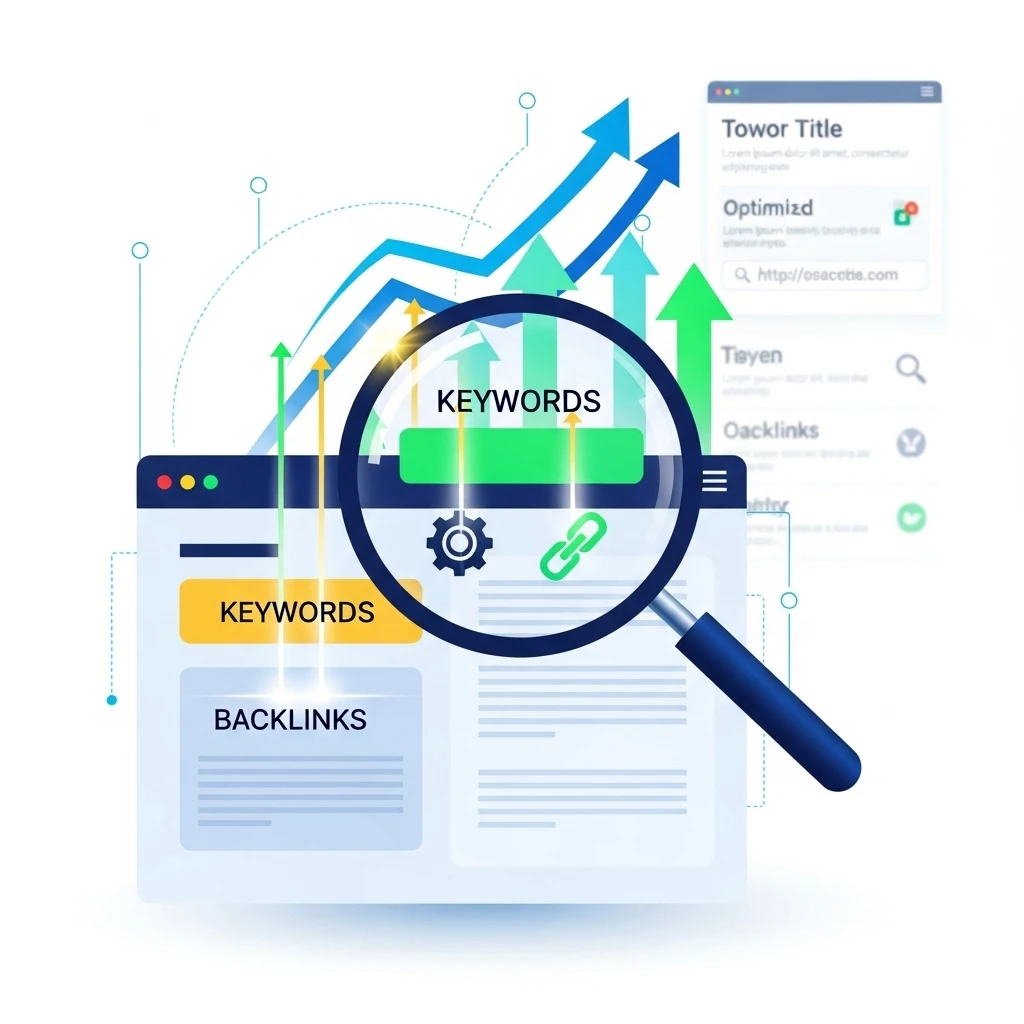
Your First Steps to Boosting Website Visibility Through SEO
Feeling lost in the online noise? this guide will help

Does it ever feel like you’re shouting into the void online? You’ve got a website, you’re publishing articles, but it often seems like no one’s listening. Don’t worry, website SEO optimization isn’t some complex puzzle only experts can solve. This guide is for beginners, small business owners, or anyone new to online marketing who wants to get noticed. We’ll break down the basics of search engine optimization and show you how to start getting found by your target audience.
So, why does getting found even matter? Well, organic search remains a primary driver of website traffic. A 2024 BrightEdge study found it accounts for 53.3% of all site visits across industries. The higher you rank in search results, the more people see you. Think about it: when you need something, where do you go? Google, right? This guide will help you get your website to show up when people search for what you offer. It’s not just about visibility, either; the #1 organic result in Google search results has an average click-through rate (CTR) of 27.6%, according to a 2023 Backlinko study. If you’re looking for a comprehensive overview, you might also find this starter guide to search engine optimization helpful.
We’ll cover everything from understanding how search engines work to optimizing your website’s content and structure. You’ll learn the value of keywords, how to make your content engaging, and how to track your progress. I’ll share practical tips and strategies to improve your website’s visibility and attract more organic traffic. Using tools like GenWrite can make the process easier. You’ll also discover how AI can assist with content generation and how to make AI-written text sound more human.
This guide isn’t about overnight success; it’s about building a strong base for long-term growth. We’ll avoid the hype and focus on what actually works, giving you clear steps you can take today to improve your website’s presence. You’ll also learn the best ways to humanize content to ensure your content truly connects with readers. By the end, you’ll have a clear understanding of SEO and a plan to start climbing those search rankings.
So, what exactly is SEO, and why does it matter?
Ready to get your website noticed? Good. Let’s cover the basics: What is SEO, and why should you care? Search Engine Optimization (SEO) means making your website better so it shows up higher on search engines like Google. It’s basically a way to make your site easier for people to find when they search for what you do. Rank higher, get more visitors. Simple.
Why does this matter? The top spot gets most of the clicks. A 2023 study found the first organic result gets about 27.6% of clicks on average. Further down? Much less traffic. People also trust organic results more than ads. It’s a fact.
Think of it like this: You open a new coffee shop. SEO is picking a busy street corner, making your shop look inviting, and putting up clear signs. Without SEO, your website is stuck in a hidden alley. Your coffee (content) might be great, but no one will find it.
Getting started with SEO can seem daunting. Tools like GenWrite can help. GenWrite gives practical advice on using AI for keyword research, checking out competitors, and improving content. It avoids hype about AI. We want to give you strategies for creating good, SEO-friendly content that search engines and LLMs will like. If you need a beginner’s path to search rankings with AI tactics, check out GenWrite.
Many people think SEO is a one-off task. That’s wrong. It’s a continuous process. Just posting content isn’t enough; you need a real plan. A huge 90.63% of indexed pages get zero traffic from Google. To be seen, start with the fundamentals. Make sure your site is easy to use, loads fast, and actually helps visitors. Then, create great content that answers what people are asking. Need to make AI text sound human? You’ll find tips in this guide. Knowing this stuff is your first step to getting your website seen and driving traffic.
So, don’t just post and hope. Treat SEO as a necessary, ongoing job. Your website’s visibility depends on it.
The undeniable numbers: why ignoring SEO is a costly mistake

Ignoring SEO might seem harmless for your business, but you should probably think again. The data paints a clear and stark picture. A 2023 study by Backlinko reveals that the top organic search result captures an average click-through rate (CTR) of 27.6%. That’s almost a third of all clicks. So, it’s obvious: a well-planned SEO strategy is not optional; it’s essential.
Organic Search Reigns Supreme
Organic search truly dominates the internet. Research from BrightEdge in 2024 shows it’s still the main source of trackable web traffic, making up 53.3% of all site visits across different industries. This means over half of your potential customers find websites through search engines. Consider this: Google’s own data indicates that 76% of people searching for local businesses on their smartphones visit those businesses within a day. Of those visits, 28% result in a purchase. This really shows how local search can lead to immediate business.
SEO’s Effect on Your Profits
Look at River Pools and Spas. During the 2008 recession, owner Marcus Sheridan stopped traditional advertising. He switched to an SEO strategy focused on content. He began writing blog posts that answered customer questions directly, like “How Much Does a Fiberglass Pool Cost?”. The company eventually became one of the largest pool installers in the U.S. A single blog post brought in over $2 million in sales! While paid advertising (PPC) offers immediate visibility, SEO, in my view, delivers growing returns over time. Rand Fishkin of SparkToro describes SEO as a “flywheel” instead of a “light switch.” The initial work, including keyword research and technical setup, requires time to build momentum. But once that flywheel starts turning, it brings in traffic at a much lower cost per increment than paying for ads constantly.
Cost-Effectiveness and Return on Investment
Although the initial investment in time and content creation can seem substantial, the long-term advantages of website SEO optimization frequently exceed those costs. A 2023 Ahrefs survey found that the typical monthly retainer for SEO optimization services for small businesses ranges from $500 to $1,500. You might consider a do-it-yourself approach, but many owners without technical backgrounds find that professional services are often judged by their ability to perform complex technical audits. We believe our SEO content optimization tool can help automate many of these tasks, simplifying your own SEO efforts.
Don’t Get Left Behind
Here’s a stark reality: a massive 90.63% of all indexed pages receive no traffic from Google. This statistic really emphasizes the need for a deliberate SEO strategy that involves more than just publishing content. GenWrite is built to help you develop that strategy, making it simpler to improve your website’s ranking. Using tools like GenWrite, you can efficiently optimize content and increase visibility, ensuring your site isn’t just another page lost in the vastness of the internet.
Want more information? Check out our SEO optimization for blogs page to get started.
Your first moves: building an SEO-friendly foundation
So, you’re convinced SEO is essential. Now what? Getting started can feel overwhelming, even with the right mindset. Don’t worry, though. I’ll break down the initial steps to build an SEO-friendly foundation, focusing on actions that deliver results.
Keyword Research: Finding the Right Words
The cornerstone of any effective SEO strategy is understanding what your audience is searching for. It’s not about guessing; it’s about data. Begin by identifying relevant keywords and phrases. Start with a brainstorming session. What terms would you use to find your business online? Then, expand your list with keyword research tools. I often use GenWrite’s built-in AI keyword research tool, which helps identify the search volume, competition, and related keywords. Using this tool efficiently targets the right terms. You can also use tools like Google Keyword Planner, Ahrefs, or SEMrush. Focus on a mix of broad and long-tail keywords. Long-tail keywords (specific phrases) often have lower competition and higher conversion rates. For example, instead of targeting “website design,” aim for “affordable website design for small businesses in London.” Remember, the goal is to match user intent with your content.
Local SEO: Claiming Your Digital Real Estate
If you’re a local business, Google My Business optimization is non-negotiable. It’s one of the most effective ways to improve your website SEO optimization and improve website ranking in local search results. First, claim and verify your Google My Business profile. Ensure all information is accurate and consistent across the web (Name, Address, Phone Number, NAP). Fill out every section of your profile completely. Add high-quality photos and videos of your business. Encourage customers to leave reviews; positive reviews are a significant ranking factor. Regularly update your profile with posts, events, and offers. By consistently optimizing your Google My Business profile, you improve your chances of appearing in the coveted local pack, those top three listings in Google Maps. According to Google’s data, 76% of people who search on their smartphone for something nearby visit a business within a day, highlighting the importance of this step.
On-Page Optimization: Making Your Site Search-Engine Friendly
With your keywords in hand and your local presence established, it’s time to optimize your website itself. This involves several key on-page elements. First, ensure each page has a unique, keyword-rich title tag and meta description. These are the snippets that appear in search results, so make them compelling and relevant. Optimize your headings (H1s, H2s, H3s) with relevant keywords; this helps structure your content and signals to search engines what each page is about. Use descriptive URLs that include your target keywords. Optimize your images by adding alt text (alternative text) that describes the image and includes relevant keywords. Finally, ensure your website is mobile-friendly and loads quickly. Since Google uses mobile-first indexing, a slow-loading site will negatively impact your rankings. GenWrite’s tools can help automate a lot of this, but it is also important to audit your current website regularly. Implementing these foundational elements is important for any business, regardless of size. For more detailed insights, you can check out the GenWrite blog post on making your site visible: a primer on search engine optimization. Remember that SEO is an ongoing process. These initial steps are just the beginning, but they set the stage for long-term success.
Don’t fall into these common beginner traps

You’ve started exploring SEO, maybe after reading about keywords or local search. That’s great! But boosting your website’s visibility isn’t always straightforward. I’ve seen many beginners trip over the same issues. Let’s make sure you don’t. Some of these mistakes can really cost you.
1. The keyword stuffing trap
Think about describing a chocolate cake. You wouldn’t say, “This chocolate cake, with chocolate frosting, and chocolate chips, is the best chocolate cake.” It sounds weird, right? That’s keyword stuffing in SEO. Beginners often think they need to jam keywords everywhere. But this practice hurts your search rankings and annoys users. Instead, naturally weave your target keywords into content that’s high-quality and easy to read. Focus on answering what people are actually searching for. A tool like GenWrite can help you find the right keywords without overdoing it.
2. The “SEO sandbox” myth
Many new SEO folks get discouraged when results aren’t immediate. They might research keywords, optimize their pages, and then quit after a few months because their site isn’t ranking high on Google. But SEO is a long game. Search engines need time to crawl, index, and rank your content. It usually takes 4 to 12 months to see significant returns. As Rand Fishkin puts it, SEO is a “flywheel,” not a “light switch.” So, be patient, stay consistent, and keep creating good content.
3. Ignoring mobile optimization
Google now uses mobile-first indexing. This means having a mobile-friendly site is essential. If your website is slow or hard to use on a smartphone, it will be penalized, no matter how good your content is. Make sure your site is responsive, adapting to different screen sizes. Use Google’s Mobile-Friendly Test to check your site and fix any problems right away. This is a key part of your SEO strategy.
4. Neglecting internal linking
Internal links are quiet heroes in SEO. They connect pages on your site, helping search engines understand your content’s structure and meaning. They also pass “link equity” or “link juice” around your site, which can improve the rankings of your important pages. Don’t just publish content and move on. Go back and add internal links from related pages to your new posts. It’s a simple but effective step many beginners miss.
5. Overlooking competitor analysis
Finally, don’t go it alone. A major beginner mistake is not looking at the competition. What keywords are they targeting? What content are they creating? What’s their backlink profile like? Tools like GenWrite’s AI SEO content generator can help you spot opportunities and see what’s working in your field. By studying what ranks well, you can build a better SEO strategy and avoid starting from scratch.
Avoiding these common SEO traps can make a big difference. Remember, SEO is a marathon, not a sprint. To keep improving, regularly check your mobile site performance, update older content with new internal links, and always watch your competitors. With patience, persistence, and the right methods, you can greatly improve your website’s visibility and draw in more organic traffic. GenWrite can help automate tasks like keyword research and competitor analysis, giving you more time to focus on creating even better content.
About the Author
GenWrite is an AI tool that automates blog creation, emphasizing SEO. It researches keywords, adds links and images, analyzes competitor content, and publishes blogs automatically to boost website traffic and organic reach. GenWrite aims to deliver high-quality, SEO-friendly content that follows search engine and LLM guidelines.
Real-world wins: how others found their spotlight
So, you know the mistakes to avoid. But what does it actually look like when SEO starts to pay off? Let me share a few real-world wins, the kind that can happen when you put in the work.
River Pools and Spas: from the brink to the top
Remember River Pools and Spas? During the 2008 recession, they were struggling. Traditional advertising wasn’t working. So, owner Marcus Sheridan shifted to a content-driven SEO strategy. By answering customer questions, like “How Much Does a Fiberglass Pool Cost?”, they became one of the biggest pool installers in the US. That single blog post generated over $2 million in sales! It just goes to show the power of providing value and directly answering your audience’s questions. You don’t need a booming market to make SEO work. I’ve always found that story to be a perfect example of what happens when you nail your niche.
Buffer: building an audience with content
Buffer offers another inspiring story. They grew from zero to 100,000 users in nine months, largely thanks to their guest posting strategy. They focused on creating high-quality, long-form content that helped users solve problems, rather than just talking about their product. This approach built trust and authority, which are key for long-term success. It’s a great example of how quality content can help you improve website ranking.
Local locksmith: Google My Business magic
Don’t think SEO is just for big businesses. A local locksmith in London saw a 300% increase in “Click to Call” actions from Google Maps. They achieved this by optimizing their Google My Business profile with consistent NAP data and customer reviews, making them highly visible in local search results. This really demonstrates the power of an SEO optimization service even for service-based businesses. It’s about being right where your customers are searching.
Where do you start?
Want to see these kinds of results yourself? I’m biased, but I think a good starting point is leveraging tools that can do a lot of the heavy lifting. GenWrite can help you with keyword research, competitor analysis, and even automated blog creation, freeing you up to focus on providing value to your audience. The reality is, even with AI, the work is still yours. The best results require a solid strategy and consistent effort. But with the right approach and tools, like those available at GenWrite, you can absolutely find your own spotlight. Remember that 90.63% of all indexed pages get zero traffic from Google, so you really need a deliberate SEO strategy beyond just publishing content to make the most of your efforts. That’s how you stand out and get noticed.
Beyond the basics: where to continue your SEO journey

So, you’ve taken the first steps. You’ve done your keyword research, optimized your on-page elements, and hopefully, you’re seeing some traction. But what comes next? The reality is, SEO is a marathon, not a sprint. Continuing your journey means ongoing learning and adaptation. Luckily, there are plenty of resources out there to help you stay ahead.
For in-depth knowledge, I’d suggest starting with industry blogs. I regularly read the Ahrefs blog, which offers practical guides and data-driven insights. The Moz blog is another solid choice, particularly for their beginner-friendly explanations. These resources are incredibly helpful for staying informed about algorithm updates and best practices. Remember, 90.63% of all indexed pages get zero traffic from Google, according to a 2023 Ahrefs study; this is why ongoing learning is so important.
Next, consider investing in a few key tools. While some SEO optimization services can be costly, understanding the tools they use really helps you gain control of your strategy. I recommend starting with a good keyword research tool. Ahrefs and SEMrush are market leaders, but even a free tool like Google Keyword Planner can get you started. These tools provide keyword suggestions, competitor analysis, and help you track your rankings. Another useful tool is GenWrite, an AI-powered platform that automates the end-to-end blog creation process, focusing on SEO optimization. GenWrite researches keywords, adds relevant links and images, analyzes competitor content, and automatically publishes blogs to help users increase website traffic and organic reach. This can free up your time to focus on other aspects of your SEO strategy, perhaps by using its AI blog writer capabilities.
Finally, don’t underestimate the power of community. Join online forums, such as the Moz Community or the r/SEO subreddit, to ask questions, share insights, and learn from others’ experiences. The SEO landscape is constantly evolving, so staying connected with other practitioners is truly valuable. Also, the average SEO optimization service cost for a monthly retainer typically falls between $500 and $1,500 per month for small businesses. Using these resources will help you navigate the complexities of search engine optimization and drive long-term success. As Rand Fishkin, founder of SparkToro, puts it, the initial effort of SEO, keyword research and technical setup, takes time to gain momentum, but once the flywheel is spinning, it generates traffic with much lower incremental costs than paid ads. So, keep learning, keep experimenting, and keep pushing forward with a smart, community-driven approach to your SEO journey.
Your site deserves to be found: take that first step
You’ve made it this far. You’ve seen the numbers and heard the success stories. Now, you’re probably feeling a spark of excitement. SEO isn’t some black box; it’s a process you can start today. You don’t need to be a tech wizard or a marketing guru. It’s about taking those first steps. Improving your website ranking is more accessible than you might think.
What’s next?
Think back to the foundation we discussed: keyword research, local SEO, and solid on-page optimization. You’ve got the basics. Now, the real work begins. Honestly, it’s less about complex tactics and more about consistent effort. Remember Rand Fishkin’s point about the SEO flywheel? The initial push is the hardest. The more you put in, the more momentum you build.
Where to start
Don’t get overwhelmed. Start with one thing. Maybe update your meta descriptions for your top pages. Or, set up Google Search Console to monitor your site’s performance in search results. The key is to start. You can begin with our guide on automated on-page SEO writing to help refine your SEO foundation. Trust me, even small changes add up.
The GenWrite Edge
If you need help, consider a tool like GenWrite. We built it to automate much of the heavy lifting, from keyword research to content creation to site analysis. Think of it as your AI assistant, handling the tedious tasks so you can focus on your business. Our AI writing tool can help significantly with your content efforts. For a deeper dive into how AI can transform your website’s optimization, check out our blog on automated blog creation for SEO optimization.
Your Site’s Future
So, what’s holding you back? Your website is waiting to be found. Take that first step. You’ve got this!
Ready to stop shouting into the void? Let GenWrite automate your SEO research and content creation, helping you get found faster.
People Also Ask About SEO Basics
What’s the quickest way to improve my website’s search ranking?
Honestly, there isn’t a magic bullet for instant ranking. But focusing on your foundational SEO is key. That means nailing your keyword research to understand what people search for and optimizing your on-page content to match those terms. Also, make sure your Google Business Profile is spot-on if you’re a local business.
How long does it actually take to see SEO results?
It’s a marathon, not a sprint! Most beginners start seeing noticeable traction between 4 to 12 months. Don’t get discouraged if you don’t see huge changes in the first couple of months; that’s totally normal. Consistency with your content and technical SEO is what builds momentum over time.
Is SEO still important with AI search becoming more common?
Absolutely! While AI search is changing things, being visible in organic search is still vital. Google’s AI often pulls information from top-ranking sites, so strong SEO means you’re more likely to be cited. Plus, many users still prefer traditional search results over AI summaries.
What are the biggest mistakes beginners make with SEO?
A huge one is keyword stuffing – just cramming keywords everywhere. Google penalizes that now. Another big mistake is expecting overnight success and giving up too soon. Also, don’t forget mobile optimization; if your site isn’t great on phones, you’re going to struggle.
How important is local SEO for small businesses?
It’s incredibly important! If you serve a specific geographic area, local SEO is your best friend. Optimizing your Google Business Profile, getting local citations, and encouraging reviews can make a massive difference. Think about it: 76% of people searching on their phones for local businesses visit them the same day!
Should I hire an SEO optimization service or do it myself?
It really depends on your time and expertise. For simple local visibility, DIY can work with tools like Google Search Console. But if you’re dealing with complex technical issues or want to scale faster, a professional service can be worth the investment, often costing between $500-$1500 monthly for small businesses.