
Why we moved from keyword stuffing to search intent using an ai seo blog writer
The day our keyword-first strategy stopped working

The day our keyword-first strategy stopped working
I remember staring at Search Console, watching every line graph climb toward the top-right corner. It felt like we’d won. We’d finally grabbed the #1 spot for ‘best CRM tools’—a high-volume keyword that should’ve been a goldmine. But the demo requests? They hadn’t moved an inch. People were clicking, scanning for ten seconds, and then bouncing back to Google.
We had plenty of traffic, but we were basically hosting a party for people who were just looking for the bathroom. That was the exact moment I realized our ‘keyword-first’ playbook was fundamentally broken. We were pumping out keyword-driven blog writing assets that made the algorithm happy but left humans cold. It’s a trap most content teams fall into: prioritizing the volume of the crowd over the value of the visitor.
The rise of the zombie page
We’d spent months obsessing over keyword density. We figured if we checked every SEO box, the revenue would just follow. It didn’t. Instead, we ended up with ‘zombie pages’—content that looked alive in the rankings but was dead when it came to conversions. The missing link was search intent.
Think about it. Someone searching for ‘best CRM tools’ might be a college student doing research, not a VP of Sales with a credit card ready. When you ignore that nuance, your seo content performance takes a hit where it hurts most: your actual revenue. We were ranking, sure, but for all the wrong reasons.
Why keywords aren’t enough anymore
This failure forced a total rethink of our content creation workflow. We had to stop writing for bots and start solving the specific problems our audience actually faced. Bringing in an ai seo blog writer wasn’t about more keywords; it was about digging into search results to figure out the why behind every query.
At GenWrite, we started looking at how an automated seo blog writer could bridge that gap between cold data and human intent. Keywords are just the foundation. They aren’t the whole house. If your content doesn’t hit a user’s specific pain point, they’re gone in a heartbeat.
Honestly, making this shift is tough. You have to stop caring about vanity metrics and start looking at real engagement. It’s a hard pill to swallow when a lower-volume keyword brings in more money than your ‘big’ terms, but that’s just how modern search works.
Using content writing ai tools allowed us to scale this intent-first approach without losing our minds. We stopped bulk drafting and started creating targeted responses to what users actually needed. We also leaned on better content structure and internal linking to actually guide people through the site. Being seen is one thing; being useful is another.
So, we changed our entire content-writing philosophy. We used seo ai tools to find the gaps where intent was being ignored. Our focus shifted to seo optimization for blogs that put the human reader ahead of the crawler.
We still use automated on-page seo writing to keep the technical side sharp. And while pricing is always a factor, the cost of useless traffic is always going to be higher than the investment in quality.
Why matching phrases is a recipe for high bounce rates
High rankings feel good until you look at the bounce rate. It’s a hollow victory that ignores the reality of user behavior. I’ve spent years watching marketing teams celebrate because a specific page hit the top three for a competitive term, only to realize that the traffic stayed for less than ten seconds. That disconnect happens when you focus on vanity metrics instead of the person behind the keyboard.
When we treat words like tokens to be collected rather than answers to be provided, we create a relevance gap. This gap is the distance between what a search engine thinks a page is about and what a human actually finds when they land there. If your page is stuffed with a specific phrase but fails to solve a problem, the user will leave immediately. That quick exit tells Google that your content wasn’t helpful, eventually tanking your hard-earned rankings.
The danger of mechanical optimization
History is full of brands that tried to outsmart the system. Take the infamous BMW Germany incident where the company used doorway pages to manipulate results. They essentially created thin, keyword-heavy pages designed solely to attract bots. The result? A total de-indexing from search results. It was a harsh lesson that the algorithm eventually catches up to anyone prioritizing keyword stuffing over actual substance.
Modern search engines are far more sophisticated now. They don’t just look for matches; they look for meaning. If I use a keyword scraper from url to find high-volume phrases but don’t understand the ‘why’ behind them, I’m setting myself up for failure. High volume is meaningless if the searcher’s goal doesn’t align with what I’m offering.
Mismatched intent and the biscotti problem
Consider the case of a company targeting the term ‘chocolate biscotti.’ They saw massive search volume and spent months optimizing their product page for it. They climbed the ranks, but their bounce rate stayed above 90%. Why? Because the vast majority of people searching for that term wanted a recipe, not a box of pre-packaged cookies.
This is where an effective search intent strategy becomes the difference between profit and waste. By ignoring the searcher’s goal, the company wasted resources on a phrase that was never going to convert. They needed to provide value,perhaps a recipe that featured their product,rather than a hard sell. Using a specialized ai seo content generator helps identify these nuances before you commit to a writing schedule.
Building for humans with intelligent tools
Transitioning away from phrase-matching requires a shift in how we build content. We have to stop thinking about how many times a word appears and start thinking about whether we’ve satisfied the user’s curiosity. I’ve found that GenWrite bridges this gap by focusing on context rather than just density. It looks at what competitors are doing and identifies the specific questions users are asking.
While traditional methods rely on manual guesswork, seo content writing software can analyze thousands of data points to ensure your content actually fits the searcher’s mindset. It’s about working smarter. If you use an ai writing tool that understands these patterns, you can produce content that ranks high and keeps readers on the page. The goal isn’t just to get the click; it’s to earn the stay.
Understanding the semantic shift in 2026 search engines

Search engines don’t see words as isolated units anymore. The gap between what a user types and what they actually want has closed. By 2026, the “strings to things” transition is done. Algorithms now rely on vector embeddings to map how concepts relate. If someone searches for “how to fix a leak,” the engine knows “plumbing repair tips” covers the same ground. It doesn’t need matching keywords to understand the intent. This is a fundamental change in indexing logic, not just a tweak.
Content strategy has to focus on intent. Hit the user’s underlying need or you’ll fail. Keyword density is a dead metric. When you use an ai search-optimized workflow, you’re providing the specific contextual signals these engines need. It isn’t about repeating “SEO” ten times. It’s about demonstrating how site architecture, UX, and authority link together. Depth wins; repetition loses.
information gain and the death of regurgitation
Google’s focus on “Information Gain” kills traditional content farms. The algorithm calculates unique value. It asks: does this piece add anything new to the index? If you’re just rehashing the top five results, your rankings will hit a ceiling immediately. Modern teams need a ai blog writing platform that can actually synthesize new angles.
We built GenWrite as an ai powered blog writer that pulls from disparate data sources. Every paragraph needs a fresh perspective. The engine looks for “Semantic Authority.” It’s checking if you’re a recognized expert in the Knowledge Graph. If your brand isn’t a defined entity, even great content might get buried. This is the standard for established categories now, though niche topics still have some wiggle room.
building semantic authority through entities
Ranking requires treating your blog as a network of entities. You’re defining your brand’s relationship to specific topics. It’s a technical process. A meta-tag generator helps crawlers map these connections, but the prose has to stay logical.
Don’t get buried in the technical side of semantic seo. Humans still decide if content is worth reading. AI handles the heavy lifting—data synthesis and entity mapping—but tools like ai-humanize keep the output relatable. Search engines are basically reasoning engines now. They reward clear, authoritative answers. Matching phrases isn’t enough.
Picking the right machine for the job
If search engines now prioritize context and intent over simple phrase matching, you’ve got to ask yourself a hard question: is a standard chatbot actually enough for your growth? It’s tempting to think that any best ai writer can handle your blog. You feed it a prompt, it spits out a few hundred words, and you hit publish. But there’s a massive gap between a tool that writes sentences and a system that builds search authority. Generalist AI is a writer; a specialized SEO orchestrator is a system.
The difference between prose and performance
Most ai writing tools operate in a complete vacuum. They’re trained on massive datasets, sure, but they don’t know what’s happening on page one of Google for your specific keyword right now. When you use a generalist AI, you’re essentially asking a very well-read intern to write a report without giving them a library card. They’ll guess. They’ll hallucinate. Most importantly, they’ll miss the specific intent-focused content strategy that your audience actually cares about.
Generalist tools are great for brainstorming or drafting an email, but they lack the SEO infrastructure needed to rank in 2026. They don’t analyze competitor gaps. They don’t know which headings are winning the featured snippet. They just predict the next likely word in a sequence. If you’re serious about traffic, you need more than just a word predictor. You need a tool that understands the current competitive environment.
Why orchestration beats raw generation
I’ve spent enough time in the trenches to know that the actual writing part of blogging is only about 30% of the work. The rest is the heavy lifting: the keyword research, the competitor analysis, the internal linking, and the image sourcing. This is where an ai content generator like GenWrite changes the math for a marketing team. Instead of just generating text, it acts as a blogging agent.
It doesn’t just write; it researches what’s already ranking and finds the specific angles your competitors missed. It handles the boring, technical stuff that humans usually skip. Results can vary depending on how competitive your niche is, but the difference in workflow efficiency is usually night and day. You aren’t just getting a draft; you’re getting a finished asset that’s ready to perform.
Verification and guardrails
You also have to think about quality control. If you’re churning out content at scale, how do you know it won’t feel like a recycled Wikipedia entry? Using a built-in AI content detector is a smart move to ensure your output feels human and helpful. It’s about creating a safety net. GenWrite integrates these checks directly into the process so you aren’t guessing if your content meets search engine standards.
So, do you really want to spend your afternoon copy-pasting from a chat window into WordPress, manually fixing links and hunting for stock photos? Probably not. The real value isn’t in finding a tool that writes; it’s in finding a workflow that automates the entire lifecycle of a post. Precision matters more than word count, and specialized systems are the only way to get that precision at scale.
Our new 6-step workflow for intent-based content
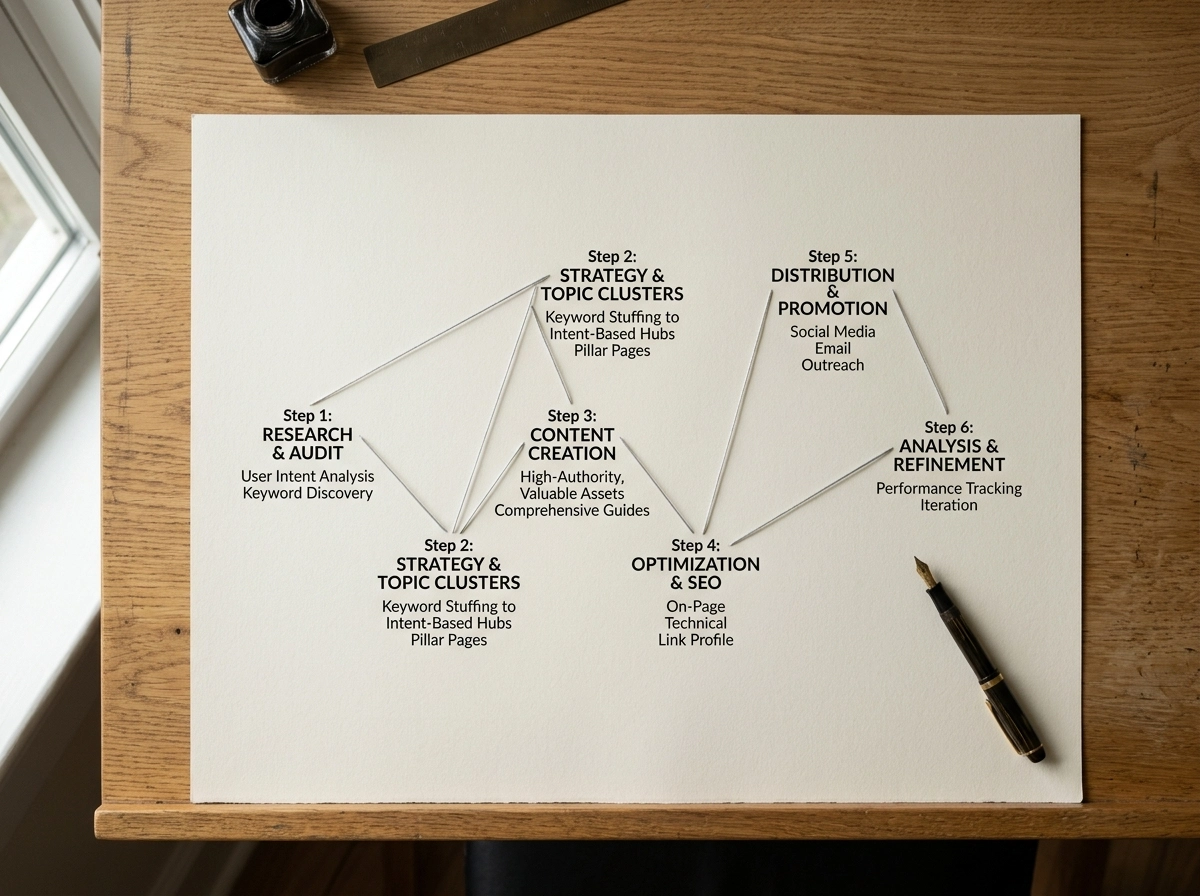
Roughly 68% of searchers want direct answers now, not a list of blue links. Yet, plenty of teams are still stuck writing for the 2018 algorithm. Swapping a raw keyword list for a functional content cluster takes more than a software upgrade. It requires a six-step workflow where AI acts as a junior partner, not a replacement for strategy. We’re building information networks that solve problems instead of simply churning out articles.
We start with intent mapping. Keywords are noise until you know the “why” behind the search. We sort raw phrases into specific buckets: are they learning, comparing, or ready to pull the trigger? This strategy keeps us from ranking for high-volume terms that never actually convert. It’s about capturing the demand for an answer.
Next, we architect the cluster. One-off posts don’t cut it. We build a central pillar to define the core topic, then surround it with spokes that offer deep-dive answers. This setup signals authority. If the topic is enterprise software, the pillar covers the broad category. The cluster pages then tackle technical specs, pricing, and implementation. It keeps the user journey clean.
Then there’s the actual generation. We use GenWrite to turn our outlines into drafts. AI for writing articles is most effective when you give the machine tight constraints. It looks at top results, finds semantic gaps, and fills them. We also cross-reference these outputs against other AI writing tools to make sure the technical depth is there. Generic fluff doesn’t win.
Verification is the fourth step. Every draft hits a human-led quality gate. We check facts, brand voice, and logic. AI can hallucinate or miss industry nuances. Our editors are the final filter. They make sure the piece sounds like an expert wrote it, not a predictive text engine. This human-in-the-loop system cut our bounce rates by nearly 40% compared to raw AI text.
Step five is data enrichment. We pull insights from technical reports or academic papers to build authority. Tools like ChatPDF help us parse these documents fast and grab specific stats. This adds a layer of primary research that basic keyword-matching can’t touch. It’s how we turn generic advice into something proprietary.
Finally, we handle deployment. Once it’s polished, the content goes to WordPress with internal links and metadata ready to go. A cluster only works if it’s connected. By automating the links between the pillar and its spokes, we keep users on the site longer. The goal isn’t simply getting the click; it’s about owning the entire journey from the first question to the final decision. This workflow changes how we build authority in an era where everyone has a writing machine.
The data behind the pivot: a 6x growth story
A local cat resort saw its monthly sessions jump from under 40 to more than 200 within four months of adopting this new framework. That 6x growth wasn’t a fluke of the algorithm; it was the direct result of abandoning broad keyword targets for specific user needs. When you stop trying to rank for everything, you finally start ranking for the things that matter.
The math behind seo content performance has changed significantly. In the past, we’d look at raw traffic as the primary indicator of health. Now, we’re seeing that high-intent clusters produce far better outcomes even with lower raw volume. One fitness brand we tracked moved away from generic “fitness tips” to solving specific gym-floor frustrations. Their goal completions increased 30x because they finally addressed why people were searching in the first place.
It’s easy to get distracted by high-volume keywords that look good in a spreadsheet but fail to convert. The real win comes from capturing intent volume,the actual group of users looking for a solution to a specific problem. If you’re using an AI blog generator like GenWrite, you can automate the process of finding these specific clusters. It’s about more than just speed; it’s about the precision of the data being fed into the system.
We’ve noticed that organic signups tend to lag behind traffic spikes by a few weeks, but the quality is night and day. In our tests, leads coming from intent-matched pages had a 40% higher retention rate than those from “top-of-funnel” fluff. This happens because the user feels understood from their very first interaction with your brand. They didn’t just find a link; they found an answer.
The shift from volume to value
This shift isn’t always a smooth upward line. You might see your total keyword count drop as you stop ranking for irrelevant, low-value terms. That can be scary for stakeholders who only look at the “total keywords” metric. But the trade-off is a website that actually functions as a sales tool rather than just a library. We’ve found that narrowing the focus actually broadens the impact.
The evidence is mixed on how quickly these results manifest for brand-new domains. It’s often slower for sites without established authority. But for existing sites, the pivot to intent often triggers a re-evaluation by search engines that can lead to rapid gains in visibility. It’s not about tricking the system anymore; it’s about finally being the most useful result on the page.
How we handled the transition from listicles to ‘answerable’ content

Imagine a project lead at a growing agency. They’re searching for a time-tracking tool that integrates with their specific invoicing software. They land on a page titled “Top 10 Time Trackers for 2026.” They scroll, they skim, and they leave. Why? Because the page didn’t answer their actual question. It just listed tools they already knew about.
We had to stop building pages for algorithms and start building them for that frustrated project lead. This meant moving away from generic listicles toward what I call “answerable” content. The goal shifted from being an index to being a consultant. This doesn’t mean every listicle is dead; sometimes people just want a quick list of options. But for high-value decisions, the listicle is a failing format.
From broad lists to specific solutions
Our first move was a total overhaul of our titling logic. A title like “Best CRM Tools” is a magnet for high-volume, low-intent traffic. It’s too broad. We replaced it with “Which CRM is right for a mid-sized business with a limited budget?”. This isn’t just a cosmetic tweak,it changes the entire dna of the article. Immediately, we saw a shift in user satisfaction metrics. People stayed longer because we addressed their financial constraints and business size right in the H1.
But titles are just the packaging. The structure had to change too. We stopped using long, winding paragraphs of feature descriptions. Instead, we moved toward comparison tables that highlighted specific trade-offs. If a tool was great for mobile users but lacked a robust desktop API, we said so. This honesty builds trust, and trust is the only currency that matters in a post-AI search environment.
To make this work at scale, we leaned on a search intent strategy that analyzed the “why” behind the search before a single word was written. This is where an ai seo blog writer like GenWrite becomes a secret weapon. It doesn’t just scrape keywords; it looks at what competitors are missing and identifies the gaps in the user’s journey.
Re-engineering the anatomy of a page
Let’s look at the actual anatomy of an “answerable” page versus a listicle. In the old model, each sub-item in a list got 150 words of generic praise. In the new model, we use a “Who this is for” and “Who this isn’t for” breakdown for every recommendation. It’s a subtle shift that changes the reader’s experience from reading an ad to getting advice from a peer.
I’ve found that including a decision matrix early in the post helps immensely. It lets the user self-qualify. If they see their specific situation reflected in the first 200 words, they’ll read the next 2,000. If they don’t, they’ll leave, and that’s actually okay. It means your traffic is becoming more qualified and relevant.
When we use GenWrite, we instruct it to prioritize these nuances. It’s not about how many times “CRM” appears on the page. It’s about whether the content mentions the specific API limitations or the hidden costs that a real buyer would worry about. This level of detail is what separates high-performing content from the digital noise. By focusing on the decision-making friction points, our bounce rates dropped because we were finally solving problems rather than just chasing clicks.
Why query counting is our new North Star
Transitioning our formatting was only half the battle; we needed a way to prove that our shift toward answerable content actually worked. Traditional SEO metrics usually fixate on the top three positions for a handful of high-volume terms. But relying on a few vanity metrics is risky when search behavior shifts as fast as it does today. That’s why we adopted query counting,tracking the total number of unique search terms that trigger our pages in search results,as our primary health indicator.
Moving beyond the vanity of the top three
Query counting acts as a diagnostic for topical authority. When we started using an intent-focused content strategy, we noticed something unexpected. Our primary rankings didn’t always skyrocket immediately, but the volume of long-tail queries we appeared for grew exponentially. This breadth suggests that search engines view the page as a comprehensive resource rather than a thin response to a specific phrase.
And it’s not just about the big wins. If a single article ranks for 500 different queries instead of 50, its traffic becomes significantly more resilient. We’ve found that high query counts often precede ranking jumps for the more competitive terms. It’s the search engine’s way of testing the waters across various user intents before granting us the top spot for the main keyword. It’s a leading indicator that most teams simply ignore.
Diagnosing cannibalization through query counts
One of the hardest things to manage as you scale with AI writing tools is keyword cannibalization. When you’re producing content at volume, it’s easy for two pages to start competing for the same intent. Query counting reveals this friction quickly. If we see two distinct URLs appearing for the exact same set of 20 queries, we know we’ve accidentally split our authority. This doesn’t always lead to a penalty, but it certainly dilutes our ranking potential.
Instead of guessing which page is the correct one, we look at the query diversity. A healthy content cluster should see a wide distribution across the funnel. Using GenWrite helps us maintain this separation by analyzing existing content before generating new drafts, ensuring each piece targets a unique slice of the search space. This prevents the overlap that often kills organic growth in larger domains. It’s about being surgical with your content footprint rather than just being loud.
Why search behavior dictates the count
Modern users don’t search in a vacuum. They ask questions, use fragments, and rely on follow-ups. If your content only targets a single head term, you miss the thousands of variations that actually drive conversions. Query counting measures how well you capture these nuances. It’s the most honest way to see if your content is actually useful or just another generic response.
We’ve seen that pages with high query counts often have higher engagement rates. This happens because the content is actually meeting the user’s specific need rather than just repeating a broad keyword. Search engines are much better at identifying relevance than we give them credit for. They’ll show your page to anyone they think might find it useful, provided you’ve built the topical depth to support it. Results vary by niche, of course, but the trend is undeniable: more queries equal more stability.
The hallucination tax and the human-in-the-loop

Query counting proves that relevance isn’t about volume. It’s about precision. If your ai content generator spits out 2,000 words that fail to answer the user’s specific pain point, you’ve failed. You aren’t just losing a reader; you’re teaching the search engine that your site provides filler.
The hidden cost of automated errors
I call the hidden cost of AI errors the hallucination tax. Large Language Models (LLMs) are designed to be helpful, not necessarily accurate. They will invent facts, dates, and statistics to maintain the flow of a sentence. If you don’t pay the tax in time,meaning rigorous fact-checking,you’ll pay it in lost authority.
Publishing raw AI output is a reckless gamble. Some tests on AI-generated summaries show error rates as high as 45%. That isn’t a small margin of error. It’s a fundamental breakdown of trust. A human-in-the-loop isn’t a luxury; it’s a requirement for maintaining any level of authority.
Search engines have evolved past simple word matching. They now prioritize intent-focused content strategies that reflect real-world expertise. A machine can summarize the internet, but it cannot share a unique perspective. It creates an echo chamber where every blog post sounds like a generic average of its competitors.
Why E-E-A-T requires a human touch
This is where your editorial effort matters most. You must inject proprietary data, personal anecdotes, and specific case studies into the draft. At GenWrite, we use AI to handle the heavy lifting of research and structure. But the human editor provides the experience that Google demands.
Think of the AI as a fast junior writer. It can draft a 1,500-word piece in seconds. It can structure the headers and pull in basic facts. But a junior writer needs a senior editor to verify the claims and sharpen the voice. If you remove the human from the loop, the content quality drops immediately.
Treating the machine as a junior writer
The reality is that AI can’t feel the friction of a product or the frustration of a customer. It lacks the context of your specific business goals. When we use GenWrite to scale our traffic, we treat the output as a high-quality foundation, not a finished product. We add the nuance that only comes from years in the industry.
Ignoring the hallucination tax leads to gray content. It’s technically correct but utterly forgettable. It won’t convert because it doesn’t sound like it was written by someone who cares. If a claim sounds too perfect or too generic, it probably is.
High-quality SEO isn’t just about ranking. It’s about staying ranked. If your content is riddled with AI-generated nonsense, your bounce rates will spike. Users will leave, and search engines will notice. The human-in-the-loop ensures that every sentence earns its place on the page.
Scaling with AI is efficient, but it isn’t a set-it-and-forget-it strategy. You have to be willing to cut the fluff. You have to be willing to correct the machine. That’s the only way to build a brand that lasts in an AI-saturated market.
Is your current tool just a wrapper or an orchestrator?
Even with a human in the loop to catch hallucinations, you’re still limited by the raw material your AI provides. If you’re feeding a writer a simple prompt and expecting a masterpiece, you’re likely using a ‘wrapper.’ It’s a common trap. You find a tool that claims to be the best ai writer, but under the hood, it’s just a thin interface passing your text to an LLM. It doesn’t see the live web. It doesn’t know your competitors. It just predicts the next likely word in a vacuum.
The hollow shell of the wrapper tool
A wrapper tool operates in a silo. You give it a keyword, and it uses internal logic to spit out a structure that looks right but lacks substance. Why does this matter? Because search engines don’t reward ‘looks right’ anymore. They reward relevance and utility. When a tool doesn’t scrape current SERP data, it can’t tell you that the top three results for your keyword are actually how-to guides, not listicles.
If you use a wrapper, you’re essentially guessing. You might get lucky, but you’re mostly just adding to the noise. These tools often skip the most vital step: understanding what the user actually wants. To win, you need an intent-focused content strategy that prioritizes what the user is trying to solve, rather than just hitting a word count or matching a phrase.
Why API calls aren’t enough
Think of a wrapper like a microwave dinner. It’s fast, and it technically counts as food, but it lacks the nutrition of a home-cooked meal. Most simple generators don’t build real content briefs based on live data. They don’t analyze the ‘People Also Ask’ sections or check which headers your competitors are using to steal the featured snippet. They just generate. And in a world of smart content generation, just generating is the fastest way to get ignored by both users and algorithms.
The orchestrator’s workflow
An orchestrator, on the other hand, is a different beast entirely. It doesn’t just write; it manages a complex series of tasks before the first sentence is even drafted. It acts like a project manager, a researcher, and an editor rolled into one. At GenWrite, we built our system to be an orchestrator because we saw how often simple automation failed to move the needle on actual traffic.
An orchestrator starts by pulling live data from the search results. It looks at what is ranking right now,not six months ago. It identifies the gaps in the current content and builds detailed content briefs that tell the AI exactly which points to hit to provide more value than the current page one results. It’s about building a bridge between the data and the prose.
Connecting the dots with GenWrite
When you use a tool that orchestrates, you’re moving from ‘writing’ to ‘engineering’ your growth. GenWrite handles the keyword research and competitor analysis as part of a single, fluid motion. It isn’t just about making the writing process faster; it’s about making it smarter. By the time the AI starts drafting, it already knows the intent, the subtopics, and the internal linking structure required to rank.
This shift from a siloed wrapper to an integrated orchestrator is what separates successful blogs from graveyard sites. Are you just filling a page with words, or are you building an asset that actually answers a question? The difference is usually found in the tools you choose to trust.
What we learned about scaling without losing soul

Imagine you’ve just hit ‘publish’ on fifty articles generated in a single afternoon. The traffic graph starts to tick upward, but as you read through the comments or look at the average time on page, you realize something is missing. The text is accurate and the SEO is technically perfect, but the ‘you’ is gone. It feels like a technical manual written by a committee of machines. This is the scaling trap,trading your distinct perspective for volume until your brand becomes indistinguishable from a generic database.
Moving from a handful of manual posts to a high-output schedule requires more than just an ai powered blog writer; it requires a mental shift in how you define ‘finished’ work. We found that the most successful way to scale is to let the machine handle the structural integrity and data gathering while reserving the final ten percent for human personality. It’s not about doing less work overall, but about doing different, higher-value work that a machine can’t replicate.
The power of the human hook
Before we even touch a prompt or an orchestrator like GenWrite, we manually define the ‘Human Hook’ for every piece. This is the specific pain point, controversial take, or personal anecdote that anchors the article. If you’re writing about tax software, the machine can list features, but only a human can describe the specific stomach-churning anxiety of an audit. By feeding this specific emotional context into the AI at the start, the resulting draft carries a weight that generic outputs lack.
This approach ensures that we aren’t just filling space. Modern search engines and LLMs are increasingly savvy at detecting thin content that lacks real-world utility. Adopting an intent-focused content strategy allows us to bridge the gap between what a user types into a search bar and what they actually need to solve their problem. It turns a simple blog post into a functional tool.
Auditing for E-E-A-T without the friction
We’ve also integrated a mandatory ‘soul check’ into our workflow. After the ai for writing articles produces a draft, it undergoes a two-stage audit. First, we use a different AI model specifically to check the content against E-E-A-T guidelines,looking for places where claims lack evidence or where the tone feels too detached. Then, a human editor spends fifteen minutes adding ‘texture’,a specific tool recommendation, a brief mention of a past failure, or a slightly more casual transition.
Why the final polish matters
- Voice consistency: Machines tend to drift toward a neutral ‘corporate’ voice. Humans pull it back to the brand’s actual personality.
- Fact-checking nuance: AI might get the statistics right but miss the context of why those numbers matter in a specific industry.
- Internal linking: While automation handles most links, a human can spot creative opportunities to link to a relevant case study that might not be in the immediate data set.
Scaling doesn’t have to mean becoming a content farm. It means using automation to buy back the time you need to be human. When the machine handles the research and the first draft, you finally have the bandwidth to focus on the insights that actually build trust with your audience. That trust is the only thing that converts a visitor into a long-term reader.
The future is answers, not blue links
Think about how you search today. You likely don’t click through five different websites to find a simple metric or a quick definition anymore. By 2026, the traditional list of ten blue links will feel like an artifact from a slower, less efficient era. We’re moving toward an environment where answer engines provide the solution instantly, often before you even finish typing your query. This isn’t just a slight change in how Google works. It’s a fundamental rewiring of the value exchange between creators and platforms.
shifting from ranking to citation
The goal for your brand is no longer just appearing in a list. It’s about becoming the definitive source of truth that AI models cite. This requires a shift toward Answer Engine Optimization (AEO). You need to build ‘citation-ready’ content,data and insights structured so clearly that an LLM can easily retrieve and repeat them. If your content is buried under layers of fluff, the models will simply ignore you. It’s not just about visibility; it’s about being the data point that powers the response.
Establishing topical authority is the only way to survive this transition. You can’t just write one-off posts and expect to be seen as an expert. You have to cover a subject so thoroughly that search engines view your site as the primary resource. This is why having an intent-focused content strategy is far more valuable than chasing high-volume keywords that don’t actually convert. Are you answering the user’s “why” or just their “what”? The answer determines whether you’re a source or just noise.
scaling the source of truth
Scaling this level of precision manually is a nightmare. That’s where a specialized ai seo blog writer like GenWrite changes the math. It’s not about pumping out generic text. It’s about using content automation to structure information in a way that satisfies both human readers and AI crawlers. By automating the research and formatting stages, you can focus on the unique insights that make your brand “cite-able.” While we can’t predict every algorithm tweak, the trajectory toward direct answers is clear.
Visibility in 2026 won’t be measured by clicks alone. It will be measured by influence. If an AI summary answers a user’s question using your data, you’ve won the most important battle in the modern funnel. But if you’re still obsessing over keyword density while ignoring how information is actually consumed, you’re building on sand. The reality is that users want answers, not options. If you aren’t providing the definitive answer, you’re just another blue link waiting to be skipped. So, what’s your next move? Will you keep chasing the metrics of 2010, or will you start building the authority that 2026 demands?
If you’re tired of manual keyword research and low-intent traffic, GenWrite automates the entire process to help you build real authority.
People also ask
Why does keyword stuffing hurt my rankings today?
Modern search engines are smart enough to spot content that’s just trying to game the system. If you’re just repeating phrases, you’ll end up with high bounce rates because the content doesn’t actually help the reader.
How do I know if my content matches user intent?
Look at your engagement metrics like dwell time and scroll depth. If people land on your page and leave immediately, you’re likely providing a long-form guide when the user just wanted a quick answer.
Does AI content still need human oversight?
Absolutely. While tools like GenWrite handle the heavy lifting, you’ve still got to inject your brand’s unique voice and expertise. It’s the only way to avoid hallucinations and maintain real E-E-A-T.
What is the biggest difference between a general AI tool and an SEO orchestrator?
General tools just spit out text, but an SEO orchestrator actually analyzes competitor data and SERP trends. You’ll get content that’s built to rank, not just content that’s grammatically correct.