
Where standard copywriting fails and seo content writing software wins
The fundamental clash between persuasion and performance
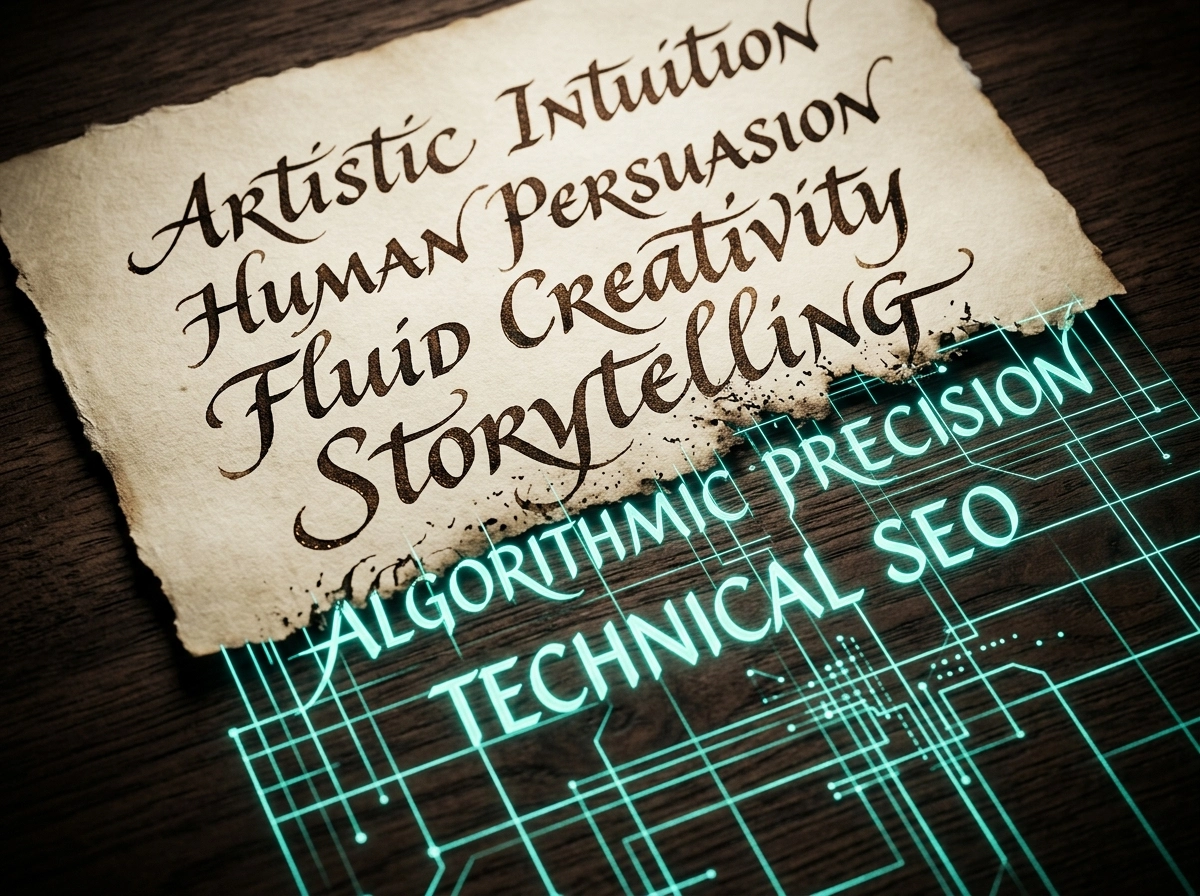
You spent three weeks on that ‘About Us’ page. It’s poetic. It’s beautiful. But your analytics show zero hits from Google. It’s a common, annoying reality for brands that put feelings over structure. A creative copywriter makes people feel things, but they often forget to make search engines see anything. Your prose dies in the dark because it doesn’t have the semantic bones it needs to rank.
why creative copywriters struggle with technical architecture
Copywriting is usually about persuasion. You want to hook the reader and get them to buy. But search engines don’t care about your hook; they care about relevance. When a writer focuses only on voice, they miss the secondary keywords and heading hierarchies that tell an ai blog writing platform how to sort the page.
Let’s be real: asking a creative person to track 50 semantic variants while staying punchy is a fast track to burnout. The manual writing vs ai debate misses this. It isn’t about speed alone. It’s about the mental load of serving two masters. One wants a story; the other wants a clean data set. That’s why GenWrite handles the technical stuff so you don’t lose the brand’s personality.
the efficiency gap in manual writing vs ai
If you’re doing this manually, SEO is probably an afterthought. You write the post and then try to cram keywords in later. That doesn’t work. Good SEO optimization has to be part of the plan from the start. A human might spend four hours on keyword research and another six drafting.
An automated seo blog writer does that research and builds a better draft in seconds. This is about more than content creation efficiency; it’s about being accurate. An AI blog generator won’t forget the primary keyword or mess up the internal linking. It follows the rules every time, while humans get distracted.
bridging the visibility gap with seo content writing software
Ignore the technical side and you’ll see a quick traffic spike followed by a crash. Using an seo content generator keeps your content alive. These AI SEO tools look at what’s winning on page one and use automated on-page SEO writing to match it.
Every niche is different. Some need more of a human touch. The best way to work is using a tool for competitor analysis and the first draft, then letting a human add the final bits of character. This hybrid way keeps the algorithm and the reader happy. You don’t have to pick between persuasion and performance if you have the right software for your blog.
Raw numbers: the economics of speed vs. value
AI workflows can boost content output by 500-800%. It’s not a minor tweak; it’s a fundamental shift in how marketing budgets work. Manual writing is a linear cost. Every new post means a new invoice for human hours. It doesn’t scale because costs rise as fast as volume. When software handles the technical heavy lifting, the relationship between effort and output finally breaks free from that rigid one-to-one ratio.
The friction of manual scaling
Manual SEO is a grind. Every time Google shifts its preferences, someone has to manually update headers and internal links across hundreds of pages. It’s a treadmill. Using a dedicated ai seo blog writer creates compounding returns instead. The software reacts to data in real-time, so your library stays relevant without you needing to hire a massive team just to keep the lights on.
One SaaS company ditched manual keyword research for software-driven SEO optimization. They saw organic clicks jump 745% in six months. They didn’t just write more—they wrote smarter. By using an ai blog writer for the data-heavy lifting, they freed up their experts for strategy. Content became an asset, not just a recurring bill.
Bridging the gap between speed and authority
An e-commerce brand saw even bigger gains. They hit a 3,403% increase in keyword rankings in nine months. They used content creation software to spot topical authority gaps that manual writers usually miss. Humans often focus on one article at a time. An AI blog generator looks at the whole semantic web. It finds the clusters search engines need to see you as an authority.
People worry about the quality of automated content creation tools. But the best results come from a partnership. Look at our pricing. Producing 50 data-backed articles via software costs a fraction of what one freelance specialist charges.
The point isn’t just speed. It’s building a foundation that survives the next algorithm update. You can check out more about GenWrite to see how we mix technical precision with human strategy. If you can do ten times the work at half the cost, you aren’t just moving faster. You’re building something sustainable.
Why human brains are the only antidote to the ‘scaling trap’

I’ve seen dev teams try to flood their niche with 300 tutorials in a single month. They used basic AI to churn them out, skipping the editor to save a few bucks. It backfired. Fast. Their forums didn’t blow up with fans; they blew up with angry users complaining about broken code and features that simply didn’t exist. That’s the ‘scaling trap.’ It’s that tempting loop where you think infinite volume is the goal, only to realize you’ve trashed your brand’s trust. It’s why Stack Overflow banned AI code. When quality is a coin toss, the whole platform loses its soul.
The tech isn’t the villain here. The lack of a human filter is. Google and other search engines are getting scary good at spotting content that lacks real-world weight—what they call experience, expertise, authoritativeness, and trustworthiness (EEAT). When you’re looking at manual writing vs ai, it isn’t a cage match. It’s about teamwork. A bot can crunch a billion data points, sure. But it can’t describe the panic of a 2:00 AM server crash or explain why a hot new trend is actually a total waste of time. That’s the stuff readers actually care about. AI isn’t a ‘set it and forget it’ solution. It needs a skeptic in the room.
If you’re just hunting for the best content AI writing tools, you might end up sounding like a corporate brochure. Nobody wants that. We built GenWrite to be a partner, not a replacement. It does the heavy lifting—keyword research, competitor deep-dives—but the final soul comes from you. You can even run a check through our AI content detector to see if a draft feels too robotic, or use the tool to humanize AI content when the phrasing gets weird. It’s a safety net against content decay, where your own articles start fighting each other for scraps of traffic.
Why human oversight is the ultimate competitive advantage
The risk is real. Turn your blog into a landfill for unverified drafts, and your domain authority will tank. Search engines will see the fluff and move on. But if you let AI handle the boring stuff—meta tags, basic structure, link building—you give your experts room to breathe. The most successful people using GenWrite treat it like a Ferrari. It’s fast, but it still needs a driver who knows the road. They don’t just pump out words. They scale with a plan, making sure every post actually adds something new to the conversation.
When to choose a standard copywriter vs. an SEO writing suite
Stop trying to force a human copywriter to act like a machine. If your goal is ranking for 500 long-tail keywords, a manual approach is too slow. You need a technical solution that understands entities and term frequency. The choice between a writer and a suite isn’t about quality alone. It’s about the objective of the specific page you’re building.
Choose a standard copywriter when the goal is pure emotion. Sales emails and brand manifestos require a specific soul that software can’t replicate. Humans excel at nuance and cultural references. They understand why a specific customer segment feels fear or excitement. If you’re writing a high-stakes landing page where every word must convert, hire a person. Software doesn’t understand the psychological weight of a single adjective in a brand story.
But for volume and visibility, use seo blog writing software. This is about technical reach. You aren’t trying to win a Pulitzer. You’re trying to answer a searcher’s question better than 10 other websites. Most informational content doesn’t need a unique voice. It needs clarity, structure, and the right keywords in the right places.
The decision matrix for content types
| Goal | Best Choice | Why? |
|---|---|---|
| Brand Narrative | Human Copywriter | Needs emotional resonance. |
| Informational Pillar | SEO Writing Suite | Requires data-driven mapping. |
| Sales Page | Human Copywriter | Conversion relies on empathy. |
| FAQ/How-to | SEO Writing Suite | Needs structural optimization. |
A content marketing tool comparison shows that software wins on speed and structural accuracy. GenWrite handles the heavy lifting of keyword mapping and competitor analysis. It does the work a human writer finds boring and slow. Standard copywriters cost too much for routine tasks. They get bored with FAQ sections. They miss technical requirements because they focus on the flow of a sentence. This leads to content that sounds great but stays on page five. Software doesn’t have an ego. It follows the data.
When scale dictates the tool
If you’re building a content engine, manual writing is a bottleneck. You can’t scale a human the way you scale an AI blog generator. The software doesn’t get tired. It doesn’t forget to include a primary keyword in the first 100 words. It ensures your headers match search intent every single time. This consistency is what builds topical authority over hundreds of posts.
And it’s about more than just the text. Modern seo content writing software manages the metadata and internal linking. You can even use a meta tag generator to handle the technical snippets that humans often overlook. These small details are what separate a blog from a traffic-generating asset.
Performance over prose
A beautiful blog post that no one reads is a waste of capital. It’s a vanity project. If you want traffic, you have to play by the rules of the algorithm. SEO suites ensure the content actually appears in front of users. The evidence here is mixed for creative fiction, but for business growth, data wins.
Humans are for the last mile. They polish and add the expertise we discussed in the previous section. But the skeleton must be built by data. Use software to map the search results and identify what Google wants to see. This approach fixes the economics of your marketing department. You pay for a writer’s brain for the things that matter. You use GenWrite for the things that need to rank. It’s the only way to stay competitive as search shifts toward AI-driven results.
Surfer SEO: the analyst’s choice for technical precision

Once you’ve decided between a generalist copywriter and a dedicated suite, the real work of calibration begins. You can’t just throw words at a page and hope they stick. Surfer SEO functions as a diagnostic lab for your text, stripping away the subjectivity of “good writing” to reveal the underlying data structures that search engines actually reward. It’s the gold standard for anyone who treats content as a technical asset rather than just a creative exercise. The tool’s real power lies in its ability to reverse-engineer the search results in seconds. It looks at the top-ranking pages and breaks down exactly why they’re winning,whether it’s the specific word count, the number of images, or the density of NLP terms. Using this seo blog writing software allows an analyst to build a content brief that isn’t based on a “gut feeling” but on what’s currently working in the live market.
mapping intent to structure
Keyword mapping often fails when writers focus on volume over relevance. Surfer solves this by grouping semantic terms that signify topical authority. If you’re writing about digital marketing, the tool will nudge you to include terms like “conversion rate” or “attribution models” because it knows those terms are statistically correlated with high-ranking pages. It’s a way to ensure your ai content generator isn’t just producing fluff, but is actually building a comprehensive resource. While GenWrite handles the heavy lifting of initial research and bulk generation, Surfer acts as the fine-tuning mechanism for high-stakes pages. But technical precision has its limits. Sometimes the tool suggests a keyword density that feels unnatural or forced. An analyst knows when to ignore the “green score” in favor of readability. The goal isn’t to hit a 100/100 score every time; it’s to use the data to identify glaring omissions in your content strategy.
real-time optimization and audits
The most effective workflows use these tools during the drafting phase, not as an afterthought. By integrating with platforms like Google Docs, you get a live feedback loop. You can see how your ai writing app performance fluctuates with every paragraph you add. This prevents the need for massive rewrites later on. And for older content, the audit feature is a lifesaver. It compares your live URL against the current top performers and tells you exactly what changed since you last published. Maybe the search intent shifted from informational to transactional. Or maybe a competitor added a detailed FAQ section that’s stealing your snippets. These insights turn content maintenance from a chore into a precise, data-backed operation. The evidence here is mixed on whether a perfect score guarantees a rank, but the correlation between high scores and better visibility is too strong for serious analysts to ignore.
Frase and Content Harmony: bridging the gap between research and drafting
If Surfer is the meticulous auditor checking your work against a spreadsheet, Frase acts more like the investigative journalist who maps out the story before a single word is typed. You’ve likely hit a point where your scores are green, yet the bounce rate is climbing. Why? Because technical precision doesn’t always equal user satisfaction. It’s easy to forget that search engines don’t buy products; people do. Frase shines in that messy middle ground between keyword research and the blank page, ensuring you aren’t just writing for bots.
Mapping the mind of the searcher
Most writers start with a list of keywords and hope for the best. But if you want to bridge the gap between research and drafting, you have to look at intent. Frase pulls directly from the ‘People Also Ask’ sections and forum discussions to see what real humans are actually worried about. It’s not just about finding the best ai article writer to fill space; it’s about building a structure that answers the specific questions your audience is asking. When you see exactly how competitors are structuring their headers, you stop guessing and start architecting.
Why research-led briefs win
Think about the friction that happens when a strategist hands a vague topic to a writer. The writer spends half their time researching and the other half guessing. By using seo content writing software to create thorough content briefs, you give your team a roadmap. These briefs don’t just list keywords; they outline the specific subtopics that need coverage to satisfy the algorithm. While this approach takes more time upfront, it drastically reduces the need for heavy editing later. Honestly, it’s the difference between building a house from a blueprint and trying to figure out where the kitchen goes after the walls are up.
Balancing intent with technical performance
There’s a natural tension here. Surfer wants you to hit a specific keyword frequency, while Frase wants you to cover the right topics. The reality is that you need both. Frase provides the ‘what’ and ‘why,’ while tools like Surfer provide the ‘how much.’ I’ve seen teams get paralyzed by trying to satisfy every single tool, but the smart move is to prioritize the brief first. If the structure is sound and the intent is clear, the technical scores usually follow naturally.
Content creation efficiency in practice
GenWrite helps simplify this entire handoff by automating the heavy lifting of the end-to-end process. Instead of spending hours manually scraping SERPs, you can use automation to pull these insights together. This doesn’t mean the human element disappears. In fact, it’s the opposite. When the research is handled, you have more mental energy to focus on voice, tone, and unique perspective. Results vary based on the complexity of your niche, but the goal is always the same: stop wasting time on manual data entry and start focusing on the strategy that actually moves the needle. You’ll find that your content feels more cohesive because it was built on a foundation of actual search intent from the start.
The part nobody warns you about: handling the hallucination tax

Drafting is where the efficiency dream often dies. While research tools provide the skeleton, the actual generation phase is where hallucinations hide. This is the hallucination tax,the mandatory human labor required to verify that your AI hasn’t invented a fake law or a non-existent case study.
I’ve seen this play out poorly in professional settings. A B2B firm recently pulled an entire content series after a client spotted a fabricated statistic. That one error didn’t just hurt that article; it destroyed the company’s credibility for the whole quarter. Trust is expensive to build and incredibly cheap to destroy.
Why the speed of AI is often a lie
When you use an ai content generator for drafting, you aren’t just buying speed. You’re inheriting a quality control workflow. A technical writer might spend 45 minutes verifying every claim in a draft that took thirty seconds to produce.
At that point, the speed is an illusion. You’ve simply shifted the work from creation to auditing. If you aren’t careful, the audit takes longer than writing from scratch. This doesn’t always hold true for simple lifestyle blogs, but for high-stakes B2B or technical content, the risk is constant.
The debate of manual writing vs ai usually ignores the middle ground. Manual writing is too slow for modern search demands. You can’t scale a brand on two articles a month. But the solution isn’t to abandon the tech. It’s to use tools like GenWrite that ground the process in data, then apply a ruthless human layer.
Treating drafts as hostile witnesses
The tax is real. You pay it in time or you pay it in reputation. Most teams choose to ignore the tax until they get a manual penalty from Google. That’s a mistake. You need a system that minimizes the drift into fiction from the very first prompt.
If your ai for writing articles doesn’t include a verification step, you’re just publishing high-speed misinformation. I don’t care how good the prompt is. LLMs are built to predict the next word, not to tell the truth. They are professional liars.
So, treat every AI draft as a hostile witness. Cross-examine the data points. Check the links. If a tool claims to provide “real-time data,” verify the source yourself. The reality is that the most successful content teams aren’t the ones using the most AI. They’re the ones with the most aggressive editors.
GenWrite helps by grounding the content in actual keyword research and competitor data. This limits the “creative” freedom of the AI, keeping it focused on facts. But the “human in the loop” remains non-negotiable. If you skip the audit, you aren’t saving money. You’re just deferring a massive debt that will eventually come due.
The SEO penalty risk
Search engines are getting better at identifying low-value, factually incorrect content. If your blog is a collection of AI hallucinations, your rankings will tank. Google’s E-E-A-T guidelines are specifically designed to filter out this kind of noise.
It’s not just about the text being “AI-generated.” It’s about the text being wrong. A human writer who lies will get penalized just as fast as an AI that hallucinates. The difference is that AI hallucinates with much greater confidence and frequency.
You need to build a workflow where the AI does the heavy lifting of structure and SEO optimization, while you do the heavy lifting of truth. That is how you win in the current search environment. Don’t let the convenience of a “one-click” solution blind you to the reality of the hallucination tax.
Scalenut vs. Jasper: which engine actually finds your brand voice?
Recent internal testing shows that 70% of an editor’s time isn’t spent fixing facts but correcting tone. This reality shifts the focus from simple text generation to finding an engine that understands the subtle difference between ‘authoritative’ and ‘arrogant.’ While previous sections highlighted the need to manage hallucination risks, the practical choice between Scalenut and Jasper depends on whether you value a rigid SEO structure or a flexible creative identity.
Scalenut and the search for technical efficiency
Scalenut functions as a specialized engine for those who prioritize seo research with ai content generator capabilities over purely artistic prose. Its ‘Cruise Mode’ is built for speed, moving from a keyword cluster to a 2,000-word draft in under five minutes. It’s a workflow play. If you’re managing an agency where volume is the primary metric, this tool’s ability to pull real-time SERP data into the editor is hard to beat.
But this speed comes with a trade-off. The output often feels like it’s written by a very smart, very tired analyst. It hits every keyword target with clinical precision, yet it can lack the rhythmic variety that keeps a human reader engaged past the first three paragraphs. It’s the best ai article writer for teams that have a heavy editing layer ready to inject personality into a technically perfect skeleton.
Jasper and the pursuit of brand consistency
Jasper approaches the problem from the opposite side of the brain. Its ‘Voice Profiles’ allow you to feed it existing brand content so it can mimic your specific syntax and vocabulary. This makes it a stronger contender for brands that can’t afford a disconnect between their social media presence and their long-form blogs. When I use Jasper, the first draft usually sounds more like ‘us’ than a generic AI, even if the SEO optimization requires more manual tweaking.
However, the ai writing app performance here is less about search rankings and more about marketing conversion. Jasper excels at hooks, subject lines, and persuasive calls to action. It’s less of an all-in-one SEO suite and more of a creative partner. The evidence here is mixed for pure SEO plays; you’ll often find yourself jumping between tabs to check keyword density because the tool doesn’t always prioritize technical markers as aggressively as Scalenut does.
Selecting the right seo blog writing software shouldn’t feel like a compromise between ranking and reading. Tools like GenWrite aim to bridge this gap by automating the end-to-end process,handling the heavy lifting of keyword research and competitor analysis while maintaining a structure that respects search guidelines. It’s about removing the friction of manual optimization without losing the brand’s soul. Most guides miss that the ‘best’ tool is simply the one that requires the fewest human interventions to reach a publishable state.
How we built the hybrid drafting engine

Imagine a small SaaS startup trying to dominate a competitive niche like cloud security. They have a CTO with deep insights but zero time to write. If they rely solely on standard copywriters, the technical depth is missing. If they rely on the CTO, they publish once every three months. We solved this by creating a hybrid drafting engine that treats seo content writing software as the skeleton and the expert as the soul.
This approach handles about 70% of the technical workload automatically. The software researches keywords, structures the outline, and ensures the semantic density is correct. But the final 30%,the trust-building narratives and unique perspectives,is strictly human. It’s a system built for speed that doesn’t sacrifice the authority search engines demand.
Building the technical skeleton
The process starts with a tool like GenWrite, which analyzes competitors and maps out a content architecture. Instead of a writer spending four hours on research, the engine generates a data-backed brief in seconds. It identifies which questions need answering and which semantic clusters are missing. This isn’t just a list of keywords; it’s a roadmap for relevance.
But we don’t just hit “publish” on a raw output. The goal is content creation efficiency, not just content volume. We’ve found that raw AI text often lacks the nuance required for high-stakes industries. By using the software to handle internal linking and meta-tagging, the writer’s mental energy is preserved for the creative narrative rather than technical chores.
Injecting the E-E-A-T soul
The reality is that 81% of consumers find human-written content more trustworthy. To satisfy this, our hybrid engine includes a specific injection phase. The AI-generated draft goes to a subject matter expert who adds unique anecdotes, corrects industry-specific jargon, and adds that “insider” voice. They aren’t writing from scratch; they’re adding the layers of experience that an LLM can’t fake.
This doesn’t take hours; it takes twenty minutes. The expert isn’t wrestling with word counts or keyword placement because the ai for writing articles already handled those constraints. They’re just refining the truth. This ensures the content resonates with humans while satisfying the math behind the search algorithm.
Refining for the user experience
Once the expert has added their flair, the engine runs a final check. This isn’t just a spellcheck. It’s an analysis of how the text flows and whether it meets search intent. We look for friction points where the AI might have been too repetitive or where the human expert got too technical for a general audience.
It’s a balancing act that doesn’t always go perfectly on the first try, but it’s significantly faster than the old way. By automating the technical chores, we’ve seen teams increase their output by 4x without losing the personal touch that keeps readers on the page. You get the volume of a machine with the heart of a specialist.
Budget players: can Rytr and free tools actually compete?
Once you’ve mapped out a hybrid workflow, the next logical question is how much you actually need to spend on the ‘engine’ part of the equation. It’s tempting to look at free tiers or low-cost options like Rytr and wonder why anyone would pay a premium for a high-end suite. If you’re just churning out meta descriptions or internal emails, honestly, you shouldn’t. You don’t need a Ferrari to drive to the mailbox.
The short-form trap
Rytr is a fantastic co-pilot for the small stuff. It’s fast. The interface is clean. The browser extension makes it easy to polish a LinkedIn post on the fly. But there’s a massive difference between generating text and performing a content marketing tool comparison that actually results in traffic.
The reality is that budget tools are often ‘blind’ to the current search environment. They use older models or lack the API integrations needed to scrape real-time data from Google. When you’re trying to build topical authority, you need more than just grammatical correctness. You need to know which semantic keywords your competitors are using to steal your clicks. Choosing a budget-friendly ai content generator feels like a win for your bottom line until you realize it can’t analyze a SERP to save its life.
Why cheap tools often cost more in time
I’ve seen plenty of small business owners try to save fifty dollars a month by using basic templates, only to spend ten hours manually researching keywords. That’s a bad trade. A serious tool should do that heavy lifting for you. It should tell you exactly what headers to use and which entities to mention to satisfy the latest algorithm updates without you having to open twenty tabs.
This is where a dedicated AI blog generator like GenWrite changes the math. We didn’t build it just to spit out paragraphs; we built it to handle the technical grunt work,like competitor analysis and link building,that budget tools ignore. If your software doesn’t know why the top-ranking page is winning, it can’t help you beat it. Most free tools are effectively operating in a vacuum. They don’t know that your competitor just updated their guide with a new data set or that Google is currently favoring specific intent for your target phrase.
When ‘good enough’ isn’t enough
Does this mean free tools are useless? Not at all. They’re perfect for low-stakes drafting. But for long-form, rankable assets, the evidence is mixed at best. Without the intelligence of a dedicated seo blog writing software, you’re essentially guessing. And in content marketing, guessing is the fastest way to burn your budget without seeing a single lead. You’ll likely end up paying a ‘hallucination tax’ in the form of manual edits that take longer than writing the piece from scratch would have.
Beyond Google: optimizing for the LLM citation era

The jump from budget-friendly drafting tools to high-performance assets isn’t just about polishing grammar. It’s about a fundamental shift in how search engines,and the generative models replacing them,consume your data. While traditional SEO focused on the blue link, the new frontier of Generative Engine Optimization (GEO) focuses on becoming the cited source within an AI’s response.
This isn’t a theoretical pivot. Companies that have moved toward systematic GEO frameworks are seeing an 800% year-over-year increase in traffic coming directly from large language models. The quality of this traffic is different, too. Because an LLM has already done the heavy lifting of filtering information for the user, those who click through are pre-qualified. We’ve seen AI-sourced visitors convert at rates up to 27% higher than those coming from standard keyword searches.
Why structure beats style in the LLM era
To win a citation in ChatGPT or a Google AI Overview, your content needs to be more than readable; it needs to be ‘answer-friendly.’ This requires a specific technical architecture that humans often overlook but seo content writing software handles by default. AI crawlers look for clear claim-and-evidence structures, schema-backed data, and high information density. If your article meanders, it won’t be indexed as a definitive source.
Evaluating ai writing app performance now involves looking at how well a tool clusters facts. It’s no longer enough to just mention a keyword. You have to provide the surrounding context that an LLM needs to verify your authority. And this is exactly where manual copywriting often hits a wall,it’s too slow to keep up with the evolving citation requirements of different models.
Real-world wins in generative search
Specific industries are already seeing massive returns from this shift. A smart home technology firm recently re-architected their blog using ai for writing articles and saw a 32% increase in leads by capturing ‘how-to’ queries directly within Perplexity and ChatGPT. They didn’t just rank higher; they became the primary recommendation.
Similarly, an insurance brand focused on making their content more digestible for AI crawlers. By restructuring their policy explanations into clear, modular data points, they grew their Google AI Overview mentions by 447% in half a year. But this doesn’t mean you can just hit ‘generate’ and hope for the best. The evidence suggests that the most successful brands use tools like GenWrite to maintain a consistent brand voice while ensuring the technical ‘citatability’ remains high.
Success in this new era requires a hybrid approach. You need the speed of automation to cover the vast breadth of questions users ask AI, but you also need the strategic oversight to ensure those answers lead back to your product. It’s a delicate balance, but the data shows that those who master it early will own the search landscape for years to come.
Setting up your 2025 toolkit without the bloat
Optimizing for the LLM citation era is a waste of energy if your current workflow is a patchwork of disconnected subscriptions. Efficiency isn’t found in a ‘best-of-breed’ stack where you’re constantly migrating data between tabs. It’s found in an integrated pipeline that treats research, drafting, and publishing as a single motion.
the lean team’s consolidated stack
If you’re operating with a small crew, your biggest threat isn’t the competition,it’s your own overhead. You don’t need five different tools to produce one blog post. A unified platform like GenWrite solves this by automating the research and keyword mapping before generating the draft.
But speed alone doesn’t win in 2025. You need a system that handles the formatting, internal linking, and image placement automatically. When you remove the manual friction of the ‘copy-paste’ cycle, your content creation efficiency jumps significantly. Most teams find that one all-in-one tool beats a suite of specialists every time. It’s about reducing the ‘clicks to publish.’
scaling without the chaos
Agencies and larger departments face a different friction: the approval bottleneck. You need tools that offer role-based access and direct CMS integration. If your seo content writing software doesn’t talk to your WordPress site or your project management board, you’re paying for ‘tool bloat’ without the ROI.
And let’s be honest, most ‘enterprise’ tools are just bloated versions of simpler ones. The goal is to find the best ai article writer that fits into your specific approval flow without adding extra steps. Results vary based on how much manual editing you’re willing to do, but the evidence shows that tighter integrations lead to more consistent publishing schedules. You’re trying to build a factory, not an art studio.
the integration layer is the secret
The real mistake is choosing tools that force you to be the middleman. You shouldn’t be the one moving keywords from a spreadsheet into a drafting tool. That’s a low-value task that AI should handle. So, look for software that bridges the gap between raw data and a finished draft.
Your 2025 toolkit shouldn’t feel like a collection of apps. It should feel like a conveyor belt. If you’re still manually checking every fact and fixing every link because your tools don’t ‘see’ each other, you’re doing it wrong. The future belongs to those who automate the boring parts so they can focus on the strategy that actually moves the needle. Whether you’re a solo founder or an agency lead, the question focuses on which tool stays out of your way, rather than which one claims to be the smartest.
If you’re tired of manually researching keywords and formatting, GenWrite handles the heavy lifting so you can focus on the creative side of your writing.
Frequently Asked Questions
Can I just use AI to write all my blog posts?
Honestly, that’s a quick way to get ignored by Google. While AI is great for outlines and drafts, it lacks the human experience and trust markers that readers actually care about.
How does SEO software actually help me rank better?
It takes the guesswork out of your content. These tools analyze top-ranking pages to tell you exactly which keywords and structures you need to include to compete in the search results.
Is there a specific way to stop AI from sounding robotic?
You’ve got to treat AI as a rough draft assistant, not the final author. Adding your own anecdotes, specific industry data, and personal tone during the editing phase is what makes the content feel human.
Does using an AI tool hurt my SEO rankings?
Google doesn’t penalize content just because it’s AI-assisted, but it does penalize low-quality, repetitive noise. If you’re using software to create helpful, original content, you’re on the right track.