
Which ai blog content creator actually understands niche topical clusters?
The shift from keyword strings to semantic things
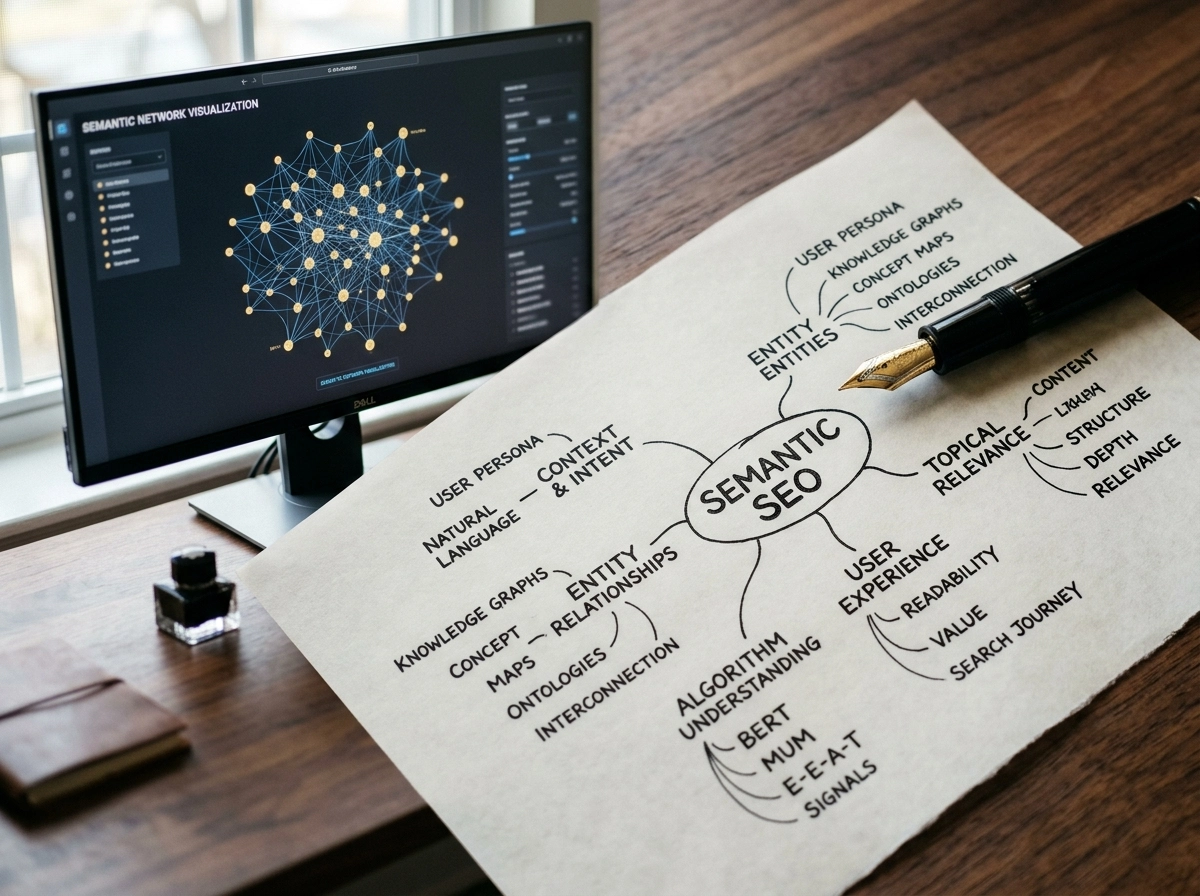
If you’re still chasing individual keyword rankings like it’s 2015, you’re building a house on shifting sand. Search engines don’t see words as isolated strings anymore. Instead, they map how those words connect to bigger concepts. Sites that ditch the shallow approach and cover a topic thoroughly gain traffic up to 57% faster than those sticking to one-off posts. It’s the difference between shouting a random word and actually holding a conversation.
Beyond the single-keyword trap
Think about a fitness site. A decade ago, you’d obsess over the term ‘weight loss tips.’ You’d sprinkle it everywhere and hope for the best. Today, that’s a recipe for obscurity. A modern content clustering strategy means building a topic universe. You don’t just write about weight loss; you build a hub around ‘post-partum nutrition for recovery.’
You link that hub to spokes like macro-tracking for breastfeeding mothers, safe caloric deficits after a C-section, and iron-rich meal planning. This shows Google you aren’t a content farm. You have topical authority. It proves you understand the nuance of the subject, rather than just the search term. While this approach works, it isn’t a magic bullet that overrides every other ranking factor.
Why AI search engines demand depth
Modern algorithms and LLMs look for ‘things,’ not just ‘strings.’ They’re trained to recognize semantic relationships. If your site lacks the connective tissue between related ideas, an automated blog post creator might churn out text that looks okay but lacks the depth to rank. This is where most generic tools fail.
They produce flat content because they don’t understand the ‘neighborhood’ of a topic. We built GenWrite to handle the heavy lifting of competitor analysis and research. It isn’t about volume; it’s about the density of expertise. When you use seo content writing software, you’re giving the search engine a roadmap of your knowledge.
Just be careful. If you let an automated blog post creator handle your news or your core authority topics without a plan, you risk creating ‘AI slop’ that lacks internal logic. You need a tool that understands search intent optimization to fill those semantic gaps.
The mechanics of the hub and spoke
Imagine a travel blogger. Writing five separate articles about ‘cheap flights’ creates internal competition. But building an extensive hub around ‘budget-friendly European rail travel’ lets you dominate a niche. You use keyword research to identify the spokes, like Interrail pass hacks, night trains vs. budget air, or packing for long rail journeys.
Tools like GenWrite’s ai writing tool help automate blog creation so each piece of content reinforces the others. This automated on-page SEO writing makes sure your internal links are strategic, not random. Search engines are smart enough to see the gaps in your knowledge. If you talk about ‘hiking boots’ but never mention ‘ankle support,’ the algorithm senses a lack of depth. Using the best ai tools for topic clusters helps you cover every corner of the map. It’s about more than what you say; it’s about how it all fits together.
Why most AI writers fail the cluster test
Standard ai blog post generator tools have no memory. That’s the problem. They treat every new prompt like a first date, ignoring the twenty articles you just pushed live. When you churn out content in a vacuum, you aren’t building a cluster. You’re just piling up digital trash that fights itself for a spot on page one.
The trap of semantic cannibalization
If a tool doesn’t understand hierarchy, it’ll repeat the same core ideas across every page. Imagine trying to rank 50 articles on “digital marketing” without a pillar. Instead of one strong guide supported by niche sub-topics, you get five different posts all explaining “what is SEO.” It’s redundant and lazy.
This mess ruins rank-ready content. Google gets confused about which page actually matters, so it just rotates them in and out of the index. That kills your momentum. Your own pages end up competing for the same search intent. We call this semantic cannibalization, and it’s a ranking killer.
Why generic prompts fail the cluster test
LLMs are reactive. They do what they’re told in the moment. If you aren’t using a automated blog post creator that actually tracks your site’s history, the AI won’t know it should link to your category page. It won’t know it already covered that specific sub-topic yesterday. Don’t assume the machine remembers anything. It doesn’t.
Real niche blog automation needs a bird’s-eye view. You need a cluster ai tool to map keywords before you write a single word. Without that plan, your site is just a bunch of fragments. It isn’t a fortress of knowledge; it’s a mess. Results change depending on how deep your niche is, but fragmented authority is a universal risk with cheap, high-volume tools.
Building a fortress through governance
Authority comes from structure and internal links. At GenWrite, we look at how an ai seo blog writer handles the relationship between posts. Writing isn’t enough. Every piece has to fit a map. If your niche is tiny, maybe you can wing it. For everyone else, hierarchy is the difference between ranking and sinking.
An AI content detector might tell you if the prose is robotic, but it won’t fix a broken structure. You need a system that knows why a link exists. Check our pricing models to see how we handle this at scale. The GenWrite team built these workflows to stop the repetitive “slop” that comes from generic AI.
Surfer SEO: mapping the SERP overlap

Surfer SEO addresses the isolation problem by treating the SERP as a live data feed of what Google currently rewards. While standard LLMs often guess what a thorough article should contain, this platform maps the intersection of top-ranking pages to reveal the specific semantic markers that Google associates with expertise. It’s less about creative writing. It’s about reverse-engineering the successful logic of your competitors.
This engine identifies the semantic gaps that stall your traffic. If you’re using best ai writing tools to scale production, you’ve likely noticed that high word counts don’t guarantee rankings. The issue is often an “intent gap.” For instance, a guide on “beard grooming tips” might fail if it misses sub-topics like “oil vs. balm ratios” or “trimming neckline symmetry”—details that the top three ranking pages all share.
Identifying semantic gaps through live SERP data
Surfer’s Content Editor uses a multi-layered approach to analyze the real-time SERP overlap. It doesn’t just look for keywords; it looks for the density and relationship between terms that signal topical authority. By comparing your draft against the live environment, you can see where your article is a general overview while the winners are providing specific templates or listicles that satisfy user intent more directly.
Mapping a single page is only part of the process. A strong content clustering strategy requires understanding how these pages link together to form a network of authority. Surfer identifies these clusters by finding terms that frequently appear together across multiple top-ranking domains. It’s a data-driven way to make sure your SEO optimization efforts aren’t wasted on orphaned pages that lack a logical parent topic.
Expanding clusters with competitive intelligence
The “Boost Coverage” feature is useful when you’ve hit a ceiling. It highlights the entities and phrases your competitors are using that you’ve overlooked. Sometimes, the missing piece isn’t a new keyword but a specific technical nuance. Using a keyword scraper from URL can help you see the raw data, but Surfer synthesizes that into a prioritized score, allowing you to focus on terms that will actually shift your ranking position for your specific URL.
It’s often helpful to pair this with SEOcluster.ai, especially when you need to turn Google Search Console data into a page-level strategy. While Surfer focuses on the “what” (the content itself), tools like SEOcluster.ai help with the “where” (detecting cannibalization and internal linking structures). This combination guarantees your content automation strategy isn’t just generating noise, but building a structured knowledge base that feels authoritative to both users and crawlers.
The reality is that even the most effective seo content writing software needs a grounding in real-world performance data. Without a map of the SERP overlap, you’re essentially guessing, hoping that your AI’s training data matches what Google’s algorithm currently prefers. Results vary based on the volatility of the niche, but the data usually points to the same conclusion: coverage beats creativity every time in the eyes of a search engine.
BrandWell and the 30-day automated authority roadmap
Publishing 22 articles and refreshing 10 existing posts within a single 30-day window isn’t just a high-velocity sprint; it’s a systematic approach to search rankings that often yields tangible results, like seeing two primary keywords hit page one before the month ends. This isn’t about throwing thin text at a wall. It’s about how a modern ai blog content creator handles the architecture of a site. While many tools focus on the individual post, the real shift happens when you automate the hub-and-spoke model to build site-wide authority from scratch.
Building the knowledge graph
Brand-new sites often struggle because they lack a clear internal structure that signals expertise to search engines. BrandWell addresses this by acting as a no-code engine for creating a structured knowledge graph. Instead of looking at keywords in isolation, the system looks for how they connect. If you’re employing niche blog automation strategies, this means your ‘spoke’ articles automatically reference your ‘hub’ pages, creating the kind of internal link density that usually takes a human editor weeks to map out manually.
This level of automation isn’t just about saving time; it’s about consistency. When you’re managing 50 or 100 posts, a human writer will inevitably miss internal linking opportunities. An automated system doesn’t. It identifies every chance for long-tail keyword targeting across the entire cluster. This ensures that every new piece of content strengthens the authority of the existing pages, rather than sitting in a digital silo.
The cost of high-volume output
It’s a steep entry price. Most hobbyists will flinch at the $249 monthly minimum. That’s a significant investment compared to pay-as-you-go tools that charge a few cents per prompt. But the reality is that you aren’t paying for words; you’re paying for the infrastructure. For a business scaling a content wing, the ability to generate 2,500-word articles that feel researched and structured is worth the premium. You’re buying back the hours spent on keyword research and manual formatting.
Handling technical friction
No tool is perfect, and this one has its quirks. While the long-form generation is strong, complex HTML elements or intricate tables often require a quick manual cleanup before they look right on a live site. It’s also common to see minor repetition in headers if the initial prompt isn’t specific enough. I’ve found that using an ai content humanizer can help smooth out these edges, ensuring the final output doesn’t just rank well but actually reads like it was written by a subject matter expert.
At GenWrite, we see this trend toward automation as the standard, not the exception. The goal isn’t just to publish more; it’s to publish smarter. By focusing on how articles relate to one another, you can build a defensive moat around your niche that simple, one-off AI writers can’t touch. The evidence is clear: sites that prioritize these automated clusters see faster indexing and more stable rankings over the long term.
Frase: the strategist’s choice for content briefs

While high-volume automation creates the roadmap for your site’s authority, you still need a way to ensure each individual turn is technically perfect. That’s where Frase steps in. It doesn’t just throw text at a page; it functions as a strategist’s co-pilot by dissecting what the search engine actually wants to see. If you’ve used an ai blog post generator before, you know the frustration of getting back generic fluff that ignores the specific questions your audience is asking. Frase solves this by starting with research, not just prompts.
Turning raw data into structural logic
Frase uses natural language processing (NLP) to scrape the top 20 results for your target query. It doesn’t just list keywords; it looks for the intent behind the headings. It then builds a logical H2 and H3 hierarchy based on what’s actually ranking. You aren’t guessing which sub-topics matter. You’re seeing exactly how competitors structured their success. For anyone looking for the best ai writing tools, the ability to pull ‘People Also Ask’ data directly into a content brief is a massive time-saver. It ensures that when you finally sit down to write,or let an automated system take over,the foundation is rock solid.
Of course, NLP isn’t infallible. Sometimes it picks up outlier topics that don’t fit your specific brand voice, but as a starting point, it’s remarkably accurate. You can see the clusters forming in real-time. By the time you’re done refining the brief, you’ve got a roadmap that covers every base. This is seo content writing software designed for people who care about the ‘why’ as much as the ‘how’. It’s about building the skeleton of the article so the AI has no room to hallucinate irrelevant details.
The content score as a real-time guide
Once the brief is set, the platform uses a ‘Content Score’ to guide the writing process. This isn’t just a gimmick; it’s a feedback loop that tells you if you’re hitting the necessary word count and topic coverage benchmarks. It feels like having an editor over your shoulder, pointing out that you missed a specific semantic term that every top-ranking competitor included. And when you’re refining these technical details, you might also use a specific meta tag generator tool to ensure your click-through rate matches the quality of your internal structure.
Why briefing beats raw generation
Why does this matter? Because a search engine doesn’t just rank sentences; it ranks answers. If your content doesn’t answer the secondary questions hidden in the SERP, it won’t stay on page one for long. Tools like GenWrite often work best when the initial strategic research is this precise. It allows you to move from ‘writing a post’ to ‘dominating a niche.’ You’re not just filling space; you’re building a resource that satisfies both the algorithm and the human reader. But don’t expect the tool to do all the thinking for you. The strategist still needs to decide which questions are worth answering and which are just noise from the competitors.
Writesonic and the rise of Generative Engine Optimization
The structured briefs provided by tools like Frase are a great start, but the execution phase is where the battle for the AI Overview is won or lost. Picture a marketing manager at a mid-sized SaaS firm who has spent years perfecting their “blue link” strategy. They finally hit the top spot for a high-intent keyword, only to find that Google’s AI Overview has pushed their result below the fold. Worse, the AI summary cites a competitor whose article is half as long but twice as direct. This shift isn’t a minor tweak to the algorithm; it’s a fundamental change in how information is retrieved and presented.
Writesonic addresses this head-on through what it calls Generative Engine Optimization. The goal here isn’t merely to appease a crawler but to feed an LLM exactly what it needs to feel “confident” in citing you. When AI Overviews appear in roughly 30% of all searches, being the primary source for those summaries becomes a survival metric. It’s no longer enough to have a good AI blog generator on your side; you need a system that understands how to structure data for generative visibility.
Beyond the blue link
Traditional SEO focuses on intent and relevance, but GEO adds a layer of “citability.” I’ve seen brands use the Writesonic GEO dashboard to realize a painful truth: they are invisible to AI. One specific audit of a brand like Grammarly showed they appeared in 85% of relevant AI answers with a 77% positive sentiment. That didn’t happen by accident. It happened because their content was structured to provide clear, authoritative answers that LLMs can easily parse and credit.
But how do you actually achieve that at scale? It requires building deep topical authority across an entire niche. You can’t just write one great post and hope for the best. You need a cluster of interlinked, high-quality assets that prove to the engine that you own the topic. This is where the synthesis of strategy and execution becomes critical. If your content doesn’t connect to a broader narrative, the AI treats it as a one-off outlier rather than a trusted source.
The sentiment and citation gap
The real friction occurs when your content is technically correct but lacks the “trust signals” LLMs look for. Writesonic’s tools help identify where competitors are getting cited and you aren’t. Maybe your tone is too promotional, or perhaps you’re missing the specific data points that AI models prefer to highlight. It’s about finding the “why” behind the citation.
And so, we have to stop thinking about content as a static page and start seeing it as a data source. If an AI model can’t extract a clear fact or a unique perspective from your writing, it won’t use you. The stakes are high: if you aren’t in the AI Overview, you effectively don’t exist for a third of your potential audience. Building rank-ready content today means preparing for a world where the search engine is also the reader. It’s a transition from being found to being referenced, and that requires a level of precision that basic AI writers simply can’t reach.
How we measured ‘Intelligence’ in these tools

Moving from superficial visibility to structural logic requires a shift in how we define software intelligence. It’s no longer about how many words an LLM can produce per minute,it’s about how accurately it maps the conceptual relationships between those words. We assessed these tools by their ability to transition from keyword string matching to true semantic clustering.
quantifying semantic distance through vectorization
To evaluate clustering quality, we looked at how each tool handles vector embeddings. This process converts text into numerical coordinates in a multidimensional space. Tools that understand intent can see that ‘how to fix a flat tire’ and ’emergency bike repair’ are mathematically close, even without sharing many characters.
We tested whether the software could consolidate these into a single content brief or if it redundantly suggested two separate pages. This distinction is vital for a content clustering strategy that aims for topical authority without fluff. A tool that fails to recognize these overlaps creates a fragmented site structure that confuses search engines and users alike.
evaluating intent grouping and cannibalization risks
A sophisticated seo content writing software must do more than just group similar words. It needs to prevent internal competition. We used the Herfindahl-Hirschman Index (HHI) to measure the concentration of topical authority across the generated clusters.
A high HHI score across multiple pages for the same primary intent signals a failure in the tool’s logic. It indicates that the software is creating content cannibalization rather than a clean hierarchy. We looked for tools that could flag these overlaps before the first word is even written. This proactive analysis is what separates high-level strategy from simple text generation.
The reality is that many ‘automated’ solutions still struggle with this. They often produce a flat list of articles rather than a tiered structure of pillar pages and supporting nodes. While vector-based clustering is powerful, it occasionally misinterprets highly technical jargon in extreme micro-niches where training data is sparse. This is where the difference between a basic writer and a true AI SEO suite like GenWrite becomes obvious.
methodology for niche blog automation
Our testing involved feeding 500 raw, unorganized queries from a specialized niche into each platform. We then measured the ‘intelligence’ by the ratio of queries to unique content opportunities. A tool that produces 450 separate briefs from 500 keywords isn’t intelligent; it’s a factory for duplicate content.
Conversely, a platform that condenses those 500 queries into 40 distinct, high-impact clusters demonstrates a genuine understanding of search intent. This level of niche blog automation is what separates sustainable growth from temporary traffic spikes. We focused on whether the output felt like a cohesive knowledge base or a fragmented collection of SEO-bait. Creating dozens of disconnected pages might offer short-term gains, but it fails to build the long-term topical authority required in the current search environment.
The math behind the topical authority ratio
A B2B SaaS company recently tracked a 200% increase in organic traffic by shifting their focus from a single high-volume head term to a comprehensive cluster of 40 related long-tail keywords. This shift highlights a fundamental truth: search engines no longer reward isolated pages but rather the density and relevance of your entire topic universe. Chasing vanity rankings for a single keyword is a legacy tactic that ignores how modern semantic search actually functions. Success now depends on a specific mathematical relationship between your content volume and the niche you intend to dominate.
Quantifying the topical authority ratio
To quantify this, we look at the Topical Authority Ratio, which is the number of pages dedicated to a specific topic divided by the total number of pages on your site. If you have 100 pages and only 3 are about “headless commerce,” your ratio is a measly 0.03. But if you’re using an AI blog generator to systematically build out 30 pages covering every nuance of that niche, your ratio jumps to 0.3. This concentration signals to algorithms that you aren’t just a generalist; you’re a definitive source.
And it’s not just about internal ratios. You also need to calculate your Topic Share. This involves exporting every keyword ranking for a head term and its variants, then analyzing which domains capture the largest slice of the traffic pie. It’s a blunt way to see where you actually stand. You might rank #1 for a specific term but hold less than 5% of the total traffic for the broader cluster. That’s a precarious position because a single algorithm tweak can wipe you out if your authority isn’t broad enough to support the weight of the head term.
The mechanics of rank-ready content
Achieving a high ratio requires more than just volume. It requires rank-ready content that satisfies the semantic requirements of the cluster. Most legacy strategies fail here because they treat each page as a silo. In contrast, modern automation focuses on long-tail keyword targeting across the entire breadth of the topic. This ensures that even if your head term page doesn’t hit page one immediately, the combined traffic from 20 specific, low-competition long-tail pages provides the momentum needed to lift the entire group.
But this math doesn’t always hold if your internal linking is a mess. You can’t just dump 50 articles into a folder and expect a miracle. The connections between those pages are the variables that multiply your authority. If the links don’t flow logically from general to specific, the authority becomes diluted. The reality is that search engines use these links to crawl and understand the hierarchy of your knowledge. Without a clear structure, your Topical Authority Ratio is just a vanity number that lacks the structural integrity to move the needle. So, the strategy isn’t about winning a single race; it’s about owning the track through mathematical consistency and topical depth.
Managing the ‘human-in-the-loop’ hybrid model

Numbers tell you where the gaps are, but they don’t tell you how to earn a reader’s trust. Trust is earned in the margins. It’s found in the specific, messy details that a large language model can’t quite grasp yet. If every ai blog content creator looks at the same search results to build a cluster, they’ll all eventually produce the same generic response. This creates a ceiling for your growth where your site looks like everyone else’s, and Google has no reason to rank you above the established players.
Why the skeleton needs skin
AI is phenomenal at identifying that a guide on commercial solar installation needs a section on tax credits and structural load. But it can’t tell your reader about the specific permitting hurdle you faced last Tuesday in a rainy suburb. That is the “Experience” in E-E-A-T. You need to take the draft and inject those lived-experience insights that prove you aren’t just an echo chamber. And honestly, this is the only way to survive the coming wave of AI-generated noise.
Most niche blog automation fails because it ignores this last mile of production. You shouldn’t expect a tool to be your entire marketing department; expect it to be a high-speed research assistant. By using GenWrite for SEO optimization, you can automate the heavy lifting of keyword research and competitor structure. This frees you up to do the one thing the machine can’t: add a unique perspective. It’s about using the tool to build the car so you have more energy to drive it.
The last mile of content creation
So, what does this actually look like in practice? It means taking an AI draft and spending twenty minutes adding a few specific elements. Maybe it’s a quote from an interview you conducted or a screenshot of a proprietary dataset. It could even be a simple paragraph where you disagree with the common consensus in your industry. These small human interventions signal to both readers and search engines that there’s a real brain behind the screen.
Admittedly, this doesn’t always hold true for every single low-competition keyword, but for anything that matters, the human touch is the differentiator. You’re looking for the best ai writing tools to give you a head start, not a finish line. When you treat the output as a first draft rather than a final product, you avoid the generic content trap. You’re no longer just filling a cluster; you’re building a brand.
But don’t mistake this for a call to return to manual labor. The goal is efficiency. You want to spend 90% of your time on the 10% of the content that actually moves the needle. Let the automation handle the meta descriptions, the internal linking, and the basic structural hierarchy. Your job is to make sure the final result sounds like it was written by someone who actually knows what they’re talking about.
Where most teams trip up with automation
Human oversight is the safety net, but even the best editors can’t save a site suffering from mass publishing without semantic governance. This is where the wheels fall off for most teams. They treat automation like a fire hose, aiming it at a keyword list and hoping for a flood of traffic. Instead, they get a mess of overlapping intent that confuses search engines and tanks rankings. The reality is that search engines reward structure, not just volume. If your AI is churning out articles in a vacuum, you’re building a house of cards.
The cannibalization trap
The most visible failure in automated SEO is keyword cannibalization. It happens when you generate content for dozens of slight variations of the same phrase. For example, creating separate pages for “SEO in London” and “SEO in UK” without a clear hierarchy is a mistake. Google doesn’t know which one to rank, so it often chooses neither. You’re effectively competing against yourself for the same search intent. This turns a potentially powerful content clustering strategy into a series of conflicting signals that dilute your domain authority.
Semantic overlap and intent
Most basic tools don’t understand that two different keywords can share the same intent. If you target “how to bake a cake” and “baking a cake guide” as separate entities, you’re wasting resources. You need to group these under a single, authoritative piece. Automation should help you identify these overlaps, not ignore them for the sake of higher page counts.
The authority flow disconnect
Authority doesn’t just happen. It flows. Most automated workflows treat each post as an island, ignoring the reality that search engines rank sites based on how well-connected their information architecture is. Without a strategic internal linking structure, Google has no way to identify which page is your primary hub of expertise. This lack of direction tells the algorithm that your site lacks depth. An AI blog generator like GenWrite solves this by automating the research and linking process from the start, ensuring your site has a logical skeleton.
Shallow expansion and long-tail errors
There is a common misconception that long-tail keyword targeting is just about finding low-volume phrases and writing 500 words on them. That approach is dead. If those pages don’t offer unique value or a different perspective, they’re redundant. You end up with a site that is broad but shallow, which is a death sentence in modern search.
Reliability isn’t guaranteed by the tool alone. It’s about how you integrate seo content writing software into a wider plan. Using these tools should be about scaling your best ideas, not replacing the need for an actual strategy. If you don’t define the boundaries of your clusters early on, no amount of AI-generated text will fix the structural decay of your domain. You have to tell the machine where one topic ends and the next begins.
Case study: transforming a scattered niche blog into a fortress

Imagine a travel blog where a deep-dive guide on Bulgarian train schedules ranks in twenty-four hours, while a beautifully written essay on hiking the Alps lingers on page ten. This isn’t a fluke of the algorithm. It’s a signal that Google has pinned the site’s topical authority to very specific coordinates. The owner had plenty of content, but it existed as a series of disconnected islands, failing to signal any real expertise to search engines.
When we audited this site, the friction was obvious. They were hitting the automation wall where they produced volume but ignored the connective tissue. To fix this, we moved away from the one-off post mentality and toward a fortress strategy. We used a systematic approach to map out the entire Interrail universe, identifying forty distinct sub-topics that the site had completely ignored.
The architecture of a 57% acceleration
Instead of guessing which keywords might stick, we used an AI blog post generator to build a semantic map. This wasn’t about generic travel tips. We targeted high-intent, granular queries like “how to validate a pass in Budapest” and “best backpacks for sleeper trains.” By filling these gaps with rank-ready content, the site began to show a logical hierarchy that search engines could finally parse.
The results were immediate. Within three months, the site’s organic traffic growth rate was 57% higher than its historical average. It’s worth noting that results aren’t always this linear,highly competitive niches like finance or health require much longer lead times,but the structural logic remains the same. The site stopped being a collection of articles and became a definitive resource.
Lessons from the Retro Dodo model
This fortress approach is exactly how smaller publishers beat giants. Consider a site like Retro Dodo. They rank for over 31,000 keywords containing the word “pokemon.” They consistently outrank massive media conglomerates like BuzzFeed or IGN on these specific topics. They don’t have the massive backlink profiles of those giants, but they have something better: exhaustive depth.
When you own every possible sub-topic, from niche hardware mods to specific game glitches, you create a gravity well for your primary keywords. Search engines don’t just see one good post; they see a comprehensive knowledge base. Most teams fail here because they stop once they’ve covered the big keywords. They leave the long-tail gaps open, which is where authority is actually won or lost.
Transitioning to this model requires a shift in how you think about your content tools. They shouldn’t just be for writing; they need to be architects. If you aren’t using your technology to find and fill the cracks in your topic universe, you’re just adding more noise to the islands. The goal is to build a structure so dense that the algorithm has no choice but to recognize your site as the primary source of truth.
Choosing your cluster engine: the final verdict
Seeing that 57% traffic jump in a case study is one thing, but replicating it across your own portfolio is another challenge entirely. You’ve seen the technical math and the real-world wins, so we’re left with the most important question: which engine actually gets the keys to your domain? It’s easy to get lost in feature lists, but the reality is simpler. Your choice shouldn’t be about which tool has the most buttons, but about which one fixes your specific bottleneck.
If you’re a strategist who loves the “why” and “how” before the “what,” Frase is usually the play. It’s built for teams that need deep briefs and structured hierarchies before a single word is typed. You’ll spend more time in the research phase, but the resulting H2 and H3 structures will be rock solid. It’s a researcher’s tool, not an autopilot button. But if your niche is hyper-competitive and you’re fighting for the top spot where every NLP term counts, Surfer is the scalpel you need. It’s less about the “cluster” as a concept and more about the surgical overlap of what’s already winning.
For those of us focused on high-volume growth, the requirements change. You can’t afford to spend three hours on a single brief when you have an entire topical map to conquer. This is where an AI blog generator like GenWrite changes the math by handling the end-to-end SEO optimization. It’s designed for the publisher who needs to move from a keyword list to a live, interlinked authority site without a dozen manual steps in between. You aren’t just buying a writer; you’re installing a system that manages research, drafting, and even the technical publishing logistics.
Choosing between these best ai writing tools often comes down to your operational maturity. Are you a solo creator looking for a specific competitive edge, or are you building a content factory? If it’s the latter, you need a solution that understands how a post about “best soil for roses” connects to “winter pruning techniques” without you having to manually link them every time.
Decision matrix for cluster tools
| Focus Area | Recommended Tool | Best For |
|---|---|---|
| Manual Strategy | Frase | Editorial teams and agency strategists |
| SERP Competition | Surfer SEO | High-competition niches needing precision |
| Autonomous Growth | GenWrite | Bulk publishing and automated authority building |
| Content Briefs | Jasper | Creative teams needing varied templates |
Selecting your seo content writing software shouldn’t be a permanent marriage, but it does need to be a deliberate one. The evidence suggests that tools focusing on the entire lifecycle,from keyword research to WordPress auto-posting,provide the fastest path to topical authority. This doesn’t mean a tool will fix a fundamentally broken content strategy, but it will certainly accelerate a good one by removing the friction of manual execution.
The next phase of search isn’t just about writing more; it’s about owning the map of your niche before the competition even realizes there’s a territory to defend. Start by picking one pillar of your cluster and letting your chosen engine build out the support posts. The goal isn’t a perfect first draft, but a finished fortress of content that search engines can’t ignore.
If you’re tired of manual cluster planning, GenWrite automates the heavy lifting so you can focus on building actual topical authority.
Frequently Asked Questions
Does AI content actually help me build topical authority?
It depends on the tool. Most basic generators just spit out text for a single keyword, which doesn’t help your site’s authority at all. You need a platform that maps semantic relationships and structures content into clusters to see real results.
Why does Google care about topical clusters more than keywords?
Google’s algorithms now prioritize entities and how they relate to each other. When you group content into a hub-and-spoke model, you’re signaling to search engines that you’re an expert on the entire topic, not just a single search term.
Is it worth using AI if I still have to edit the content?
Honestly, you shouldn’t skip the human part. AI is great for research and structure, but you need your own expertise to add the ‘information gain’ that makes content worth reading. It’s a hybrid model, not a set-it-and-forget-it solution.
How do I avoid keyword cannibalization when generating clusters?
You need to map your intent before you start writing. If you don’t have a clear structure for your pillar and spoke pages, you’ll end up with multiple articles fighting for the same query. It’s a common trap that’s easy to avoid with a solid content brief.