
Stop wasting time: How an AI content generator makes writing fast and painless
The blank page stares back: why content creation feels like a grind

It’s 9 AM on a Tuesday. All you see on your screen is a blinking cursor against a white background. The brief’s clear, you know your keywords and audience, but that deadline? It’s coming fast. And the words? They’re just not showing up. We often call this “writer’s block,” but honestly, it’s a symptom of something bigger, a real snag in how modern marketing works.
We’re all stuck in what I call the Content Scale Paradox. Businesses constantly need fresh, high-quality content—blog posts, social updates, you name it—just to stay visible in a digital world that’s packed to the gills. Search engines love frequent, deep content. Problem is, our human brains haven’t suddenly gotten faster or more brilliant on command. Trying to churn out machine-level content with only human tools? That’s just not sustainable. It’s why so many content teams are burning out.
The real cost of the content grind
This constant pressure often means quality takes a hit. When the main goal is simply getting something published, content inevitably gets bland. It turns into a checklist of keywords and talking points, often just recycled from competitors. The result? A “Sea of Sameness” where nothing truly stands out. Sure, you’re publishing, but it’s not building real authority or bringing in meaningful traffic. It’s just another drop in a very big ocean.
This is precisely why we need to rethink the whole AI content creation conversation. It’s not about replacing writers. It’s about getting rid of the most inefficient part of the process: starting from scratch. That blank page? It kills momentum. An AI SEO content generator can be your super-fast drafting partner. It handles the initial research and outlining, giving you a solid, structured foundation to build on.
Moving from author to editor
Imagine this: you start your day not with an empty screen, but with a 70% complete draft, already tweaked for SEO. Your job shifts. Instead of agonizing over the first sentence, you’re refining, injecting your unique insights, and polishing the final piece. Tools like GenWrite are built on this idea. They don’t just spew out words; they lay down a strategic baseline. This frees you up for the truly important stuff—the strategic thinking and narrative crafting that actually defines your brand’s voice.
Using the right AI copywriting software lets you finally escape that content paradox. You can genuinely boost your output without sacrificing the quality that makes your brand unique. The real question isn’t “human vs. machine.” It’s about finding which AI blog post generator can become your most effective partner.
Your digital intern: what an AI content generator brings to the table
The blank page doesn’t have to stop you. An AI content generator is a powerful starting point, a high-speed digital intern that can produce a first draft on command. It doesn’t replace thinking; it just speeds up turning an idea into structured text, cutting through the initial friction that often stalls projects.
An AI content generator fundamentally uses machine learning (ML) and Natural Language Processing (NLP). These systems train on massive text and code datasets, letting them recognize patterns, context, and syntax. Advanced models, often built on transformer architecture, don’t just string words together. They predict the most probable next word in a sequence based on input, producing syntactically coherent, contextually relevant sentences.
More Than Just a Text Machine
Consider it a sophisticated inference engine. You give it a prompt—a topic, a keyword, some bullet points—and the model infers the structure and content needed. This process can significantly cut initial drafting time. Hours of research and outlining condense into minutes, giving you a functional draft to refine. It’s a fundamental change in content writing, shifting the human role from creator to editor and strategist.
Here’s where the real value lies. The AI doesn’t just write sentences; it builds a scaffold. A good prompt can produce an introduction, logical sections with headings, and even a conclusion. The AI blog writer helps establish coherent flow and manages basic content structure and internal linking suggestions. But the raw output, while impressive, is rarely the final product. Output quality varies, always needing a human hand to verify facts, inject brand voice, and add genuine insight.
From Raw Draft to Strategic Asset
This is where specialized tools like GenWrite stand apart. A generic AI produces text, but an AI SEO content generator integrates this into a broader workflow. It goes beyond simple text generation, focusing on keyword-driven blog writing and automated on-page SEO writing. The initial draft is only the first step in a process that includes competitor analysis, semantic keyword integration, and aligning the final piece with search intent.
Ultimately, the generator is an efficiency tool, not an expertise substitute. It handles drafting’s heavy lifting, letting marketers and writers focus on higher-value tasks: strategy, editing, and promotion. Automating the most time-consuming process part lets teams scale efforts and publish more consistent, high-quality content. The debate isn’t about an AI content generator vs. a human writer; it’s about how a human writer, armed with the right AI writing tool, achieves far more. The goal is to create engaging content fast; these systems offer the most direct path. They mark a new era in content creation, but one still needing a skilled pilot, especially when choosing from the best AI writing generators. Your business can then focus on its blogs and SEO optimization for those blogs.
Picking your co-pilot: free vs. paid AI tools and what to look for
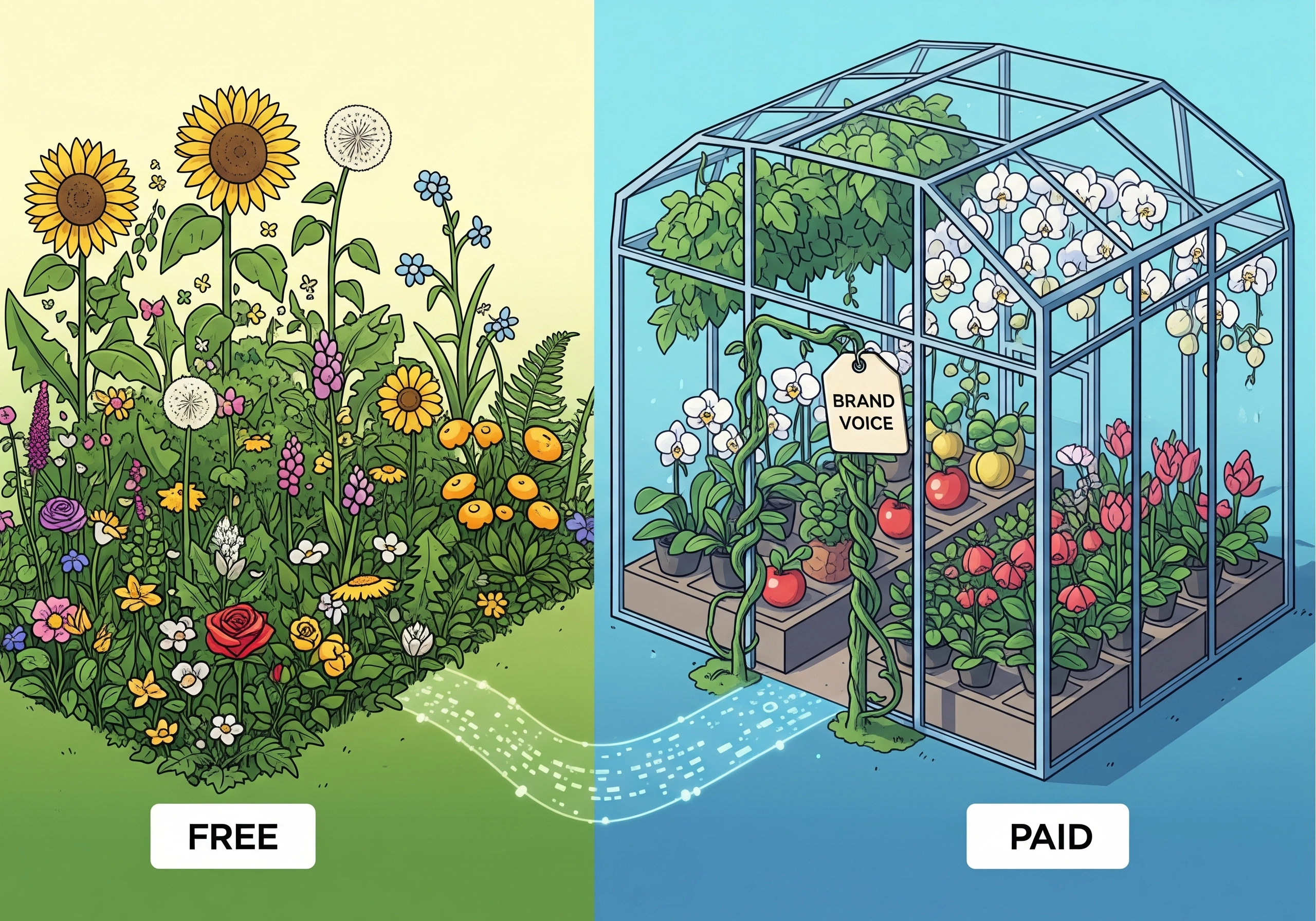
So you’re convinced an AI assistant can speed things up. Great. Now, which one do you actually pick? The market’s packed with options, and the difference between a truly helpful co-pilot and a frustrating waste of time is often smaller than you’d expect. Your choice really comes down to what you need the tool to do. Are you making a quick trip to the store, or are you hauling a trailer cross-country?
The Free vs. Paid Divide
Let’s be clear: a free AI content generator is a solid starting point. It’s your sandbox. You can use it to whip up social media captions, brainstorm a few headlines, or even draft a short email. But these tools almost always come with tight limits. Many free plans cap you at around 2,000 words per month and might not give you access to the platform’s most powerful AI models. That’s fine for occasional, low-stakes tasks, but it won’t power a real content strategy long-term. Frankly, relying too much on a free AI content generator can actually cost you rankings because the output often feels too generic to compete.
Paid tools are a different story. They’re built for serious work. You’ll get higher (or unlimited) word counts, access to the best models, and features made for professional workflows. You’re moving from a hobbyist’s gadget to a professional’s workshop. When you’re ready to invest, checking out the pricing tiers of different platforms often tells you a lot about who they’re trying to serve.
General Chatbots vs. Purpose-Built Generators
This is the biggest difference most people miss. A general-purpose chatbot is a fantastic conversationalist. You can ask it anything, and it’ll give you a reasonable, creative answer. It’s a blank canvas, which is powerful, but it also means you need to be an expert at prompting. You’re the one providing all the direction.
Specialized tools, like purpose-built content generators, are different. Tools like GenWrite aren’t just for generating text; they’re full-fledged blogging agents. They come with structured templates and workflows designed for specific goals, like a high-ranking blog post. Instead of just taking a prompt, they walk you through a tested process that often includes competitor analysis, keyword research, and structural optimization. This is how you get an article that’s not only well-written but also built to perform in search results. You can dig into this more with guides to the best AI blog generators for high-ranking content.
What to Look For in a Serious Tool
When you’re ready to move beyond the free tier, what features actually matter? It’s more than just word count.
- Brand Voice: Does the tool let you upload a style guide or scan your website to learn your specific tone? The best AI content generator for you should sound like you, not a generic robot. This feature saves a ton of time, meaning you won’t have to heavily edit for tone later.
- SEO Integration: A good tool writes and optimizes. Look for a built-in SEO content optimization tool that analyzes SERPs, suggests relevant keywords, and helps with internal linking. It should be an AI SEO blog writer, not just a wordsmith.
- Workflow Automation: Can the tool connect to your CMS and auto-post to WordPress? Does it have team collaboration features? These integrations are what turn an AI writer from a simple tool into a vital part of your content operation. The goal is to fit an AI writing assistant smoothly into your existing processes, which is an important part of picking the best AI blog generator for your content needs.
The secret sauce: crafting prompts that get results (and avoid generic outputs)
You’ve got a powerful AI tool. Now, learn to drive it. The biggest mistake people make with an AI text content generator is treating the prompt box like a search bar. It isn’t. Type “blog post about social media marketing,” and you’ll get a generic, soulless article a hundred other websites already have. It’s useless.
Want high-quality output? Stop asking questions. Start giving directions. Think of the AI as a fast, eager junior writer with zero context about your business. Your prompt isn’t a query; it’s a creative brief.
The Anatomy of a Powerful Prompt
Effective prompting builds a container for the AI’s creativity. You set the rules, the context, and the goal. The AI fills in the words. A weak prompt is an empty field. A strong prompt is a blueprint.
Here are the essential parts of a brief that actually gets results:
First, define the AI’s Persona. Who is it? Don’t just say “expert.” Tell it to “Act as a skeptical CFO with 20 years of experience in enterprise finance.” This one instruction completely changes the tone and vocabulary.
Next, specify the Audience. Who are you writing for? Be precise. “Marketing managers at Series B tech startups” works far better than “business owners.” This detail dictates the complexity, examples, and pain points the AI will tackle.
Then, state the Task. What exactly do you need? “Write a 500-word blog post introduction” is a clear task. “Write about SEO” isn’t. Define the format, length, and specific components you expect. This keeps the AI from generating rambling content that goes nowhere.
Finally, provide Context & Constraints. This is critical. Give it the raw materials: key data points, brand voice descriptors (e.g., “Tone is witty, direct, and slightly irreverent”), a list of keywords to include, and things to avoid. For example, when generating blog content, you might tell the AI to skip commonly cited but outdated statistics.
Zero-Shot vs. Few-Shot Prompting
A “zero-shot” prompt gives a command without examples. Most people do this by default. A “few-shot” prompt, however, provides 2-3 examples of the desired output before you make your final request. This is the quickest way to get the AI to match your brand’s unique rhythm and style.
If you want the AI to write a witty product description, first give it two examples of your existing witty descriptions. This prepares the model. It’s a simple step that separates generic copy from content that feels authentic to your brand. Without it, you’re just guessing, and guessing isn’t a strategy. The truth about whether an AI content generator could actually beat your human writers often comes down to the quality of the inputs it receives.
Sure, this sounds like more work. But it’s the difference between a tool that churns out mediocre drafts and a partner that genuinely speeds up your entire workflow. Platforms like GenWrite learn your brand voice over time, making this process even faster. But the core idea holds: the quality of your output directly reflects the quality of your instructions. Specificity is everything. Even the best free AI content generators can produce impressive results when you give them a well-crafted prompt.
From thought to draft: accelerating your articles and blog posts

Got a solid prompt? Things really pick up. You’re not wrestling a blank page anymore; you’re directing a content assembly line. This workflow cuts down hours of research and writing to mere minutes.
From prompt to structure in seconds
Your first command converts a prompt into a working structure. A good AI content generator won’t just start typing; it’ll lay out a logical framework first. Feed it your target keyword, main arguments, and preferred tone. In under 30 seconds, you’ll get a detailed outline: H2s, H3s, bullet points—the whole article mapped out. This kills ‘blank page syndrome’ instantly. It gives the AI clear boundaries, keeping the output focused and on track. This initial structural work is key to effective AI content generation.
Expanding the outline into a full draft
Outline approved? Time to expand. The AI takes each heading, then develops it into full paragraphs, linking ideas and building your argument. This is where you save serious time: five hours of intense writing now takes about five minutes. The writer’s role shifts from originator to editor. You’re not typing every word; you’re reviewing and directing the assembly of a nearly complete article. Platforms like GenWrite handle this automatically, moving straight from outline to draft.
The human role in refinement
Naturally, the first draft isn’t always perfect. AI produces a strong initial text, not a finished, publishable piece; human expertise is essential here. The fast drafting process frees up hours for higher-value tasks: fact-checking, infusing your unique brand voice, and finessing the narrative. Your energy is spent on polishing, not producing. This final stage also covers crucial SEO work that really needs a human touch—think title optimization or using a free meta tag generator for effective search descriptions. The AI handles the bulk, letting you focus on nuanced, strategic elements that guarantee quality.
The editor’s seat: how to refine AI content for impact and authenticity
Got your draft? Great. It popped out in minutes, not days, with all the core ideas ready. But hold on, don’t hit publish yet. That next step, the human review, is where you turn a decent AI piece into something truly effective. Think of the AI as your super-speedy junior writer; you’re still the editor-in-chief, and your judgment makes the final product sing.
About three-quarters of folks using these tools find the raw output needs a human touch to really connect with their brand. That’s not a tech fail; it’s just how communication works. Your job isn’t to rewrite everything, but to refine, sharpen, and add your unique perspective to the draft.
You’re the Brand Guardian
Does the draft sound like you? An AI can mimic tone, sure, but it won’t ever grasp your brand’s true spirit. It doesn’t know that inside joke you share with your audience, or the specific industry perspective that makes you unique. Your editing pass is where you infuse that personality. Ditch generic phrasing for your company’s specific terms. Toss in an anecdote that only you could tell.
Here’s where you ask if the content lives up to your brand’s promises. Is it helpful? Insightful? Funny? Direct? The AI gives you the clay; you’re the one shaping it into something recognizable. This step keeps things consistent and builds a stronger bond with your audience.
Time for a Credibility Check
This part? No compromises. AI models, for all their smarts, can confidently spit out wrong information. They might pull outdated stats or even invent sources. Your most important job as editor is to be a relentless fact-checker. Double-check every number, every date, and every claim that isn’t widely known.
Losing a reader’s trust hurts way more than publishing a day late. Just one glaring error can tank the entire piece’s credibility, and your brand’s right along with it. The risk is particularly high with a free AI content generator; they often lack the robust data checks of professional tools. Your human review is the ultimate safeguard against misinformation.
Making It Human
Read the article out loud. Seriously, do it. You’ll instantly spot sentences that are grammatically fine but just feel clunky or unnatural. The AI’s job is to put information together logically; yours is to make it flow. Smooth out those awkward transitions, break up lengthy paragraphs, and rephrase sentences for a better rhythm.
This is also your moment to add real value. Could a specific example from your own experience clarify a point? Did the AI miss a subtle detail? An AI SEO content generator can structure a post for search engines, absolutely, but human insight is what makes people share it. Great content doesn’t just answer a question; it builds a connection. Ideally, you’ll use an AI blog post generator that gives you a solid foundation, so your editing focuses on impactful refinements, not just fixing basic errors.
Beyond the blog: scaling content for every channel

You just hit publish on a 2,000-word pillar post. Great! You spent ages refining it, checking facts, making every sentence sparkle. But what happens next? That one piece of content has to last all week: a LinkedIn article, a Twitter thread, three Instagram posts, an email newsletter. Suddenly, you’re stuck in the endless copy-paste-tweak loop, and all that hard-won momentum just… disappears. That’s the kind of friction that grinds content production to a halt. A blog post isn’t the end goal; it’s really just the beginning of a much bigger effort. Instead of hacking up your work by hand, AI can seriously boost your content repurposing. It grabs your polished, human-written piece and quickly adapts it for any platform.### From one post to a full campaignFrom that one pillar post, you could get a five-tweet thread, pulling out key stats, all in under a minute. It can also whip up a professional LinkedIn post, one that really gets business people thinking about the issue. And for an email blast? It’ll craft concise marketing copy, designed to get folks clicking back to your original article. This isn’t just about saving time, though that’s a huge perk. It’s about keeping your message tight and consistent everywhere, without you having to do the same boring work over and over.Smart marketing teams, especially those growing fast, get this change. They’re not just using AI for initial drafts anymore; they’re leveraging it for large-scale content adaptation. They know tools like HubSpot’s free AI writer can quickly create copy for all sorts of programs. The boost in efficiency is massive. For e-commerce, AI-powered workflows for product descriptions can cut down the time it takes to launch new catalogs. The whole thing turns into a system of automated on-page SEO writing that goes way past just one blog post.### Building a content ecosystemHours spent switching contexts and doing repetitive tasks? Now it’s just minutes of strategic review. This method turns one SEO article into a full-blown content ecosystem. The point isn’t just to get a blog post out there; it’s to create a network of assets, all pointing back to your main message, giving it a much wider audience. This is a key part of the new frontier of content creation, where one long piece can spark dozens of smaller ones. The top systems even make sure to create search-optimized content across these formats, helping every bit contribute to your organic traffic goals.Think of your blog as the central hub. AI helps you build out all the spokes from there. You’re not just making individual posts anymore; you’re actually building a complete brand presence, all stemming from one solid, well-written source.
The pitfalls nobody tells you about: avoiding the ‘one-click trap’ and ‘hallucinations’
So you’ve scaled content everywhere. Output’s massive. But here’s the kicker: speed without quality leads straight to irrelevance. AI content problems aren’t technical; they’re about strategy and behavior.
The ‘one-click trap’ is tempting
The ‘one-click trap’ is the biggest screw-up. You prompt the AI, it spits out 1,500 words, and you hit publish. Don’t do it. The grammar might be fine, sure. But it’ll have zero perspective, no originality, and none of your brand’s actual voice. This unedited crap just adds to the internet’s ‘Sea of Sameness’ – a bunch of generic articles offering nothing of substance.
This isn’t the AI’s fault. It’s yours. Most teams have an AI SEO blog writer that can build decent outlines and drafts. Yet they ignore the strategy and just publish. The tool speeds things up; it doesn’t drive itself. Your job is to grab that 75% done draft and inject the last 25% of real insight and personality.
AI hallucinations: When the machine lies
Then there are the notorious AI hallucinations. That’s when a Large Language Model (LLM) just makes stuff up, confidently. It’ll invent stats, misattribute quotes, or flat-out fabricate history. Why? Because it’s a probability engine, not a truth-teller. It strings words together based on likelihood, not facts. It doesn’t care about objective truth.
Never trust a number, date, or specific claim from an AI draft without checking it yourself. Period. This isn’t up for debate. People constantly ask about AI copywriting software: ‘Can I trust it?’ For facts, the answer is no. Use AI for structure and flow. Get your data from reliable sources. Thinking the AI is a research assistant is a quick way to publish embarrassing, damaging lies.
Quiet penalties for low-effort content
Lastly, watch out for the quiet SEO traps. An over-optimized prompt can accidentally cause keyword stuffing, making your text sound like a robot wrote it. Even worse, content without human review almost always misses the experience and authority signals search engines now require.
Google’s Helpful Content System exists to trash content made for search engines first, people second. An unedited AI draft? That’s the textbook example. Sure, a tool like GenWrite’s AI SEO content generator can lay a decent SEO groundwork. But the human editor’s job is to layer on real expertise and firsthand experience. Skip that last bit, and your content is just a ticking penalty bomb.
When the AI stumbles: troubleshooting common issues and getting back on track

You’ve sidestepped the hallucinations and that tempting one-click trap. Great. But what happens when the AI output is just… bad? Not factually incorrect, mind you, just unhelpful, generic, or totally off-brand. It’s frustrating, sure, but rarely a dead end. Getting crummy AI output is a normal part of the process, and fixing it? Usually pretty simple.
When the output is too vague
Vague prompts usually cause vague content. You might think you’re being super clear, but the AI often interprets your request in the broadest, most general way possible. The trick isn’t a longer prompt, but a sharper one. Instead of “Write about SEO,” you need specifics: “Write a 300-word section explaining on-page SEO for a B2B SaaS blog. Focus on title tags and meta descriptions. Adopt a helpful, expert tone for an audience of marketing managers.” Learning to refine prompts like this is a real skill. Luckily, plenty of resources on AI content generation can help you nail it.
When the AI gets repetitive
Ever notice the AI just gets stuck, repeating a word or phrase endlessly? That’s the model losing its way. Don’t bother editing it; you’ll just waste time. A hard reset is your best bet. Start a new session, or drastically change the last sentence of your prompt to snap it out of its rut. Tools built for a specific purpose usually don’t have these quirks. A dedicated AI blog writer, for instance, is tuned for long-form content. That makes it far less likely to get caught in repetitive loops than a general chatbot.
When the tone is just wrong
This one is subtle but can ruin a piece of content. The facts are right, the grammar is fine, but the text sounds nothing like your brand. This is where you have to show, don’t just tell. Include a paragraph of text in your desired voice and instruct the AI to “match this style.” This approach is fundamental to effective AI content writing; it’s what separates mediocre output from great drafts. Getting the tone right really matters for audience engagement and, by extension, solid SEO optimization for blogs.
Sometimes the problem isn’t the words but the flow. If paragraphs don’t connect, you’ll need to step in as the architect. Think about your content structure and internal linking strategy before you generate text, using the AI to fill in sections of a human-made outline. After editing, you can even run the draft through an AI content detector to see if it still sounds too robotic—a common sign of poor structure.
When it might be the tool, not you
If you’re constantly fighting the AI to get what you need, it might be time to ask if you’re using the right tool. A general model is a jack-of-all-trades. For specialized work like keyword-driven blog writing, you’ll get better results from a dedicated AI writing tool. Knowing how to pick the best AI blog generator for your specific goals is half the battle. A platform like GenWrite is built from the ground up for SEO content. That means it’s already set up for your primary goal: creating content that actually ranks.
Measuring success: what the data says about AI’s impact on productivity
After you’ve learned to troubleshoot the occasional AI stumble, the real question becomes: what’s the return on that effort? The numbers are quite clear. Teams using AI writing assistants cut their initial drafting time by 50% to 80%. This isn’t just a small improvement; it fundamentally shifts how work gets done.
You’re no longer starting with a blank page. Instead, you begin with a 70% or 80% complete draft. This change drives AI’s productivity boost. The mental energy once spent struggling with an introduction or structuring an outline now goes into higher-level strategy and refinement.
Beyond just speed, this efficiency also produces better content. When writers collaborate with AI, their work quality improves by a measurable 18%. Why? Time saved on mechanical drafting gets reallocated to editing, fact-checking, and weaving in a unique brand voice. The AI handles structure and flow, freeing the human editor to focus entirely on impact and authenticity.
It’s an important distinction. The goal isn’t to replace writers, but to enhance them. In fact, about 75% of AI-generated content needs significant human input to match brand voice and ensure accuracy. This reality often gets lost in the hype, but it’s where the biggest gains happen. Understanding this helps you evaluate different pricing tiers for various tools, as some offer more robust editing and optimization features.
What you do with that reclaimed time separates successful AI adoption from a failed experiment. Instead of just publishing more, you can invest in what truly drives results. This is precisely where a dedicated AI-powered SEO content optimization tool becomes key. The time you save can immediately go into deeper keyword analysis, reviewing competitor content, and building a stronger internal linking strategy.
The debate between AI content generators and human writers isn’t a competition; it’s a partnership. A platform like GenWrite automates SEO groundwork and initial drafting. This lets you focus on the final 25% of the work that truly delivers your brand’s unique value. A quick look at some AI-generated blog posts often shows this: solid structure, but the final polish makes them stand out. Following a detailed guide on using AI in content generation can help you create a workflow that maximizes both speed and quality.
The road ahead: integrating AI into your ultimate content strategy

Productivity metrics are compelling, yet they only reveal part of the picture. Thinking of an AI content generator as just a speed tool is like owning a smartphone solely for calls; you’re overlooking its real power. The true shift in an AI content strategy doesn’t just speed up old workflows. It creates entirely new ones.
The path ahead requires moving beyond simple task automation toward deep system integration. We’re past just telling an AI to write a blog post. Instead, imagine an engine where AI analyzes SERPs, pinpoints keyword opportunities, outlines articles from top competitors, drafts the content, and then proposes three social media posts for promotion. This kind of AI workflow integration views content as one interconnected system, not a string of separate tasks.
The Content Professional’s Changing Role
This systemic approach fundamentally alters job roles. The most important skill isn’t just writing prose anymore. It’s the capacity to design, manage, and refine the AI-driven content engine. Your team’s focus moves from pure creation to curation and strategy.
Instead of just writers, a team might include an AI Content Strategist, someone who identifies topics, sets parameters, and defines system goals. You’d also need a Prompt Architect, specializing in crafting the intricate instructions and context chains that generate nuanced, high-quality outputs. Finally, a Quality & Voice Editor becomes essential, verifying factual accuracy, ensuring brand voice alignment, and connecting with human readers. This last role stays vital; even the best systems demand human oversight.
Scaling Intelligence, Not Just Words
The true aim of content scaling isn’t merely to boost publishing from four to forty articles monthly. It’s about scaling the intelligence driving your content program. An advanced AI strategy employs models to analyze performance data, predicting which topics will resonate next quarter or pinpointing older articles ready for an update. This builds a feedback loop, allowing the AI to learn from its own outcomes.
Tools designed for end-to-end automation, like GenWrite, point to content’s future. The process moves past simple text generation, demanding a deeper grasp of SEO, competitor analysis, and automated publishing. While many guides provide basic instruction on using AI for content generation, the actual competitive edge emerges from integrating these capabilities into one intelligent workflow. The discussion about whether an AI content generator could beat human writers misses the crucial point: the objective is a hybrid system that surpasses either working solo.
Stop procrastinating: your content engine is ready to start
Strategy? That’s the easy bit. The real work, the stuff that makes market leaders, is execution. The AI content debate is over. It’s here, it works. Sticking to manual processes isn’t a principled stand anymore; it’s just a competitive disadvantage.
That friction you feel? It’s real. Demand for articles, social posts, and targeted messages simply outruns any human team. This is modern content marketing’s reality. You either hire an army of writers or you change how you produce content. The first choice is costly and slow. The second? Inevitable.
An AI content generator makes that change happen. It shrinks the time from idea to first draft, from hours or days down to minutes. This doesn’t replace writers; it boosts them. It gives them the power to focus on strategy and polishing, not just the endless slog of typing words. The process is simple. You’ll find plenty of guidance on using AI for content to get going right away.
The cost of waiting
Every day you drag your feet, a competitor drops three more optimized blog posts. They’re testing angles, grabbing long-tail keywords, and building authority while your team struggles with one outline. Good tools don’t just write faster; they integrate the whole SEO workflow. GenWrite, for instance, does this. It goes beyond basic text, automating research, optimization, and even publishing. You can compare platforms, but the main perk of fast writing is common across the best AI blog generators.
This isn’t about blind automation, obviously. Smart content teams treat AI like a powerful intern, not the creative director. It tackles 80% of the grunt work that eats a writer’s day. That frees up human experts for the crucial 20%: injecting unique insights, checking facts, and making sure the final piece matches the brand’s voice. The AI provides the engine; you’re still driving.
The content engine’s built. It’s fueled, it’s ready. Will you turn the key?
Tired of staring at a blank page? Let GenWrite handle the heavy lifting of content drafting so you can focus on adding your unique insights and strategy.
People Also Ask
Can AI content generators actually replace human writers?
Not really! Think of AI as your super-fast digital intern. It’s fantastic at handling the initial heavy lifting, like research and drafting, but it still needs a human editor to add nuance, brand voice, and factual checks. It’s about augmenting human creativity, not replacing it.
How much time can an AI content generator save me?
You’ll be surprised! Research shows AI can cut down the time spent on initial drafts by 50-80%. For instance, a small business owner might go from five hours of writing a blog post to just 30 minutes, including AI drafting and human editing.
What’s the ‘one-click trap’ and how do I avoid it?
The ‘one-click trap’ is publishing AI content without any review. It’s a common pitfall that can lead to generic, uninspired text or even factual errors (‘hallucinations’). Always treat AI output as a first draft and spend time refining it with your unique perspective and brand voice.
Are free AI content generators as good as paid ones?
Free tools are great for getting started and learning the ropes! However, paid versions usually offer more advanced features, higher output limits, access to the latest AI models, and better tools for brand voice consistency and SEO. For professional, high-volume work, paid is generally better.
How do I write prompts that produce good AI content?
It’s all about context and clarity! Be specific about your topic, target audience, desired tone, and any key points you want included. Instead of ‘write a blog post,’ try ‘write a 1000-word blog post for small business owners about the benefits of email marketing, using a friendly and informative tone, and include a section on list segmentation.’
Do search engines penalize AI-generated content?
Search engines like Google focus on content quality, not its origin. If your AI-assisted content is well-researched, accurate, original, and provides value to the reader, it won’t be penalized. The key is thorough human editing and fact-checking to ensure it meets high standards.