
SEO writing AI: the trend every marketer’s watching?
Why is the future of SEO writing intertwined with AI?

The Inevitable Shift in Content Strategy
Let’s face the facts: the question isn’t whether AI will change search marketing, but how quickly you can adapt. The future of SEO Writing AI is already here, and the data paints a stark reality. With the market projected to explode to nearly $32 billion by 2030, relying solely on manual workflows is becoming a competitive disadvantage.
Why the sudden urgency? It comes down to scale and precision. An advanced AI writing tool for SEO content can process SERP data, identify gaps, and structure articles faster than any human team could manage alone. In fact, companies leveraging these tools often see a 2x increase in organic traffic, proving that volume and quality can finally coexist.
The Efficiency Gap:
- Scalability: Automating routine drafts to focus on strategy.
- Precision: Using data to predict ranking probability.
- Speed: The ability to create SEO-optimized content rapidly allows you to capture trends instantly.
We aren’t just talking about faster typing; we are talking about GenAI SEO Writing as a strategic partner. By 2026, AI is expected to automate 30% of SEO tasks, freeing us to focus on high-level engagement rather than keyword stuffing.
Insight: The winners of 2025 won’t just write better; they will write smarter by merging human creativity with machine intelligence.
What forces are accelerating the AI revolution in SEO content?
The perfect storm: Speed, scale, and sophistication
Let’s be real: the days of spending a week researching and drafting a single blog post are fading fast. It’s not that quality matters less—in fact, Google demands more value than ever—but the sheer volume required to stay visible has exploded. This pressure is the primary engine driving the adoption of AI SEO writing tools. We are seeing a shift where speed isn’t just a luxury; it’s a survival metric.
Modern SEO content writing AI isn’t just spitting out generic text anymore. Thanks to advanced Large Language Models (LLMs), these tools can now analyze vast datasets to predict search intent, adapt to specific brand voices, and structure articles for maximum readability in seconds.
Here are the specific forces reshaping the landscape:
- The Velocity Gap: Market demand for fresh content outpaces human typing speed. AI bridges this by handling the heavy lifting of drafting.
- Data-Driven Precision: An AI-powered SEO content writer can process competitor data and keyword clusters faster than any human researcher.
- Algorithmic Complexity: As search engines prioritize user experience, AI tools help structure content to meet these evolving technical standards automatically.
This evolution is why we built GenWrite—to automate the tedious parts of the optimizing AI writing workflow, allowing marketers to focus on strategy rather than syntax.
Which key AI trends are reshaping SEO writing strategies?
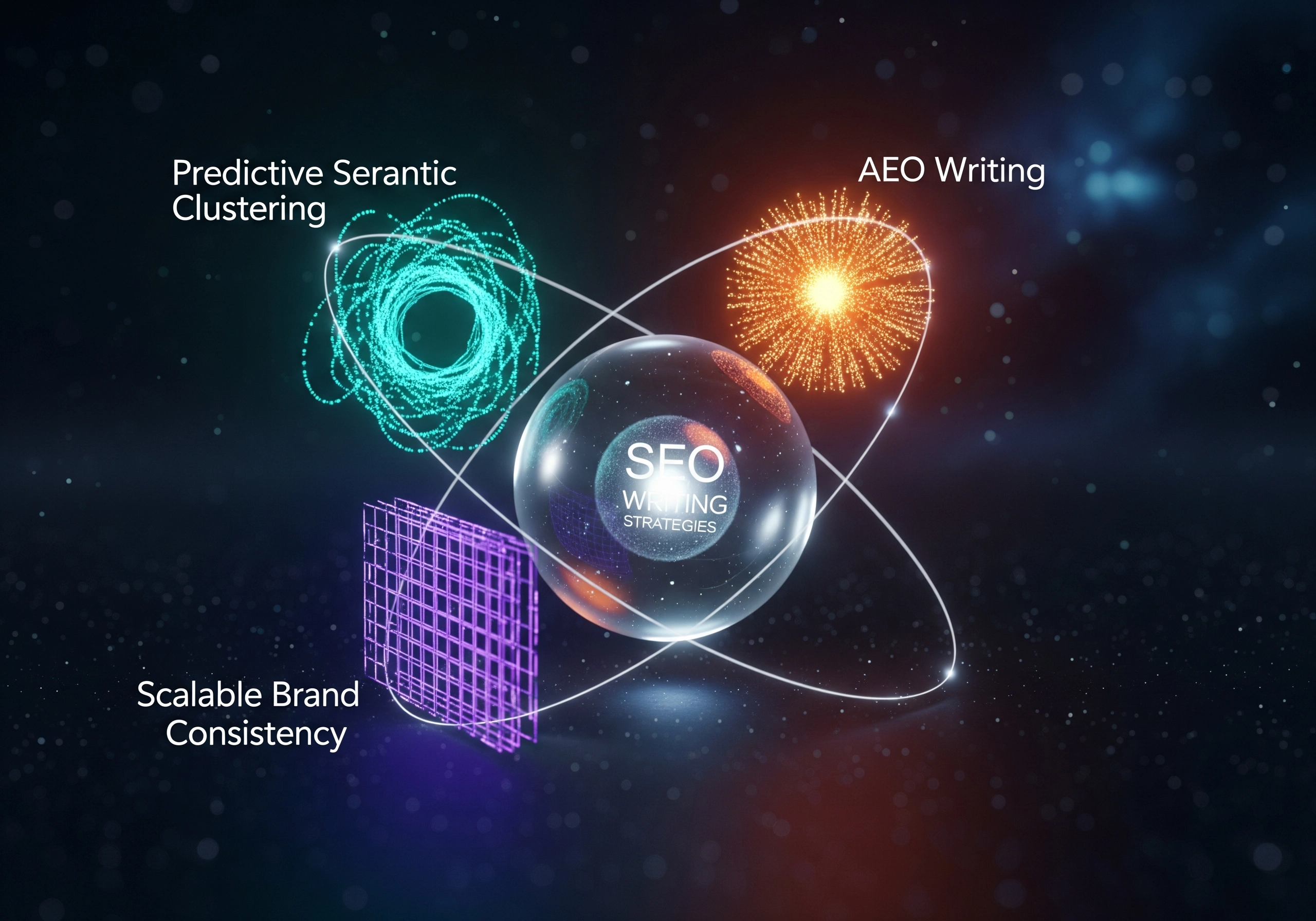
We aren’t just watching a tool upgrade; we’re witnessing a fundamental shift in how the web is indexed. With the AI in SEO market projected to hit nearly $32 billion by 2030, sticking to manual keyword stuffing is a fast track to invisibility. The trends reshaping our industry prioritize intent over volume and answers over links.
The Rise of AEO (Answer Engine Optimization)
Search engines are becoming answer engines. AEO writing focuses on providing direct, concise answers that AI models can easily cite. Instead of burying the lead, effective GenAI SEO writing structures content to be the “source of truth” for platforms like Google’s SGE. If you can’t answer the user’s question in the first paragraph, an AI summary will do it for you—likely using someone else’s content.
Predictive Semantic Clustering
The best SEO writing AI doesn’t just count keywords; it maps the entire conversation. We are moving away from single-keyword targets to semantic clusters that establish topical authority. By integrating a specialized SEO ai writer, marketers can analyze vast datasets to identify content gaps competitors haven’t even noticed yet. This allows you to build a library of interlinked content that signals deep expertise to search algorithms.
Scalable Brand Consistency
Historically, high-volume content meant generic, robotic text. Today, the goal is rigorous seo optimization that retains human nuance. An advanced SEO AI writing tool for websites can now ingest your brand guidelines to ensure every post sounds like you, eliminating the trade-off between speed and quality.
The future belongs to marketers who use AI to scale their unique voice, not replace it.
How can marketers effectively adapt to AI-driven SEO writing?
Adopting SEO writing AI software isn’t about replacing your creative team—it’s about upgrading their toolkit. The most successful marketers today aren’t just writing; they are orchestrating. To adapt effectively, you need to shift your mental model from “content writer” to “content architect.”
Train, Don’t Just Prompt
Generic inputs yield robotic outputs. To make an AI SEO writer for blogs resonate, you must actively train it on your brand voice rather than relying on default settings.
- Feed it examples: Upload your top-performing posts so the AI learns your specific cadence and tone.
- Set strict boundaries: Explicitly list jargon or passive structures to avoid.
- Focus on AEO: Structure content to answer specific user questions directly, catering to the rise of AI search summaries.
The “Human-in-the-Loop” Standard
While AI SEO writing tools excel at data analysis and speed, they need your strategic guidance to truly shine. We recommend a “sandwich” workflow: human strategy, AI execution, human polish.
Key Insight: Automation is useless if it doesn’t align with user intent and brand values.
Tools like GenWrite simplify this by automating the end-to-end blog creation process, from keyword research to publishing. This allows you to leverage generative AI to automate content generation while you focus on the creative nuance that drives conversion.
Can real-world examples illustrate AI’s impact on SEO success?

Real Tools, Real ROI: The Data Don’t Lie
Let’s cut the fluff. Does SEO writing AI actually move the needle? Absolutely. The proof isn’t just in projected market growth; it’s in the trenches. HubSpot, a giant in the space, reported a solid 20% increase in organic traffic after deploying AI to optimize their blog archives. Similarly, Neil Patel Digital saw leads jump by 30% by using AI to hyper-personalize content. These aren’t just anomalies; they are the new baseline for performance.
This shift is driven by accessibility. Platforms like Jasper and Writesonic have empowered teams to scale up as a proficient AI-powered SEO content writer, while Surfer SEO helps nail the semantic relevance Google craves. It’s no longer about choosing between quantity and quality.
At GenWrite, we see this impact firsthand. We designed our AI blog generator to go beyond simple drafting—automating the entire lifecycle from keyword research to WordPress publishing. By leveraging SEO content writing AI, our users streamline workflows that used to take days into minutes, proving that automation is the key to consistency. As noted in recent breakdowns of the 13 best AI SEO content writer tools that write like humans, the brands winning in 2025 are the ones combining automation with strategic oversight to dominate the SERPs.
What’s the next step for mastering AI in SEO writing?
Stop Watching, Start Automating
Analyzing trends is safe, but execution is what actually ranks. In 2025, the divide between a stagnant blog and a traffic powerhouse boils down to intelligent speed. We aren’t just talking about churning out faster drafts; we’re talking about leveraging SEO writing AI to scale your expertise without sacrificing the human nuance that builds trust.
The era of manual keyword digging is fading.
To stay visible, you must pivot from traditional methods to GenAI SEO writing and the emerging standard of AEO writing (Answer Engine Optimization). With AI projected to automate nearly 30% of SEO tasks by 2026, the competitive advantage lies in integration. That’s why we designed GenWrite to act as a full-stack partner. We handle the end-to-end grind—from deep keyword research and competitor analysis to final SEO optimization.
By letting AI SEO tools manage the technical heavy lifting, you gain the freedom to focus on high-level strategy. The next step isn’t just learning; it’s deploying. You can produce high-ranking content with AI SEO writers starting today. The technology is ready—are you?
Ready to supercharge your SEO content? Discover how AI-powered solutions like GenWrite can automate your blog creation and drive organic traffic.
Quick Summary
AI is rapidly transforming SEO writing, making it essential for marketers to adapt.
- AI’s Role: AI is intertwined with the future of SEO writing, driving efficiency, traffic, and engagement.
- Accelerating Forces: Demand for speed and scale, advancements in LLMs, and evolving search engine expectations are accelerating AI adoption.
- Key Trends: AEO, predictive semantic clustering, and scalable brand consistency are reshaping SEO strategies.
- Adaptation Strategies: Marketers should train AI on brand voice, use a ‘human-in-the-loop’ approach, and focus on strategic content architecture.
- Real-World Impact: Examples from HubSpot and Neil Patel Digital show significant SEO success through AI tools.
- Next Steps: Continuous learning and thoughtful integration of AI tools are crucial for mastering AI in SEO writing and staying competitive.
People Also Ask
What is SEO writing AI and why is it important?
SEO writing AI refers to artificial intelligence tools designed to assist in creating content that is optimized for search engines. It’s crucial because it enables marketers to produce high-quality, SEO-friendly content at scale, much faster than traditional methods, thus improving website visibility and engagement.
How do AI writing tools help with SEO content?
AI writing tools can help by conducting keyword research, suggesting topic clusters, optimizing content structure, ensuring brand voice consistency, and even generating drafts. They bridge the gap between the need for speed and scale in content production and the demands of search engine algorithms.
What are the key AI trends in SEO content writing?
Key trends include AEO (AI-Enabled Optimization), which goes beyond traditional SEO by using AI to understand user intent and context. Predictive semantic clustering helps group related topics, and scalable brand consistency ensures AI-generated content aligns with a brand’s unique voice and style.
How can marketers ensure AI-generated content maintains brand voice?
Marketers can train AI models with their existing content and style guides to learn the brand’s voice. A ‘human-in-the-loop’ approach, where human editors review and refine AI outputs, is also essential for maintaining authenticity and brand alignment.
Are there real-world examples of AI impacting SEO success?
Yes, companies like HubSpot and Neil Patel Digital have reported significant increases in organic traffic and leads by integrating AI tools into their content strategies. Platforms like Jasper and Surfer SEO are frequently used to enhance efficiency and content quality, demonstrating tangible results.
What is the ‘velocity gap’ in SEO content creation?
The ‘velocity gap’ refers to the challenge marketers face in producing content quickly enough to meet market demand and search engine expectations, especially with complex topics. AI helps close this gap by automating many time-consuming aspects of content creation and optimization.