
How to Fine-Tune Your AI Writer for SEO Success in 2025
What’s Shifting in SEO and AI Writing for 2025?

The landscape of Search Engine Optimization (SEO) and AI-powered content creation is undergoing a seismic transformation as we approach 2025. Gone are the days when rudimentary AI tools could churn out generic articles that still found their way onto the first page of search results. Today, the bar for quality and relevance has been significantly raised, driven by increasingly sophisticated search algorithms and discerning user expectations.
This isn’t merely an evolution; it’s a recalibration of what constitutes valuable online content. Google’s algorithm updates in late 2024, particularly their emphasis on E-E-A-T (Experience, Expertise, Authoritativeness, and Trustworthiness), have fundamentally reshaped ranking factors. Content that lacks genuine depth or unique insights now struggles to compete, regardless of its keyword saturation.
The Shift from Volume to Value in AI Writing
For years, the promise of an seo ai writer was primarily about scale—generating vast quantities of text quickly. While AI is expected to automate 80% of routine writing tasks by 2025, freeing human writers for more strategic work, this automation no longer guarantees visibility. A recent survey revealed that 67% of SEO professionals anticipate AI-driven content will significantly impact rankings, but only if it’s high-quality.
Generic AI content is now a liability, not an asset.
The focus has irrevocably shifted from sheer volume to demonstrable value. Basic AI writers, while grammatically sound, often fail to imbue content with the nuanced understanding, real-world experience, or unique perspectives that E-E-A-T principles demand. This creates a critical gap between merely generated text and truly authoritative content that resonates with both readers and search engines.
Elevating Your AI Writer for SEO Performance
The challenge for marketers and content creators in 2025 is clear: leverage AI without sacrificing quality. The future of ai writer seo lies in fine-tuning—coaching these powerful tools to produce content that mirrors human expertise and aligns perfectly with search intent. This involves moving beyond simple prompt engineering to a more strategic, iterative process of guidance and refinement.
Modern AI writing tools are increasingly incorporating features designed to enhance E-E-A-T, such as sentiment analysis and fact-checking capabilities. This signals a broader industry trend toward AI assistance that prioritizes quality and trustworthiness. To truly build a high-performing content strategy, a robust understanding of how to guide your AI is essential. Learn more about how to Build a High-Performing Content Strategy Using an AI SEO Writer.
The era of set-it-and-forget-it AI content is over. Success now hinges on strategically integrating AI, providing human oversight, and meticulously optimizing its output to meet the exacting standards of both users and algorithms. This ensures your content stands out in an increasingly crowded digital landscape, delivering genuine value and demonstrating clear authority.
Why Can’t a ‘Basic’ AI Writer Deliver Top SEO Results Anymore?

The era of simply generating text with an ai seo writer and expecting top search engine rankings is definitively over. While early iterations of AI writers offered a novelty factor, the sophisticated demands of today’s search algorithms have rendered basic output largely ineffective for competitive SEO.
The Shifting Sands of Search Engine Algorithms
Google’s continuous algorithm evolution, particularly with late 2024 updates emphasizing E-E-A-T (Experience, Expertise, Authoritativeness, and Trustworthiness), has fundamentally altered the landscape. Content that merely rehashes existing information, or lacks genuine insight, now struggles to gain traction. A survey in late 2024 revealed that 67% of SEO professionals anticipate AI-driven content’s significant impact on rankings within the year, yet this impact hinges on quality, not quantity.
Generic AI content often fails to embody the E-E-A-T principles Google now prioritizes.
Basic AI tools, while adept at grammatical correctness and keyword inclusion, frequently fall short in demonstrating real-world experience or deep expertise. They can assemble facts but rarely infer nuance, convey a unique perspective, or build the trust essential for an authoritative voice. This absence of depth means such content often gets categorized as low-value, failing to connect with readers or satisfy complex search queries.
Why ‘Basic’ AI Writers Miss the Mark
1. Lack of Genuine Experience and Insight: True expertise comes from lived experience, nuanced understanding, and original thought. Basic AI writers synthesize existing data, often leading to derivative content that lacks a unique perspective or practical application. They can’t replicate the ‘why’ behind a decision or the ‘how’ from personal trial and error.
2. Inability to Demonstrate Authority: Authority is built through consistent, high-quality contributions, original research, and a clear, confident voice. AI-generated content, especially from simpler models, often sounds generic and lacks the conviction and depth that signals true authority to both users and search engines.
3. Superficial Understanding of Nuance: Search engines are increasingly adept at understanding context and nuance. Basic AI writers struggle with the subtleties of language, cultural context, and the emotional resonance that makes content truly engaging and trustworthy. This can lead to factual inaccuracies or misinterpretations that undermine credibility.
4. E-E-A-T Deficiencies: As mentioned, E-E-A-T is paramount. A basic seo writing ai tool cannot authentically demonstrate experience (e.g., personal anecdotes, case studies), deep expertise (e.g., original research, complex analysis), authoritativeness (e.g., a consistent, expert voice), or trustworthiness (e.g., transparency, factual accuracy backed by credible sources). These are human-centric qualities that current AI struggles to replicate authentically.
The Path Forward: Advanced AI and Human Collaboration
To achieve top SEO results today, content needs to go beyond mere keyword optimization and grammatical correctness. It requires:
- Deep Research and Originality: Leveraging AI for research and initial drafts, but with significant human input for analysis, unique insights, and original perspectives.
- Demonstrable Expertise: Incorporating real-world examples, case studies, expert interviews, and author bios that clearly establish credibility.
- Nuanced Storytelling: Crafting narratives that engage readers emotionally and intellectually, going beyond a simple recitation of facts.
- Trust and Transparency: Ensuring all information is accurate, well-sourced, and presented clearly, building confidence with the audience.
While AI tools continue to evolve, the most effective seo writing ai solutions will be those that augment human creativity and expertise, rather than attempting to replace it entirely. The future of SEO content lies in a synergistic blend of advanced AI capabilities and indispensable human judgment, experience, and insight.
How Do You Identify the Right AI SEO Tools for Your Strategy?

Navigating the crowded landscape of artificial intelligence (AI) tools to pinpoint the ones that genuinely elevate your search engine optimization (SEO) strategy can feel like a complex puzzle. In an era where Google’s algorithms increasingly scrutinize content for E-E-A-T (Experience, Expertise, Authoritativeness, and Trustworthiness), generic AI outputs simply won’t suffice. The critical question isn’t just if you should use AI, but which seo writing tools are purpose-built to meet the exacting demands of 2025 and beyond.
Moving Beyond Basic Text Generation
Many early AI writers excelled at producing grammatically correct, coherent text. However, the current SEO environment demands far more than surface-level fluency. You’re looking for an AI that can act as an extension of your strategic thinking, not just a word generator. The shift is profound: from basic automation to intelligent augmentation.
The right AI SEO tools empower strategic content creation, not just content production.
This means evaluating tools not on their ability to write, but on their capacity to think like an SEO expert and produce content that resonates with both algorithms and human readers. The true value lies in features that enable fine-tuning, ensuring every piece of content contributes meaningfully to your ranking objectives.
Essential Features of a Top-Tier AI SEO Writer
Identifying the best seo ai writer for your specific needs involves a deep dive into its functional capabilities. Look for platforms that integrate a suite of features designed to address the full spectrum of SEO challenges:
1. Robust Keyword Research and Intent Mapping
A superior AI tool won’t just suggest keywords; it will help you understand search intent. This involves analyzing not only keyword volume and difficulty but also the underlying user queries and the semantic relationships between terms. The tool should help identify long-tail opportunities and topical clusters that your competitors might overlook.
- Does it integrate with real-time search data?
- Can it analyze competitor keyword strategies?
Understanding user intent is paramount for crafting content that truly satisfies the searcher’s needs, a core pillar of modern SEO.
2. Advanced Content Optimization and E-E-A-T Enhancement
This is where many seo writing tools differentiate themselves. The ideal AI should offer more than just keyword density checks. It needs to provide suggestions for improving content depth, identifying semantic gaps, and incorporating entities relevant to your topic. Furthermore, look for features that help inject E-E-A-T signals, such as suggesting credible sources, structuring for clarity, and even prompting for expert insights.
AI should guide you in crafting content that Google perceives as authoritative and trustworthy.
This includes readability scores, sentiment analysis, and suggestions for improving overall content quality to meet high editorial standards. By leveraging these features, you ensure your AI-generated content moves beyond generic output to become a valuable resource.
3. Competitor Analysis and Content Gap Identification
The best seo ai writer provides a strategic advantage by analyzing what your top-ranking competitors are doing well—and where they fall short. This allows you to identify content gaps in your own strategy and create superior content that fills those voids. It should pinpoint areas where your competitors’ content lacks depth or expertise, giving you clear targets for differentiation.
4. Readability, Structure, and User Engagement
Even perfectly optimized content won’t rank if users bounce immediately. The right AI tool will offer insights into content structure, readability, and engagement metrics. It should suggest headings, subheadings, bullet points, and even appropriate internal linking opportunities to enhance user experience. This focus on human readability ensures that your content isn’t just found but also consumed.
Integrating for Strategic Advantage
Ultimately, the goal is to select seo writing tools that integrate seamlessly into your existing workflow and provide actionable insights, not just raw content. The right solution empowers you to fine-tune every aspect of your AI-generated content, transforming it into a powerful asset for ranking. To truly produce high-ranking content with AI SEO writers in 2025, you need tools that offer granular control and strategic guidance.
Choosing the right AI SEO tool means prioritizing intelligence over mere automation, ensuring your content stands out in an increasingly competitive digital landscape.
What Are the Core Pillars of SEO Fine-Tuning for AI Content?
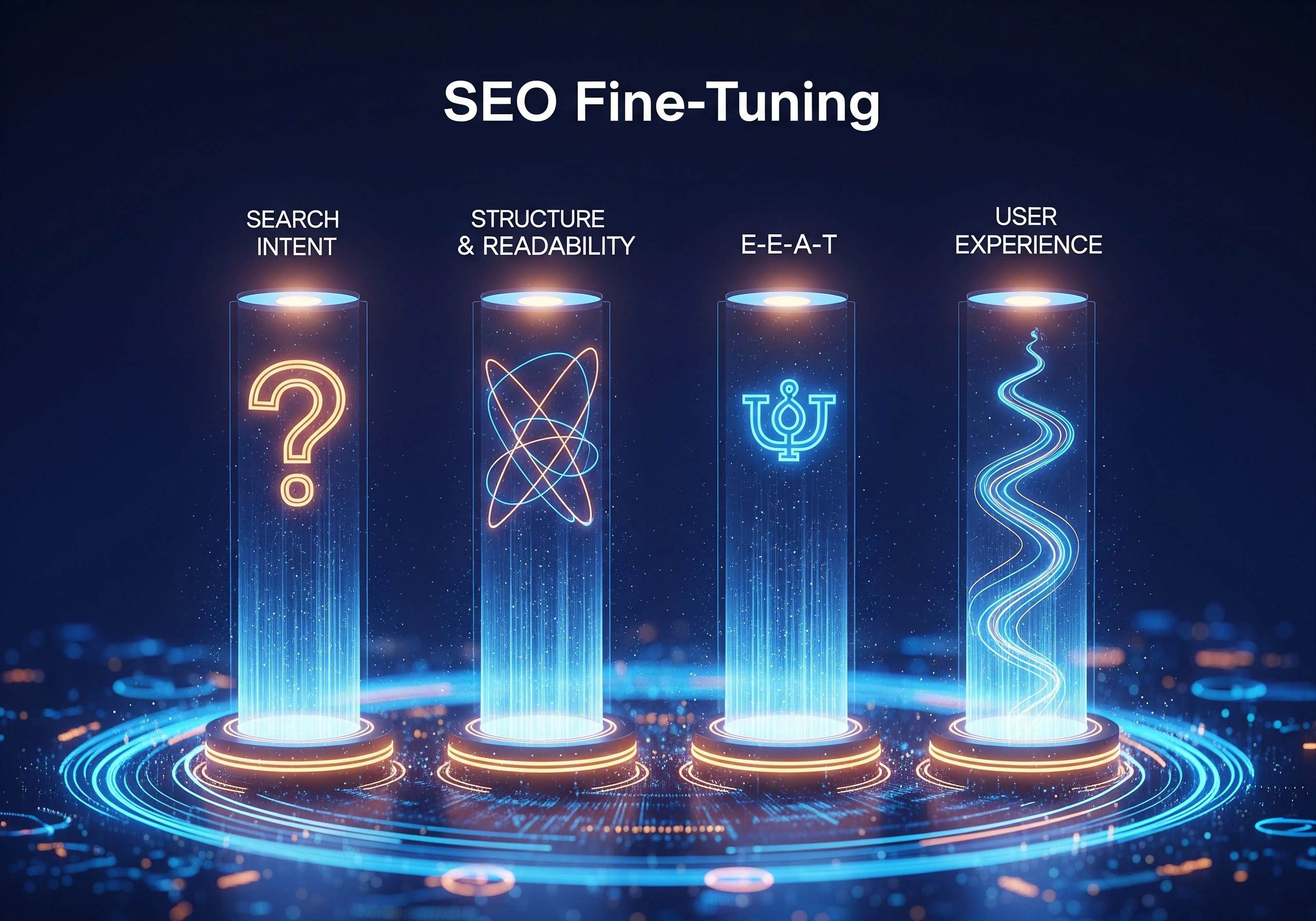
The transition from basic AI content generation to truly high-ranking material demands a strategic overhaul. In an SEO landscape increasingly dominated by discerning algorithms and user expectations, merely producing text is insufficient. The core pillars of fine-tuning an AI writer for SEO success in 2025 aren’t just about keywords; they’re about deeply understanding search intent, structuring for human and machine readability, and instilling genuine authority.
Precision Keyword Strategy & Intent Matching
Gone are the days when keyword stuffing offered any advantage; today, semantic relevance and user intent reign supreme. Fine-tuning your ai seo content writing means guiding the AI to not just include target phrases, but to understand the underlying questions, problems, and aspirations of the searcher. This involves moving beyond head terms to long-tail variations, related entities, and conversational queries that reflect how real people search.
True SEO fine-tuning elevates AI from a keyword placer to an intent interpreter.
By leveraging advanced prompting techniques and integrating comprehensive semantic research, an AI can generate content that directly addresses the nuances of user intent. This ensures the output is not only rich in relevant terms but also delivers precise, valuable answers, satisfying the user’s need. This sophisticated approach drastically improves relevance scores and user satisfaction.
Structuring for Readability and Engagement
Content structure is no longer a mere formatting exercise; it’s a critical SEO signal. For an AI SEO writer, this means going beyond paragraph breaks to create a clear, scannable hierarchy that benefits both search engine crawlers and human readers. Short, punchy paragraphs, strategic use of headings (H3s, H4s), bullet points, and numbered lists break down complex information into digestible chunks.
A well-structured piece guides the reader and signals clarity to search engines.
This meticulous organization enhances readability, reduces bounce rates, and improves dwell time—all positive signals to search engines about content quality. An AI trained to prioritize such structural elements will naturally produce content that is easier to consume, leading to higher engagement and better organic rankings. It’s about engineering content for maximum comprehension at a glance.
Cultivating E-E-A-T and Trustworthiness
Google’s emphasis on E-E-A-T (Experience, Expertise, Authoritativeness, and Trustworthiness) has fundamentally reshaped content creation. Fine-tuning an AI means teaching it to emulate these human qualities. This isn’t about AI having experience, but about it presenting information in a way that demonstrates expertise and builds trust, often by citing credible sources, presenting unique data, or adopting a confident, knowledgeable tone.
E-E-A-T signals transform generic AI output into authoritative insights.
This involves providing the AI with rich, authoritative source material and instructing it to synthesize and present information with a clear, expert voice. When an AI can weave in data-backed claims, reference industry standards, or even suggest real-world examples, it moves beyond superficial content to establish a foundation of credibility that resonates with both users and search algorithms. This is crucial for content that aims to rank in competitive niches.
Enhancing User Experience (UX) and Engagement
Ultimately, SEO is about serving the user, and fine-tuning an AI must extend to optimizing the overall user experience. This pillar focuses on making the content not just informative, but also compelling and interactive. An AI-generated piece should hold the reader’s attention, encourage deeper exploration, and facilitate a positive interaction with the brand or information.
Engagement is the ultimate validator of content quality and relevance.
This involves prompting the AI to adopt narrative arcs, pose rhetorical questions, or incorporate calls to action that guide the reader. By focusing on elements like emotional resonance, clarity of explanation, and anticipatory problem-solving, an AI can produce content that genuinely connects with its audience. This deeper engagement translates into longer session durations and lower bounce rates, which are strong indicators of content value to search engines, ultimately boosting visibility. To truly guide an AI SEO writer for higher content visibility, focusing on these engagement metrics is paramount.
How Can You Optimize AI-Generated Content for Search Engine Ranking?

Optimizing AI-generated content for search engine ranking isn’t a passive process; it’s a strategic, multi-layered endeavor. While an ai seo content generator can produce drafts at speed, transforming them into high-ranking assets requires a keen understanding of both algorithmic demands and human psychology.
The critical shift in 2025 is away from generic AI content and towards AI-assisted content that genuinely adds value, demonstrates E-E-A-T (Experience, Expertise, Authoritativeness, and Trustworthiness), and resonates with search intent.
The Indispensable Human Layer: Refining AI Output
Raw AI output, no matter how sophisticated the AI blog generator, often lacks the nuanced perspective, original insight, and emotional resonance that defines truly exceptional content. This is where human editors become indispensable, acting as the ultimate quality gatekeepers.
Human oversight elevates AI content from functional to authoritative.
Unlike an ai seo content generator, a human editor can inject unique angles, personal anecdotes, and real-world experience that deeply connect with readers. They ensure factual accuracy, verify sources, and align the narrative with the brand’s voice, preventing the flat, often repetitive tone common in unedited AI drafts.
Strategic Keyword Integration and Semantic Depth
While seo content writing tools excel at identifying keywords, effective optimization goes beyond mere keyword stuffing. It involves understanding semantic clusters, user intent, and how different phrases relate to a broader topic.
Moving Beyond Surface-Level Keywords
Instead of just targeting a single keyword, focus on the entire ecosystem of related terms. An ai seo content generator can provide a foundation, but human insight, often augmented by advanced keyword research features within AI SEO tools, ensures that content covers all relevant subtopics and answers every potential user query.
This holistic approach helps search engines understand the comprehensive nature of your content, boosting its perceived authority and relevance. It’s about building a robust topical map, not just individual keyword targets.
Crafting for E-E-A-T and User Experience
Google’s November 2025 algorithm update heavily penalizes content perceived as “AI-generated without added value.” This underscores the absolute necessity of infusing E-E-A-T into every piece.
Demonstrating Authority and Trustworthiness
To enhance E-E-A-T, ensure your AI content includes author bios with relevant credentials, cites credible external sources, and showcases real-world examples or case studies. This transformation from basic text to authoritative resource is a key differentiator.
User experience is equally vital. Content must be highly readable, logically structured with clear headings (H3, H4), short paragraphs, and bullet points. SEO optimization also means ensuring mobile-friendliness and fast loading times, which are critical for retaining user attention and improving dwell time.
Integrating Internal and External Links
Strategic link building within your content serves multiple purposes. Internal links, like to our guide on AI SEO writer, help distribute authority across your site and guide users to related topics. External links to reputable sources bolster your content’s trustworthiness and provide additional value to the reader. This is a crucial step in refining what an ai seo content writing tool initially produces.
The Iterative Optimization Cycle with Advanced AI Tools
Optimization isn’t a one-time task; it’s a continuous cycle of analysis, refinement, and adaptation. Leveraging AI SEO tools like GenWrite can streamline this process significantly.
Continuous refinement is the secret to sustained top rankings.
After initial publication, monitor content performance using blog analysis features. Track metrics like organic traffic, bounce rate, and conversion rates. Use this data to identify areas for improvement, whether it’s updating outdated information, adding more detailed sections, or improving calls to action.
Tools that support content automation for tasks like WordPress auto posting and image addition can free up time for this analytical work. Platforms like GenWrite, designed for bulk blog generation and traffic generation, provide comprehensive suites that combine keyword research, competitor analysis, and SEO optimization features, allowing for seamless iteration and improvement. This integration ensures your AI content consistently meets the evolving demands of search engines and users alike, propelling your content creation strategy forward.
Ready to elevate your AI content for peak SEO performance? Discover how GenWrite can automate your end-to-end blog creation and drive organic traffic.
People Also Ask
What are the biggest SEO shifts impacting AI writers in 2025?
In 2025, SEO is heavily focused on E-E-A-T (Experience, Expertise, Authoritativeness, Trustworthiness) and satisfying specific search intent. Generic AI content will struggle because it often lacks genuine insight and authority, making precise fine-tuning essential for ranking.
Why are basic AI writers no longer sufficient for achieving top SEO rankings?
Google’s algorithm updates prioritize high-quality, user-centric content that demonstrates expertise and trustworthiness. Basic AI writers typically produce generic text that doesn’t meet these E-E-A-T standards or deeply address user intent, leading to poor search performance.
What features should I look for in an AI SEO tool?
Look for AI SEO tools that go beyond basic text generation. Essential features include robust keyword research, intent mapping, content optimization for E-E-A-T, competitor analysis capabilities, and tools to improve readability and user engagement. The right tool integrates strategic guidance with AI power.
How does human oversight improve AI-generated SEO content?
Human oversight is critical for refining AI drafts to ensure they accurately reflect E-E-A-T, possess semantic depth, and genuinely engage the reader. It bridges the gap between AI generation and the nuanced requirements of search engines and users, ensuring content is authoritative and valuable.
What is the role of search intent in fine-tuning AI content?
Understanding search intent is fundamental. Fine-tuning AI content involves ensuring the generated text directly answers the user’s query and fulfills their underlying needs. This means aligning the content’s topic, depth, and format with what the searcher is looking for.
Can AI tools like GenWrite help with competitor analysis for SEO?
Yes, advanced AI tools such as GenWrite can assist with competitor analysis by researching keywords, analyzing top-ranking content, and identifying gaps. This information is crucial for fine-tuning your AI-generated content to be more competitive and effective in achieving higher search rankings.