
How to Guide AI SEO Writers for Higher Content Visibility in 2025
Why is AI Redefining Content Visibility for SEO in 2025?

The Shifting Sands of Search: Why Traditional SEO No Longer Suffices
The landscape of Search Engine Optimization (SEO) is undergoing a profound transformation, driven overwhelmingly by artificial intelligence. What worked effectively just a few years ago for achieving high search rankings is now, by 2025, largely obsolete. The sheer volume of content, coupled with increasingly sophisticated search algorithms, has created an urgent need for a new approach to content visibility.
AI isn’t just an advantage in SEO; it’s rapidly becoming a non-negotiable prerequisite.
This paradigm shift is rooted in the remarkable capabilities of AI. While human SEO specialists once painstakingly analyzed data and crafted content, AI algorithms now process vast datasets at unprecedented speeds, identifying trending topics, optimizing for nuanced keyword clusters, and even personalizing user experiences. This directly translates into higher search engine rankings and significantly improved organic traffic.
The AI Imperative: From Automation to Optimization
By 2025, AI is projected to automate a staggering 70% of SEO tasks, encompassing everything from content creation to intricate optimization strategies. This isn’t just about efficiency; it’s about precision. Studies consistently demonstrate that AI-optimized content can boost organic traffic by as much as 2x compared to traditionally optimized counterparts. This stark contrast highlights why leveraging an AI SEO writer is no longer a luxury but a strategic imperative.
Google’s algorithm updates, particularly the BERT update in late 2024 and subsequent changes, have fundamentally reshaped content evaluation. These updates emphasize natural language understanding and heavily penalize content lacking E-E-A-T (Experience, Expertise, Authoritativeness, and Trustworthiness). This means that generic, keyword-stuffed articles are out, and ‘people-first’ content—rich in unique insights and genuine value—is paramount. For further insights into maximizing your reach, consider how AI enhances content visibility on emerging platforms. You can explore how to get your content seen on LLMs and Perplexity in 2025.
The New Era of AI Writing for SEO
The integration of AI into content creation signifies more than just faster output; it represents a complete re-evaluation of what makes content rank. An AI SEO writer can analyze user intent with greater accuracy, predict search trends, and adapt content dynamically to algorithm shifts. This continuous learning loop ensures that content remains relevant and highly discoverable in a competitive digital environment.
AI ensures your content isn’t just present; it’s prioritized.
The market for AI in content marketing is expanding rapidly, with projections indicating a 40% year-over-year increase, reaching a value of $5 billion by 2025. This growth underscores the widespread recognition of AI’s transformative power in achieving superior content visibility and maintaining a competitive edge. Embracing AI is no longer optional; it’s essential for anyone serious about digital relevance.
What Core AI Capabilities Drive Modern SEO Content Creation?
The landscape of SEO content creation has fundamentally shifted, moving beyond simple keyword stuffing to a sophisticated, data-driven approach powered by artificial intelligence. While traditional methods relied heavily on manual research and intuition, modern content strategies leverage AI to unlock unparalleled insights and efficiencies.
The Power of Natural Language Processing (NLP)
At the core of modern AI content creation lies Natural Language Processing (NLP). This advanced AI capability enables machines to understand, interpret, and generate human language in a way that is both meaningful and contextually relevant. For SEO, NLP is transformative; it allows AI systems to analyze vast amounts of text data, deciphering the nuances of search queries and the semantic relationships between words.
NLP helps AI grasp user intent, not just keywords.
This means an ai seo writer can move beyond simple keyword matching, understanding why a user is searching for something and generating content that directly addresses that underlying need. Google’s BERT update in late 2024 further underscored the importance of natural language understanding, making NLP an indispensable tool for content that aims to rank.
Semantic Analysis: Decoding Meaning and Context
Building on NLP, semantic analysis is where AI truly shines in crafting high-ranking content. Instead of just identifying keywords, AI uses semantic analysis to understand the meaning of an entire document, the relationships between concepts, and how different phrases contribute to a broader topic. This capability allows for the creation of rich, comprehensive content that covers a topic exhaustively, satisfying both search engines and human readers.
Modern SEO demands topical authority, not just keyword density.
AI-driven semantic analysis helps identify crucial sub-topics, related entities, and questions that a human audience might have, ensuring content is not only relevant but also authoritative. This contrasts sharply with older SEO tactics that often led to disjointed, keyword-stuffed articles. The result is content that aligns perfectly with search engine algorithms looking for E-E-A-T (Experience, Expertise, Authoritativeness, and Trustworthiness).
Intelligent Content Generation and Optimization
Once NLP and semantic analysis have laid the groundwork, AI moves into the active phase of content generation and optimization. An advanced ai seo writer can draft outlines, generate entire sections of text, or even create multiple variations of content, all while adhering to specific stylistic and SEO requirements. This capability dramatically scales content production, allowing businesses to maintain a consistent presence across numerous platforms.
For example, AI can analyze top-ranking articles for a given keyword, extract common themes, identify gaps, and then synthesize this information into a unique, optimized piece. It can also assist in optimizing existing content by identifying outdated information, suggesting keyword integrations, and improving readability. This iterative process of analysis, creation, and refinement is what makes ai seo content writing so powerful in today’s competitive digital landscape. AI platforms continuously learn from performance data, refining their output to produce even more engaging and visible content over time. Can an AI really help you write better blog posts in 2025? Absolutely, by handling the heavy lifting of research and drafting, freeing human creators to focus on adding unique insights and personal touches that resonate with readers.
How Can You Strategically Integrate AI into Your Keyword Research and Topic Generation?

The landscape of digital visibility has fundamentally shifted, moving far beyond the simplistic pursuit of isolated keywords. In 2025, strategically integrating AI into your keyword research and topic generation isn’t merely an advantage; it’s a necessity for maintaining relevance and achieving superior organic visibility. AI transforms this process from a manual, often speculative endeavor into a data-driven, predictive science, enabling content creators to anticipate user needs rather than just reacting to them.
Beyond Individual Keywords: Understanding User Intent with AI
Traditional keyword research often centered on identifying high-volume search terms. While this provided a baseline, it rarely captured the nuanced motivations behind a user’s query. AI, powered by advanced Natural Language Processing (NLP), deciphers the true intent embedded within search queries, analyzing context, sentiment, and semantic relationships.
This capability allows you to move past surface-level terms and uncover the underlying questions and problems users are trying to solve. AI illuminates the ‘why’ behind the search, not just the ‘what.’ By understanding user intent with such precision, your content can be crafted to provide exact, satisfying answers, which is paramount for Google’s E-E-A-T guidelines.
AI’s deep semantic analysis transforms keyword lists into intent-driven insights, ensuring every piece of content directly addresses user needs.
Building Topical Authority Through AI-Powered Clustering
Google’s algorithms, particularly after updates like BERT, favor content that demonstrates deep topical authority, not just articles optimized for a single keyword. AI excels at identifying and mapping topical clusters – groups of semantically related keywords and concepts that collectively cover a subject comprehensively. Instead of writing one article per keyword, AI helps you plan a network of interconnected content that establishes your expertise.
AI tools analyze vast datasets, including competitor content, search result pages (SERPs), and user queries, to identify these natural groupings. This allows you to build a robust content strategy that covers all facets of a topic, from broad overviews to niche long-tail queries. This holistic approach signals to search engines that your site is a definitive resource, significantly boosting your authority and ranking potential.
By leveraging AI for topical clustering, you can create interconnected content that establishes comprehensive subject matter expertise, driving higher organic visibility.
AI-Driven Topic Generation: Anticipating Future Trends
AI’s predictive analytics capabilities extend beyond current search trends, enabling proactive topic generation. By analyzing historical data, emerging queries, and even social media discussions, AI can identify nascent trends and content gaps that human researchers might miss. This foresight allows you to create timely, relevant content before the competition catches up.
Furthermore, AI assists in identifying areas where existing content can be expanded or updated for optimal performance. This continuous loop of analysis and creation is crucial for effective ai article optimization. When you guide your AI writers with these intent-rich, cluster-based insights, the resulting content is naturally more relevant, comprehensive, and engaging, aligning perfectly with the demands of search engines and human readers alike. For a deeper dive into harnessing AI for high-ranking content, explore how to produce ai seo content writing.
Strategic topic generation with AI means you’re always one step ahead, capturing demand as it forms.
Integrating AI into keyword research and topic generation is about more than efficiency; it’s about shifting to a more intelligent, predictive, and user-centric content strategy that drives unparalleled content visibility in 2025 and beyond.
What are the Best Practices for Guiding AI to Produce High-Quality, SEO-Optimized Content?
Guiding artificial intelligence to produce truly high-quality, SEO-optimized content isn’t a passive act; it’s a strategic partnership. While AI can automate up to 70% of SEO tasks by 2025, its output quality is directly proportional to the precision of your input. The shift isn’t about letting AI write whatever it wants, but mastering the art of instructing an ai seo content generator to meet rigorous standards.
The Prompt Engineering Imperative: Crafting Intelligent Directives
Effective guidance begins with meticulous prompt engineering. Generic requests yield generic results. To guide AI writing effectively, you must provide a detailed blueprint that encompasses context, intent, and specific constraints, moving beyond simple keyword stuffing to semantic richness.
A well-engineered prompt transforms AI from a simple text generator into a strategic content partner.
The Context-Intent-Constraint (CIC) Framework
Think of your instructions as a refined framework, not just a command. This CIC Framework ensures the AI understands the why, what, and how of its task.
- Context: Define the audience, their pain points, the blog’s overall purpose, and the specific stage of the customer journey this content addresses. For example, specify that the content should resonate with early-stage researchers looking for solutions, not just product features.
- Intent: Clearly state the desired outcome. Do you need a 1000-word blog post, a product description, or a comparative analysis? Specify the primary keyword, secondary keywords, and the core message to convey.
- Constraints: This is where precision shines. Dictate tone (professional, authoritative), style (short paragraphs, bullet points), length, required E-E-A-T signals (e.g., cite studies, expert opinions), and internal linking opportunities. This helps your seo content writing ai align with your brand voice and SEO goals.
Injecting Semantic Intelligence and E-E-A-T Directives
Beyond basic keywords, provide the AI with semantic clusters and entities. Instead of just listing “AI SEO,” instruct it to cover related concepts like “natural language processing for SEO,” “machine learning in content strategy,” and “Google BERT update implications.” This builds topical authority, a critical factor for visibility, especially with Google’s emphasis on natural language understanding.
Guiding for ‘People-First’ Content
Google’s 2024 algorithm updates heavily penalized content lacking E-E-A-T. Your guidance must explicitly instruct the AI to integrate elements that demonstrate Experience, Expertise, Authoritativeness, and Trustworthiness. This might involve:
- Factual Basis: Provide data points, statistics (like AI’s projected market value of $5 billion by 2025), and links to authoritative sources.
- Unique Insights: Prompt the AI to explore nuanced perspectives or potential future trends, which elevates the content beyond mere information aggregation.
- Expert Integration: Instruct the AI to simulate expert opinions or reference specific industry thought leaders, aligning with the need for strong E-E-A-T signals.
High-quality AI output isn’t just about keywords; it’s about compelling narratives backed by verifiable expertise.
Iterative Refinement and Human Oversight
The initial AI output is rarely the final version. Treat it as a highly sophisticated first draft. Establish a feedback loop where human editors review for accuracy, brand voice consistency, and the crucial ‘people-first’ element. This human touch ensures the content is not only optimized for search engines but also genuinely engaging and valuable for readers.
By carefully refining AI-generated content, you ensure it maintains high AI content visibility and avoids penalties. The goal is to leverage the speed of an AI blog writer while preserving the depth and nuance only human expertise can provide. This collaborative process is key to achieving superior organic traffic, potentially doubling it compared to non-optimized content.
How Does AI Assist in Optimizing and Auditing Existing Content for Enhanced Visibility?
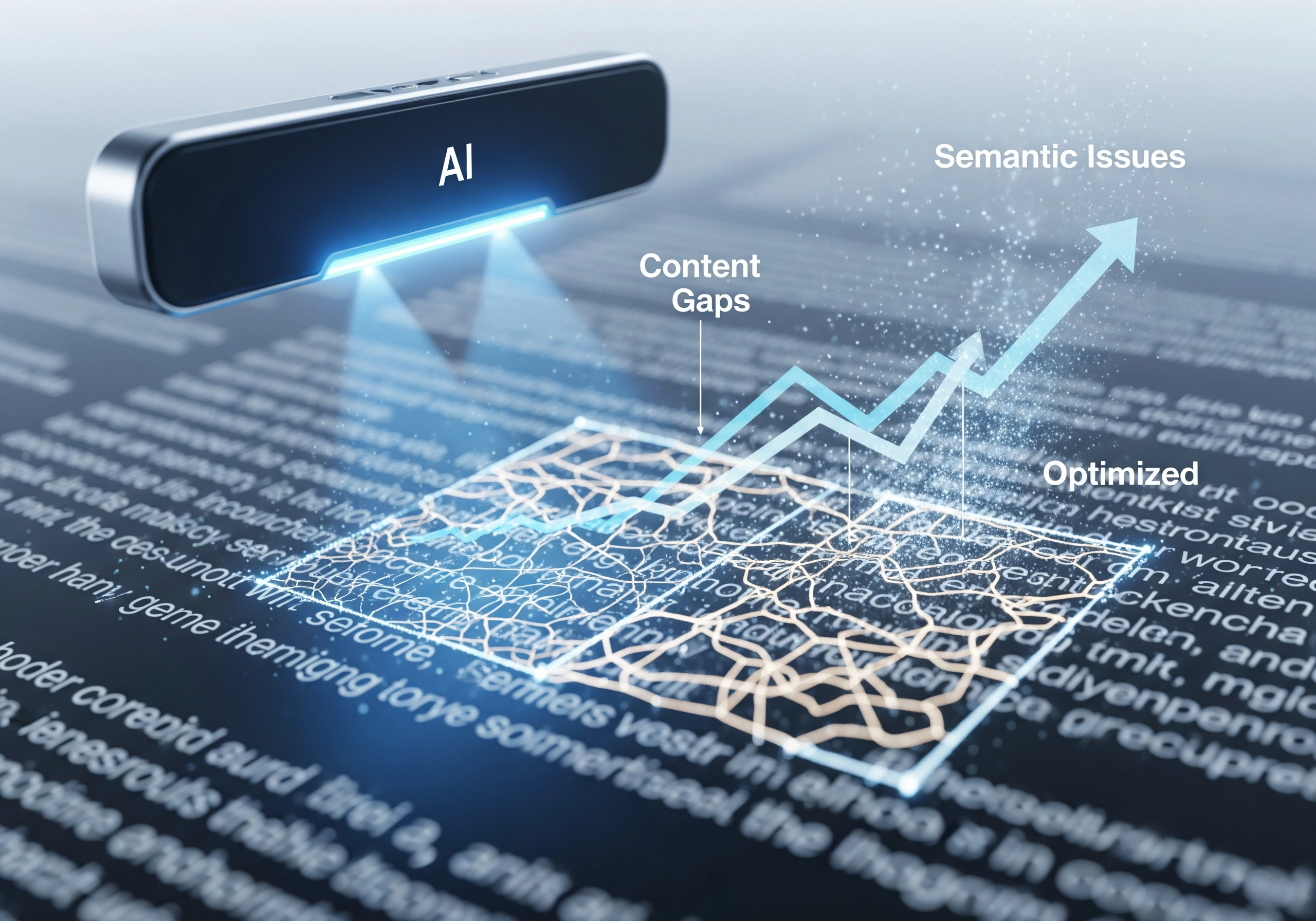
Maintaining content relevance in a rapidly evolving search ecosystem is a monumental task. As algorithms like Google’s BERT continue to prioritize contextual understanding and E-E-A-T, even high-performing articles can quickly become outdated or semantically misaligned. This is where artificial intelligence steps in, transforming the arduous process of content auditing and optimization into a streamlined, data-driven operation.
Uncovering Content Gaps with AI Audits
Historically, auditing existing content involved manual, time-consuming reviews that often missed subtle but critical issues. AI tools now automate this process, scanning vast libraries of content with unprecedented speed and precision. They identify outdated statistics, broken links, and factual inaccuracies that could erode trust and diminish E-E-A-T signals.
More profoundly, AI excels at pinpointing semantic gaps and keyword cannibalization. It can analyze an article’s topical coverage against competing content and identify areas where a deeper dive into related subtopics or long-tail keywords would significantly enhance its authority and relevance. This comprehensive analysis provides a clear roadmap for ai article optimization.
AI acts as a tireless digital editor, flagging unseen opportunities and critical flaws in your content library.
AI’s analytical prowess is especially critical for maintaining AI content visibility across diverse search platforms, including LLMs and traditional search engines. It ensures your foundational content remains robust and aligned with current user intent.
AI-Powered Enhancements for Existing Content
Once gaps are identified, AI shifts from auditor to optimizer, providing actionable recommendations for improvement. For readability, AI suggests sentence restructuring, simplification of complex jargon, and improvements to overall flow, ensuring content is accessible and engaging for its target audience. It can even assess the emotional tone, recommending adjustments for better resonance.
Regarding semantic relevance, AI analyzes keyword clusters, latent semantic indexing (LSI) terms, and related entities to enrich the article’s topical depth. This deep understanding allows for the seamless integration of semantic variants, bolstering the content’s comprehensive coverage without resorting to keyword stuffing. It ensures the article fully addresses the user’s implicit intent.
AI also automates metadata optimization, suggesting compelling title tags and meta descriptions that improve click-through rates (CTR) from search results. Furthermore, it identifies strategic internal linking opportunities, strengthening site architecture and distributing link equity effectively across your content ecosystem. This continuous refinement cycle is crucial for sustained organic performance.
From micro-edits to macro-structural suggestions, AI elevates content quality and search performance.
This continuous feedback loop for ai content creation and refinement is vital for keeping your content fresh and competitive in a market where content decay is a constant threat. AI ensures every piece of existing content works harder for your SEO goals.
The Iterative AI Optimization Loop
The most effective approach is to view ai article optimization as an ongoing, iterative process, not a one-time fix. AI tools facilitate a continuous loop of:
- Analysis: Deep dive into performance data, keyword rankings, and user engagement.
- Recommendation: AI suggests specific improvements based on its analysis.
- Implementation: Human editors or AI assistants apply the recommended changes.
- Monitoring: Track the impact of changes on visibility and engagement metrics.
This agile approach to content management ensures that your existing assets are consistently refined, adapting to algorithm shifts and evolving user needs. It transforms your content library from static pages into dynamic, high-performing assets.
Can AI Tools Like GenWrite Help You Scale Content Production and Maintain Authority?
The paradox of modern content marketing lies in the need to produce a high volume of content without sacrificing quality or authority. In a landscape where AI is projected to automate up to 70% of SEO tasks by 2025, the question isn’t if AI can help, but how strategically it can be deployed to scale operations while upholding brand integrity.
Historically, scaling content meant an exponential increase in resources—more writers, editors, and project managers. This traditional approach often led to bottlenecks, inconsistent quality, and a significant drain on budgets. The advent of sophisticated AI platforms, however, has fundamentally shifted this paradigm, offering a powerful lever for unprecedented scale.
AI as a Force Multiplier for Content Operations
Modern AI tools act as a force multiplier, transforming slow, manual processes into rapid, data-driven workflows. They enable bulk content generation, moving beyond single-article creation to producing entire content clusters or campaign assets simultaneously. This capability is critical for businesses aiming for aggressive market penetration or maintaining a dominant share of voice.
Strategic content automation is key to unlocking scalable, authoritative content production.
Platforms like GenWrite exemplify this shift, offering robust content automation features designed to streamline the entire content lifecycle. From initial ideation to final publication, these systems manage complex tasks, ensuring efficiency without compromising output quality.
Precision in Content Optimization and Automated Publishing
Scaling isn’t just about quantity; it’s about intelligent, optimized quantity. AI excels at integrating SEO best practices directly into the content generation process. This includes real-time keyword density analysis, semantic optimization, and readability checks, ensuring each piece is engineered for maximum organic reach from its inception.
AI-powered content optimization ensures every article is not only well-written but also highly relevant to search intent. This precision is vital for traffic generation, converting broad search queries into engaged site visitors.
Beyond creation, AI tools facilitate automated publishing, integrating seamlessly with Content Management Systems (CMS) to schedule and release content. This reduces manual overhead and ensures a consistent publishing cadence, a critical factor for maintaining search engine relevance and audience engagement. Such capabilities position an AI platform as the best seo ai writer for forward-thinking organizations.
By automating the tactical aspects of content production, teams can reallocate human expertise to strategic oversight, nuanced editing, and the infusion of unique insights that bolster E-E-A-T (Experience, Expertise, Authoritativeness, and Trustworthiness). This human-in-the-loop model ensures that while scale is achieved, the content remains ‘people-first’ and authoritative.
AI tools provide the infrastructure for rapid content deployment and optimization, enabling brands to significantly boost their content visibility across diverse digital channels. This allows for both high volume and high impact, a combination previously unattainable.
Ultimately, AI platforms empower businesses to scale content production dynamically, ensuring that every piece contributes to maintaining and enhancing their expert authority in an increasingly competitive digital arena.
What Crucial Steps Ensure Your AI-Generated Content Remains ‘People-First’ and Avoids Penalties?

The specter of Google penalties for AI-generated content looms large, yet the truth is nuanced: it’s not about whether AI is used, but how it’s employed. Google’s algorithms, particularly after updates like BERT, prioritize people-first content that demonstrates Experience, Expertise, Authoritativeness, and Trustworthiness (E-E-A-T). This means your seo writing ai efforts must be meticulously guided by human insight.
The Human-in-the-Loop Imperative
Automating content creation with AI offers immense efficiency, but true value emerges when human editors refine and elevate the output. Think of AI as a highly capable first-draft generator or a research assistant. It can synthesize vast amounts of information rapidly, but it lacks the nuanced understanding, critical judgment, and subjective experience that define human communication.
AI is a co-pilot, not an autopilot, for truly impactful content.
Your role is to act as the quality gatekeeper, ensuring the AI’s output aligns with your brand voice, factual accuracy, and most importantly, provides genuine value to the reader. This iterative process of generation and refinement is non-negotiable for avoiding content that feels generic or thin.
Injecting Unique Value and Experience
Google explicitly states its preference for content that offers unique perspectives or personal experience. AI, by its nature, draws from existing data, making it prone to generating derivative content. To counteract this, human input must inject original thoughts, real-world case studies, proprietary data, or unique observations.
Ask yourself: What fresh angle can this piece offer? What personal anecdote or expert opinion can elevate it beyond what AI alone can produce? This is where your brand’s unique E-E-A-T signals become powerful differentiators.
Rigorous Fact-Checking and Accuracy
While AI SEO tools are increasingly sophisticated, they can still hallucinate—presenting false information as fact. Relying solely on AI for factual content is a direct path to eroding trust and inviting penalties. Every statistic, claim, and piece of data generated by AI must undergo stringent human verification.
Establish a robust fact-checking protocol. Cross-reference sources, consult subject matter experts, and ensure all information is current and accurate. Trustworthiness is a cornerstone of E-E-A-T, and it’s built on a foundation of verifiable truth.
Semantic Depth and Intent Alignment
AI can optimize for keywords, but understanding the deeper search intent behind a query still largely requires human discernment. A people-first approach means going beyond surface-level keyword matching to address the user’s underlying questions, pain points, and desires comprehensively.
Evaluate whether the AI-generated content truly answers the user’s implicit needs, offers actionable solutions, and provides a holistic understanding of the topic. This depth, often achieved through human-led content structuring and elaboration, significantly enhances content visibility and user satisfaction. For example, to make your content stand out on platforms like Perplexity in 2025, a deep understanding of user intent is paramount for effective AI search engine optimization.
Cultivating a Distinct Voice and Style
Generic, bland prose is a hallmark of unedited AI content. Your brand’s unique voice, tone, and style are critical for connecting with your audience and building authority. Human editors must fine-tune the AI’s output to reflect this distinct brand personality, ensuring the content is engaging, relatable, and memorable.
By prioritizing human input at every stage—from ideation and unique value injection to rigorous fact-checking and stylistic refinement—AI-generated content transcends mere information, becoming genuinely valuable, penalty-proof, and truly people-first.
How Can GenWrite Transform Your SEO Workflow and Analytics for Continuous Improvement?
Navigating the ever-shifting landscape of SEO demands more than just initial content creation; it requires a robust system for continuous improvement. The challenge for many organizations lies not in generating content, but in systematically analyzing its performance, understanding market dynamics, and adapting strategies in real-time. Without powerful analytics and strategic insights, even the most well-crafted articles can stagnate, failing to deliver sustained organic visibility.
GenWrite steps into this gap, transforming how SEO professionals approach their workflow and analytics. It moves beyond basic reporting, offering a sophisticated suite of features designed to empower data-driven decisions and foster an agile content strategy. This platform serves as an indispensable ally for forward-thinking SEOs aiming for sustained growth and market dominance.
Advanced Blog Analysis for Deeper Insights
Traditional content performance metrics often paint an incomplete picture. GenWrite elevates blog analysis by providing granular data on how each piece of content performs across various search parameters. It tracks not just rankings and traffic, but also user engagement signals, conversion paths, and the semantic relevance of your content in relation to evolving search intent.
Understanding why content performs (or doesn’t) is crucial for effective optimization.
This depth of insight allows you to pinpoint underperforming articles, identify content gaps, and understand the precise elements that contribute to high-ranking, engaging pieces. It’s about moving from guesswork to informed, actionable strategy, ensuring every optimization effort is targeted and impactful.
Unveiling Competitor Strategies Through Intelligent Analysis
Staying ahead in the digital race necessitates a keen understanding of your rivals. GenWrite’s competitor analysis capabilities provide an unparalleled view into what your competitors are doing right—and where they might be falling short. The platform leverages advanced AI to dissect competitor content strategies, identify their top-performing keywords, and analyze their backlink profiles.
By comparing your content performance against theirs, GenWrite helps you uncover new opportunities for topical authority and keyword targeting. This intelligence allows you to benchmark your efforts, identify strategic advantages, and even anticipate future market shifts. It’s like having a strategic intelligence unit dedicated to your SEO success.
The GenWrite Loop: From Data to Continuous Improvement
At its core, GenWrite facilitates a powerful cycle of creation, analysis, and refinement. As an advanced AI SEO writer, it doesn’t just help generate content; it closes the loop by feeding performance data back into the content strategy. This allows for constant iteration and optimization, ensuring your content remains relevant and competitive.
GenWrite offers data-driven recommendations, highlighting specific areas for improvement, such as keyword optimization, content expansion, or internal linking opportunities. This continuous feedback mechanism ensures that every new piece of content benefits from the learnings of its predecessors, consistently pushing the boundaries of your organic reach. Integrating an AI SEO tool like GenWrite into your operations transforms your workflow from reactive to proactively optimized, fostering a culture of perpetual content excellence.
What Future Trends in AI SEO Should You Be Preparing For in 2025 and Beyond?

The digital horizon of 2025 and beyond is set to be radically reshaped by accelerating AI capabilities, fundamentally redefining how content visibility is achieved. We’re moving beyond basic keyword optimization into an era where artificial intelligence doesn’t just assist; it’s becoming the architect of search success.
The Dawn of Hyper-Personalization and Predictive Content
Prepare for an unprecedented level of search personalization. Future AI algorithms will transcend simple query matching, anticipating user intent by analyzing vast amounts of behavioral data, contextual clues, and even emotional indicators. This seismic shift means ai writing for seo must evolve to generate dynamic, highly segmented content that adapts in real-time to individual user profiles, leaving static articles behind.
True personalization will emerge as the ultimate differentiator for search ranking.
This evolution necessitates AI tools capable of understanding complex user journeys and proactively crafting content that resonates deeply with specific audience segments. The ability to forecast trending topics and anticipate user needs before they fully materialize will be a critical competitive advantage, transforming reactive SEO into a predictive science.
Embracing Multimodal Search and Advanced Semantic Understanding
Voice and visual search are merely the precursors to AI’s deeper integration across multimodal search interfaces. Content optimization will extend beyond text to encompass audio, images, and video, demanding AI that can extract and synthesize meaning across these diverse formats. Google’s continuous advancements in Natural Language Processing (NLP) will foster a more profound comprehension of language, context, and semantic relationships, rendering superficial content ineffective.
AI will increasingly analyze sentiment and emotional tone, ensuring content is not only informative but also emotionally resonant.
This advancement will elevate E-E-A-T (Experience, Expertise, Authoritativeness, and Trustworthiness) to paramount importance. AI writing for SEO must now prioritize the production of content that demonstrably showcases deep subject matter expertise and authentic insights. Consequently, human oversight of AI-generated content becomes indispensable for maintaining quality and safeguarding against potential penalties.
Navigating these future trends requires a commitment to continuous learning and agile adaptation. Embrace AI not merely as a tool, but as an indispensable partner in deciphering and shaping the future of search.
Ready to revolutionize your content strategy? Discover how GenWrite can help you scale AI-powered SEO content creation and boost your visibility.
People Also Ask
How is AI changing SEO content visibility in 2025?
AI is redefining SEO by automating tasks, enhancing precision, and adapting to algorithm changes. This allows for more efficient content optimization, leading to higher search rankings and sustained relevance in a competitive digital landscape. The focus is shifting towards ‘people-first’ content that AI helps to deliver at scale.
What are the key AI capabilities for SEO content creation?
Core AI capabilities driving modern SEO content include Natural Language Processing (NLP) and semantic analysis. These enable AI writers to understand user intent, decode meaning, and generate comprehensive, authoritative content that aligns with search engine algorithms and E-E-A-T principles.
How can I use AI for keyword research and topic generation?
AI can be strategically integrated into keyword research and topic generation by understanding user intent beyond basic keywords, building topical authority through clustering, and proactively generating topics by anticipating future trends. This ensures content is relevant, comprehensive, and aligned with search engine demands.
What are the best practices for guiding AI to produce quality SEO content?
Best practices involve strategic prompt engineering, such as using the Context-Intent-Constraint (CIC) framework, and injecting semantic intelligence. Crucially, human oversight is necessary for iterative refinement, ensuring the content is both search engine friendly and valuable to readers.
How does AI help in optimizing existing content?
AI revolutionizes content auditing and optimization by uncovering content gaps, identifying semantic issues, and suggesting data-driven improvements for readability and relevance. This creates an iterative AI optimization loop, transforming static content into dynamic, high-performing assets.
Can AI tools like GenWrite help scale content production while maintaining authority?
Yes, AI tools like GenWrite act as force multipliers, enabling efficient content generation, optimization, and automated publishing. By automating tactical tasks, AI allows human teams to focus on strategic oversight and unique insights, ensuring ‘people-first’ content that drives traffic and enhances brand authority.