
Your first steps with an AI blog generator — A total beginner’s roadmap
Getting started: ditching the blank page for good

That blinking cursor on a blank page is the worst, isn’t it? You know you need to create content for your business, but the starting friction feels immense. This is the exact moment where an AI blog writer changes the game, though probably not in the way you think.
Let’s get the big worries out of the way first. Is using AI for blog writing some form of cheating? Absolutely not. It’s a tool, and its value depends entirely on who’s using it. Believing that AI is a cheat code for ranking higher on Google is a beginner mistake that leads to disappointing results. And what about the output? It’s true that raw AI text can sound generic. We all recognize that robotic tone, but there are proven techniques to humanize AI content so it reflects your actual voice.
This guide is built on a fundamental mindset shift for anyone creating beginner AI blogs. You are not a writer handing your job to a machine; you are becoming an Editor-in-Chief. The AI is your incredibly fast junior writer, handling the heavy lifting of drafting and structuring. You provide the strategy, the unique insights, and the final polish that makes the content resonate.
So, we’ll walk through a complete workflow that avoids the common ‘one-prompt trap’,where you just ask for a blog and publish the first thing you get. Instead, you’ll learn a repeatable process to guide the AI, review its output critically, and add the human element that search engines and readers value. This human-in-the-loop approach is exactly how tools like our own AI blog writer are designed to function, automating the tedious parts while keeping you in control of the final product. By the end, you’ll have a framework to consistently produce quality blog posts without ever starting from scratch again.
Understanding your new writing partner: what’s an AI blog generator?
So, you’ve ditched the blank page. Good. An AI blog generator isn’t some magic button that spits out perfect articles. It’s a powerful, often frustrating, creative partner. To really get this relationship, stop thinking of yourself as merely a writer. You’re the Editor-in-Chief now.
Your new AI tool? Think of it as the junior writer on your team. It’s lightning fast, has consumed nearly all written content, and never clocks out. But it’s useless without your direction, your specific expertise, and your final sign-off. It doesn’t have opinions or real-world experience. It just recognizes patterns.
What an AI blog generator does
Basically, a standard ai blog post writer is a generative model. You feed it a prompt, and it churns out a text draft. How? By constantly predicting the most statistically probable next word. It’s just stitching together a plausible-sounding article from the massive dataset it trained on.
More advanced platforms, often called a generative ai agent, do much more. A system like GenWrite’s AI writing tool doesn’t just write; it integrates the entire content workflow. This means it handles keyword research, competitor analysis, and structural optimization. It takes a raw idea and turns it into a data-backed draft. This kind of automation lets creators slash blog production time by a third or even more.
The biggest beginner mistake to avoid
Here’s the most common screw-up I see: the “One-Prompt Trap.” Someone types a lazy command like “write about SEO,” gets a generic article, and then hits publish. That’s a guaranteed failure. The output will be bland, offer no unique perspective, and that’s precisely why most AI SEO content fails to rank. The tool isn’t the problem; your lack of editorial oversight is. Your job is to take that raw material and forge something exceptional.
Why bother with AI? It’s not just about speed

Three out of four marketing professionals now use AI in their content creation. It’s not just about cutting 30-50% off writing time, though that’s a huge plus. The real change? Your job shifts from content laborer to strategic editor. AI simply eliminates the “blank page” problem.
Instead of wrestling with a first draft for hours, you’re guiding the process. Your main work involves refining, fact-checking, and injecting your unique expertise into the initial text. This lets you focus on strategic SEO optimization for blogs and effective keyword-driven blog writing. You’re no longer bogged down by the simple act of putting words on a page; you’re free to consider the broader strategy.
Search engines don’t penalize this. Their algorithms reward quality, authority, and trustworthiness (E-E-A-T), no matter what tools you used for the first draft. Frankly, a well-edited AI draft often outperforms a rushed human one. Why? You gain time for elements truly impacting search engine optimization. An advanced AI SEO content generator takes care of the grunt work, letting you perfect content structure and internal linking – key signals of expertise.
This isn’t about outsourcing your brain; it’s about making it stronger. The whole debate about AI writer performance misses the mark when it frames this as a competition. The best outcomes come from collaboration. That’s where tools like GenWrite shine. They integrate automated on-page SEO and function as a potent SEO content optimization tool. It’s a system built to support high-quality content writing at scale, a subject we often discuss on our blogs. The aim isn’t just faster writing. It’s smarter thinking.
Your first hour with AI: a practical 60-minute workflow
Knowing AI can write fast is one thing; actually building a process that delivers quality content is another. Forget the blank page. Your new job is editor-in-chief, and this is your first hour. This AI blog writing workflow moves you from idea to a solid first draft in 60 minutes.
Minutes 0-15: Strategic Briefing
Your initial task isn’t writing; it’s directing. The quality of AI output hinges entirely on your instructions. Start by defining non-negotiables in a simple text document you’ll feed the AI. This brief should specify the target audience, primary keyword, core article objective, and a precise tone of voice. A robust prompt also includes what not to do, such as avoiding clichés or specific jargon. This initial setup demonstrates how an AI blog writer can transform your content.
Next, have the AI generate a detailed, hierarchical outline from your brief. Don’t accept the first one. Request two or three variations until you have a logical flow that serves your reader’s journey. This outline becomes your production blueprint.
Minutes 15-45: Section-by-Section Drafting
Resist the urge to ask the AI to write the entire blog post in one go. That approach often leads to ‘context drift,’ where the AI loses track of your initial instructions midway. Instead, work section by section. Feed the AI each relevant heading from your outline along with your original strategic brief. This modular approach forms the core of an effective AI blog generator workflow.
For each section, you’ll prompt something like: “Using the brief I provided, write the section for H3: [Your Section Title Here]. Keep it under 150 words and focus on [specific point].” This keeps the output tight and on-message. It’s a reliable method, especially if you’re considering why an AI blog writer might benefit your content.
Minutes 45-60: The Human Polish
The AI’s job is to produce the clay, not the finished sculpture. This final phase demands your expertise and personality. Read through the draft. Correct awkward phrasing, verify every claim. Add personal anecdotes or specific data points only you possess. This is where you build trust.
Run the text through an AI content detector. Check its readability and confirm it doesn’t sound robotic. Finally, leverage the AI one last time for SEO mechanics. Have it generate a compelling title and description, then refine these using a dedicated meta tag generator. This hybrid approach reflects our philosophy about our tools and ourselves at GenWrite.
The beginner traps: what to avoid for genuinely good content
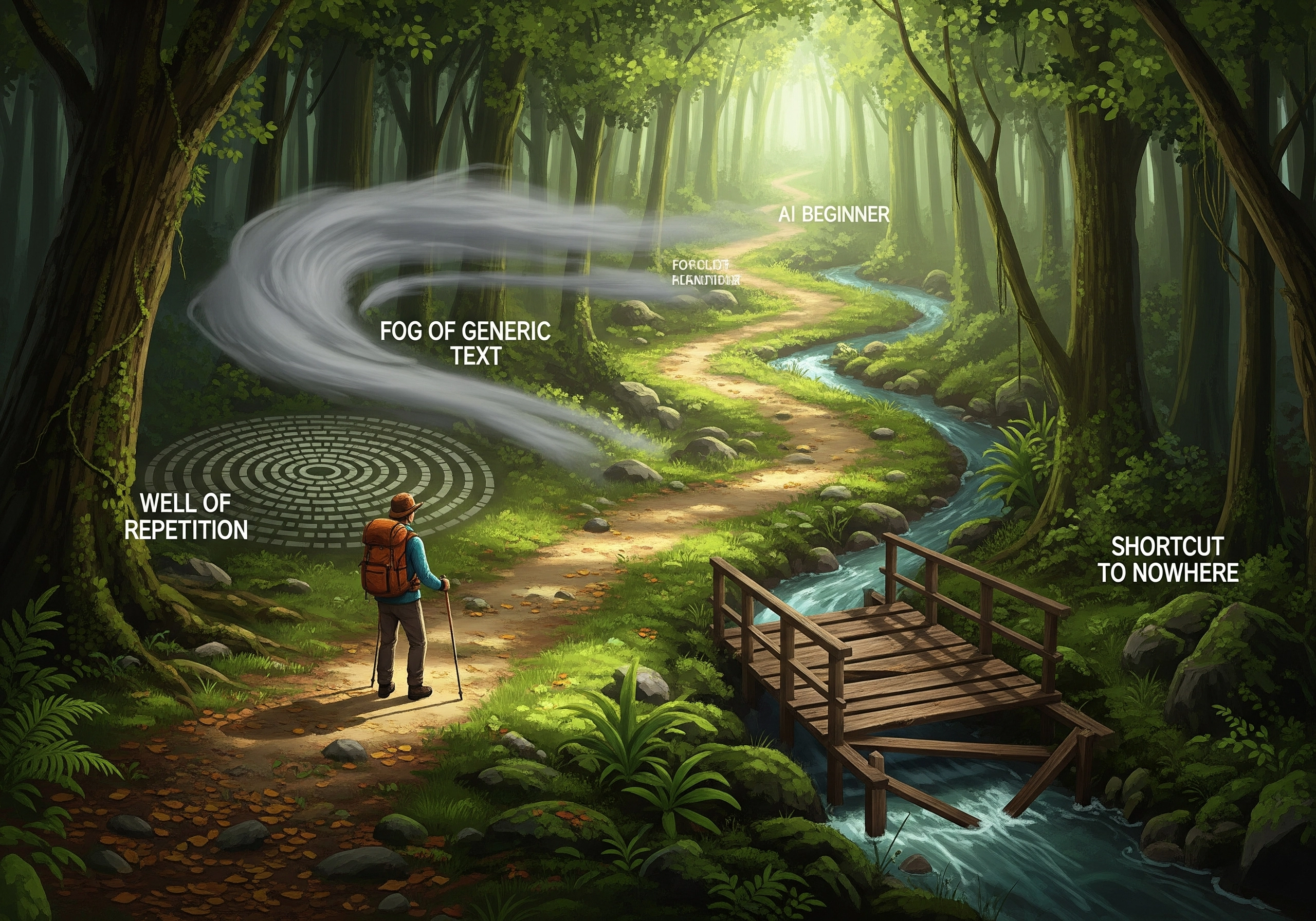
So, you’ve just finished your first 60-minute workflow. The AI spat out a complete blog post, and hey, it looks pretty coherent. Intro, body, conclusion – check, check, check. It’s incredibly tempting to just hit ‘publish’ right now. But hold on. This is the very first, and probably the biggest, trap: seeing the AI as a content vending machine instead of, say, a junior writing partner.
That initial draft? It’s a starting point, not the finish line. Usually, it’s pretty generic, a bit too formal, and frankly, it doesn’t have your voice. The most important thing you can do for truly great content is to fight that urge to publish it untouched.
The Myth of the Finished Draft
One of the biggest blunders new users make is thinking the AI’s first output is ready to go. Sure, the AI’s good at building a solid draft, but it can’t give you your unique take, your experiences, or your dissenting views. Your real job? Take that C+ draft and make it an A+ article. That means tweaking sentences until they sound like you, maybe dropping a personal story into the intro, or even pushing back on a popular idea in your field.
Picture it this way: you’re directing a film, not just pressing ‘record.’ You’re the expert. The AI? It’s your super-speedy research assistant and first-draft typist. The real quality emerges from your direction, not just how fast it can churn out words.
Forgetting Who You’re Writing For (and What They Value)
Search engines—and, let’s be honest, readers too—really value content showing E-E-A-T: Experience, Expertise, Authoritativeness, and Trustworthiness. An AI can sound knowledgeable, but it can’t actually have genuine experience. It’s never wrestled with a tough project, patched up a leaky faucet, or calmed an upset client. That’s where you come in.
This is exactly why a ‘human-in-the-loop’ approach is so important. Drop in a quick story about when you actually used the advice you’re sharing, and watch the whole article come alive. It’s the difference between reading a dry textbook and getting wisdom from a real mentor. Think of it this way: an AI blog generator gives you the canvas; your experience is the paint.
Blindly Trusting the ‘Facts’
AI models, bless their hearts, are infamous for ‘hallucinations.’ They’ll confidently make up statistics, wrongly credit quotes, or invent historical dates that sound totally believable but are just plain false. These things are built for recognizing language patterns, not for being factually precise. Just assuming every number or claim in that draft is correct? That’s a surefire way to trash your credibility.
Your process absolutely has to include a verification step. Every single statistic, date, or big claim needs a quick double-check. There’s just no getting around this if you want quality AI content. Yeah, it sounds like more work, but it’s way less effort than writing a draft from scratch, and it’s crucial for keeping your process humming along. Sure, good tools can automate a lot, but that final fact-check? That’s still on you. You’ll find different tools offer varying levels of support, and for a more complete, soup-to-nuts solution, check out GenWrite pricing.
Real stories: how everyday creators are making AI work
Okay, you’ve got the common pitfalls down. But what does real success look like when you’re using an AI blog generator every day? It’s not about aiming for some perfect, robotic output. It’s about becoming a quicker, smarter editor of your own thoughts.
From content bottleneck to engine
Meet Maria, a freelance marketing consultant. Her issue wasn’t a knowledge gap; it was simply a time crunch. Each blog post felt like a five-hour war, and she’d be lucky to get one up a month. That inconsistency really hurt her site’s growth.
Her big change came when she stopped seeing the AI as a flawless writer. Instead, she started using it as an incredibly quick research assistant. Now, she’ll give the AI her main argument, some crucial data points, and details about her audience. The tool then builds the initial structure and draft.
Her role? She’s the Editor-in-Chief. Maria spends about an hour adding personal stories, pushing back on weak arguments, and making sure the tone is completely her own. She bakes in the ‘Experience’ and ‘Expertise’ Google’s E-E-A-T guidelines love to see. Instead of starting from scratch, she’s polishing a 70% complete draft. This is a huge shift: she’s not just a writer anymore; she’s a content strategist.
Honestly, this is one of the strongest AI content applications I’ve come across. With a tool like GenWrite, Maria now puts out a truly insightful, SEO-optimized post weekly. She found a powerful AI blog writer can be your secret weapon for creating engaging content if you steer it with your real expertise. It doesn’t replace thinking; it just makes your thinking go further.
From niche passion to search presence
Then there’s David, who runs a small e-commerce site selling specialized hiking gear. He loved his products, but Google couldn’t find him; big retailers completely outranked him. A content team was just too expensive.
David’s strategy was smart. He used his blog generator AI for deep analysis, digging up long-tail keywords his competitors missed — queries like “how to re-wax a canvas daypack.” The AI then whipped up a solid, SEO-focused draft specifically for that search.
His main job was to add that irreplaceable human touch. He’d embed his own photos, maybe a quick video showing a technique, and weave in stories explaining why his products stood out. He wasn’t just writing generic articles; he was building trustworthy resources. The AI laid the SEO groundwork; he built the actual trust.
The outcome? His blog started ranking for dozens of niche terms. This drove qualified traffic directly to his product pages. He wasn’t just another store; he became a go-to source. For David, the AI became his competitive advantage.
Beyond the basics: tools and communities to keep you learning

Watching creators succeed with AI is one thing; building the skills to replicate it yourself is another. After you’ve mastered the basic workflow, your progress hinges on the tools you use and the information you absorb. The world of AI writing resources is huge, yet only a handful truly matter for serious bloggers.
Core AI writing tools
You’ll probably start with general-purpose models, ChatGPT or Claude, for instance. They’re fine for brainstorming and drafting, and many work as a great free AI blog writer to get you going. But these tools dump the entire load of research, outlining, structuring, and SEO right back on you. They’re just a piece, not a full system.
When you’re ready to shift from manual prompting to a fully automated workflow, you’ll need a specialized tool. That’s where a blogging agent like GenWrite truly makes a difference. It manages everything from keyword analysis and competitor research to final publishing. Think of it: the difference between a writing assistant and an entire content department.
Refining your output
No AI-generated draft is ever perfect. Your editing role is what separates mediocre content from great content. Tools like Grammarly and ProWritingAid are necessary for catching stylistic and grammatical errors AI often misses. I also suggest running drafts through a plagiarism checker as a final check, confirming the content’s uniqueness before it goes live.
Communities and learning hubs
This field moves incredibly fast; what worked six months ago might be obsolete today. To stay current, I lean on a few key sources. Ahrefs and Search Engine Journal blogs offer solid insight into SEO, which is where AI content really shows its worth. For a broader perspective, the Marketing AI Institute provides strong analysis on strategy and implementation. Keeping up with these trends is key for anyone serious about discovering your secret weapon for 2025 content success.
Joining communities on platforms like Reddit or LinkedIn can also give you real-time feedback and fresh ideas. The trick isn’t using every tool out there, but rather building a small, effective stack that helps you hit your specific goals.
Embrace the editor-in-chief mindset
Embrace the editor-in-chief mindset
Forget the endless tools and communities. None of that matters without the right mindset. Seriously. If you’re using AI, stop calling yourself a writer. Your job changed. You’re the editor-in-chief now.
This isn’t some fancy title change; it’s a complete overhaul of your responsibility. A writer just fills a blank page. An editor-in-chief? They set the whole strategy, define the brand’s voice, and ensure the final product hits a high standard. The biggest rookie mistake? The ‘one-prompt trap.’ You type a single sentence, then hit ‘publish’ on the first draft. That’s not a strategy; it’s just gambling with your content.
An editor-in-chief doesn’t just rubber-stamp the first thing. They grill it. Is it accurate? Does it sound like us? Is the argument actually compelling? They’ll guide the AI with better prompts, fix awkward phrasing, and drop in personal stories or unique insights no algorithm could ever dream up. You’re steering this ship, not just riding along. You provide the creative direction, the critical eye, and the final ‘go-ahead.’
Think of the AI as your brilliant, tireless, but sometimes clueless staff writer. It’ll churn out the raw text, but you’re the one shaping it into something great. This hands-on approach is what separates forgettable articles from stuff that genuinely connects. Let the AI run wild, and you’ll get lifeless copy. That’s why learning to humanize content isn’t just a ‘nice to have’; it’s essential for any modern editor.
So, grab that editor’s hat. Challenge the AI. Mix, match, rewrite. This isn’t just a good idea; it’s the only way to consistently produce standout content. True mastery isn’t about a hundred complex prompts. It’s about owning your new role as the ultimate quality control.
Ready to stop staring at a blank page? See how GenWrite automates blog creation, letting you focus on being the editor-in-chief. Get your content strategy moving today!
People Also Ask About AI Blog Generators
Is using an AI blog generator considered ‘cheating’?
Not at all! Think of it like using a calculator for complex math. AI handles the heavy lifting of drafting and structuring, freeing you up to focus on adding your unique insights, expertise, and voice. It’s about working smarter, not cutting corners.
How much time can an AI blog generator actually save?
Most creators find they can cut down the time spent on a single blog post by 30-50%. This means you can produce more content or spend more time on strategy and promotion, which is crucial for growing your blog’s reach.
What’s the ‘One-Prompt Trap’ and how do I avoid it?
The ‘One-Prompt Trap’ is when you give the AI a super simple prompt like ‘write about dogs’ and publish whatever it spits out. To avoid this, break down your topic into smaller points, provide context, and guide the AI with specific instructions. Always edit and refine the output!
Can search engines detect AI-generated content?
Search engines like Google focus on content quality and E-E-A-T (Experience, Expertise, Authoritativeness, Trustworthiness), not just how it was created. As long as your AI-assisted content is accurate, helpful, and original after your human edits, it should perform well.
What’s the difference between a general AI writer and a dedicated blog generator?
General AI writers are versatile but might need more specific prompting for blog posts. Dedicated blog generators often have built-in SEO features, outline builders, and tone settings tailored for long-form content, making them more streamlined for blogging.
How do I ensure AI content sounds like me and not a robot?
This is where your ‘editor-in-chief’ role shines! After the AI generates a draft, inject your personal stories, opinions, and specific examples. Adjust the tone to match your brand’s voice – AI can give you a solid base, but you provide the soul.