
Why we moved our local news desk to an ai powered blog generator
The math behind a crumbling newsroom
Picture a city hall meeting. A tax hike is on the table, the room is packed, but the press gallery is totally empty. It’s a ghost town. Since 2005, newsroom jobs have dropped by 57%. That means the few people left are doing the work of three on half the budget. It’s a math problem that doesn’t add up, and the result is a “news desert.” When we can’t cover the basics, the community loses its watchdog.
You can’t ignore the burnout. Imagine one editor trying to crank out 10 posts a day while also chasing a tip about city hall corruption. It’s exhausting. That’s why an automated editorial process isn’t a luxury anymore; it’s how we survive. If weather updates, high school scores, and press releases eat up 80% of the clock, the real investigative work just dies. It’s a brutal trade-off.
shifting from survival to scale
Modern media is simple: adapt or go dark. We use GenWrite for the grunt work. It lets a tiny team look as big as a major outlet. We aren’t replacing our writers. Instead, we’re using automated copywriting software to take over the repetitive, data-heavy drafts that usually lead to burnout. Adding SEO AI tools to the mix gives us a steady rhythm that humans alone can’t keep up with.
We have to be real about the trade-offs, though. If you just let the machine run wild, you lose the local flavor that makes community news worth reading. We treat AI as a tool to help us grow. It makes sure content scaling for news doesn’t kill our accuracy. The goal is to buy back time for stories that actually matter to people on our block. Honestly, without keyword-driven blog writing, most local news just gets buried. Smart content creation is the only way we keep the lights on.
When the city council beat becomes a production bottleneck
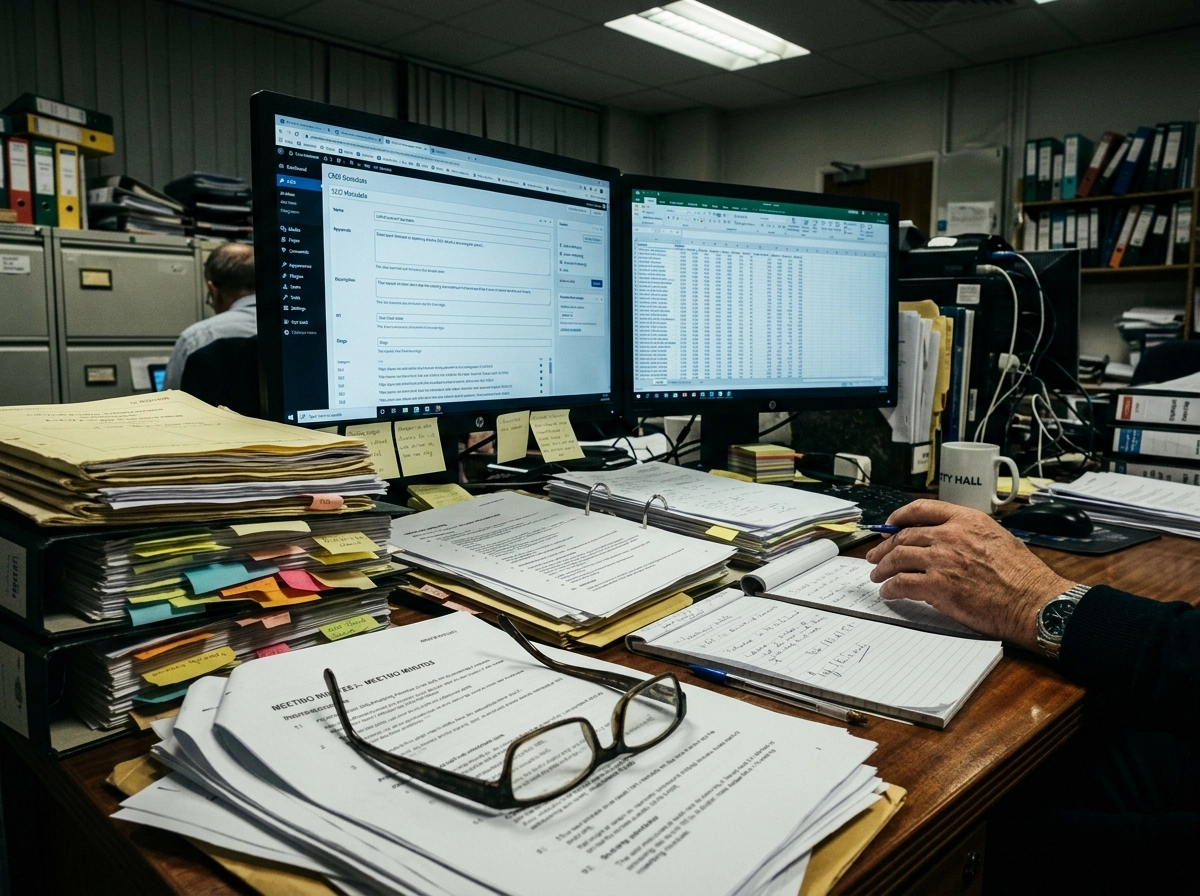
When the city council beat becomes a production bottleneck
The math is brutal. I’ve watched talented journalists sit through six hours of city council bickering only to spend another eight wrestling with a clunky CMS. It’s soul-crushing. They aren’t reporting; they’re resizing images or tagging metadata. They’re guessing at keywords. That production bottleneck turns newsrooms into graveyards for stories that actually matter.
The high cost of manual production was killing us. Our old workflow was a slow-motion collapse. If a reporter is stuck doing data entry, they aren’t out finding scoops. That’s how news deserts happen. It’s not that the stories aren’t there. It’s that we don’t have the bandwidth to hit ‘publish’. We needed an ai content generator to stop the bleeding.
The technical side was worse. Finding the best seo automation software wasn’t some fancy luxury. It was a survival tactic. Without seo optimization, our local updates were invisible. We were shouting into a void because the manual approach failed us every single day.
Scaling without losing the soul of the paper meant finding an ai writing tool that handled the grunt work. We used content automation to free the staff. By using a blogging agent, we could dump meeting transcripts into the system and get a structured draft back in seconds.
GenWrite is our ai blog writer now. It lets us run competitor analysis on what other regional outlets are doing without wasting an afternoon. The biggest win? The content structure internal linking happens automatically. No more manual link-hunting.
We stopped fighting the clock. We plugged a meta tag generator and an seo automation tool directly into the desk. Look, this doesn’t solve every editorial headache. But it fixes the math. We aren’t replacing the reporters. We’re just making sure people actually read what they write.
Building our ‘human-in-the-loop’ automation engine

Solving the production bottleneck wasn’t about replacing reporters with scripts. That’s a losing game. We wanted a pipeline that respected a journalist’s time while satisfying the search engine’s need for local updates. We started by mapping our seo automation workflow to find the friction. It turned out most of our time vanished into formatting city council minutes. You don’t need a master’s degree to structure a basic summary, yet it was eating our day.
We integrated GenWrite as our ai powered blog generator to handle the grunt work. Now, instead of a reporter spending four hours on zoning permits, they feed raw data into the engine. The tool handles the initial structure, keyword density, and meta-descriptions. This shift lets our team focus on the ‘so what’—the part that impacts the neighborhood—rather than the mechanics of the CMS.
Bridging raw data and local context
It wasn’t a ‘set it and forget it’ situation. We built custom guardrails so the machine wouldn’t strip away the local flavor that defines us. By using our internal newsroom blog as a training ground, we created a feedback loop. Editors review every AI draft for factual accuracy and tone before it goes live. This human-in-the-loop system keeps us from falling for automation bias or hallucinations.
We had to be picky about the tech stack. Most best ai writing tools lack the SEO guardrails required for high-frequency news. We needed a system that understood the difference between a generic guide and a time-sensitive report.
Refining our daily news cycle
Our workflow is a three-step process. First, the AI ingests a transcript and generates a draft based on our SEO templates. Then, the editor uses our AI humanize tool to smooth out robotic phrasing and add local anecdotes. Finally, a senior editor approves it.
It isn’t perfect. We still catch the occasional weird sentence. But the results are there. We’ve boosted daily output by 40% without hiring more staff. More importantly, our reporters are in the field instead of staring at a blinking cursor.
Did the efficiency actually translate to rankings?

Within 90 days of deploying our system, the number of local search terms we appeared for jumped by 310%. This wasn’t just noise; it was the direct result of filling content gaps that previously sat empty because our two remaining reporters couldn’t keep up with city hall and the police blotter simultaneously. We transitioned from publishing three times a week to four times a day, and the search engines responded almost immediately.
Velocity meets visibility
Efficiency is a hollow metric if it doesn’t lead to eyes on the page. By using an automated seo platform to handle the technical heavy lifting, we ensured that every piece of local news was perfectly structured for crawlers before it even hit the editor’s desk. It’s a massive shift from the old days when we’d spend twenty minutes just trying to get a meta description right.
We tracked our progress using an automated rank tracker to see how these AI-assisted pieces performed against our legacy, human-only content. To my surprise, the AI-generated drafts,once polished by our editors,actually ranked higher for long-tail local queries. This happened because the AI didn’t forget to include the neighborhood-specific keywords that a tired reporter might overlook at 6:00 PM.
The quality threshold
There’s always a fear that moving fast means moving sloppily. But the data didn’t back that up. Our bounce rate remained steady at 62%, suggesting that readers still found the content relevant.
We essentially stopped the productivity paradox where more effort resulted in less reach. You can see a similar trajectory in how we handled other areas of the business when we stopped manual drafting for our marketing campaigns to focus on strategy.
It’s not about flooding the zone with junk. It’s about using GenWrite to maintain a baseline of visibility that keeps the publication alive. While this doesn’t mean every article is a Pulitzer-winning home run, we’re seeing a 14% month-over-month increase in organic traffic. The reality is that without this volume, our domain authority would’ve continued its slow slide into irrelevance.
The reality of managing the ‘hallucination tax’

Look, the traffic spikes and ranking wins I mentioned earlier feel fantastic, but let’s be honest: they come with a hidden surcharge. I call it the ‘hallucination tax.’ If you’ve spent any time with LLMs, you know they can be confidently wrong about the most obscure local details. They’ll invent a city council member or hallucinate a non-existent zoning law just because the syntax feels right.
The biggest danger isn’t actually the AI making a mistake; it’s you getting lazy. We call this automation bias. When an seo automation workflow is humming along and producing 90% accurate drafts, your brain starts to switch off. You stop fact-checking the ‘small’ things. But in local news, there are no small things. A misspelled street name or a wrong date on a community event ruins your credibility instantly.
That’s why we had to build a rigorous automated editorial process that forces a human pause. We don’t just hit ‘publish’ and walk away. Even when using a high-fidelity AI blog generator like GenWrite, the tool acts as the heavy lifter, not the final judge. You still need an editor who knows the neighborhood to give it a once-over.
I’ve found that using an AI content detector can sometimes help flag sections that feel too ‘perfect’ or generic, which is usually where a hallucination is hiding. But honestly? Nothing beats a skeptical human eye. We’ve had to train our team to treat every AI-generated sentence as a claim that needs a quick verification, rather than a settled fact.
It’s a shift in mindset. You’re moving from being a writer who stares at a blank page to a curator who polishes a gem. This doesn’t mean the work is ‘easier’,it’s just different. You’re trading the physical labor of typing for the cognitive labor of verification. If you aren’t willing to pay that tax, the efficiency gains will eventually be wiped out by a massive loss of public trust. The question isn’t whether the machine can write, but whether you’re still awake at the wheel.
If your newsroom is drowning in manual SEO tasks, GenWrite handles the heavy lifting so your team can get back to real journalism.
People also ask
Does using an AI generator mean we’re replacing our reporters?
Not at all. It’s actually the opposite; we’re using AI to handle the tedious SEO tasks so our reporters have more time to get out into the community and report on real stories.
How do you handle the risk of AI hallucinations in news?
We treat AI output like a first draft. Every piece of content goes through a mandatory human-in-the-loop review process to verify facts and ensure the local tone is spot on.
Is it worth the effort to set up an automated SEO workflow?
Honestly, it’s a game-changer. Once you get the initial integration sorted, you’ll save dozens of hours a week that were previously wasted on manual metadata and URL formatting.
Can small newsrooms really compete with big media using AI?
Yes, it’s how you survive. By using tools to scale your output, you can maintain a consistent digital presence that keeps your local audience engaged without needing a massive budget.