How to Strategically Use an AI SEO Writer for Better Google Rankings
What Exactly is an AI SEO Writer, and Why Does it Matter for Your Rankings?
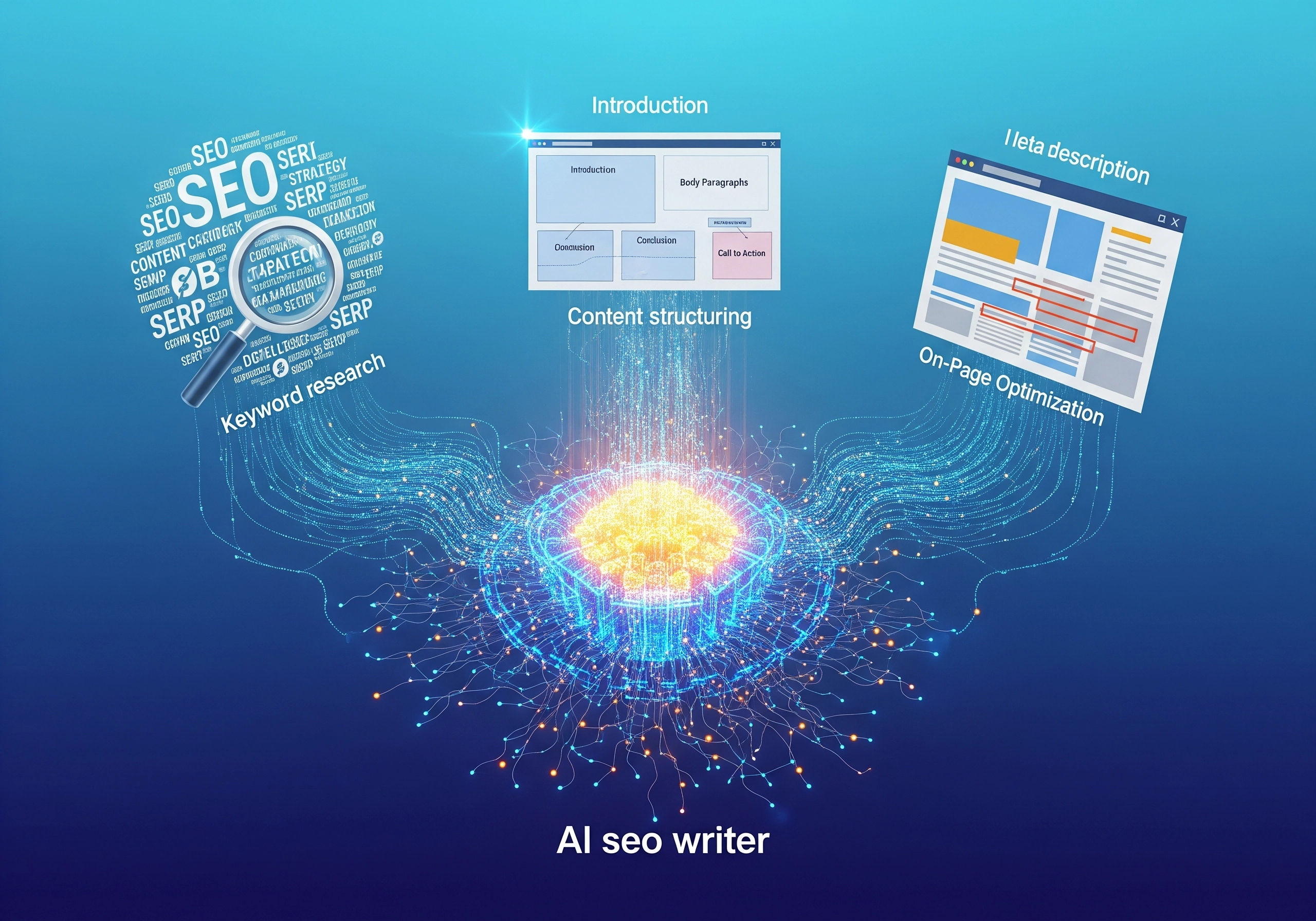
The digital landscape demands not just compelling content, but content meticulously engineered for search engines. In this high-stakes environment, the AI SEO writer has redefined the playing field, serving as a strategic partner to elevate content performance and secure top search results.
Decoding the AI SEO Writer
An AI SEO writer is advanced software leveraging natural language processing (NLP) to generate and optimize content for search engine visibility. It acts as a sophisticated digital assistant, understanding both human language nuances and complex Google algorithms. This technology automates many labor-intensive tasks, from topic ideation to comprehensive on-page optimization.
AI SEO writers are not merely content generators; they are strategic optimization engines.
Traditional content creation is often a manual, time-consuming process. In contrast, an seo ai writer integrates these steps seamlessly, shifting from reactive optimization to proactive, data-driven content development. The market for these tools is booming, projected to reach $5.8 billion by 2030, highlighting their growing indispensability.
Core Functionalities That Drive Rankings
What makes an AI SEO content writer so impactful for achieving higher Google rankings? These platforms offer functionalities directly addressing critical search engine evaluation factors:
- Keyword Research & Integration: Identifies high-volume, low-competition keywords and related terms, integrating them naturally to signal authority.
- Content Outlining & Structure: Generates detailed outlines, including H-tag structures, by analyzing top-ranking content for a given query.
- On-Page Optimization: Analyzes readability, meta descriptions, title tags, and internal linking, offering real-time suggestions for maximum SEO impact.
- Readability & Engagement Scoring: Assesses content for clarity and conciseness, suggesting improvements that keep readers engaged—a strong positive signal for search engines.
Why This Matters for Higher Google Rankings
The fundamental reason an AI SEO writer is crucial for securing higher Google rankings lies in its ability to produce search-engine-friendly and user-centric content, at scale. By automating technical SEO, these tools allow creators to focus more on narrative quality and expert insights. This dual focus is precisely what Google’s algorithms increasingly reward: authoritative, comprehensive content that provides genuine value.
Leveraging AI means not just more content, but smarter, more optimized content that truly competes.
Studies indicate AI-assisted content, combined with human editing, can improve SEO rankings by an average of 25%. This uplift comes from AI’s capacity to process vast data, identify ranking patterns, and apply insights with precision. It leads to content that consistently outperforms manually optimized alternatives, providing a clear path to enhanced online visibility and those coveted top search results.
How Can AI Content Writing Tools Revolutionize Your Content Strategy?
The landscape of content creation is undergoing a profound transformation, moving beyond traditional manual processes to embrace the unprecedented capabilities of artificial intelligence. Integrating AI content writing tools isn’t merely an incremental improvement; it represents a fundamental shift in how organizations approach their entire content strategy, delivering both scale and precision previously unattainable.
Accelerating Content Production and Scaling Output
One of the most immediate and impactful revolutions brought by AI content writing tools is the sheer acceleration of content production. Imagine generating outlines, first drafts, or even entire articles in a fraction of the time it would take a human writer. This isn’t about replacing human creativity, but augmenting it, freeing up valuable time for strategic thinking and nuanced editing.
AI allows content teams to increase their output exponentially, tackling vast content gaps and maintaining a consistent publishing schedule.
This newfound efficiency means businesses can explore new topics, target more niche keywords, and keep their audience engaged with a constant stream of fresh, relevant content. Studies indicate that AI can boost content output by up to 10x, a figure that directly translates into a more robust online presence and improved search visibility.
Elevating Quality and SEO Precision
Beyond speed, AI tools bring a level of data-driven precision to content that significantly enhances its quality and search engine optimization (SEO) potential. Traditional content creation often involves manual research and subjective judgment, which can lead to inconsistencies in keyword targeting or readability.
AI, however, can analyze vast datasets, identify optimal keyword density, assess readability scores, and even suggest improvements for meta descriptions and title tags in real-time. This ensures that every piece of content is not just well-written, but also meticulously optimized for search engines from its inception.
Leveraging these advanced seo writing tools means content isn’t just created faster; it’s created smarter, with a higher probability of ranking.
This data-driven approach to content generation with AI helps to align every article with specific search intent, leading to higher engagement rates and better organic performance. When combined with human expertise, AI-assisted content can improve SEO rankings by an average of 25%.
Empowering Strategic Decision-Making and Personalization
AI’s revolution extends into the strategic realm, providing insights that shape the very direction of your content efforts. These tools can analyze competitor content, identify emerging trends, and pinpoint content gaps that offer untapped opportunities. This proactive approach allows your ai content writing strategy to remain agile and ahead of the curve.
Furthermore, AI facilitates a new era of content personalization. By analyzing user behavior and preferences, AI can help tailor content experiences to individual segments, making each interaction more relevant and impactful. This personalization drives deeper engagement and stronger brand loyalty.
AI transforms content strategy from a reactive task into a proactive, data-informed powerhouse, capable of delivering highly personalized experiences.
This strategic foresight, powered by intelligent algorithms, allows marketers to make informed decisions about what content to create next, ensuring resources are always directed towards the highest-impact opportunities. To truly maximize this potential, understanding how to best leverage an AI SEO writer becomes paramount. The integration of such tools creates a feedback loop, where data informs creation, and performance data further refines future strategies, driving continuous improvement in your content ecosystem.
Which Are the Best AI Writing Tools for Generating SEO Content?
Navigating the burgeoning landscape of AI-powered content creation can feel like a quest for the holy grail of high rankings. The right best AI writing tools don’t just automate; they intelligently craft content designed to resonate with both readers and search engine algorithms. The key lies in finding platforms that seamlessly integrate advanced natural language processing with robust SEO functionalities, enabling you to generate SEO content at scale.
Choosing the optimal AI assistant for your content strategy hinges on several factors: the depth of its SEO integration, its adaptability to various content formats, and its ability to maintain a consistent brand voice. While many tools promise efficiency, only a select few truly excel at producing high-quality, search-optimized material.
The Contenders: Top AI Tools for SEO Content Generation
When evaluating the best AI writing tools for ai writing for search engines, a few platforms consistently rise to the top, each with distinct strengths tailored for different needs.
Jasper (Formerly Jarvis)
Jasper stands out for its versatility and robust content generation capabilities. It offers a wide array of templates for blog posts, marketing copy, and even long-form articles. Its integration with Surfer SEO, a powerful content optimization tool, allows users to get real-time feedback on keyword density, readability, and content structure as they write. This synergy makes it incredibly effective for producing comprehensive, keyword-rich content that aims for the top of the SERPs.
Jasper’s strength lies in its ability to quickly draft long-form content while keeping SEO best practices in mind.
Surfer SEO
While primarily an optimization tool, Surfer SEO’s content editor and AI writing features make it a critical asset for generate SEO content. It analyzes top-ranking pages for your target keywords, providing data-driven recommendations on word count, headings, keywords to include, and even internal link suggestions. Its AI-driven content outline generator and paragraph writer help expedite the creation process, ensuring every piece is meticulously optimized for search performance. Think of it as a blueprint designer for high-ranking articles.
Copy.ai
Copy.ai is celebrated for its ease of use and ability to generate diverse content types quickly. While perhaps less focused on deep SEO optimization than Surfer SEO, its strength lies in rapidly producing compelling copy for various marketing needs, from headlines and social media posts to blog intros and outlines. It’s an excellent choice for content teams looking to boost output and explore different angles for their content, which can then be further refined for SEO. Its intuitive interface lowers the barrier to entry for many users.
Semrush SEO Writing Assistant
Directly integrated into the Semrush ecosystem, the SEO Writing Assistant is a powerful companion for anyone serious about ai writing for search engines. It provides instant recommendations to improve your content based on your target keywords. This includes suggestions for readability, originality, tone of voice, and, crucially, SEO factors. Available as a plugin for Google Docs and WordPress, it allows you to optimize your content directly within your preferred writing environment, ensuring every draft is search-engine ready from the start.
Real-time feedback on SEO metrics is invaluable for continuous content improvement.
Choosing Your AI Ally
Selecting the best AI writing tools depends heavily on your specific workflow and priorities. If you need robust, long-form content generation with integrated SEO optimization, tools like Jasper combined with Surfer SEO offer a potent combination. For rapid content generation across various short-form formats, Copy.ai shines. For those deeply embedded in the Semrush ecosystem, the SEO Writing Assistant provides seamless, in-context optimization. Each tool offers a unique approach to help you generate SEO content more efficiently and effectively. For a deeper dive into making the right choice, consider exploring How to Pick the Best SEO Writing Tools for Content that Ranks in 2025.
Ultimately, the goal is to leverage these platforms not just for speed, but for strategic content that truly performs. An effective AI SEO writer enhances human capabilities, allowing content creators to focus on strategy, creativity, and the nuanced refinement that only a human touch can provide. The market for AI writing tools is projected to reach $5.8 billion by 2030, underscoring their growing importance in digital marketing.
How Do You Implement a Strategic Workflow for AI-Powered SEO Content Creation?
Integrating an AI SEO writer into your content workflow isn’t about replacing human effort; it’s about amplifying it strategically. The true power emerges when you establish a clear, iterative process that leverages artificial intelligence for efficiency while retaining human expertise for nuance, accuracy, and brand voice. This fusion creates a robust pipeline for high-ranking, engaging content.
The Strategic Content Workflow: A Phased Approach
Transitioning from traditional content creation to an AI-powered model demands a structured methodology. This phased approach ensures every piece of content benefits from both automated precision and insightful human direction, moving beyond simple content generation with AI to truly optimized output.
Phase 1: Foundational Strategy & AI-Assisted Research
Before any words are written, a clear strategy is paramount. Define your content goals, target audience, and the specific search intent you aim to satisfy. This human-driven phase sets the compass for all subsequent AI actions.
Strategic content begins with understanding your audience deeply.
Next, leverage an advanced seo writing assistant for comprehensive keyword research and topic clustering. These tools can analyze search volume, competition, and semantic relationships far quicker than manual methods. They identify content gaps and emerging trends, helping you build out robust content briefs that guide the AI’s initial output.
For those new to the fundamentals, a solid grounding in search engine optimization for beginners can provide the essential context for this phase.
Phase 2: AI-Powered Content Generation
With a well-defined brief in hand, this is where the ai seo writer truly shines. Input your topic, target keywords, and desired tone, and the AI will generate initial drafts, outlines, or even complete articles at unprecedented speed. This dramatically accelerates the content production cycle, potentially increasing output significantly.
AI excels at rapidly assembling information and structuring narratives based on vast datasets.
These tools can ensure initial drafts integrate target keywords and related semantic phrases naturally, laying a strong foundation for SEO. They handle the heavy lifting of drafting, freeing up human writers for higher-level tasks. Remember, the goal here is a robust first draft, not a publish-ready masterpiece.
Phase 3: Human Refinement & Optimization
This is the critical juncture where human expertise transforms AI-generated text into truly exceptional content. An AI might produce grammatically correct sentences, but it often lacks the nuanced understanding, creative flair, and critical thinking that defines high-quality, authoritative content.
- Fact-Checking and Accuracy: Always verify information generated by AI. AI models can sometimes hallucinate or present outdated data.
- Brand Voice and Tone: Edit to align with your unique brand voice, ensuring authenticity and consistency.
- Narrative Flow and Engagement: Enhance storytelling, add emotional resonance, and refine transitions for a seamless reader experience.
- Deepen Insights: Inject unique perspectives, expert opinions, and original analysis that only a human can provide.
After refining the core content, use the seo writing assistant again for a final optimization pass. This involves checking readability scores, refining meta descriptions, optimizing title tags, and suggesting internal linking opportunities. This iterative process ensures the content is not only accurate and engaging but also technically optimized for search engines, boosting its website visibility.
Phase 4: Publication & Performance Analysis
Once the content has been meticulously reviewed and optimized, it’s ready for publication. However, the workflow doesn’t end there. Continuous monitoring and analysis are vital for understanding how your AI-powered content performs in the wild.
Data-driven insights fuel continuous improvement and strategic adjustments.
Track key metrics such as organic traffic, keyword rankings, bounce rate, time on page, and conversions. Use this data to refine your content strategy, adjust your AI prompts, and further hone your human editing process. This feedback loop ensures that your ai seo writer integration remains effective and adaptive to evolving search algorithms and audience preferences.
Can AI Help You Optimize Your Blog Content for Peak Performance and Higher Rankings?

The question isn’t whether AI can optimize your blog content, but rather how strategically you leverage its capabilities to unlock peak performance and achieve higher Google rankings. Traditional content optimization often involves manual analysis, which is time-consuming and prone to human error. AI, conversely, introduces an unprecedented level of precision and scale to this critical process.
AI’s Diagnostic Power: Unearthing Content Potential
Imagine a tool that can instantly dissect every piece of your existing blog content, identifying strengths and critical weaknesses. This is where AI excels. By employing natural language processing (NLP) and machine learning, AI-powered platforms can analyze your articles for a multitude of SEO factors that impact search visibility.
These tools scrutinize elements like keyword density, relevance, and distribution, ensuring your content aligns perfectly with target search queries. They go beyond simple keyword counts, understanding semantic relationships to build richer, more comprehensive topic coverage. This deep analysis allows for highly effective blog optimization with AI, transforming underperforming posts into ranking powerhouses.
AI provides real-time insights into content gaps and optimization opportunities that human analysis might miss.
Beyond keywords, AI assesses readability scores, sentence structure, and overall content coherence. It can pinpoint sections that might confuse readers or fail to meet their search intent, offering concrete suggestions for improvement. This diagnostic capability is essential for refining older content and ensuring every word contributes to your SEO goals.
Proactive Optimization: Crafting Content for Success from the Start
For new content, AI acts as an intelligent co-pilot, guiding your ai writing for search engines efforts from conception to publication. Instead of guessing what search engines and users want, AI provides data-backed recommendations throughout the content creation lifecycle. It starts with sophisticated keyword research, identifying not just head terms but long-tail variations and related queries that offer untapped potential.
Strategic AI-Driven Content Enhancements
AI doesn’t just analyze; it also suggests actionable improvements across various on-page SEO elements. This includes:
- Meta Descriptions and Title Tags: AI can generate compelling, keyword-rich meta descriptions and title tags that improve click-through rates (CTR) and signal relevance to search engines.
- Internal Linking Structures: It identifies logical opportunities for internal links, enhancing site architecture and distributing link equity to boost the authority of key pages.
- Semantic Clustering: AI assists in grouping related topics, helping you build comprehensive content hubs that establish topical authority and improve higher Google rankings for a broader set of keywords.
- Readability and Engagement: AI tools can recommend adjustments to sentence length, vocabulary, and formatting to make your content more engaging and easier to consume, directly impacting user experience signals that Google values.
By leveraging AI to fine-tune these critical elements, you move beyond basic SEO practices into a realm of precision optimization. This strategic approach ensures your content is not only found but also resonates deeply with your target audience, fostering increased engagement and conversions.
The Continuous Optimization Loop
AI’s role extends beyond initial creation and optimization; it’s a partner in continuous improvement. After content is published, AI tools can monitor its performance, tracking keyword rankings, organic traffic, and user behavior metrics. Should performance dip or new ranking opportunities emerge, AI can alert you to necessary adjustments, facilitating an agile, data-driven content strategy.
Ultimately, integrating AI into your content optimization workflow is a clear path to achieving peak content performance and securing those coveted higher Google rankings. It’s about working smarter, leveraging powerful algorithms to amplify human creativity and expertise.
Why is Human Oversight Crucial When Using AI for SEO Content?
Even with the most sophisticated AI, the human element remains irreplaceable in crafting truly impactful SEO content. While an AI content writer can accelerate generation, it’s the discerning eye and strategic mind of a human editor that transforms raw output into high-ranking, brand-aligned material.
AI is a powerful engine, but it lacks the nuanced understanding of context, emotion, and current events that define truly compelling narratives. Without human oversight, even the best ai seo content writer can produce content that is factually flawed, tonally inconsistent, or simply unengaging.
Ensuring Factual Accuracy and Credibility
One of the primary reasons human review is non-negotiable is to guarantee factual accuracy. AI models, while vast, can sometimes “hallucinate” or present outdated information as current fact. This risk is particularly high in rapidly evolving fields or when discussing specific data points.
A human editor acts as the ultimate truth-checker, safeguarding your brand’s credibility.
They cross-reference sources, verify statistics, and ensure that every claim made within the content is substantiated. This meticulous verification prevents the publication of misinformation, which can severely damage trust and authority in the eyes of both readers and search engines.
Maintaining Brand Voice and Strategic Intent
AI excels at generating text that adheres to basic grammatical rules and keyword parameters. However, capturing a unique brand voice, infusing personality, or conveying complex strategic intent is where human expertise becomes critical. Your ai content writing strategy should always factor in this editorial layer.
An experienced editor understands the subtle nuances of your brand’s tone – whether it’s authoritative, friendly, playful, or deeply technical. They can adjust phrasing, inject specific jargon, or refine sentence structures to ensure the content resonates authentically with your target audience.
Human touch ensures your content doesn’t just inform, but also connects and persuades.
This is about more than just words; it’s about translating your brand’s ethos into every piece of content, ensuring consistency across all touchpoints.
Infusing Creativity and Strategic Depth
While an seo writing assistant can help with keyword placement and structure, it rarely produces truly original insights or deeply creative narratives. AI often synthesizes existing information, which can lead to generic or formulaic content.
Human editors bring fresh perspectives, innovative angles, and the ability to weave complex ideas into compelling stories. They can identify opportunities for unique examples, create memorable analogies, or structure arguments in a way that maximizes reader engagement and addresses specific search intent beyond surface-level keywords.
True thought leadership and distinctive content arise from human ingenuity, amplified by AI.
This blend of AI efficiency and human creativity is essential for content that stands out in a crowded digital landscape.
Refining for Readability and User Experience
Google’s algorithms are increasingly sophisticated, prioritizing user experience and content quality. While AI can optimize for keyword density, it may not always produce text that flows naturally or is easy for humans to read and comprehend. Awkward phrasing, repetitive sentence structures, or a lack of logical progression can deter readers.
Human editors smooth out these rough edges, improving sentence rhythm, varying vocabulary, and ensuring a seamless reading experience. They consider the target audience’s reading level and cognitive load, making adjustments that enhance clarity and engagement.
For businesses aiming for superior SEO optimization, integrating human oversight with tools like GenWrite ensures content is not just technically sound but also genuinely valuable and enjoyable to consume. Learn more about how to drive organic traffic using an ai seo writer.
Ultimately, human oversight transforms AI-generated draft into polished, strategic content that performs exceptionally well in search rankings and resonates deeply with your audience. It’s the critical bridge between raw potential and peak performance.
What Are the Advanced Techniques for Maximizing AI SEO Writer Efficiency and Impact?

Unlocking the full potential of an AI SEO writer goes far beyond basic commands. The true power lies in advanced prompt engineering, transforming a generic AI into a specialized content creation assistant. This technique involves crafting highly specific, detailed, and iterative instructions that guide the AI toward producing exceptional, nuanced, and semantically rich content.
Think of it as programming your AI with language, defining its persona, tone, and the precise intent of the output. Instead of a simple “write about X,” an advanced prompt might instruct: “Act as an experienced financial analyst. Write a 500-word authoritative blog post comparing the long-term investment strategies for millennials versus Gen Z, focusing on market volatility and digital assets. Ensure the tone is professional yet accessible, incorporate a clear call to action for further research, and optimize for semantic keywords related to ‘generational wealth building’ and ‘investment planning’.”
Precision prompting is the secret to moving from passable AI output to truly insightful, high-ranking content.
This iterative process often involves breaking down complex content tasks into smaller, manageable AI prompts. By refining your inputs based on initial outputs, you train the AI to better understand your specific needs, leading to higher quality drafts with fewer revisions.
Seamless Integration and Content Automation Ecosystems
Maximizing efficiency means embedding your AI SEO writer within a broader content ecosystem, not just using it as a standalone tool. Integrating AI with other platforms — from keyword research tools like Semrush and Ahrefs to on-page optimization tools like Surfer SEO, and even CRM systems — creates a powerful, automated workflow. This allows for a continuous flow of data-driven insights into the AI, and conversely, AI-generated content can be directly pushed to optimization and publishing platforms.
Imagine an AI SEO writer that automatically pulls target keywords from your SEO tool, drafts an article, then sends it to an optimization platform for scoring, before finally being routed to your CMS for human review and publication. This level of content automation drastically reduces manual effort and accelerates the entire content lifecycle. For robust content creation, platforms like GenWrite can serve as a central hub, streamlining these complex integrations and ensuring that every piece of content is not only rapidly produced but also strategically aligned and highly optimized for search engines.
Leveraging these interconnected tools ensures that your content is not only generated efficiently but also meticulously optimized at every stage.
Performance Analysis and Iterative Optimization Loops
The journey to maximizing AI SEO writer impact doesn’t end with content generation; it evolves through continuous performance analysis. Once AI-generated content is published, its performance must be rigorously tracked using analytics platforms. Key metrics include organic traffic, keyword rankings, bounce rate, time on page, and conversion rates. This data provides invaluable feedback, revealing what resonates with your audience and what needs refinement.
Data-driven iteration is essential for transforming good content into great content.
This feedback loop allows you to identify patterns and refine your AI prompts and strategies accordingly. Perhaps certain types of AI-generated headlines perform better, or content with a specific structure drives higher engagement. A/B testing different AI-generated variations of titles, meta descriptions, or even entire sections can yield profound insights. By continuously monitoring and adapting your approach, you can fine-tune your AI models and prompt engineering techniques, ensuring that your AI SEO writer consistently produces content that not only ranks but also converts. This iterative mindset fosters ongoing improvement, pushing the boundaries of what your AI can achieve.
Semantic SEO and Topic Clustering with AI
Beyond individual keyword optimization, advanced AI techniques facilitate deeper semantic understanding and strategic topic clustering. AI SEO writers can analyze vast amounts of data to identify related concepts, entities, and user intent surrounding a core topic. This allows for the creation of comprehensive content that covers an entire semantic field, rather than just targeting isolated keywords.
By leveraging AI for topic clustering, you can build authoritative content hubs that demonstrate deep expertise to search engines, improving overall domain authority. The AI helps map out related sub-topics, identify content gaps, and ensure internal linking structures reinforce semantic connections. This holistic approach, powered by advanced AI, moves beyond simple keyword stuffing to create content experiences that truly satisfy complex user queries and earn higher search rankings.
How Can You Measure the Success of Your AI-Driven SEO Content Efforts?
The true impact of any content strategy, especially one empowered by AI, hinges on its measurable outcomes. Without robust measurement, even the most sophisticated AI-driven efforts risk becoming a shot in the dark. The goal isn’t just to produce more content, but to produce effective content that drives tangible business results and continuous improvement.
Key Performance Indicators for AI-Driven Content
Measuring success requires a clear understanding of what metrics genuinely reflect progress. While vanity metrics might offer a fleeting sense of accomplishment, focusing on core SEO and business KPIs provides actionable insights. Effective measurement transforms data into a roadmap for continuous improvement.
1. Organic Traffic Growth
The most fundamental indicator of successful traffic generation is the upward trend in organic search traffic. This metric directly reflects whether your AI-generated content is attracting new visitors from search engines. Monitor not just the total volume, but also the quality of this traffic—are these visitors engaging with your site, or merely bouncing?
2. Keyword Rankings
A direct measure of your content’s effectiveness in achieving higher Google rankings is its performance for target keywords. Track the average position of your AI-optimized content for relevant terms. Look for consistent improvements in SERP visibility, especially for high-intent keywords identified during your initial research phase. Comprehensive keyword tracking tools are essential here.
3. User Engagement Metrics
Beyond traffic, how users interact with your AI-powered content is critical to effective blog analysis. Key engagement metrics include:
- Bounce Rate: A lower bounce rate suggests content relevance and user satisfaction.
- Time on Page/Session Duration: Longer times indicate that users are finding value and reading your content thoroughly.
- Pages Per Session: Users exploring multiple pages after landing on AI-generated content shows effective internal linking and a well-structured site.
These metrics offer a crucial window into the user experience, validating the quality and relevance of your AI-assisted narratives.
4. Conversion Rates
Ultimately, SEO efforts serve broader business objectives. Measuring conversion rates—whether it’s lead generation, sales, or sign-ups—directly links your AI-driven content to your bottom line. Attribute conversions back to specific content pieces to understand their direct economic impact. This is where the strategic value of AI truly shines, transforming content views into tangible business growth.
The Iterative Loop of Optimization
Success isn’t a static destination; it’s a continuous journey of refinement. Implement a feedback loop where blog analysis informs subsequent content creation and optimization. Use A/B testing for different AI-generated headlines or calls-to-action to identify what resonates most with your audience. Regularly review performance data to uncover content gaps or areas where your AI needs further human refinement.
Data-driven insights empower you to fine-tune your AI prompts and human editing processes. This iterative approach ensures that your AI-powered content strategy remains agile, adapting to algorithm changes and evolving user needs, consistently pushing for higher Google rankings and sustained traffic generation.
By meticulously tracking these metrics and embracing an analytical mindset, you can definitively measure the success of your AI-driven SEO content efforts and strategically steer them towards optimal performance.
Ready to elevate your SEO content? Discover how GenWrite can automate your blog creation and boost your rankings.
People Also Ask
What is an AI SEO writer and how does it help Google rankings?
An AI SEO writer is a tool that uses artificial intelligence to help create content optimized for search engines. It assists with tasks like keyword research, content structuring, and on-page optimization, enabling the production of search-engine-friendly content at scale to boost online visibility and search performance.
How do AI content writing tools revolutionize a content strategy?
AI content writing tools revolutionize strategy by accelerating content production, enhancing SEO precision, and enabling data-informed decisions. They allow for scaling output, improving content quality through analysis, and personalizing content, making the creation process more agile and effective.
What are the best AI writing tools for generating SEO content?
The best AI writing tools for SEO content often include Jasper, Surfer SEO, Copy.ai, and Semrush SEO Writing Assistant. The ideal choice depends on your specific needs, whether for long-form content, rapid generation, or integrated optimization, all aiming to enhance human creativity.
Why is human oversight essential when using AI for SEO content?
Human oversight is crucial for ensuring factual accuracy, maintaining brand voice, injecting creativity, and refining readability. It transforms AI-generated drafts into high-performing, engaging content that resonates with audiences and search engines, guaranteeing quality and strategic alignment.
How can I measure the success of my AI-driven SEO content efforts?
Measure success by tracking key performance indicators (KPIs) such as organic traffic growth, keyword rankings, user engagement metrics like bounce rate and time on page, and conversion rates. An iterative optimization loop using data insights is key for continuous improvement.
Can AI help optimize existing blog content for better performance?
Yes, AI can significantly enhance blog content optimization. It diagnoses existing content for SEO factors, guides keyword research and topic clustering for proactive creation, refines on-page elements like meta descriptions and internal linking, and monitors performance for suggested adjustments.