How to Optimize Content for Google’s AI Summaries and Win 2026 Search Rankings
Why Are Google AI Summaries Redefining 2026 Search Visibility?
The era of ten blue links is officially over. For years, the primary goal of SEO was to secure a top spot on a predictable results page. That battlefield has been completely redesigned. The future of Google search is not a list of websites; it’s a direct, synthesized answer, and if your content isn’t feeding that answer, you risk becoming invisible.
What Are Google AI Overviews?
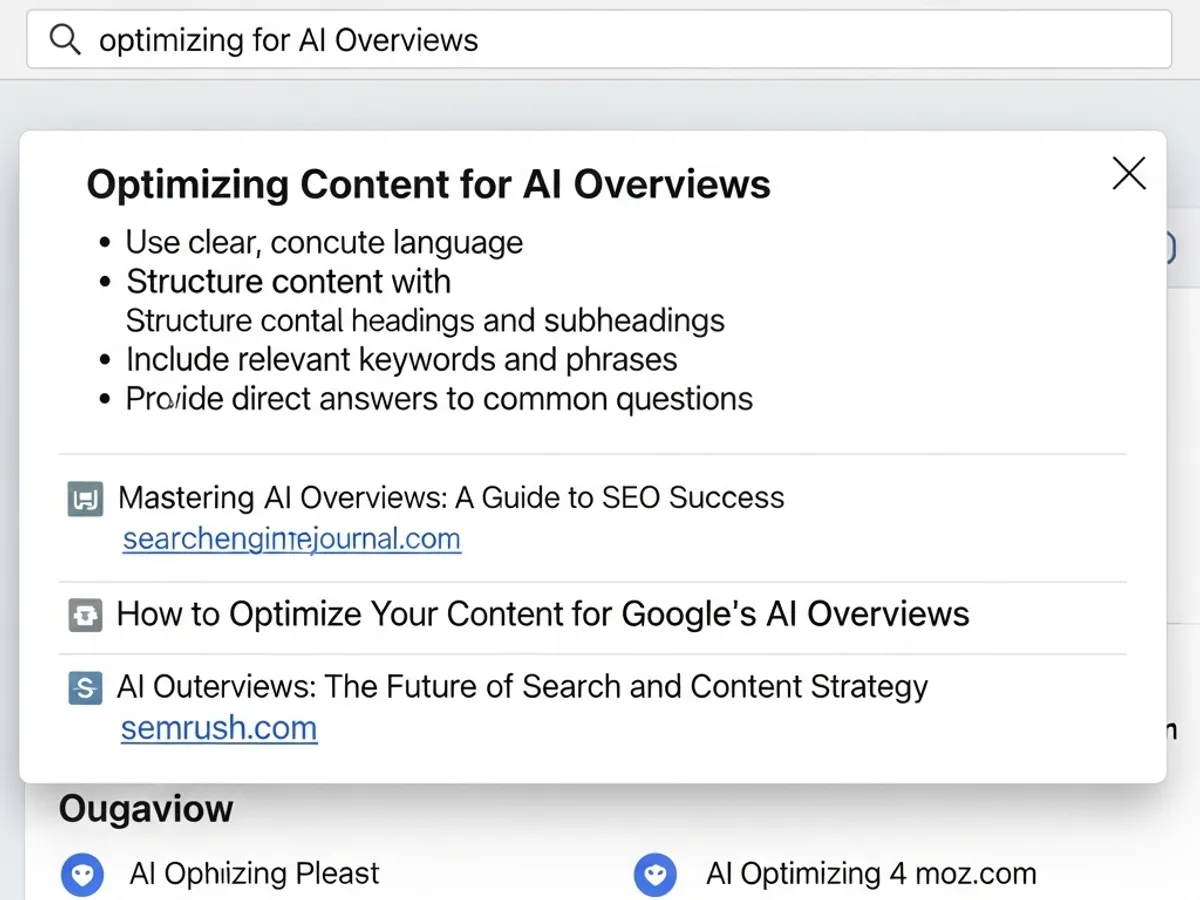
Enter Google AI Overviews, the feature formerly known as the Search Generative Experience (SGE). These are AI-generated summaries that appear at the very top of the search results page, providing direct answers to user queries. Powered by Google’s Gemini models, these overviews pull information from multiple high-ranking sources to create a single, comprehensive snapshot.
The goal is user efficiency, but the impact on publishers is seismic.
The Unignorable Impact on Clicks and Visibility
The data from 2025 paints a stark picture. For search queries that trigger Google AI summaries, organic click-through rates (CTR) have plummeted by as much as 70%. We’ve seen the average CTR for these positions fall from 1.76% to a mere 0.61%.
This means that even if you rank on page one, most users will never see your link.
With zero-click searches for informational queries climbing to 69%, the new mandate is clear: optimizing for AI search ranking isn’t a forward-thinking strategy—it’s a present-day survival tactic. The game has shifted from earning a click to earning a citation within the AI-generated text itself. To adapt, businesses now rely on an ai seo content generator to structure content for machine readability.
This guide is your playbook to master Google rankings in 2026. We will break down the precise frameworks—from content structure and technical schema to building multi-platform authority—that will get your content featured in Google’s AI Overviews and secure your visibility for the years to come.
How Can the ‘Atomic Answer’ Framework Boost Your AI Overview Citations?
To secure a coveted citation in an AI Overview, you must first unlearn a core principle of traditional blogging: the slow, narrative introduction. Large Language Models (LLMs) powering these summaries don’t read for pleasure; they hunt for facts. Your content’s ability to be cited depends entirely on how easily an AI can extract a definitive answer from it.
This is where the Atomic Answer framework comes in. The strategy is simple yet powerful: directly beneath every primary (H2) or secondary (H3) heading, place a concise, self-contained summary of 50 words or less. This summary acts as a perfect, pre-packaged “seed” for the AI to retrieve, digest, and reference. Instead of forcing the model to parse paragraphs of context, you’re serving it the conclusion on a platter.
This structure is favored by AI because it mirrors how the models are designed to work: with maximum efficiency.
AI systems prioritize clarity and extractability. A well-defined Atomic Answer reduces ambiguity and the computational cost of summarizing complex information. This is one of the most critical SGE best practices for creating content for AI summaries.
Implementing the Atomic Answer Framework
Successfully optimizing for AI results requires more than just a short summary. It demands a complete structural commitment to scannability and directness. Here’s how to implement it:
- Lead with the Answer: Every major section should begin with that 50-word atomic summary. Treat your H2 or H3 heading as a direct question and provide the answer immediately.
- Use Scannable Formats: Break down supporting details into bulleted lists, numbered steps, or tables. Research shows that between 40-61% of AI summaries leverage these formats, as they are inherently structured and easy for machines to parse.
- Adopt Prompt-Led Publishing: Frame your subheadings as questions that mirror user search intent (e.g., “How Does X Work?” instead of “The Functionality of X”). This aligns your content directly with the queries that trigger AI Overviews.
Manually applying this framework across an entire content library is a monumental task. This is where tools designed as an ai seo content generator provide a significant advantage, automating the creation of perfectly structured, AI-ready articles. By building your content around this model, you can effectively Optimize for Google AI overviews and increase your citation probability.
By treating every section of your content as a potential, self-contained answer, you align your publishing strategy with the foundational logic of generative search engines.
What Technical SEO & Entity Optimization Signals Do AI Overviews Prioritize?

While the ‘Atomic Answer’ framework prepares your content for AI extraction, your site’s technical foundation determines if it’s even understood in the first place. Old-school technical SEO focused on making content crawlable for bots. The new priority for Search Generative Experience SEO is making content comprehensible for Large Language Models (LLMs) like Gemini.
This shift hinges on one critical element: structured data.
Why Structured Data is the Language of AI
Think of structured data (schema markup) as a translator that converts your webpage’s content into a clear, unambiguous language that AI can process. Without it, the AI has to guess the context and relationships between different pieces of information on your page. With it, you are explicitly defining entities and their properties.
Structured data is the single most important technical signal for SGE optimization.
This goes far beyond basic FAQPage or Article schema. For AI Overviews, the focus is on precise entity mapping that defines who you are, what you do, and how you relate to other concepts. This level of clarity is vital for establishing trust and authority with the model.
Moving from Basic Schema to Entity-Driven Markup
To secure citations in 2026, you must map your core offerings as specific entities. This provides the AI with a detailed blueprint of your value proposition, making your content a more reliable source for its summaries.
Here’s how the focus has evolved:
| Schema Type | Traditional Use (Pre-AIO) | AI Overview Priority (2026) |
|---|---|---|
FAQPage |
Generate rich snippet dropdowns. | Provide seed answers for direct queries. |
Article |
Indicate publication date, author. | Establish E-E-A-T signals and source credibility. |
SoftwareApplication |
Basic app store info. | Map features, pricing, and integrations as entities. |
ProfessionalService |
Local business address, hours. | Define service offerings and provider expertise. |
Manually implementing this advanced schema can be daunting, which is why an AI SEO content generator that automates this process is a significant advantage. Tools like GenWrite are designed to embed this semantic structure directly into your content, ensuring that your articles are optimized for both human readers and AI agents from the moment they are published. As noted by experts, you must structure content for extraction by making every section a potential snippet source.
By prioritizing clean structured data and specific entity mapping, you provide the clear, machine-readable signals Google’s AI needs to trust and cite your content.
How Do You Build E-E-A-T and Authority That Google’s AI Can Trust?
From On-Page Signals to Cross-Web Verification
In the era of traditional SEO, E-A-T (Expertise, Authoritativeness, Trustworthiness) was largely an on-page checklist. For Google’s AI, that model is obsolete. The new standard, E-E-A-T (adding Experience), is validated not just by what you publish, but by what the rest of the web corroborates about you. Google’s AI models act as relentless fact-checkers, seeking co-occurrence—the consistent mention of your brand, authors, and data across independent, high-authority sources.
If your claims exist in a vacuum, they don’t exist to an AI.
This is the core of building E-E-A-T for AI: your authority must be externally verifiable and consistently reinforced. The AI prioritizes sources it can cross-reference, which is why it now cites an average of 13.3 sources per overview. Your goal is to be one of them.
The Pillars of AI-Driven Authority
To become a trusted entity for AI, focus on three critical areas that directly influence ranking in AI results:
- Niche Topical Authority: You cannot be an expert on everything. Instead, build deep, interconnected content clusters around a specific niche. A comprehensive pillar page supported by dozens of granular articles creates a web of knowledge that AI can easily navigate and recognize as authoritative. This strategic depth signals that you are a primary source, not just another commentator.
- Increased Citation Velocity: Authority is measured by the frequency and quality of third-party mentions. Citation velocity is the rate at which your brand, content, and experts are referenced across platforms like industry publications, forums, and wikis. Each external mention is a vote of confidence that AI models use to validate your credibility.
- Content Freshness and Accuracy: Stale content is an authority killer. AI Overviews are designed to provide the most current answers. Regularly updating your content with new data, insights, and developments ensures your information remains relevant and trustworthy, making it a more reliable source for AI to pull from.
Building this level of authority manually is a monumental task. Platforms providing AI SEO content generator tools like GenWrite are essential for scaling the creation of deep topic clusters and maintaining content freshness, allowing you to build a verifiable footprint that Google’s AI can trust.
Are There Advanced Strategies to Win Generative Engine Optimization (GEO)?

While mastering the Atomic Answer framework and E-E-A-T gets you into the game, winning in 2026 requires moving beyond basic optimization. This is the domain of Generative Engine Optimization (GEO)—the advanced practice of becoming a citable, authoritative source for AI models.
The Power of Information Gain
In an ecosystem flooded with regurgitated facts, the most valuable asset is originality. AI Overviews are designed to synthesize information, but they heavily reward sources that provide unique value, a concept known as Information Gain. This is where you introduce data, analysis, or insights that don’t exist elsewhere.
Think of it as the difference between reporting the news and breaking the news. Instead of summarizing common knowledge, focus on:
- Proprietary Data: Publishing original research, survey results, or internal case studies.
- Expert Frameworks: Creating unique models or methodologies to solve a problem.
- Deep Analysis: Offering a novel perspective on an existing trend that only a true expert could provide.
Providing unique data points makes your content a primary source, forcing AI models to cite you rather than a competitor who merely aggregated the same information.
Creating the ‘Click Gap’ with Prompt-Led Publishing
Simply being cited isn’t enough; the goal is still to drive traffic. Advanced GEO involves strategically creating a “click gap.” The AI summary should answer the user’s initial query but simultaneously create a compelling reason to click through for deeper value—the “how-to,” the template, or the full dataset.
This is achieved through prompt-led publishing. Instead of just targeting keywords, you anticipate the user’s next logical question or prompt. Your content provides the initial answer concisely, but the implementation details and actionable steps are on your page. This strategy aligns perfectly with the conversational nature of AI search, ensuring your site is the necessary next step in the user’s journey. Efficiently structuring this type of content can be streamlined with modern ai seo writing tools, allowing your team to focus on the core insights.
By combining proprietary data with a strategic click gap, you transition from being just another source to becoming an indispensable resource for both AI and human users.
Can You Truly Win by Building Content Clusters for AI Search?
Traditional SEO often felt like a series of isolated battles, each focused on winning a single keyword. That approach is obsolete. In the era of AI Overviews, search engines don’t just look for pages; they look for authorities. The key to becoming an authority is not winning one keyword, but demonstrating comprehensive knowledge across an entire topic through strategically built content clusters.
The Cluster Model: Building a Knowledge Web for AI
Think of AI as a student trying to learn a new subject. It won’t trust a single, thin pamphlet. Instead, it seeks out a comprehensive textbook. The cluster model positions your website as that definitive textbook. It works by organizing your content into two main types:
- Pillar Page: This is a long-form, authoritative guide covering a broad topic from end to end (e.g., “A Complete Guide to SEO Optimization”). It acts as the central hub.
- Supporting Cluster Content: These are shorter articles that dive deep into specific sub-topics mentioned on the pillar page (e.g., “How to Conduct Keyword Research,” “A Guide to On-Page SEO,” “Technical SEO Checklist”).
Each supporting piece links back to the pillar page, and the pillar links out to them. This structure creates a web of authority that the AI can easily navigate, signaling that your domain possesses deep expertise.
Why Semantic Density Matters for AI
AI models like Google’s Gemini thrive on context. They don’t just count keywords; they analyze the relationships between concepts. This is where semantic density becomes critical. By building out a topic cluster, you create a high concentration of related terms, entities, and concepts in one place.
This density proves your content isn’t a superficial overview. It demonstrates a rich, interconnected understanding that AI can trust and use as a primary source when compiling its summaries. Tools like an AI SEO content generator are invaluable here, helping to ensure that each piece of cluster content is thorough and semantically aligned with the pillar topic.
Effective clustering transforms your site from a collection of pages into a cohesive knowledge base.
Properly managing this strategy requires a clear system for managing content structure and internal linking. By linking these dedicated articles together with descriptive anchor text, you build a logical, machine-readable map that solidifies your topical authority, making it far easier to start optimizing for AI results.
What Common Pitfalls Should You Avoid When Optimizing for AI Overviews?

You’ve diligently applied the Atomic Answer framework and built out robust content clusters, but your pages are still nowhere to be found in Google AI Overviews. This common frustration often stems from subtle but critical missteps that sabotage your best efforts. To succeed in generative engine optimization, you must unlearn outdated SEO habits that AI models are specifically designed to penalize.
The most frequent mistake is clinging to tactics from a bygone era. Keyword stuffing, once a go-to strategy, is now a major red flag for AI. Google’s Gemini model doesn’t care about keyword density; it prioritizes semantic context and natural language. Forcing keywords into your content creates a clunky user experience and signals low-quality material to the AI, which will simply find a clearer, more helpful answer elsewhere.
Over-optimization is the fastest way to become irrelevant in AI-driven search.
Technical and Structural Roadblocks
Sometimes, the problem isn’t your content but its technical container. One of the most significant yet overlooked issues in AI overview troubleshooting is a simple line of code. Accidentally using nosnippet tags is like putting up a “do not enter” sign that explicitly blocks Google from featuring your content in an AI Overview. It’s crucial to audit your technical SEO to ensure you aren’t inadvertently telling the AI to ignore your most valuable answers.
Another critical failure point is poor content structure. If your Atomic Answers are buried within long, unstructured paragraphs, the AI model cannot easily parse and extract them. Clear formatting isn’t just for human readers; it’s a roadmap for machines. Here’s a quick guide to aligning your content with SGE best practices:
| Common Pitfall | The 2026 Solution |
|---|---|
| Walls of Text | Break content with H3s, H4s, and bullet points. |
| Vague Statements | Use data, statistics, and concrete facts. |
| No Schema | Implement specific schema (FAQ, HowTo) to add context. |
| Ignoring Intent | Match content directly to conversational user queries. |
These structural refinements are fundamental to modern SEO optimization and are non-negotiable for overcoming AI search challenges. The goal is not to trick an algorithm but to provide the clearest information in a machine-readable format. Platforms built on strong content automation principles, like GenWrite, bake these best practices directly into the creation process, helping you avoid these pitfalls from the start.
How Can You Continuously Adapt to Google’s Evolving AI Search Landscape?
The era of “set it and forget it” SEO is over. The future of Google search is not a static endpoint but a dynamic environment that rewards continuous adaptation. Winning in this landscape means treating your content strategy not as a project, but as a perpetual optimization loop.
Your Core AI Search Playbook
To maintain and improve your AI search ranking, consistently focus on these foundational pillars. These are no longer optional tactics; they are the core SGE best practices for visibility.
- Deploy the Atomic Answer Framework: Embed concise, direct answers within your content to become the primary seed for a Google AI summary.
- Master Technical & Entity SEO: Use precise schema to create a machine-readable map of your expertise, helping AI models understand your authority.
- Build Multi-Platform E-E-A-T: Your authority is now measured by co-occurrence across the web. Cultivate your presence on relevant third-party platforms to build verifiable trust.
- Prioritize Information Gain: Use Generative Engine Optimization (GEO) to create unique, data-backed content that AI models are compelled to cite.
Unifying SEO, AEO, and GEO for Sustained Growth
True dominance comes from integrating these strategies into a single, cohesive system. Think of it as a three-layer approach: traditional SEO gets you found, Answer Engine Optimization (AEO) gets you chosen by the AI, and GEO gets you cited as a definitive source. This integrated model is how you dominate search in 2026.
Staying ahead requires both the right strategy and the right tools.
Executing this unified strategy at scale can be resource-intensive. This is where AI-powered content automation becomes a competitive advantage, enabling teams to build authoritative content clusters efficiently. By embracing continuous learning and leveraging intelligent automation, you can secure your visibility and capture traffic shifts long before your competitors even notice them.
Ready to dominate AI-driven search? Discover how GenWrite can automate your SEO-optimized content creation and keep you ahead of the curve.
People Also Ask About Google AI Overviews
What are Google AI Overviews and how do they affect search results?
Google AI Overviews (formerly SGE) are AI-generated summaries that appear at the top of search results, providing direct answers to user queries. They significantly impact organic click-through rates, often reducing them by up to 70% as users find answers within the AI snapshot itself.
How can I ensure my content gets cited in Google AI Overviews?
To get cited, implement the ‘Atomic Answer’ framework by placing concise, 50-word summaries under H2/H3 headings. Use scannable formats like bullet points and tables, and ensure your content is authoritative and well-structured. This makes it easier for AI to extract and cite your information.
What is the role of technical SEO and entity optimization for AI Overviews?
Technical SEO and entity optimization are crucial for AI discoverability. Using structured data and specific entity mapping (e.g., SoftwareApplication) helps Google’s AI models understand the relationships within your content, increasing the likelihood of being recognized and cited in AI Overviews.
How does E-E-A-T apply to optimizing for AI search?
For AI search, E-E-A-T (Experience, Expertise, Authoritativeness, Trustworthiness) is demonstrated through external validation and cross-referencing. Building niche topical authority, ensuring consistent mentions across third-party platforms, and maintaining content freshness are key signals that AI models trust.
What are the biggest mistakes to avoid when optimizing for AI Overviews?
Common pitfalls include keyword stuffing, over-optimization, misuse of ‘nosnippet’ tags, and poor content formatting. Avoid these by focusing on semantic context, clear structure, machine-readable formats, and providing genuine value rather than just targeting keywords.
How can content automation tools help with AI overview optimization?
Tools like GenWrite can automate the end-to-end blog creation process, including keyword research, content structuring for AI, and even publishing. This efficiency is vital for keeping up with AI search demands, ensuring content freshness, and maintaining topical authority in a rapidly evolving landscape.