
Boosting Website Visibility in 2026: An AI SEO Playbook for Better Rankings
What is the new frontier of search, and why does it matter for your website in 2026?

The ground beneath our digital marketing strategies is shifting dramatically, ushering in a new era where traditional Search Engine Optimization (SEO) is evolving into Generative Engine Optimization (GEO) and Answer Engine Optimization (AEO). This isn’t just a minor update; it’s a radical transformation driven by artificial intelligence, fundamentally altering how users find information and how your website achieves visibility.
Imagine a world where the primary goal isn’t just to rank on the first page of blue links, but to be the cited authority within an AI-generated response. This is the new frontier. Google AI Overviews, now reaching over 2 billion monthly users, are a prime example, causing organic click-through rates (CTR) to drop by an astonishing 61 percent for affected queries. In fact, roughly 60 percent of all searches now result in zero clicks because AI provides immediate answers directly on the search results page.
Why This Shift Matters for Your Website in 2026
This dramatic change in user behavior directly impacts your website’s ability to attract traffic and achieve high search rankings. While traditional organic clicks are declining, being cited as a source in an AI Overview provides a massive advantage, increasing organic CTR by 35 percent compared to non-cited results. Crucially, this AI-referred traffic is high-intent, converting at rates 4.4 to 23 times higher than traditional organic search, making it incredibly valuable.
The new metric of success is citation frequency and AI share of voice, not just raw clicks.
To navigate this evolving landscape and maintain strong website visibility, your content strategy must adapt. This is where AI-powered solutions, like the AI blog generator offered by GenWrite, become indispensable. We focus on automating the content creation process, ensuring your articles are not only SEO-friendly but also optimized to be the kind of authoritative, answer-first content that AI engines favor. This strategic shift is vital for any digital marketing effort aiming for relevance and growth in the coming year.
How is AI redefining keyword research and content strategy for citation success?
The landscape of keyword research has transformed dramatically, moving beyond simple search volume to a sophisticated understanding of user intent. What used to be a hunt for isolated terms is now about mapping semantic relationships and anticipating the questions AI-powered answer engines are designed to resolve. This shift means our focus moves from just ranking for a phrase to being the authoritative source an AI chooses to cite.
AI-Powered Keyword Research: From Terms to Intent
Traditional keyword research often felt like a treasure hunt for popular terms, but AI has redefined the map. We’re now analyzing entire topic clusters, understanding the nuances of conversational queries, and predicting the next wave of user questions that demand precise answers. This is where the power of ai content generation truly shines, allowing us to build comprehensive content strategies.
AI-driven keyword research helps us understand the full context of a user’s query, not just the words they type.
Tools like GenWrite’s AI keyword research capabilities allow us to automate the tedious parts of this process. They help identify not just keywords but the underlying intent, semantically related terms, and even potential competitor gaps, enabling more targeted seo optimisation than ever before.
Crafting Content for AI Citation Success
With AI Overviews leading to a significant drop in traditional organic click-through rates,down by approximately 61 percent,the game is no longer about blue links, but about becoming the cited authority. Being featured in an AI Overview dramatically increases organic CTR by 35 percent, driving high-intent traffic directly to your site. This is a crucial shift for content generation strategies.
To achieve this, our ai writing needs to be purpose-built for AI engines. This means adopting an answer-first formatting approach, where the direct answer to a query is provided within the first 30 percent of the content. It’s about being concise, clear, and directly addressing the user’s need.
Furthermore, focusing on the ‘Experience’ element of EEAT (Expertise, Experience, Authoritativeness, Trustworthiness) is paramount. AI models are trained on vast datasets and are increasingly adept at discerning genuine human experience from generic ai content. This means creating unique, human-verified content clusters that demonstrate real-world insight.
If your AI-generated content still sounds robotic, it won’t earn citations. Learning to make AI-written blogs sound natural to readers in 2026 is no longer optional; it’s essential for credibility and citation. By focusing on quality, relevance, and human authenticity, we can leverage AI to create highly citable content and achieve superior SEO optimisation in the evolving search landscape.
Which technical optimizations are essential for AI models to understand and cite your site?

As we navigate the shift towards AI-powered answer engines, understanding how AI models consume and cite information becomes paramount. It’s no longer just about ranking; it’s about being understood and validated by these intelligent systems. This means a new focus on technical page optimisation that speaks directly to machines.
The Language AI Understands: Structured Data
Think of structured data as the Rosetta Stone for AI. While humans can interpret context from unstructured text, AI models thrive on clearly labeled information. Schema.org markup is the primary language, helping Large Language Models (LLMs) parse your site accurately and identify key entities.
Implementing Organization, FAQ, and Product schema helps LLMs categorize your content with precision, making it easier to cite.
Without this clear tagging, your valuable insights might get lost in translation. For instance, GenWrite helps automate the inclusion of essential SEO elements, including structured data, to ensure your content is machine-readable and highly optimisable for AI.
Beyond Blue Links: Interaction to Next Paint (INP)
In the era of ai seo, page responsiveness is no longer just a user experience nicety; it’s a critical signal for AI models. Google’s Interaction to Next Paint (INP) metric, which measures the latency of user interactions, is now a key factor. A target threshold of under 200 milliseconds is essential for optimal ranking and AI processing.
Rapidly loading and interactive pages signal authority and quality, both to users and the AI models evaluating your content.
Prioritizing a smooth, fast user experience directly contributes to your site’s ability to be understood and cited by AI. This kind of holistic seo optimization is what drives visibility in 2026.
Multimodal Indexing: The Full Picture
AI models are becoming increasingly sophisticated, moving beyond text to process and understand various media types. This means multimodal indexing,the ability for AI to interpret video transcripts and image data,is now a critical component of a comprehensive ai seo strategy. If your content includes videos or detailed images, ensure they are properly optimized with captions, alt text, and descriptive metadata.
For AI blog generators like GenWrite, ensuring content is optimized across all formats is part of the automated content automation process. We also consider how to present content in a way that resonates with both human readers and AI, as explored in our guide on Craft Authentic AI Content. This ensures your content is not just technically sound but also genuinely valuable and trustworthy, increasing its chances of being cited by AI Overviews.
Can AI tools truly give you a competitive edge in SEO and traffic growth?
How AI Tools Transform SEO Efficiency
AI-powered solutions enable a level of seo optimisation that was previously unattainable, streamlining complex tasks and freeing up valuable time. For instance, advanced ai tools can perform sophisticated keyword clustering, identifying semantic relationships and user intent far more efficiently than manual methods. This allows for the creation of comprehensive content clusters that satisfy diverse search queries and align with how AI models process information.
AI provides a proactive lens, not just a reactive one.
Beyond research, AI assists significantly with content creation and editing. Tools like GenWrite automate the entire blog creation process, from keyword research and competitor analysis to drafting SEO-friendly content and even adding relevant links and images. This content automation ensures your content is not only high-quality but also structured for AI readability, prioritizing answer-first formatting which AI engines favor.
Leveraging AI for Predictive Traffic Growth
One of the most powerful applications of ai seo is in predictive analytics. Machine learning (ML) traffic forecasting can analyze vast datasets to identify emerging trends, predict shifts in user behavior, and even anticipate changes in algorithm preferences. This allows us to be proactive, crafting strategies that aim for traffic growth by positioning our content to be cited in AI Overviews, which increases organic CTR by 35 percent.
AI insights also provide a clearer picture of what makes content trustworthy and authoritative. By understanding patterns in cited sources, we can refine our content strategy to emphasize unique data, human-verified expertise, and strong calls to action, directly influencing our AI share of voice.
Tools like GenWrite are designed to help you achieve SEO optimization by focusing on high-quality, AI-friendly content creation, which is crucial for increasing website visibility and organic reach in this new era. They streamline the process, allowing you to focus on strategy rather than manual execution.
Being cited as a source in an AI Overview provides a massive advantage, driving high-intent traffic that converts at rates 4.4 to 23 times higher than traditional organic search, as highlighted by Semrush’s insights into AI SEO tools. The competitive edge comes from speed, precision, and the ability to adapt to AI’s evolving search behaviors.
Why does brand authority and ‘AI Share of Voice’ now outweigh traditional backlinks?
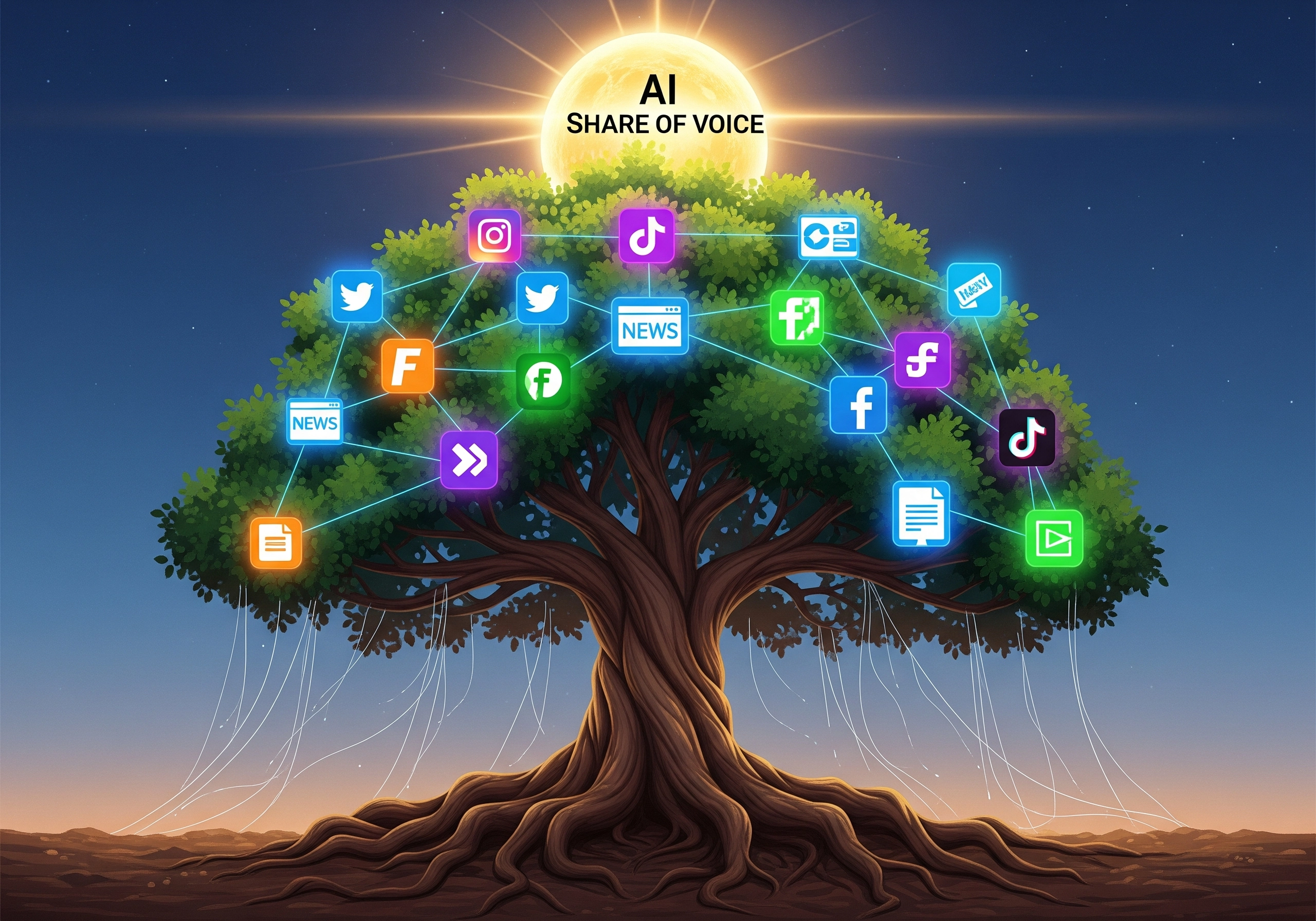
The landscape of digital marketing has shifted dramatically. Where once the holy grail of SEO was a robust backlink profile, today’s AI-driven search environment demands a far broader definition of authority. It’s no longer just about who links to you, but who mentions you, and how pervasively your brand appears across the digital sphere.
AI models, with their expansive training data, evaluate trustworthiness by looking at your brand’s entire digital footprint. They consider not just direct backlinks, but also brand mentions, cross-platform presence, and the overall sentiment surrounding your entity. This holistic view determines your perceived authority.
Embracing ‘AI Share of Voice’ as a New KPI
This evolving criterion introduces a critical new Key Performance Indicator (KPI): ‘AI Share of Voice.’ This metric measures how frequently your brand or content is cited as a source within AI-generated responses, like Google AI Overviews. Being cited provides a massive advantage, boosting organic click-through rates by 35% compared to non-cited results, and driving high-intent traffic that converts at significantly higher rates.
Your goal is to be the authoritative source AI turns to for answers.
To build this new form of authority and enhance your website visibility, traditional backlink efforts must be augmented with comprehensive strategies. Digital PR, influencer engagement, and consistent brand messaging across various platforms are now paramount. These actions signal to AI models that your brand is a reliable and recognized expert in your field.
Tools designed for SEO optimization play a key role in freeing up your team to focus on these high-level strategies. By automating core content creation, platforms like GenWrite allow you to dedicate more resources to building the broad, cross-platform presence that AI models now prioritize for search rankings. This strategic shift is essential for securing your position as a trusted AI citation source in 2026 and beyond. For example, leveraging an AI blog generator can streamline your content production, allowing you to amplify your digital PR efforts and secure more brand mentions.
What tactical shifts are needed to build your 2026 AI visibility roadmap?
The AI-powered search landscape demands a fundamental shift in digital marketing. Building your 2026 AI visibility roadmap requires tactical shifts, beginning with executive alignment.
Securing C-Level Buy-In
Executive understanding is paramount. With traditional search volume declining 25 percent by 2026 and AI Overviews dominating, prioritizing website visibility in this new paradigm is critical. Highlight the drastic organic CTR drop for non-cited results and the high-intent of AI-referred traffic to secure buy-in.
AI-powered insights are a strategic imperative, not just a marketing tactic.
Operationalizing AI for Repeatable Success
Once leadership aligns, embed AI into daily operations. Shift from ad-hoc experiments to a structured approach, tying AI-driven seo optimisation to new KPIs like citation frequency. Tools like GenWrite automate keyword research and content generation for AI citation, creating repeatable processes for EEAT-rich content.
Fostering Adaptability for AI Visibility Enhancement
Teams must adapt from raw traffic volume to AI visibility enhancement. Continuous learning about AI model parsing and intent is key. Encourage multimodal content and structured data experimentation, making your site the authoritative source for AI answers, crucial for SEO optimisation for blogs.
This framework ensures your organization actively shapes its future search presence.
How can your brand confidently navigate the AI search revolution and secure future success?

The AI search revolution is a fundamental shift, demanding adaptation. With organic click-through rates plummeting and 60 percent of searches now zero-click, being cited in an AI Overview is paramount for significant traffic growth.
Navigating this new landscape means embracing Generative Engine Optimization (GEO). True AI-driven seo requires becoming the trusted authority AI models cite, moving beyond blue links. This entails prioritizing ‘Experience’ in EEAT, meticulous data structuring, and cultivating ‘AI Share of Voice’ via pervasive brand mentions.
Your brand’s future hinges on a powerful synergy: AI precision combined with human ingenuity. Tools like GenWrite, an advanced AI blog generator, automate the heavy lifting,from keyword research to content creation. This empowers human experts to infuse unique insights, empathy, and verified experiences that forge lasting brand connections.
By strategically leveraging ai seo tools for content automation, brands confidently optimize for both AI models and human users. This dual focus ensures robust search rankings and high-intent, converting traffic, securing your brand’s future.
Ready to dominate AI-driven search in 2026? Discover how GenWrite can automate your AI SEO strategy and boost your website visibility.
People Also Ask
How will AI change search results by 2026?
By 2026, AI is projected to significantly alter search results, with traditional search volume declining by 25%. AI Overviews will provide direct answers, leading to more zero-click searches but also higher conversion rates for cited sources. The focus will shift from ranking blue links to being a cited authority within AI-generated responses.
What is Generative Engine Optimization (GEO)?
Generative Engine Optimization (GEO) is the new paradigm for SEO in the age of AI. It means optimizing your content not just for traditional search engines but for generative AI models, aiming to be cited as a trusted source within AI-generated answers and summaries. This involves focusing on authority, unique data, and clear, concise answers.
How does AI impact content strategy for SEO?
AI redefines content strategy by prioritizing the ‘Experience’ element of EEAT and favoring ‘answer-first’ formatting. Content needs to be unique, human-verified, and presented in interconnected clusters to be favored by AI models. Natural-sounding AI writing is crucial for establishing credibility and improving SEO.
Why are technical optimizations like Schema.org important for AI SEO?
Structured data, such as Schema.org, is the primary language AI agents use to understand your website. Implementing Organization, FAQ, and Product schema helps AI models parse your content accurately, increasing the likelihood of your site being understood and cited in AI-generated results. This technical foundation is crucial for AI visibility.
Is brand authority more important than backlinks for AI SEO?
Yes, brand mentions and overall online authority are becoming increasingly important, often outweighing traditional backlinks for AI SEO. AI models assess trustworthiness based on broad training data and cross-platform presence. Building your ‘AI Share of Voice’ through digital PR and consistent brand messaging is key.
What is the conversion rate for traffic referred by AI?
Traffic referred by AI is exceptionally high-intent and converts at rates significantly higher than traditional organic search. Studies suggest conversion rates can be 4.4 to 23 times higher, making AI-driven traffic a valuable asset for businesses aiming for superior conversion rates and ROI.