
AI Blog Post Generators: How They Really Change Your Workflow
The content creation landscape: a sudden shift

Remember staring at a blank page for content ideas? That’s quickly becoming a distant memory. AI blog post generators have completely changed how we work, not just as another tool, but as a fundamental shift in our approach.
First trying an AI content generator can feel a bit strange. But get past that initial hurdle, and you’ll spot the real chance. You’re not just writing words anymore; you’re the content architect. That means guiding the machine, polishing its output, and ensuring each piece hits your bigger targets.
This is a huge mental shift. The real value now lies in your editorial judgment and strategic oversight, not just churning out words. Think of it: you’re no longer the line cook; you’re the executive chef. AI writing tools aren’t here to replace you; they’re like giving you a whole kitchen crew. This means you’ll need different skills, less about perfect sentences and more about optimizing AI for SEO content that truly works.
So, what’s this look like daily? How does your workflow change with this tech? We’ll dive into the whole content process, from brainstorming and research to drafting, editing, and SEO. It’s not just about being faster; it’s about changing every step to use automation and boost your unique strategic thinking.
Beyond just generating text: what these tools actually do
Most folks see an AI blog post generator and just think ‘text machine.’ Sure, they generate text, but that view completely overlooks the strategic role these tools play. They don’t just write; they actually build the core structure of a high-performing article, long before a human even looks at it.
Consider it content orchestration. A sophisticated AI blog writer doesn’t start from scratch. It pulls in data, then crafts keyword-driven blog writing by dissecting search intent and competitor frameworks. The result isn’t just a block of words. It’s a complete, structured draft, packed with headings, subheadings, and a logical flow engineered for both human readers and search engine bots. This initial structural work is often the biggest time sink in manual creation, and it’s precisely where automated blog writing offers its first significant efficiency gain.
From raw data to structured draft
What’s happening under the hood is a series of automated tasks. The process often kicks off with an intensive analysis of keyword clusters. This analysis uncovers how automated SEO software finds top keywords and pinpoints the actual questions users are asking. From there, the tool maps out a structure directly targeting those queries. Building proper content structure and internal linking is essential for strong search performance.
Then comes the draft itself, integrating those keywords and their semantic variants right into the copy. This isn’t just keyword stuffing; it’s about crafting a coherent piece of content writing that thoroughly covers the topic. Platforms like GenWrite push this even further, managing the often-tedious aspects of automated on-page SEO writing and even suggesting meta descriptions via a built-in meta tag generator. What you get is a solid first version, already packed with most of the required SEO optimization for blogs. Of course, this won’t guarantee a viral hit; that still needs a human touch to inject unique insights and voice. It’s a common misunderstanding among new users, one that points out some of the AI blog generator pitfalls. Ultimately, a good AI writing tool aims to deliver a 90% complete, strategically solid article for you to refine, not a hands-off final product.
The human-in-the-loop model: from writer to architect

Remember those days? You’d open a blank page, just staring at that blinking cursor. Maybe an hour gone before you even had a decent opening sentence. Now, imagine opening a 1,500-word article that’s already got a solid structure, keywords baked in, and the initial research done. Your task isn’t to build from scratch; it’s to polish, question, and improve what’s already on the page. That’s how content creation works today.
This whole thing shifts your role from just “writer” to more of a “content architect.” We’re talking about the human-in-the-loop model here, where your human smarts direct and approve what the AI spits out. You won’t be just moving words around; you’ll be making big-picture calls on tone, story, and how well it all fits your brand.
What a content architect actually does
A content architect doesn’t get hung up on the initial draft. Instead, they’ll use an AI SEO content generator to get that basic framework down. Then the real fun starts. Your job is to inject the company’s unique voice, drop in those personal stories an algorithm could never dream up, and scrutinize every single claim for accuracy and nuance. You’re the editor-in-chief, making sure the final article truly resonates and speaks with the authority a human reader expects.
This flips the old blog creation process on its head. The machine handles all that heavy lifting – the research, the initial drafting – which frees your brainpower for what really counts: strategy and quality control. Honestly, this is the hardest bit to hand off. You’re the one deciding if an argument makes sense, if the piece genuinely helps the reader. That means you need a sharp grasp of how different AI content tools vs copywriting software stack up and when to use each one.
Protecting your brand’s voice
Look, without a human architect, AI content often just sounds bland and lifeless. It can list facts all day, but it won’t spin a great yarn or share a truly earned viewpoint. Your expertise, plain and simple, protects your content strategy. When you let tools like GenWrite manage the grunt work, you can really concentrate on weaving your brand’s personality and trustworthiness into every single article. The finished product? It’s a mix of machine efficiency and human smarts – way stronger than either could ever be solo.
Real numbers: where AI actually delivers efficiency and ROI
The shift from writer to architect isn’t just a theory; the data clearly shows its effect on performance. A solid 68% of organizations report better content Return on Investment (ROI) after bringing AI into their workflows. This isn’t a small bump—it’s a direct win from getting back the most crucial resource in content: time.
Think about it: a writer might spend over six hours researching and drafting an article. Now, a human editor, guiding AI, can churn out a high-quality first draft in less than an hour. That’s a typical time savings of three to five hours per article. This isn’t just time saved; it’s time reinvested, letting teams boost output by 500% to 800% without the usual burnout.
From speed to strategic impact
This surge in content volume directly improves business results. With more content hitting more keywords, 65% of teams report real SEO gains. Suddenly, crafting competitive long-form content—often 2,100 to 2,800 words—isn’t a monthly struggle; it’s a routine part of operations. Consistently putting out high-volume blog content builds a strong competitive advantage.
An AI-powered SEO content optimization tool becomes critical here, directing the creation of articles designed to rank. Naturally, results aren’t automatic; the ‘architect’ still needs to check quality, often using tools like an AI content detector to uphold brand standards. But with the right approach, teams can genuinely master content creation for search. The numbers confirm it: for a vast majority of marketing pros (between 85% and 94%), using these key AI SEO writing tools isn’t an option anymore; it’s how things are done.
The pitfalls and why ‘AI slop’ is a real problem
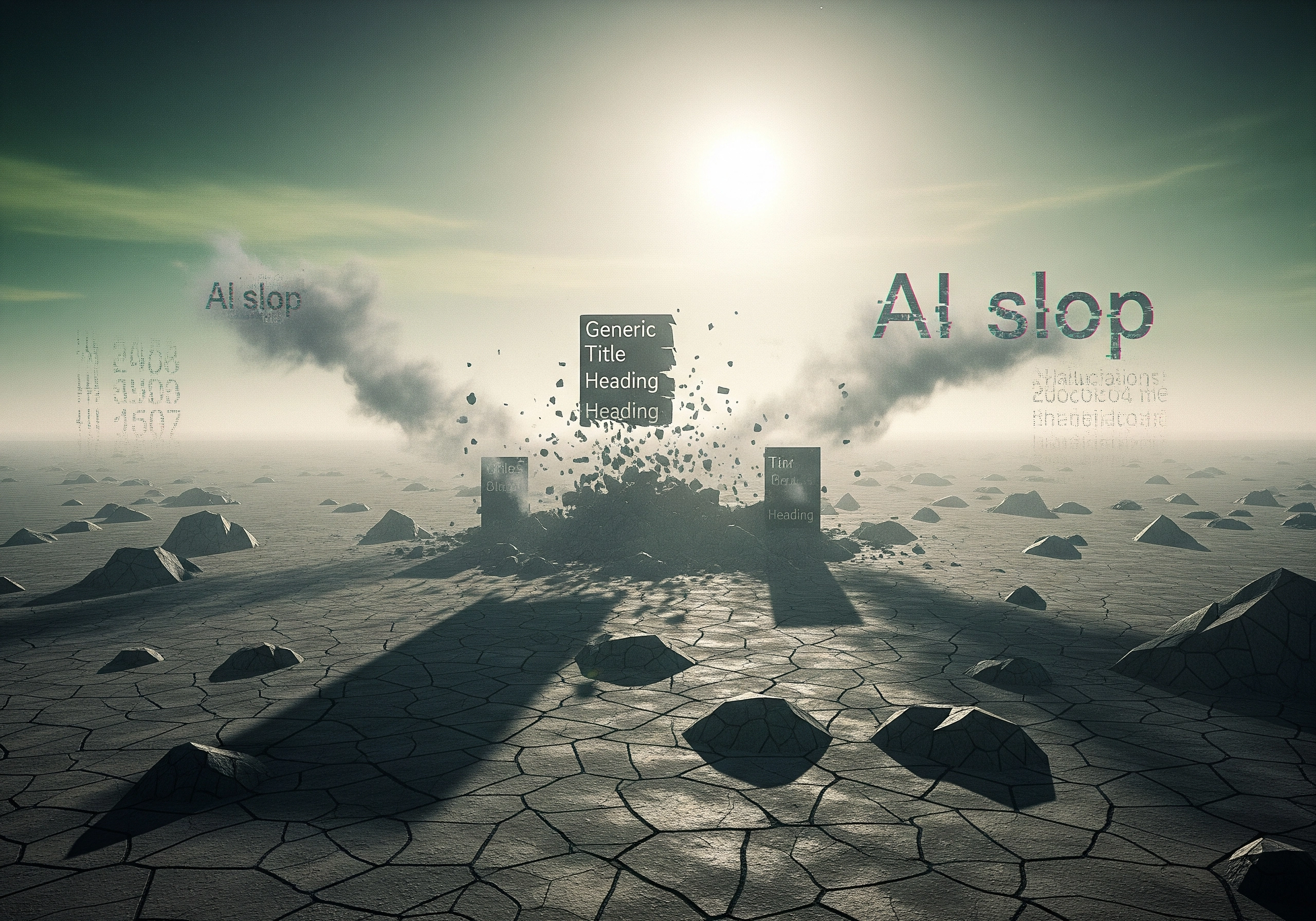
Sure, that efficiency is tempting. It’s easy to get hooked on speed. But hit ‘generate’ and publish without a second thought? You’ve just torpedoed your brand’s authority. This is how the internet gets buried in ‘AI slop’, content that’s technically readable but utterly soulless.
What exactly is AI slop? It’s the homogenized, statistical average of everything already online. You won’t find new insights here. It lacks a unique viewpoint because, well, it has no viewpoint. It simply reassembles existing patterns, spitting out text that feels familiar but says nothing new. Honestly, publishing this stuff is worse than publishing nothing at all. It screams to users and search engines alike that you bring zero original thought to the table. This is brand pollution, plain and simple. Don’t do it.
The E-E-A-T problem
This is where unchecked AI articles slam right into Google’s E-E-A-T guidelines. An LLM can’t have ‘Experience’. It’s never run a project, debugged code, or dealt with an angry customer. It just simulates expertise by summarizing other people’s experiences. Without a human expert adding real, firsthand insight, your content is hollow. It fails the most important test for modern search, period.
And we haven’t even touched the technical failures yet. AI hallucinations (where the model confidently invents facts, sources, or statistics) are a credibility-killing disaster. Seriously, it’s just waiting to happen. Over-optimized, keyword-stuffed text that sounds robotic? That’s another dead giveaway of low-effort automation. Audiences are getting smarter; they spot this stuff, and they hate it.
The answer isn’t ditching the tech. It’s using it as the powerful assistant it’s meant to be. A tool like GenWrite aims to automate 80% of the grunt work. This frees you up to focus on the 20% that truly matters: adding your unique expertise. You absolutely must humanize your AI-generated writing to inject authentic experience. That’s the real secret to using AI writing tools for superior SEO without just becoming another contributor to the digital landfill. Don’t be part of the problem.
Streamlining your content process: a workflow breakdown
Okay, so you get the risks. Just hitting ‘generate’ and ‘publish’ without thinking? That’s a quick way to make content no one cares about. But what does a truly effective workflow actually look like? How do you make blog content creation more efficient without losing its spark?
It’s not one big move, but a process with several steps where you hand off particular jobs to the AI. Picture it less like a factory line and more like a specialized workshop, with you, the expert, wielding some seriously powerful tools.
Phase 1: Strategy and Research
Your work kicks off well before you even type a prompt. First, figure out your audience, your unique angle, and the post’s business goal. What core question are you trying to answer for your readers? With that clear, you can then tell your AI writing tool to do the heavy lifting. Have it dig up keyword ideas, check out what top-ranking competitors are doing, and spot any content gaps. The AI acts as your tireless research assistant, remember, not your main strategist.
Phase 2: Building the First Draft
Here’s where you really save a ton of time. Give the AI your research, your angle, and a solid outline. Within minutes, you’ll have a structured draft back. Is it flawless? Almost certainly not. But it’s a solid base, complete with headings, paragraphs, and a logical flow. You’ve just bypassed that scary blank page, landing right in the editor’s seat. This approach is key to a content strategy that truly balances speed with quality.
Phase 3: Human Editing and Enrichment
This step is absolutely crucial, and it’s all you. You grab that 70% complete draft and pour in what the machine simply can’t: your unique experience. Maybe you’ll drop in a personal story, question a popular idea, or add some data from your company’s own research. You’ll fine-tune the tone so it perfectly matches your brand’s voice. And, of course, you’ll fact-check every single claim. This is how you turn a generic article into something genuinely useful. While the precise steps may differ, this human touch is essential for earning your audience’s trust.
Strategic applications: repurposing, semantic SEO, and localization

Once an efficient workflow is in place, AI’s true strategic power for blogs reveals itself. It shifts from a mere efficiency tool to an engine driving architectural content strategy, moving beyond single-post creation to building entire content ecosystems.
Expanding Assets: Content Repurposing
Take a one-hour webinar. Manually transcribing and dissecting this asset into multiple blog posts takes a human writer a week. An AI, with the same transcript, identifies five or six distinct subtopics, extracts relevant quotes, structures logical outlines, and generates first drafts for each in under an hour. It doesn’t just summarize; it deconstructs a single dense asset into a cluster of targeted, keyword-optimized articles. This content repurposing approach transforms every long-form piece into an editorial calendar force multiplier.
Building Authority: Semantic SEO
Here, the strategy complicates. Instead of chasing individual keywords, modern AI performs semantic SEO analysis at scale. It analyzes top-ranking content for a pillar topic like “cloud data security” and maps related entities, concepts, and user questions. The output isn’t a keyword list; it’s a content blueprint for an entire topic cluster. The system pinpoints gaps for unique value or ‘information gain’. This topical authority approach underpins the philosophy behind our AI-powered content automation tools, which build comprehensive, interconnected content networks, not merely isolated articles.
Achieving Scale: Localization
Finally, localization presents a significant challenge. Translating a blog post is simple, but culturally adapting it is hard. An AI takes a core article and generates region-specific versions, swapping US examples for UK ones, adjusting currency and measurement units, and tweaking tone for local communication styles. While a native speaker’s final check remains recommended for critical content, AI handles 90% of the adaptation. This makes maintaining a dozen localized blogs, rather than just one, entirely feasible.
The future of blogging: balancing speed with authentic connection
Seeing an AI spin a webinar into five targeted articles is impressive. But that’s where the real work begins. The temptation with any AI blog generator is to max out volume. That’s a trap.
This isn’t a simple “traditional blog versus AI” choice; the future blends both. Your job shifts from writing every word to being the source of the core, truly human idea. You’re the one bringing the anecdote, the unique data from your own research, or that spicy contrarian take that makes an article genuinely worth reading. The machine, on the other hand, handles the heavy lifting: building SEO-friendly structures, drafting initial sections, and ensuring you hit those crucial keywords. It’s a powerful assistant, not the creative director. How you strike this balance will differ for everyone, but the core principle holds.
Nailing this partnership? That’s the only real long-term content strategy that works. It’s what sets truly thoughtful, authoritative pieces apart from the endless stream of generic “AI slop” that both readers and search engines are quickly learning to disregard. As you check out different options, you’ll notice how various AI blog generator pricing plans offer different levels of automation and control.
The most important skill you can hone right now isn’t prompt engineering. It’s editorial judgment. This means knowing what to keep, what to cut, and exactly where to drop in that human insight that changes everything. AI gives you speed and leverage, but you’re still the one at the wheel.
Tired of the content grind? See how GenWrite streamlines your blog creation, turning hours of work into minutes so you can focus on strategy, not just writing.
People Also Ask
How do AI blog generators actually change a content creator’s job?
AI blog generators shift your role from just writing to becoming a content architect. You’ll focus more on strategy, editing, and ensuring brand voice, while the AI handles the heavy lifting of research and initial drafts. It’s about guiding the AI to produce high-quality, strategic content.
What are the biggest risks of using AI for blog posts?
The main danger is creating ‘AI slop’—content that’s grammatically okay but lacks real insight or originality. You also risk ‘hallucinations’ where the AI invents facts, or over-optimization that triggers spam filters. It’s crucial to always have a human editor involved to maintain E-E-A-T and brand authenticity.
Can AI blog generators really improve my website’s SEO?
Yes, they absolutely can. AI tools help with keyword research, semantic SEO mapping, and ensuring content covers all relevant subtopics. When used correctly with human oversight, AI-assisted content often shows improved SEO results and increased ROI because it can scale content production effectively.
How much time can I save using an AI blog writer?
Most creators report saving between 3 to 5 hours per article when using AI effectively. This efficiency boost allows teams to increase their output significantly, sometimes by 500% to 800%, without sacrificing quality, provided they follow a hybrid human-AI workflow.
Is it better to use traditional methods or AI for blog content?
Honestly, it’s not an either/or situation. The most successful strategies use a hybrid approach. Traditional methods excel at deep narrative and emotional connection, while AI provides scale and speed for research and drafting. Combining them leverages the strengths of both.
How can I ensure my AI-generated content feels authentic and not robotic?
That’s where the ‘human-in-the-loop’ model is key. You need to inject your unique brand voice, personal experiences, and strategic insights during the editing phase. Think of the AI as your research assistant and first drafter, but you’re the final arbiter of quality and tone.